- Study Abroad /
- blog /
- Canadian Experience Class (CEC): Eligibility Criteria and Application Process
Canadian Experience Class (CEC): Eligibility Criteria and Application Process


Author
11-03-2025

Securing permanent residency in Canada can feel complicated. The Canadian Experience Class offers a pathway for skilled workers with Canadian work experience. The Express Entry system, which includes the CEC, is the most popular way for skilled Indian immigrants to obtain Canadian PR. This guide outlines the eligibility criteria, application process, and tips for a successful application. Find out if you qualify and how to increase your chances.
What is the Canadian Experience Class (CEC)?
The Canadian Experience Class (CEC) offers an opportunity for permanent residency for skilled workers (under the National Occupational Classification) with Canadian work experience since 2008. Previously a standalone program, it was integrated into the Express Entry system on January 1, 2015. The CEC processes applications within three to six months after receiving an Invitation to Apply (ITA).
The CEC presents a favourable opportunity for Indian nationals, given the increasing number of skilled workers from India seeking immigration pathways in Canada. The program is beneficial as it doesn’t require proof of settlement funds, a barrier in other streams.
In summary, the benefits of CEC are:
- Faster processing times: The CEC processes applications more quickly than other programs.
- No need to prove settlement funds. This is a major advantage over other economic immigration programs.
- Canadian experience points give CEC applicants an advantage in the Express Entry pool.
- Pathway to Canadian citizenship: After the required time in Canada, permanent residents can apply for citizenship through CEC.
Key Eligibility Criteria for CEC
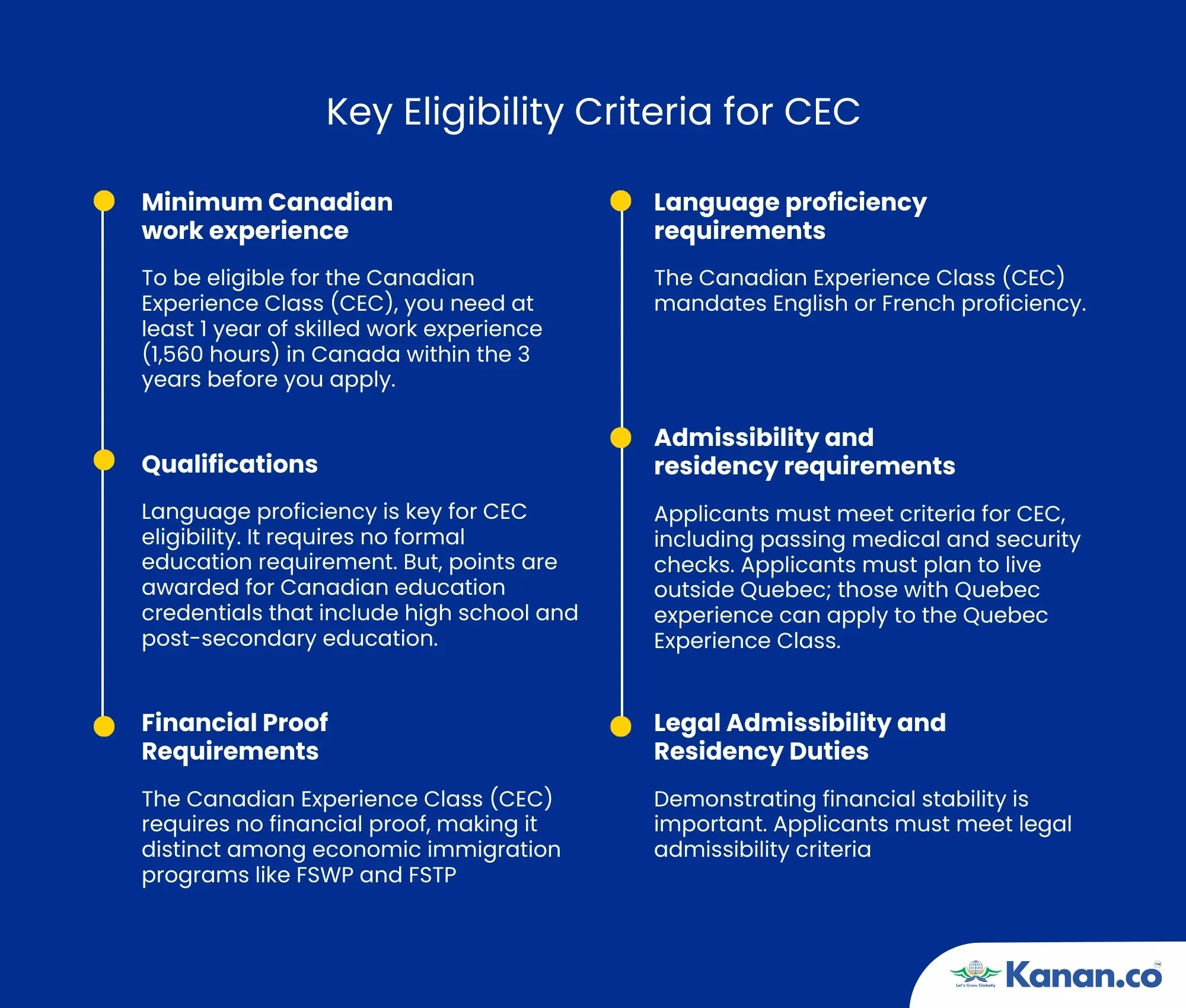
The Canadian Experience Class (CEC) uses specific criteria to assess your eligibility for permanent residency.
1. Minimum Canadian work experience
To be eligible for the Canadian Experience Class (CEC), you need at least 1 year of skilled work experience (1,560 hours) in Canada within the 3 years before you apply.
The work experience must fall under NOC TEER (Training, Education, Experience, and Responsibilities) categories: TEER 0, TEER 1, TEER 2, or TEER 3. Volunteer work and unpaid internships are not eligible.
Self-employment and full-time student work experience are excluded. You must meet the minimum work experience requirement to apply for permanent residence through the CEC.
2. Language proficiency requirements
The Canadian Experience Class (CEC) mandates English or French proficiency. Applicants must take approved tests assessing writing, reading, listening, and speaking skills.
The minimum Canadian Language Benchmark (CLB) level is 7 for NOC (National Occupational Classification) 0 or A jobs and 5 for NOC B jobs. Language test results are valid for 2 years.
Recognised Canadian language tests include IELTS and CELPIP for English and TEF Canada or TCF Canada for French.
Test results must be valid on the day you apply for permanent residence.
3. Qualifications
Language proficiency is key for Canadian Experience Class (CEC) eligibility. The CEC has no formal education requirement. Points are awarded for Canadian education credentials.
Credentials include high school and post-secondary education. Foreign education requires an educational credential assessment report confirming equivalence to a Canadian certificate, diploma, or degree.
The Canadian Experience Class (CEC) doesn't have a formal education requirement, but having a Canadian degree, diploma, or certificate can be a significant advantage. It can earn you valuable points and boost your ranking in the Express Entry pool.
4. Admissibility and residency requirements
Applicants must meet strict admissibility criteria for the Canadian Experience Class (CEC) and be admissible to Canada, including passing medical exams and security checks.
Applicants must not have criminal records. You must plan to live outside Quebec and demonstrate your intention to do so. Individuals with Quebec work experience and plans to reside there may apply to the Quebec Experience Class.
5. Financial Proof Requirements
The Canadian Experience Class (CEC) requires no financial proof, making it distinct among economic immigration programs like the Federal Skilled Worker Program (FSWP) and the Federal Skilled Trades Program (FSTP).
6. Legal Admissibility and Residency Duties
Demonstrating financial stability is important. Applicants must meet legal admissibility criteria, including clean criminal records and satisfactory medical conditions.
Work Experience Assessment
It’s crucial to understand if your Canadian work experience qualifies for the CEC, so continue reading.
Criteria for qualifying work experience
Canadian work experience must be continuous, legal, and paid.
- Skill Level: Your work experience must be in skill level 0, 1, 2, or 3 of the 2021 National Occupational Classification (NOC). These occupations encompass management, technical, and skilled trades, making a trade background valuable for applicants.
- Work Experience Duration: You need at least 12 months of full-time work experience or an equivalent amount of part-time work totalling 1,560 hours. Full-time is 30 hours or more per week. Part-time is less than 30 hours.
- Paid Work: The work experience must be paid, meaning you received a salary or wages. Volunteer work or unpaid internships do not qualify.
- Legal Status: You must have had legal status to work in Canada during your work experience, meaning a valid work permit, like a Post-Graduation Work Permit.
- Work Experience Exclusions: Self-employment and work experience gained while studying full-time, like during a co-op work term, do not count towards the minimum requirement. This exclusion ensures the Canadian Experience Class targets individuals with genuine Canadian work experience in a traditional setting.
These criteria determine if your Canadian work experience qualifies you for permanent residency.
Part-time and full-time
The Canadian Experience Class (CEC) considers full-time and part-time work experience. You must meet the minimum work experience requirement to be eligible.
- Full-time work equals one year of full-time experience, at least 1,560 hours total, which is 30 hours/week for 12 months.
- Part-time work for 15 hours/week for 24 months equals one year of full-time experience.
- You can combine full-time and part-time jobs to meet the minimum work experience requirement. For example, working 15 hours/week at one job and 15 hours/week at another for 24 months equals one year of full-time experience. It must be in the same NOC code, legal, and paid.
Understanding how your work experience is assessed is crucial for a successful Canadian Experience Class application.
Exemptions and exclusions
The Canadian Experience Class (CEC) has specific work experience requirements, and not all work experience is equal.
- Work Without Authorisation: You can’t use work experience gained without a valid Canadian work permit to meet the CEC requirements.
- Self-employment is not considered eligible work experience for the CEC. You must have been employed by an eligible employer in Canada.
- Full-Time Student Work: Work experience gained on a study permit as a full-time student doesn’t count towards the CEC requirement.
- Refugee Claimants: In Canada, refugee claimants can’t apply for permanent residence through the CEC.
- Work experience without status: The CEC will not accept work experience acquired in Canada without valid temporary resident status.
- Temporary Resident Permit (TRP) Individuals: Those who have worked in Canada on a TRP are eligible to apply under the CEC if they meet other requirements and are not inadmissible.
Vacation time
Periods of self-employment or unauthorised work don’t count towards the minimum work experience requirement. Reasonable vacation time can be included, e.g., two weeks of paid vacation within a 52-week work period.
Each application is assessed individually based on the information.
Additional Points to Remember
Certain situations, like bridging open work permits, may impact your eligibility. Consult authorised immigration consultants like Kanan.co, to address specific circumstances and optimise your application.
Bridging open work permits
A bridging open work permit (BOWP) lets individuals with Canadian experience continue working while their permanent residence applications are processed. This applies to Express Entry Canadian experience class candidates and those in Provincial Nominee Programs (PNPs).
Applicants must reside in Canada and possess a valid or expired work permit. Among the required supporting documents is an acknowledgement of receipt letter.
Nuances of the application process
A bridging open work permit lets you keep working while your PR application is processed. Applicants must choose the correct application stream based on their work experience.
They must demonstrate language proficiency by taking an approved test. The Canadian Experience Class has a processing standard of three to six months from the Invitation to Apply (ITA) date.
Applicants must provide detailed work reference letters from previous employers confirming their work experience.
How to Apply for the Canadian Experience Class (CEC)?
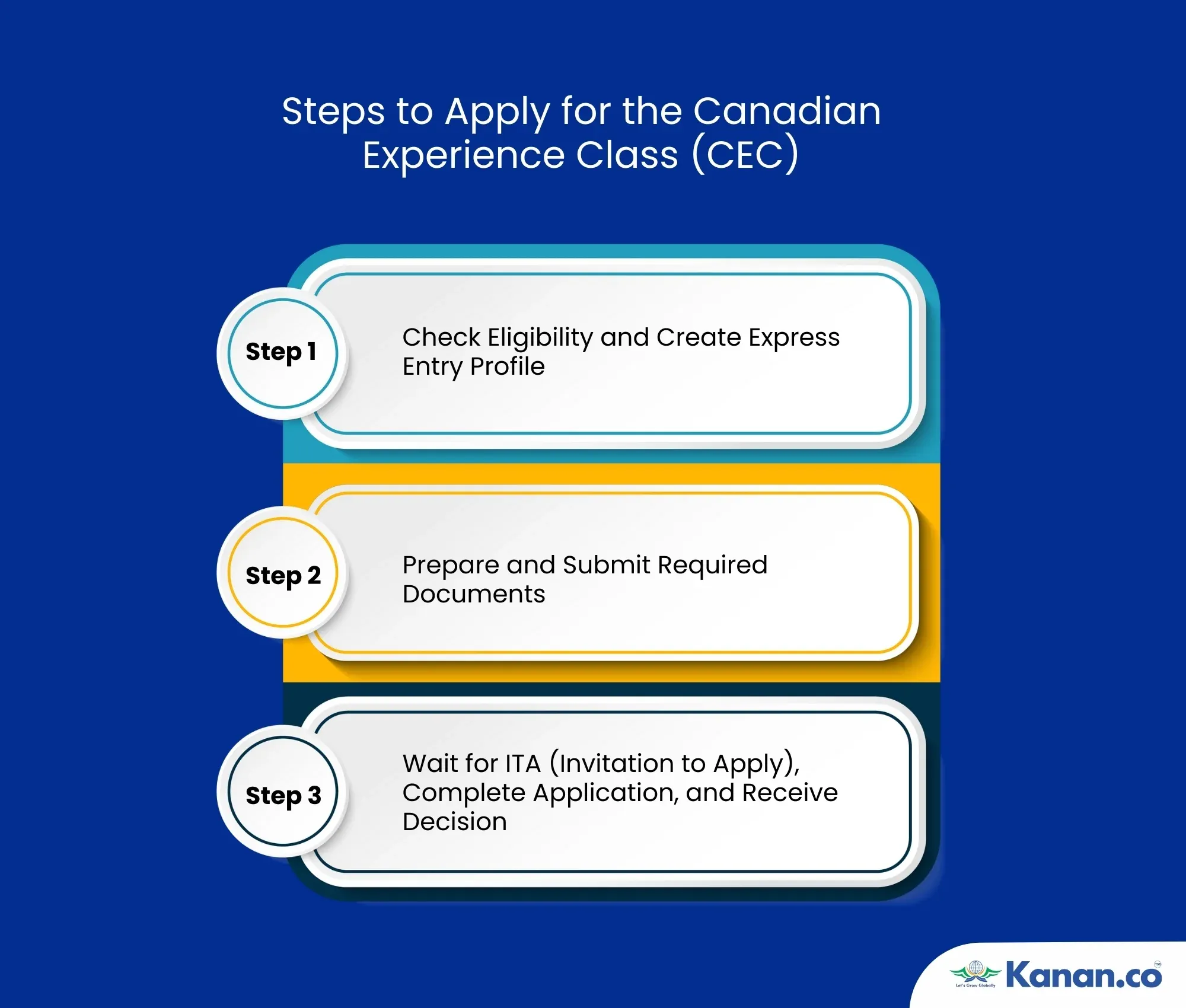
The application process for the Canadian Experience Class involves several key steps to ensure a smooth and successful application.
Step 1: Check Eligibility and Create Express Entry Profile
Canadian Experience Class (CEC) applications. You need to create an Express Entry profile, providing details about your work experience, language proficiency (CLB 7 for NOC TEER 0 or 1, CLB 5 for NOC TEER 2 or 3), and education.
Ensure your work experience meets the minimum requirement of 1 year (1,560 hours) in a skilled occupation (NOC TEER 0, 1, 2, or 3) within the last 3 years. Pay the application fees ($850 CAD for adults, $515 CAD for the right of permanent residence). If eligible, you'll enter the Express Entry pool and receive an Invitation to Apply (ITA) for permanent residence.
Step 2: Prepare and Submit Required Documents
Document preparation and submission are crucial for a successful Canadian Experience Class application. You must gather all necessary documents to prove your eligibility for permanent residency in Canada.
- Language Test Results: Submit IELTS or CELPIP test scores demonstrating your English or French proficiency.
- Educational Credential Assessment (ECA): If you completed your education outside Canada, obtain an ECA report. The ECA verifies your foreign credentials meet Canadian standards. It’s not a prerequisite for eligibility but can improve your CRS score.
- Work Experience Letters: Include detailed letters from past or current employers outlining job duties, duration, and hours.
- Passport and Travel Documents: Provide copies of your valid passport and relevant travel documents to demonstrate your travel history and residency status.
- Police Background Check: Obtain police certificates from all countries where you lived for six months or longer in the past ten years. A clear criminal record is essential for Canadian immigration.
- Provincial Nomination (If applicable): If you received a provincial nomination certificate, include it. A provincial nomination can enhance your likelihood of receiving an Invitation to Apply (ITA) for permanent residence.
- Application Forms: Complete all required application forms accurately and thoroughly. These capture your personal information, immigration history, and eligibility details.
- Application Fee Payment: Pay the processing fees online or through authorised methods. Keep payment confirmation receipts.
After you compile all necessary documents, submit your application through the IRCC (Immigration, Refugees and Citizenship Canada) online portal. Kanan.co offers expert guidance and support throughout the Canadian immigration process.
Step 3: Wait for ITA (Invitation to Apply), Complete Application, and Receive Decision
A complete CEC application begins processing. The Canadian government aims to process applications within six months. Applicants receive a decision on their permanent residence application.
- Application Review: Immigration officers review applications for completeness and eligibility.
- CRS Ranking: Eligible applications enter the Express Entry canadian experience class. The Comprehensive Ranking System (CRS) awards points based on work experience, language skills, and education.
- Invitations to Apply (ITAs): The government conducts regular canadian experience class draws, inviting the highest-ranking candidates to apply for permanent residence.
- Final Review: After receiving an Invitation to Apply (ITA), applicants must submit a complete application with supporting documents within 60 days. Immigration officers review the application for accuracy before making a final decision.
- Decision: If approved, applicants receive a Confirmation of Permanent Residence (COPR) and can immigrate to Canada as permanent residents.
CRS Score for Canadian Experience Class
Your CRS score for Canadian Experience Class is out of 1200 points is calculated based on the following factors:
- Core/Human Capital Factors (460-500 points): Age, education, official language proficiency, Canadian work experience
- Spouse or Common-Law Partner Factors (40 points): If applicable, spouse's age, education, language proficiency, work experience
- Skill Transferability Factors (100 points): Combinations of education, foreign work experience, and language proficiency
- Additional Points (600 points): Job offer, provincial/territorial nomination, sibling in Canada, French language proficiency
Conclusion
The Canadian Experience Class is a great way for skilled workers who've worked in Canada to live there permanently. Canada welcomes people from all over the world, making it a better place. Applying for the CEC helps both you and Canada's uniqueness.
As you start your journey to become a permanent resident, remember you're not alone. There will be tough times, but don't give up. If you need help, contact Kanan.co.
Start your journey to make Canada your permanent home today! Use what you learned in Canada to help you become a permanent resident.
FAQs
1. How does the Canadian Experience Class compare to other Express Entry programs?
| Target audience | Work experience | Settlement Funds | Processing Time | |
| Canadian Experience Class (CEC) | Skilled workers with at least 1 year of recent Canadian work experience. | Requires Canadian work experience. | Not required. | Canadian experience class processing time is faster than other Express Entry programs. |
| Federal Skilled Worker Program (FSWP) | Skilled workers with foreign work experience. | No Canadian work experience required. | Required. | Can exceed CEC length |
| Federal Skilled Trades Program (FSTP) | Skilled tradespeople with foreign or Canadian work experience | Requires a qualifying job offer or a certificate of qualification. | Required unless you have a valid job offer. | Can exceed CEC. |
2. Can I apply for the Canadian Experience Class if I'm outside Canada?
Yes, you can apply for the Canadian Experience Class (CEC) if you’re currently outside Canada. Applicants need not be in Canada when they apply and during application processing, as long as they have gained the required work experience in Canada within the last three years.
3. What strategies can I use to improve my CRS score for Canadian Experience Class?
You can improve your CRS score by:
- Retake IELTS or CELPIP tests for higher CLB levels.
- Each additional year of skilled Canadian work experience earns more points.
- A Canadian degree, diploma, or certificate can significantly boost your score.
- Getting a Provincial Nomination: A nomination can add significant points, increasing your chances of an ITA.
- Including your spouse or partner in your application can boost your overall CRS score, especially if they have strong language skills, education, or work experience.
- Proficiency in both of Canada's official languages (English and French) can result in additional CRS points.
- Some provinces have their own immigration streams with lower CRS requirements than the federal Express Entry system.
4. What is the minimum education requirement for Canadian Experience Class?
There is no educational requirement for applying to the Canadian Experience Class.
Anyone can apply if they have valid work experience and eligibility criteria from the “Key Eligibility Criteria for CEC.”
5. Do I need a job offer for Canadian Experience Class?
No, you don’t need a job offer to apply for the Canadian Experience Class (CEC). It is for individuals with at least one year of skilled work experience in Canada, obtained through various employment types. A valid job offer can provide additional points in the Comprehensive Ranking System (CRS) under Express Entry, but it’s not a requirement.
About Author Prabu Rajasekaran
Prabu is a highly experienced content writer with expertise in English proficiency tests such as IELTS, GRE, TOEFL, and PTE. He develops a range of materials, including practice tests, mock exams, guides, and checklists to help students enhance their performance. Prabu is a meticulous researcher who collaborates with domain experts and counsellors to provide accurate guidance on study abroad consultancy, education loans, SOP, and admission processes in top colleges in Canada, USA, Ireland, Australia, and the UK.

Kanan.co is a trusted study abroad consultancy offering comprehensive services, resources, and solutions for students and education institutions. We support students at every stage of their global education journey, ensuring a smooth and guided experience. Along with test preparation for IELTS, GRE, TOEFL, and SAT, we provide expert services such as SOP writing, visa guidance, accommodation support, scholarship assistance, and education loan support. Our expertise and commitment to excellence make us a reliable partner for students pursuing international education.
Get Canada Admission Counselling by Experts








Global Headquarters
Kanan Int EdTech Inc
320 Bay Street, Suite 321 (Spaces), Toronto ON, Canada M5B 1N9
Indian Headquarters
Kanan International Pvt. Ltd.
D-wing, 2nd Floor, Trident Complex, Ellora Park Vadiwadi Road, Vadodara, Gujarat 390007
IT/ Digital Campus
Kanan International Pvt. Ltd
Old, New No 3, 2nd Floor, 1A, Dr Sadasivam Rd, T. Nagar, Chennai, Tamil Nadu 600017
Our branches
- Bardoli
- Bharuch
- Chennai
- Dehradun
- Gurugram
- Himatnagar
- Karnal
- Nadiad
- Navsari
- Palanpur
- Rajkot
- Vadodara
- Valsad
- Vallabh Vidyanagar
- Vapi
Study Abroad
Test Prep
Top Universities
Consultants
IELTS Centers
GRE Centers
TOEFL Centers
SAT Centers
Language Courses in Vadodara
Study Abroad Calculators
Featured Blogs
Study Abroad Consultants in Chennai
Study Abroad Consultants in Surat
Study Abroad Consultants in Navsari
Study Abroad Consultants in Bardoli
Study Abroad Consultants in Ahmedabad
Study Abroad Consultants in Anand
Study Abroad Consultants in Khanna
Study Abroad Consultants in Nadiad
Study Abroad Consultants in Vadodara
Study abroad consultants in Valsad
Copyright © 2026 KANAN.CO All rights reserved.