- Study Abroad /
- blog /
- CEFR Level IELTS 2026 - A Score Comparison
CEFR Level IELTS 2026 - A Score Comparison


Author
20-12-2025

Employers, organisations and teachers worldwide use CEFR Level IELTS scores to compare students' language skills and scores with CEFR (Common European Framework of Reference for Languages). The CEFR scale for IELTS helps teachers, examiners and students to compare language skills and scores across various tests and qualifications. In other words, the CEFR scale serves as a framework for measuring foreign language students' proficiency at different levels and describes their learning ability.
According to the Common European Framework, CEFR is an international standard that describes a student's language ability using a six-point scale ranging from A1 (beginners) to C2 (advanced), with IELTS scores ranging from 0 (zero) to 9 (nine).
This post discusses how to compare your IELTS scores with CEFR levels, what each level represents and how it helps your IELTS preparation.
Download CEFR Level IELTS PDF
CEFR Level to IELTS Score Comparison
The table below compares CEFR Level and IELTS scores which is also referred to as an IELTS to CEFR level calculator.
| CEFR Level | Proficiency Level | IELTS Band Score | Key Skills at this level |
| C2 | Expert User | 8.5 - 9.0 | C2 - Proficient (9.0) Can understand virtually everything, summarize information from different sources, and express themselves precisely. |
| C1 | Very Good User | 8.0 | C1 - Advanced (8.0 – 8.5) Can express ideas fluently, understand long academic texts, and use the language flexibly in social and professional settings. |
| Good User | 7.0 - 7.5 | ||
| B2 | Competent User | 6.0 - 6.5 | B2 - Upper-Intermediate (6.5 – 7.5) Can communicate effectively, produce clear and detailed text, and understand complex ideas. |
| Modest User | 5.0 - 5.5 | ||
| B1 | Limited User | 4.0 - 4.5 | B1 - Intermediate (5.0 – 6.0) Can handle day-to-day conversations, understand main points of familiar topics, and write simple texts. |
| A2 | Extremely Limited User | 3.0 | A2 - Elementary (4.0 – 4.5) Can understand frequently used expressions, communicate in routine situations, and describe personal background. |
| A1 | Intermittent User | 2.0 | A1 - Beginner (2.5 – 3.5) Can understand and use basic phrases, introduce themselves, and ask simple questions. |
| Non - User | 1.0 |
What is the CEFR?
The Council of Europe specified “threshold levels” for English and French in the mid-1970s and released the CEFR in 2001 to describe different levels of proficiency in a structured way. Later, the CEFR became a landmark for foreign language teaching and adaptable to suit various languages. As John Trim (a CEFR author) noted, the CEFR was intended as a framework for reflection rather than a precise scoring scale.
Its other objectives are promoting plurilingualism and diversification, supporting plurilingual profile, developing and reviewing language curricula and defining positive ‘can do’ descriptors, supporting teacher education, enhancing quality and success in learning teaching and assessment processes and ensuring transparency in testing. It also facilitated promotion of new methodologies like the communicative approach.
Language proficiency is organized in six levels, A1 to C2—categorised into three broad levels: Basic User (A1, A2), Independent User (B1, B2) and Proficient User (C1, C2) which can be subdivided further.
The CEFR language levels are defined by ‘can-do’ descriptors that categorise foreign language learners’ proficiency as follows:
CEFR Level A1
CEFR level A1 is a basic user who can comprehend and use simple terms. Identify themselves and provide or request for personal information. Can talk about common everyday topics.
CEFR Level A2
CEFR level A2 is about a basic user who can interpret commonly used phrases and expressions in day-to-day contexts like shopping, work, etc. Can give simple directions. Discuss various desires and requirements.
CEFR Level B1
CEFR level B1 refers to an independent user who can comprehend and talk about family, friends, work and leisure activities. Can articulate travel needs, brief paragraphs based on interests, aspirations and experiences.
CEFR Level B2
CEFR level B2 is equivalent to an independent user who is capable of composing documents of various themes. Comprehend major concepts using complicated texts. Discuss naturally with native speakers.
CEFR Level C1
CEFR level C1 talks about a proficient user who can comprehend convoluted talks or messages. Explain difficult concepts in professional, social or formal situations. Write detailed texts about in-depth subjects.
CEFR Level C2
CEFR level C2 is assigned to a proficient user who can comprehend, summarise any data that is easy to understand. In challenging circumstances, they can express themselves clearly.
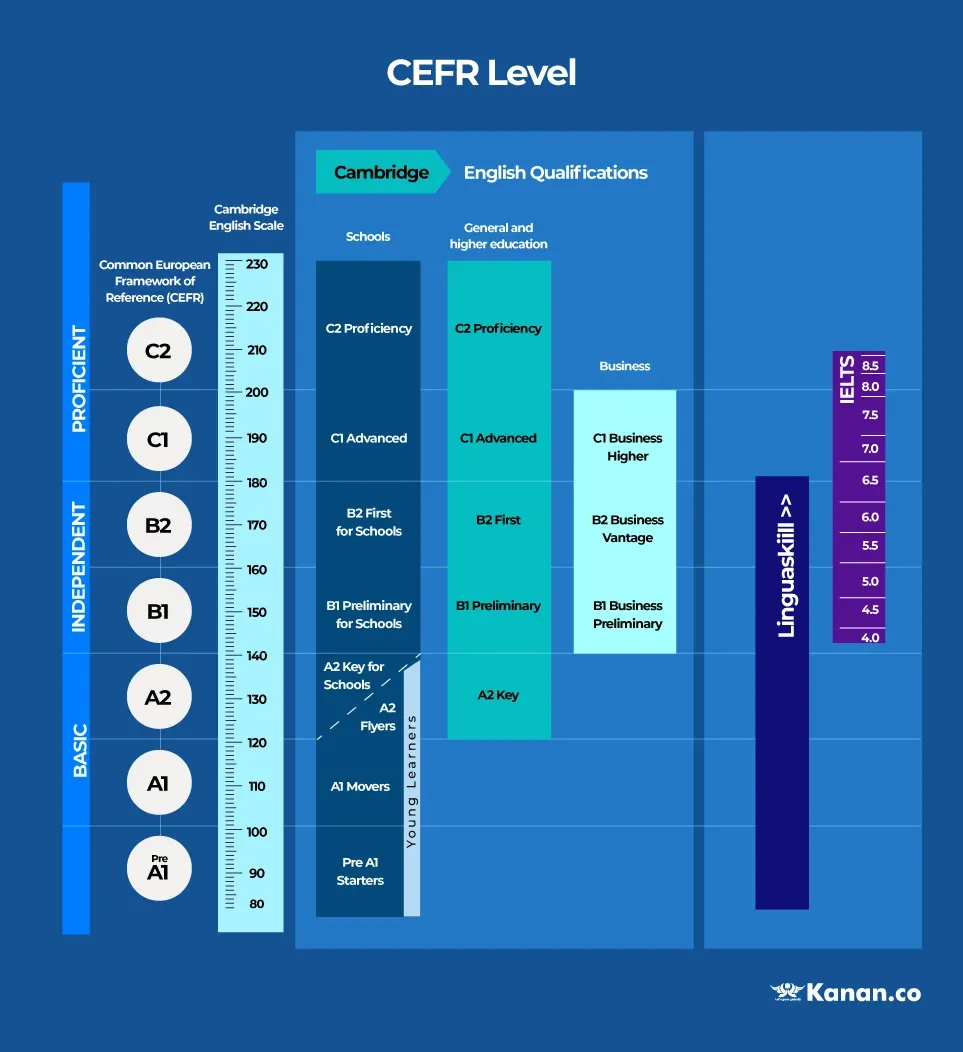
From the above CEFR versus IELTS score chart, you can understand that an IELTS band score of 7.0 is equivalent to a CEFR level of C1. Similarly, an IELTS band score of 4.5 is equivalent to a CEFR level of B1.
Linguaskill reports up to a maximum score of 180+, which equates to C1 (or above) on the CEFR scale.
What is IELTS?
IELTS (also known as the International English Language Test System) is an international standardised test established in the 1980s. IELTS contains four sections: Listening, Reading, Writing and Speaking. Non-native English speakers take the IELTS test to prove their language proficiency for study abroad, visa and migration purposes. IELTS scores obtained out of 40 are converted to the band scale of 0 (zero) to 9 (nine).
Your IELTS test results comprises an overall test score of between 0 and 9, and individual scores for each section of the exam. This scale is to help you understand your English proficiency level and its purpose. The 9 band scores of IELTS are explained below.
9 Skill Level: Expert
The test taker has complete operational command of the English language.
They use appropriate, accurate and fluent English language, and understand everything.
8 Skill Level: Very Good
The test taker has fully operational command of the English language with only occasional unsystematic inaccuracies and inappropriate usage.
They may misunderstand some things in unfamiliar circumstances. They handle complex and detailed argumentation well.
7 Skill Level: Good
The test taker has operational command of the English language, albeit with occasional inaccuracies, inappropriate usage and misunderstandings in some situations.
They handle complex language well and understand detailed reasoning.
6 Skill Level: Competent
The test taker has an effective command of the English language despite some inaccuracies, inappropriate usage and misunderstandings.
They can use and understand reasonably complex language, especially in familiar situations.
5 Skill Level: Modest
The test taker has a partial command of the English language and copes with overall meaning in most situations, although they are likely to make many mistakes.
They should be able to handle basic communication in their own world.
4 Skill Level: Limited
The test taker’s basic competence is limited to familiar situations.
They frequently face problems in understanding and expression.
3 Skill Level: Extremely Limited
The test taker conveys and understands only general meaning in very familiar situations.
There are frequent breakdowns in communication.
2 Skill Level: Intermittent
The test taker has great difficulty understanding spoken and written English.
1 Skill Level: Non-user
The test taker has no ability to use the language except a few isolated words.
0 Skill Level: Did not attempt the test
The test taker did not answer the questions.
Why Compare your CEFR Level to IELTS?
Whether you want to study at an English-speaking university or work or apply for a visa, it’s important to know its language requirements and the ability to compare the CEFR level to IELTS scores. It helps you decide how much effort you need to put into passing your exams.
The CEFR level and IELTS scores comparison get rid of confusing terms like “Basic,” “Intermediate,” and “Advanced,” making the CEFR levels assessing your English fluency easier to understand than the IELTS bands and provide more accurate indicators, which led some companies and organizations to prefer using CEFR levels.
CEFR Level IELTS: Current Research Studies and Improvements
IELTS partners and individual researchers have conducted multiple research studies to develop a relationship between IELTS scores and CEFR levels and periodically re-evaluate the alignment with new data to confirm that the score-to-CEFR link remains valid.
Cambridge English, which manages IELTS test development, has led research to map IELTS bands onto CEFR levels. They emphasized that linking a test to the CEFR “is not a one-off activity, but rather involves the accumulation of evidence over time.” Subsequently, different official studies and independent research support general mapping of IELTS bands to CEFR levels, with the caveat that mappings are empirically established ranges rather than absolute certainties.
It’s important to understand that IELTS band scores are overall band scores, not the individual band scores for Listening, Reading, Writing and Speaking. Moreover, IELTS is not a level-based test but rather spans a continuum of proficiency. Since IELTS uses a 9-band scoring scale and CEFR uses broad proficiency levels (A1–C2), mapping IELTS bands to CEFR levels is not a one-to-one conversion. Therefore, any alignment between IELTS and CEFR must be done carefully and empirically.
Whether you apply for a university, visa or start a professional career, know your objectives and learn how institutions assess language requirements and interpret your IELTS scores in CEFR terms.
CEFR Level Required for Study Abroad
International students planning to study abroad in European universities must have a B1 CEFR level for foundation/diploma courses, B2 CEFR level for Bachelor’s and C1 CEFR level for Master’s degree courses to exempt them from the Placement test and/or attending a compulsory English language course.
Conclusion
To study or work in Europe, students must know “CEFR level IELTS.” CEFR interprets IELTS scores through a six-point scale to bring clarity to the reviewers (employers, organisations and schools). The ability to compare CEFR level to IELTS helps you decide how much effort you need to put it to pass the exam. Therefore, plan your IELTS preparation in 2026 based on this CEFR-level IELTS score interpretation and start your journey abroad.
References:
- About CEFR - International Language Standards | Cambridge English. Retrieved 27 January 2025, from https://www.cambridgeenglish.org/exams-and-tests/cefr/
- Saville, N (2005) An interview with John Trim at 80, Language Assessment Quarterly 2 (4), 263–288. Taylor, L and Jones, N (2006) Cambridge ESOL exams and the Common European Framework of Reference for Languages (CEFR) (PDF).
FAQs
1. What is the CEFR level in IELTS?
The CEFR level IELTS is an international standard that describes IELTS band score ranging from 0 (zero) to 9 (nine) along with six levels (A1, A2, B1, B2, C1, C2). The CEFR level (A1 to C2) is categorised into three levels: Basic User, Independent User and Prominent User. Many national language policy makers use CEFR to facilitate multilingualism and overall literacy.
2. What is CEFR?
The CEFR stands for the Common European Framework of Reference for Languages. It was established in the 1990s by the Council of Europe. The CEFR is an international standard for describing language ability, especially in an academic setting. In other words, the CEFR is a framework that defines international standards for language learning, i.e., different levels of communicative skills a person exhibits with users of that language. Now, the CEFR is a language benchmark for 40 global languages.
3. What are the purposes of the CEFR?
The CEFR English Test is intended to help in language teaching and testing, to develop language curricula and textbooks, to improve quality and success in the learning, teaching and assessment processes, and to be transparent and empower teachers.
4. What are the benefits of CEFR Level IELTS comparison?
A recent survey carried out among Council of Europe member states revealed that the CEFR has helped some countries to develop strategic language policy documents and practical teaching materials. Moreover, the CEFR has facilitated the communicative approach to language teaching more action-oriented.
5. Is 6.5 IELTS B2 or C1?
The IELTS score 6.5 is bordering B2/C1. However, the actual level of language performance given in the result has not changed.
6. What CEFR level is IELTS 7?
The IELTS band score 7 is equivalent to C1 in CEFR level.
7. What is CEFR for 7.5 IELTS score?
As a rule of thumb, the IELTS score 7.5 is equivalent to the C1 level in the CEFR.
8. What is CEFR level in IELTS B2?
The B2 in CEFR level is equivalent to upper intermediate in IELTS. This means that “I am a confident English speaker.”
9. Is IELTS 7 B2 or C1?
According to the CEFR level IELTS conversion chart, a band score 7 is equivalent to B2.
10. What is CEFR level C1 in IELTS?
A candidate with a C1 in CEFR level compared to 6.5 or 7.0 in the IELTS band score.
11. Is CEFR level C1 good in IELTS?
CEFR level C1 is equivalent to 6.5 or 7 band score of IELTS. Hence, it is good. Similarly, candidates with a C1 Advanced grade C, scored between 180 and 192 on the Cambridge English Scale, are at Level C1 of the CEFR.
12. How Do I Check My CEFR Level?
To check your CEFR level, take any international standardized language tests (TOEFL, IELTS, Cambridge English exam) mapped to the CEFR framework and compare your score with the CEFR six-point scale. You could take the test online or in-person, offered by language schools, universities and professional testing organizations.
About Author Roshan Sunthar
Roshan Sunthar is a study abroad expert as well as a renowned writer and author in international education. His academic excellence and 5+ years of work experience give him in-depth knowledge of international standardised exams and test preparation in IELTS, TOEFL, GRE, PTE, SAT, etc. The study materials he prepares incorporate exam-like questions. He’s also an expert in writing Statement of Purposes (SOPs) and Letter of Recommendations (LORs) for college admissions. He usually spends his leisure time watching English classics and documentaries, travelling, etc.

Kanan.co is a trusted study abroad consultancy offering comprehensive services, resources, and solutions for students and education institutions. We support students at every stage of their global education journey, ensuring a smooth and guided experience. Along with test preparation for IELTS, GRE, TOEFL, and SAT, we provide expert services such as SOP writing, visa guidance, accommodation support, scholarship assistance, and education loan support. Our expertise and commitment to excellence make us a reliable partner for students pursuing international education.
Ace the IELTS Exam: Try a FREE Demo Today!








Global Headquarters
Kanan Int EdTech Inc
320 Bay Street, Suite 321 (Spaces), Toronto ON, Canada M5B 1N9
Indian Headquarters
Kanan International Pvt. Ltd.
D-wing, 2nd Floor, Trident Complex, Ellora Park Vadiwadi Road, Vadodara, Gujarat 390007
IT/ Digital Campus
Kanan International Pvt. Ltd
Old, New No 3, 2nd Floor, 1A, Dr Sadasivam Rd, T. Nagar, Chennai, Tamil Nadu 600017
Our branches
- Bardoli
- Bharuch
- Chennai
- Dehradun
- Gurugram
- Himatnagar
- Karnal
- Nadiad
- Navsari
- Palanpur
- Rajkot
- Vadodara
- Valsad
- Vallabh Vidyanagar
- Vapi
Study Abroad
Test Prep
Top Universities
Consultants
IELTS Centers
GRE Centers
TOEFL Centers
SAT Centers
Language Courses in Vadodara
Study Abroad Calculators
Featured Blogs
Study Abroad Consultants in Chennai
Study Abroad Consultants in Surat
Study Abroad Consultants in Navsari
Study Abroad Consultants in Bardoli
Study Abroad Consultants in Ahmedabad
Study Abroad Consultants in Anand
Study Abroad Consultants in Khanna
Study Abroad Consultants in Nadiad
Study Abroad Consultants in Vadodara
Study abroad consultants in Valsad
Copyright © 2026 KANAN.CO All rights reserved.