- Study Abroad
- / gre
- / algebra
GRE Algebra: Overview, Examples and Practice Questions


Author
23-08-2024

Gre Algebra is a part of the quantitative reasoning section of the GRE general test. The algebra concepts cover a wide range of topics, including elementary algebra, linear algebra, abstract algebra, and number theory. The questions related to algebra are presented in any of four question types - problem-solving, quantitative comparison, numeric entry, and multiple correct answers.
This article will guide you through the topics of algebra on the GRE in detail, including common problem types, and essential GRE math practice questions related to Algebra. At the end of this blog, you'll find additional practice questions along with a downloadable PDF to help you succeed in the GRE exam.
Check out the infographic below for an overview of the topics covered in GRE Algebra:
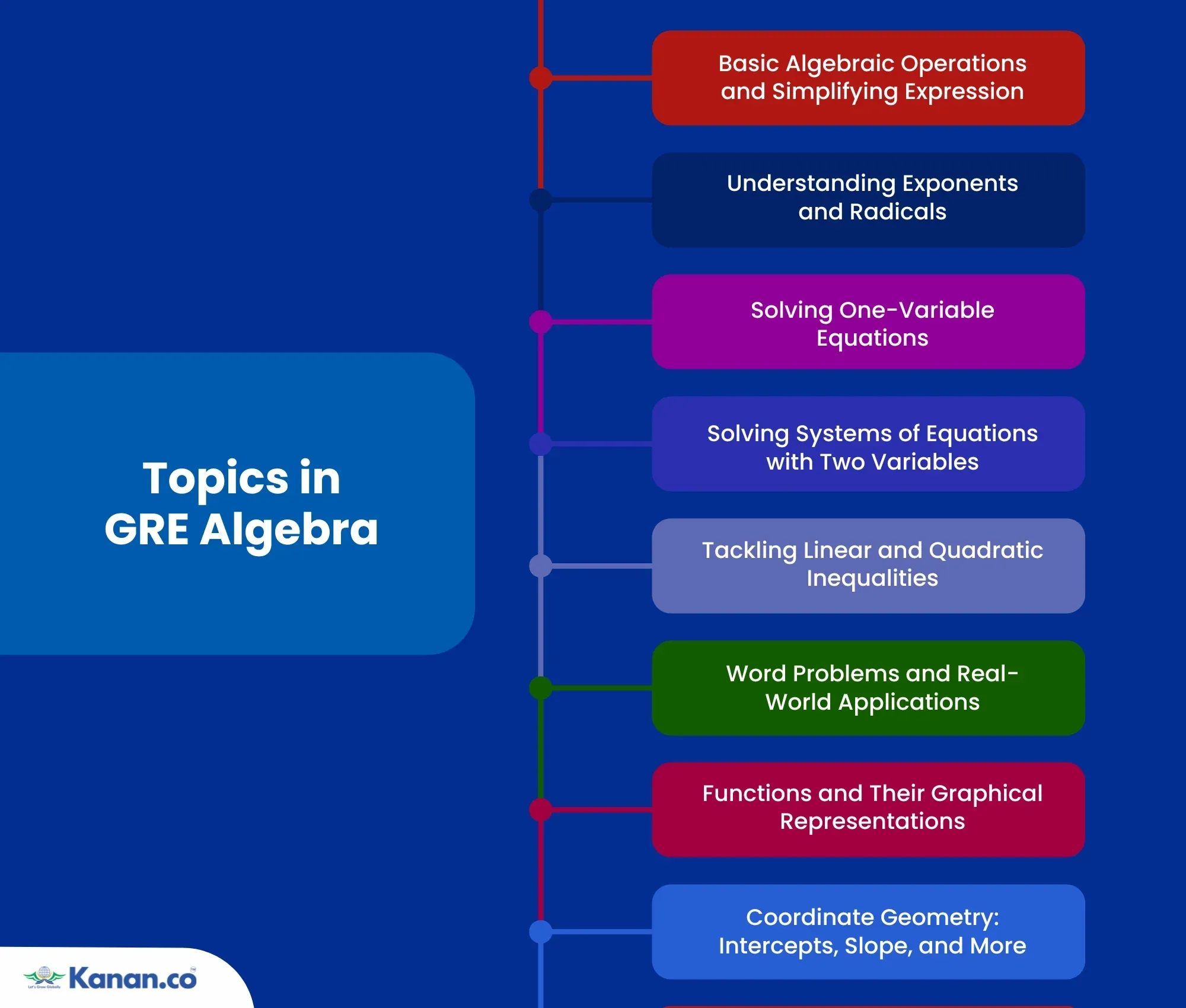
In the following sections, we'll discuss each concept in detail to help you develop the skills needed for GRE algebra.
Basic Algebraic Operations and Simplifying Expressions
Algebraic operations are the foundation of all algebraic problem-solving in GRE Algebra. Algebraic expressions involve variables representing unknown values and can be written as a single term or as a sum of terms. GRE algebra questions typically comprise one or more variables, each term containing a constant term and a coefficient of the variable. When simplifying these expressions, it's crucial to follow several fundamental rules:
- Adding/Subtracting: Combine terms only if they are like terms, meaning they have the same variable and exponent. For instance, 3x + 5x = 8x but 3x + 5y cannot be combined because they are not like terms.
- Multiplying: Apply the distributive property, which states that you must distribute each term inside parentheses by the term outside. This method helps simplify expressions by multiplying every term inside the parentheses by the term outside. For example, a(b + c) = ab + ac.
Example:
Find the coefficient of x4 y3 in the expression: 3xy[(2x3y2 - 4x2y3) + (x3 y + 6x4 y3 )]
Options:
(A) 3
(B) 6
(C) 9
(D) 12
(E) 18
Solution:
To find the coefficient of x4 y3 in the given expression 3xy[(2x3y2 - 4x2y3) + (x3 y + 6x4 y3 )], we will follow these steps:
- Simplify the expression inside the brackets.
- Multiply the simplified expression by 3xy.
- Identify the coefficient of x4 y3
Let's simplify the expression step by step.
Step 1: Simplify the expression inside the brackets
Given: (2x3y2 - 4x2y3) + (x3 y + 6x4 y3 )
Combine like terms:
2x3y2 + x3y - 4x y + 6x4 y3 )
Step 2: Multiply by 3xy
Now, multiply the simplified expression by 3xy:
3xy (2x3y2 + x3y - 4x2y3 + 6x4y3)
Distribute 3xy:
(3xy 2x3y22) + (3xy x3y) - (3xy 4x2y3) + (3xy 6x4y3)
= 6x4y3 + 3x4y2 - 12x3y4+ 18x5y4
Step 3: Identify the coefficient of x4 y3
The term involving x4 y3 is 6x4y3.
Therefore, the coefficient of x4 y3 is 6.
Answer: (B) 6
Now, let's understand the exponents and radicals in GRE algebra. These concepts are key to understanding more complex math problems.
Understanding Exponents and Radicals
Exponents in GRE algebra denote repeated multiplication of a base number, which is crucial for solving equations and simplifying expressions efficiently. Radicals, including square roots and cube roots, represent the inverse operations of exponents and are essential for handling equations involving roots and higher-order terms.
Here are the 3 basic rules of exponents:
- Product Rule: When multiplying powers with the same base, add the exponents.
x3 ⋅xb = xa+b - Quotient Rule: When dividing powers with the same base, subtract the exponents.
xa /xb = xa-b - Power Rule: When raising a power to another power, multiply the exponents.
(xa)b = xab
Converting radicals into exponents involves rewriting expressions like the b-th root of xa is equivalent to x raised to the a/b power.
b√xa= xa/b
Example:
If 125 ⋅ 53x = 5m, where x and m are integers, what is m in terms of x?
Options:
(A) 3x
(B) 3x+1
(C) 3x+2
(D) 3x+3
(E) 15x+3
Solution:
To solve this equation, start by expressing 125 as 53.
53 ⋅ 53x = 5m
Using the properties of exponents, 53+3x = 5m
Now, equate the exponents since the bases are the same:
3 + 3x = m
Therefore, m = 3 + 3x
Answer: (D) 3x+3
Now, let's tackle solving one-variable equations in GRE algebra below.
Solving One-Variable Equations
Solving linear equations with one-variable is a fundamental skill in GRE algebra, essential to excel in the Quantitative Reasoning section. These equations typically involve operations such as addition, subtraction, multiplication, division, and sometimes exponents or radicals. The goal is to isolate the variable on one side of the equation to find its value. On the GRE, you may encounter situations where you need to solve for an unknown in an equation involving multiple variables, requiring careful application of algebraic principles.
Example:
Solve 4xy - 3x + 2y = 6x2for y in terms of x.
(A) (6x2 + 3x) / (4x-2)
(B) (6x2- 3x) / (4x-2)
(C) (6x2+ 3x) / (4x+2)
(D) (6x2- 3x) / (4x-2)
(E) (4x-2) / (6x2- 3x)
Solution:
To solve for y in terms of x from the equation 4xy - 3x + 2y = 6x2,
Rearrange the equation to isolate terms involving y:
4xy + 2y = 6x2+ 3x
Factor out y from the left-hand side:
y(4x+2) = 6x2+ 3x
Solve for y:
y = (6x2+ 3x)/(4x+2)
Therefore, y in terms of x is (6x2+ 3x)/(4x+2).
Answer: (C)
Let's look into solving systems of equations with two variables in GRE algebra below.
Solving Systems of Equations with Two Variables
In GRE algebra, solving linear equations with two variables is a key skill. These systems involve finding the values of two variables that satisfy two separate equations simultaneously. The most common methods for solving these systems are substitution or elimination. Learning these techniques is crucial for tackling a variety of problems in the GRE Quantitative Reasoning section, where you will often need to determine the values that make both equations true.
Example:
3x - 2y = 5
2x + 4y = 14
Quantity A: The ratio a/b where (a,b) is a solution to the system.
Quantity B: 5/3
Solution:
Solve for x and y,
From the first equation: 3x - 2y = 5
From the second equation: 2x + 4y = 14
To solve the system, we can use the elimination method. Let's first eliminate y. Multiply the first equation by 2:
2(3x - 2y) = 2(5)
6x - 4y = 10
Now we have:
6x - 4y = 10
2x + 4y = 14
Add these equations:
6x - 4y + 2x + 4y = 10+14
8x = 24
x = 3
Substitute x = 3 back into the second equation to find y.
2(3) + 4y = 14
6 + 4y = 14
4y = 8
y = 2
So the solution to the system is (x,y) = (3,2)
Determine the ratio a/b:
Given that (a,b) = (x,y) = (3,2), we find: a/b = 3/2.
Compare the ratio to Quantity B (5/3)
Quantity A: 3/2 = 1.5
Quantity B: 5/3 ≈ 1.667
Since 1.5<1.67, Quantity A is less than Quantity B.
Therefore, the answer is Quantity B is greater.
Now, let's explore the details of linear and quadratic inequalities in GRE algebra below.
Tackling Linear and Quadratic Inequalities
In GRE algebra, cracking the linear and quadratic inequalities can improve your score in the Quantitative Reasoning section. Inequalities, denoted by symbols like <, >, ≤, and ≥, establish comparisons between quantities. While linear inequalities can often be resolved with straightforward methods, encountering quadratic or more complex expressions requires a deeper analysis. This analysis helps in determining the range of values that satisfy the inequality.
Example:
Given x>3, compare the following quantities:
Quantity A: x2 - 4x +3
Quantity B: 0
Solution:
Set up the inequality: To determine when Quantity A is greater than Quantity B, x2 - 4x +3 > 0
Solve the inequality: Factor the quadratic expression, x2- 4x +3 > 0
x2- 3x - x +3 > 0
x(x-3) -1(x-3) > 0
(x-1) (x-3) > 0
Determine critical points: The inequality (x-1) (x-3) > 0 holds true in the intervals where both factors are either positive or both are negative. The critical points where the sign changes are x = 1 and x = 3.
Test intervals:
- For x<1, test x=0, (0-1) (0-3) = (-1)(-3) = 3 (Positive)
- For 1<x<3, test x=2, (2-1) (2-3) = 1(-1) = -1 (Negative)
- For x>3, test x=4, (4-1) (4-3) = (3)(1) = 3 (Positive)
So, Quantity A ( x2- 4x +3 ) is positive when x<1 or x>3
Quantity A is negative when 1<x<3
Given x>3, Quantity A is positive because x>3 falls into the interval where (x-1) (x-3) > 0.
Therefore, the answer is Quantity A is greater than Quantity B.
Let's discuss word problems and real-world applications in GRE algebra below.
Word Problems and Real-World Applications
Word problems in GRE algebra test your ability to translate real-world scenarios into mathematical expressions and equations. These problems require you to interpret the given information, set up the appropriate equations, and solve for the unknowns. Each word problem poses a challenge because it presents a unique scenario. This uniqueness requires you to devise an algebraic approach to find the solution rather than simply solving a given equation. Additionally, some problems necessitate the use of specific formulas that must be memorized before test day.
Example (Numerical Entry)
Alice wants to invest $2500. What annual simple interest rate would be required in order for Alice to have a balance of $3250 by the end of four years?
Solution:
We use the simple interest formula:
A = P(1 + rt)
where:
- A is the future amount ($3250)
- P is the principal amount ($2500)
- r is the annual interest rate (as a decimal)
- t is the time in years (4 years)
First, set up the equation:
3250 = 2500 (1 + r×4)
Next, solve for r:
3250/2500 = 1+4r
1.3 = 1+4r
1.3-1 = 4r
0.3 = 4r
r = 0.3/4
r = 0.075
Convert the decimal rate to a percentage:
r = 0.075 × 100%
r = 7.5%
Therefore, the required annual simple interest rate is r = 7.5%
Explore the functions and their graphical representations in GRE algebra in the next section.
Functions and Their Graphical Representations
A function is essentially a mathematical rule that tells you what to do with the numbers. In GRE Algebra, a function specifies how each input value (typically denoted as x) corresponds to a unique output value (denoted as y). For example, the function f(x) = x2 directs you to square any input value. Therefore, for f(x-1), the expression becomes (x-1)2 = x2 - 2x + 1. In this case, y is implicitly represented as f(x), where y = x2 for the given function f(x). Graphically, functions are represented by plotting points (x, y) where y = f(x). This visual representation helps illustrate how the function behaves across different input values.
Example:
If the function h(x) = bx2 - 3 passes through the point (−1,7), what is the value of b?
(A) 2
(B) 10
(C) 12
(D) 5
(E) 6
Solution:
To find the value of b, substitute x = -1 into the function h(x) = bx2 - 3.
h(-1) = b(-1)2 - 3
h(-1) = b - 3
We know y = f(x)
y = h(-1) = 7
On substituting, 7 = b - 3
b = 7 + 3
b = 10
Therefore, the value of b is 10.
Answer: (B)
Now, let's learn about coordinate geometry: intercepts, slope, and more in GRE algebra.
Coordinate Geometry: Intercepts, Slope, and More
Coordinate geometry, also known as analytic geometry, involves the study of geometric figures using coordinate systems. It establishes a connection between algebra and geometry by representing geometric shapes with algebraic equations.
In coordinate geometry, the slope-intercept form y = mx + b is a fundamental equation for representing lines on a coordinate plane. Here, m represents the slope of the line, which determines its steepness or direction, and b represents the y-intercept, where the line crosses the y-axis. This form allows you to easily identify the slope and intercept of a line, providing essential information for graphing and analyzing linear relationships in algebraic terms.
Example:
What is the y-coordinate where the line through (−2,6) and (4,−3) crosses the y-axis?
Solution:
Find the Slope (m):
The slope m of a line passing through points (x1, y1) and (x2, y2) is given by:
m = (y2 - y1) / (x2 - x1)
Substitute the points (−2,6) and (4,−3):
m = (-3 - 6) / (4 - (-2))
m = -9/(4+2)
m = -9/6
m = -3/2
Write the Equation of the Line:
Use the slope-intercept form y = mx + b and substitute the slope m and one of the points to solve for b:
Using point (−2,6):
6 = -3/2 (-2) + b
6 = 3+b
b = 6-3
b = 3.
The y-intercept b is found to be 3, which represents the y-coordinate where the line crosses the y-axis.
Therefore, the y-coordinate where the line through (−2,6) and (4,−3) crosses the y-axis is 3.
GRE Algebra: Practice Questions and Answers
Ready to sharpen your GRE algebra skills? Let's explore some practice questions and answers, with simple explanations to ensure you're fully prepared.
1. Expand the following equation: (x2 + 5) (x - 4)
(A) x3 + x2 - 20
(B) x3- 4x2 + 5x - 20
(C) x3- 20
(D) x2- 4x + 5
(E) x2- 4x + 5x - 20
Solution:
To expand the equation (x2+ 5) (x - 4), we will use the distributive property (also known as the FOIL method for binomials).
(x2 + 5) (x - 4) = x2(x) +x2(-4) +5(x) + 5(-4)
Upon simplifying,
(x2+ 5) (x - 4) = x3- 4x2 + 5x - 20
Therefore, the correct answer is: (B) x3- 4x2 + 5x - 20.
2. (x + 4y) (x − 4y) = 12
Quantity A: x2- 16y2
Quantity B: 20
(A) The two quantities are equal.
(B Quantity B is greater.
(C) Quantity A is greater.
(D) The relationship cannot be determined from the information given.
(E) Quantity A is greater than or equal to Quantity B.
Solution:
To compare the given quantities, we first need to simplify the left-hand side of the equation using the difference of squares formula. The given equation is: (x + 4y) (x − 4y) = 12
Using the difference of squares formula, we get: (x + 4y) (x − 4y) = x2- 16y2
Therefore, the equation simplifies to: x2- 16y2 = 12
Now, for comparing the quantities;
Quantity A: x2- 16y2
Quantity B: 20
From the simplified equation, we see that x2- 16y2 = 12
Thus, Quantity A is equal to 12.
So, Quantity A: 12 and Quantity B: 20
Clearly, 20 is greater than 12 which means Quantity B is greater.
Therefore, the correct answer is: (B) Quantity B is greater.
3. The speed of sound is approximately 3.40 × 10² meters per second. In scientific notation, how many kilometers per hour is the speed of sound?
(A) 1.22 × 10³
(B) 2.04 × 10⁶
(C) 3.40 × 10⁵
(D) 1.22 × 10⁶
(E) 3.40 × 10⁶
Solution:
To convert the speed of sound from meters per second to kilometers per hour, we need to follow these steps:
- Convert meters to kilometers.
- Convert seconds to hours.
The speed of sound is approximately 3.40 × 10² meters per second.
Convert meters to kilometers
1 kilometer = 1000 meters,
so, 3.40 × 10² meters = (3.40 × 10²)/1000 = 3.40 × 10⁻¹ kilometers.
Convert seconds to hours
1 hour = 3600 seconds,
so, 3.40 × 10⁻¹ kilometers per second × 3600 seconds per hour
Now, we calculate,
3.40 × 10-1 × 3600 = 3.40 × 10-1× 3.60 × 103 = 12.24 × 102 = 1.224 × 10³
Therefore, the speed of sound in kilometers per hour, in scientific notation, is (A) 1.224 × 10³
4. A three-year certificate of deposit (CD) is opened with $2000 in it and an interest rate of 3%, compounded annually. This account is allowed to compound for three years. Which of the following most closely approximates the total amount in the account after that period of time?
(A) $2185
(B) $2187
(C) $2191
(D) $2200
(E) $2215
Solution:
Given:
Initial principal (P): $2000
Annual interest rate (r): 3% (or 0.03 in decimal form)
Number of years (t): 3
Compounded annually
Year 1:
Initial principal: P = 2000
Annual interest rate in decimal form: r = 0.03
Calculate the amount after the first year:
A1 = P × (1 + r) = 2000 × (1 + 0.03) = 2000 × 1.03 = 2060
Year 2:
Amount at the end of Year 1 becomes the new principal for Year 2: P = 2060
Calculate the amount after the second year:
A2 = P × (1 + r) = 2060 × (1 + 0.03) = 2060 × 1.03 = 2121.80
Year 3:
Amount at the end of Year 2 becomes the new principal for Year 3: P = 2121.80
Calculate the amount after the third year:
A3 = P × (1 + r) = 2121.80 × (1 + 0.03) = 2121.80 × 1.03 = 2185.454
After 3 years of compounding annually with an initial principal of $2000 and an annual interest rate of 3%, the total amount in the account is approximately 2185.
Answer: (A) $2185
5. Simplify the expression (165 -49) / 4.
(A) 3 ⋅ 48
(B) 47
(C) 2 ⋅ 49
(D) 164
(E) 3 ⋅ 47
Solution:
Calculate 165
165 = (42)5 = 410
Substitute and simplify: (410 - 49) / 4
Factor out 49 from the numerator:
49 (4 - 1) / 4
= 49 (3) / 4
Cancel out the 4 in the numerator and denominator:
3 ⋅ 48
Therefore, the simplified form of (165 -49) / 4 is (A) 3 ⋅ 48
6. If 9m = 27n and both m and n are rational numbers, what is m/n?
(A) 1/2
(B) 2/3
(C) 3/4
(D) 3/2
(E) 4/3
Solution:
Rewrite 9 and 27 using powers of 3:
9 = 32 and 27 = 38
Substitute into the equation 9m = 27n
(32)m = (33)n
Simplify the exponents, 32m = 33n
Equate the exponents, 2m = 3n
m/n = 3/2
Therefore, the correct answer is (D) m/n = 3/2
7. Solve for x in the equation 2x = 1/16
(A) -4
(B) -3
(C) -2
(D) -1
(E) 0
Solution:
Rewrite 1/16 as a power of 2, 1/16 = 2-4
Therefore, the equation can be rewritten as: 2x = 2-4
Since the bases are the same, equate the exponents: x = -4
So, the solution to 2x = 1/16 is x = -4.
Therefore the correct answer is (A) -4.
8. Solve for x in the equation 32x+3 = 243.
(A) -3
(B) -2
(C) -1
(D) 0
(E) 1
Solution:
Rewrite 243 as a power of 3, 32x+3 = 35
Since the bases are the same, equate the exponents: 2x + 3 = 5
Solving for x,
2x = 5 - 3
2x = 2
x = 1.
So, the solution to 32x+3 = 243 is x = 1.
Therefore the correct answer is (E) 1.
9. Solve for x in the equation 4(x + 2) = 2(x + 5).
(A) 5
(B) 3
(C) -2
(D) -5
(E) 1
Solution:
Given, 4(x + 2) = 2(x + 5)
Distribute on both sides of the equation: 4x + 8 = 2x + 10
On solving,
4x - 2x = 10 - 8
2x = 2
x =1.
So, the solution to 4(x + 2) = 2(x + 5) is x=1.
Therefore the correct answer is (E) 1.
10. Jane invested a total of $5,000. Part of the money was invested in a bond that paid 12% simple annual interest, and the remainder was invested in stocks that paid 9% simple annual interest. If Jane earned $480 in interest at the end of the first year, how much did she invest in each type of investment?
(A) $2,000 at 12%, $3,000 at 9%
(B) $3,000 at 12%, $2,000 at 9%
(C) $1,000 at 12%, $4,000 at 9%
(D) $2,200 at 12%, $2,800 at 9%
(E) $2,800 at 12%, $4,200 at 9%
Solution:
Let x be the amount invested in the bond (12% interest), and y be the amount invested in stocks (9% interest).
From the given information,
x + y = 5000 (Total amount invested is $5,000)
0.12x + 0.09y = 480 (Total interest earned is $480)
From x + y = 5000, solve for y:
y = 5000 − x
Substitute y into the interest equation:
0.12x + 0.09(5000 − x) = 480
Simplify and solve for x:
0.12x + 450 − 0.09x = 480
0.03x = 30
x = 30/0.03 = 1000.
On calculating y,
y = 5000 − x = 5000 − 1000 = 4000
So, x = 1000 and y = 4000.
Therefore, Jane invested $1000 at 12% interest and $4000 at 9% interest which is option (C).
Download the GRE Algebra PDF to practice later
Frequently Asked Questions (FAQ’s)
1. What level of algebra and math is tested on the GRE?
The GRE tests a range of mathematical concepts, including elementary algebra, linear algebra, abstract algebra, and number theory, which constitute about 25% of the exam. This section covers fundamental topics such as equations, inequalities, functions, and their applications. Additionally, the GRE features math questions from various levels of difficulty, with around 50% focusing on calculus and its applications, typically covered in undergraduate programs. Understanding these concepts and their applications is essential for success on the GRE.
2. Is GRE math hard?
The difficulty level of GRE math is moderate, focusing on high school-level concepts but presented in challenging ways. The test requires quick problem-solving skills, with questions designed to be tackled within strict time limits. If you find yourself unable to solve these questions within the allotted time, it often indicates a need for clearer understanding and faster application of fundamental math concepts.
3. Is graphing essential for GRE Algebra questions?
Yes, graphing is crucial. It plays a significant role in interpreting and solving problems, particularly those involving functions and inequalities.
4. Is a calculator allowed for GRE Algebra questions?
Yes, you can utilize an on-screen calculator provided during the Quantitative Reasoning sections of the GRE. However, it's advisable to also develop proficiency in mental math to expedite calculations and manage time effectively during the test.
5. What strategies are effective for solving algebra questions on the GRE?
To tackle algebra questions on the GRE effectively, it's crucial to understand word problems, allocate about 2 minutes per question, follow systematic procedures, and break down complex figures or equations into manageable parts. These strategies help in maintaining clarity and efficiency while solving algebraic problems under timed conditions.

About Author Sravani Kota
Sravani is an enthusiastic author who is deeply passionate about continuous learning, writing, and reading. Her academic background includes a Bachelor's and Master's degree in engineering from JNTU, gaining expertise in technical English writing, paper publications, test preps like IELTS, GRE, SAT, TOEFL, etc., and study abroad services like SOP, LOR, etc. Her expertise in the education sector makes her an excellent resource for students seeking guidance and advice. In her leisure time, she enjoys spending quality time with family, watching popular TV shows like Stranger Things and Money Heist, and she also loves to travel, explore new places, and create videos of her experiences.
Kanan.co is a trusted study abroad consultancy offering comprehensive services, resources, and solutions for students and education institutions. We support students at every stage of their global education journey, ensuring a smooth and guided experience. Along with test preparation for IELTS, GRE, TOEFL, and SAT, we provide expert services such as SOP writing, visa guidance, accommodation support, scholarship assistance, and education loan support. Our expertise and commitment to excellence make us a reliable partner for students pursuing international education.
Sign Up for a Free GRE Demo Class!
Ace GRE Quant & Verbal with 320+ Score — Join Us!








Global Headquarters
Kanan Int EdTech Inc
320 Bay Street, Suite 321 (Spaces), Toronto ON, Canada M5B 1N9
Indian Headquarters
Kanan International Pvt. Ltd.
D-wing, 2nd Floor, Trident Complex, Ellora Park Vadiwadi Road, Vadodara, Gujarat 390007
IT/ Digital Campus
Kanan International Pvt. Ltd
Old, New No 3, 2nd Floor, 1A, Dr Sadasivam Rd, T. Nagar, Chennai, Tamil Nadu 600017
Our branches
- Bardoli
- Bharuch
- Chennai
- Dehradun
- Gurugram
- Himatnagar
- Karnal
- Nadiad
- Navsari
- Palanpur
- Rajkot
- Vadodara
- Valsad
- Vallabh Vidyanagar
- Vapi
Study Abroad
Test Prep
Top Universities
Consultants
IELTS Centers
GRE Centers
TOEFL Centers
SAT Centers
Language Courses in Vadodara
Study Abroad Calculators
Featured Blogs
Study Abroad Consultants in Chennai
Study Abroad Consultants in Surat
Study Abroad Consultants in Navsari
Study Abroad Consultants in Bardoli
Study Abroad Consultants in Ahmedabad
Study Abroad Consultants in Anand
Study Abroad Consultants in Khanna
Study Abroad Consultants in Nadiad
Study Abroad Consultants in Vadodara
Study abroad consultants in Valsad
Copyright © 2026 KANAN.CO All rights reserved.