- Study Abroad
- / gre
- / analytical writing
GRE Analytical Writing - A complete Guide


Author
20-12-2025

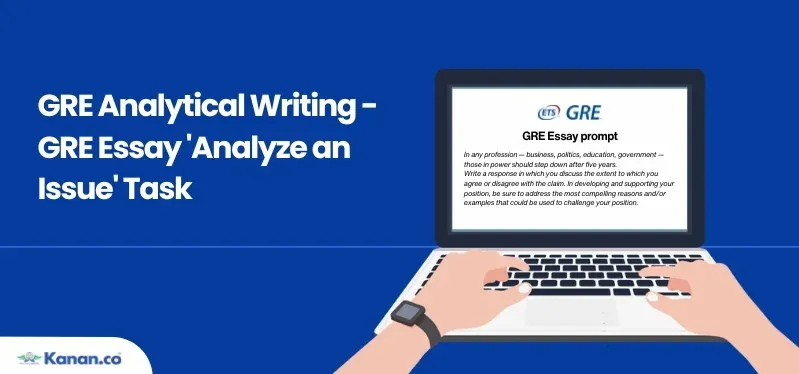
The Analytical writing section is the first section of the GRE. The purpose of the AWA GRE (Analytical Writing Assessment) section is to test the candidate's critical thinking and ability to articulate and evaluate complex arguments and discussions. It consists of two essay writing tasks of 30 minutes duration each, a task to “Analyze an issue” and a task to “Analyze an Argument”.
Previously, the GRE analytical writing section had these two essay questions. But now, as per the new GRE pattern launched by ETS, there is only one GRE Essay, which is ‘Issue Essay’. This means the argument essay no longer exists. Read on to learn about the GRE AWA section syllabus and how to prepare for an issue essay in GRE Analytical Writing.
What is the GRE Essay?
The GRE Essay is also called the Issue Task where you have to read and analyze the provided opinion of the issue and craft a well-supported argument. The duration of the task is 30 minutes and you need to write only one essay.
The GRE Essay tests your ability to form a cogent thesis statement and also checks how well you defend your argument throughout several paragraphs. The proper structure, continuity between ideas, and clarity in your writing also factor into your final score.
Since this task is to analyze the provided issue, you should be aware of the common types of issues that you will be asked to address. The GRE AWA topics normally fall under categories such as education, technology, art, government, society, philosophy, etc.
How long Should Your GRE Essay Be?
Interestingly, Longer essays generally score better on every essay topic. However, this doesn’t mean you should frantically write as much as possible to confer the much-coveted score, substance greatly matters. You must shoot for a five-paragraph essay with an intro, three body paragraphs, and a conclusion.
If you’re looking to get a high score for the AWA essay on GRE, an essay that has around 500-600 words, with around 5 paragraphs, and quality content, seems to be the ideal GRE essay length. I should also mention that paragraph length matters too. Five two-sentence paragraphs do not make a long essay. Each paragraph should flow logically and clearly from your thesis.

The above graph shows AWA scores for a sample of 500 students based on essay length. You can see, how scores go down if you go beyond 600 words. This isn’t surprising, as it’s nearly impossible for students to write a perfect 800-word count essay under 30 minutes of pressure. So, if you are shooting for a high word count, you will surely sacrifice quality of content. So, it’s safe to maintain a 500-600 word limit.
What is the Format for GRE Analytical Writing Issue Task
For the issue task, a statement will be given in the form of a sentence or short paragraph, followed by a prompt. You will be asked to explain whether you agree or disagree with the given statement and the reasoning behind that perspective. A six different set of instructions might be displayed after the issue, we suggest you pay attention to the wording of these instructions.
Below is a sample GRE issue essay prompt with an essay response for practice.
GRE Issue Essay Prompt Example
Prompt: The best ideas arise from a passionate interest in commonplace things.
Instructions: Write a response in which you discuss the extent to which you agree or disagree with the statement and explain your reasoning for the position you take. In developing and supporting your position, you should consider ways in which the statement might or might not hold true and explain how these considerations shape your position.
Check the GRE Analytical Writing Sample answer pdf.
Where can I get sample Issue Topics?
ETS (Educational Testing Service), the conducting body of the GRE has made the entire pool of GRE Analytical writing topics available on its website to make your preparation effective. This is an essential resource as the topics you see on your exam will be selected from those pools. Follow the below links to access the real gre awa questions:
GRE Analytical Writing: Computer vs Paper Test
Candidates taking computer-delivered GRE tests will use a basic word processor developed by the ETS (Educational Testing Service). The functionalities included in the ETS word processor are as follows: insert text, delete text, cut and paste, and undo the previous section. However, tools like spell checker and grammar checker are not available in the ETS software to ensure fairness for examinees who handwrite their essays at paper-delivered administrations. The handwritten essays will be transcribed directly into the test booklet along with the answers to the Verbal and Quantitative Reasoning sections.
If you are taking the paper-based test, make sure you write quickly and legibly, and you may also need to spend additional time at the beginning of your essay to organize your thoughts before writing. Now let’s see how your written GRE essays are scored.
How is the GRE Essay Scored in the Analytical Writing Section?
The GRE Essay is scored on a scale of 0-6 in 0.5-point increments, with a score of 6 representing a “cogent, well-articulated critique of the argument that conveys meaning skillfully” and a score of 0 representing “off-topic, is in a foreign language, merely copies the topic, consisting of keystroke characters, or is illegible or non-verbal”. This writing section score is independent and does not affect your overall GRE-scaled score (Which is based solely on your performance in math and verbal sections).
Most test takers end up scoring between 3.0 and 5.0. Well, What exactly does this score range mean?
- Any essay that scored 2 or below is said to have serious flaws.
- An essay that scored 3 is obviously flawed but has some competence in addressing the specific task directions, in analyzing issue, and in conveying meaning.
- An essay that gets a score of 4 is adequate and a score of 5 is strong.
- An essay that gets a 6 is truly outstanding which is very rare.
Read more about the ‘Analyze an Issue’ task’s score levels in detail on ETS’s GRE Analytical writing scoring page.
Note that for both computer-based and paper-based tests, the final GRE Analytical writing section is the averaged score of two graders: a human grader and an AI grader. The human essay grader spends around 30 seconds grading each essay. He/she checks for clear organization of your information, ensuring that paragraphs start with a topic sentence and flow into specific examples that support your analysis. The grader also looks for a conclusion that effectively summarizes your points. After assigning a score, they move on to the next essay.
As mentioned, the essay will also be reviewed by an AI grader (ETS computer program) called “e-rater”, which helps ensure standardized grading across various writing styles and knowledge backgrounds. And if for some reason the AI and human essay scores greatly disagree by more than a trivial amount, then a 2nd (second) human grader is brought in to score your essay, and the final essay score is the average of two human ratings.
ETS’s GRE AWA Percentiles
See the below table for the GRE analytical score percentile. You can see the exact percentiles for each score.
| Score | Percentile |
| 6 | 99 |
| 5.5 | 98 |
| 5 | 91 |
| 4.5 | 81 |
| 4 | 56 |
| 3.5 | 38 |
| 3 | 15 |
| 2.5 | 7 |
| 2 | 2 |
| 1.5 | 1 |
| 1 | - |
| 0.5 | - |
| 0 | - |
What do the Graders look for in a GRE Essay?
All the AWA graders mainly look for three C’s: Clarity, Coherency, and Cogency.
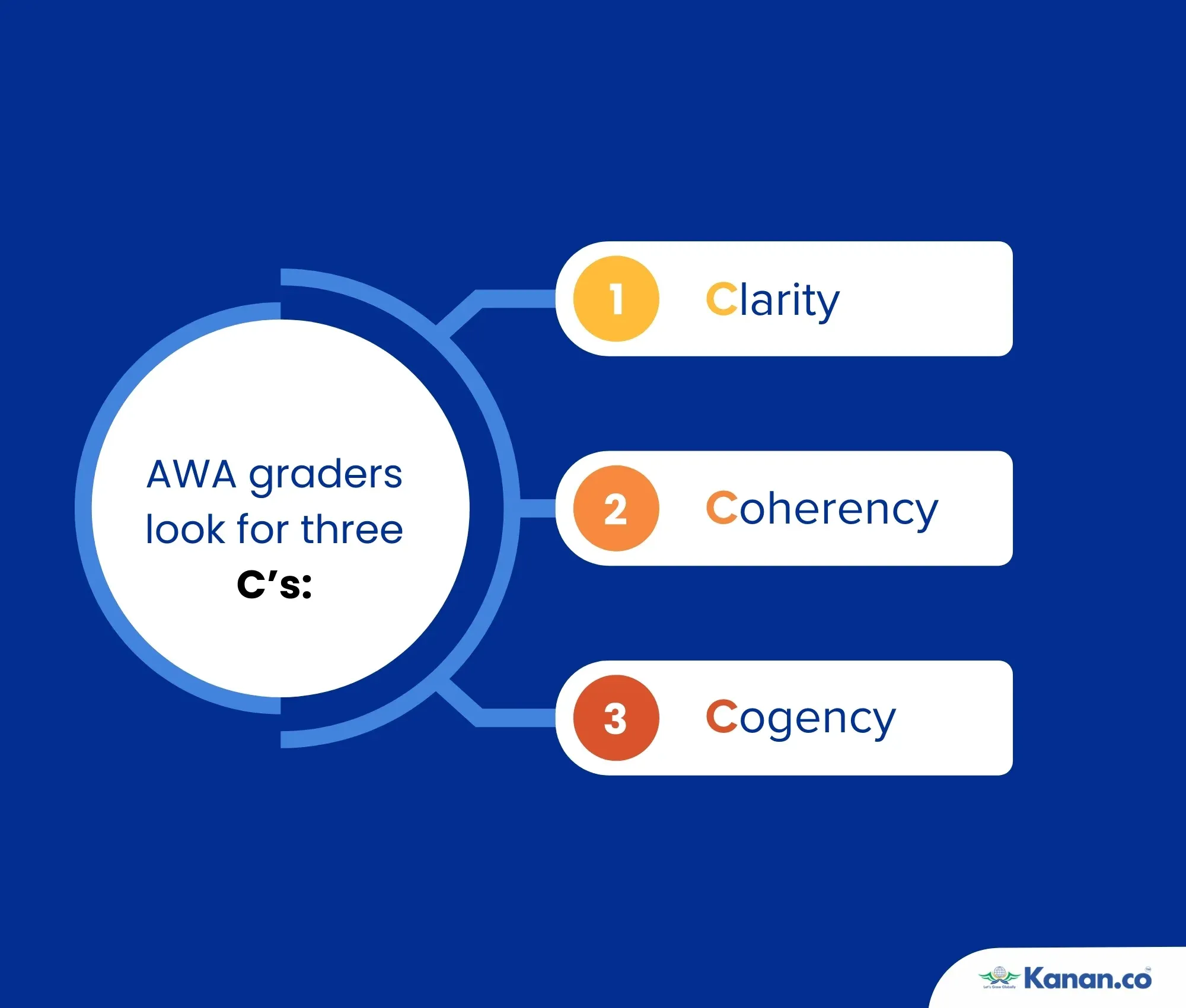
First, you need to express your ideas clearly. Using unnecessary words, or jumbling your words compromises clarity, but your essay is not just a sentence with a clearly expressed idea; it is a set of ideas that should be logically connected to each other. That is Coherence.
Next, you must provide convincing evidence to back up your thesis. Your essay will probably lack cogency if you throw some vague examples. Developing a well-thought-out example that strongly reinforces your thesis is crucial for achieving a high essay score.
Remember, the GRE essay graders don’t care how poetically you framed the context of your thesis. They mainly look for a logical essay, not a creative one, and also you won’t gain any points by using extraneous words. So avoid flowery exposition and cross-check whether you’ve successfully communicated your thesis in the first two sentences.
Other factors that Graders look for
Several other factors influence the human grader’s assessment of a GRE essay. Style matters; an essay with choppy sentences and unsophisticated vocabulary will receive a lower score than one with sophisticated syntax and advanced GRE-level vocabulary, assuming all other aspects are equal.
Grammar is another important factor. Although graders are not looking to nitpick at grammar, they will notice immediately as soon as you make the tiniest mistake. Ranging from improper use of pronouns to misspelling common words, anything can negatively impact your score. However, a few grammatical flubs won’t hinder an essay from getting a perfect score if everything else is excellent in the essay.
Overall, you need to present a GRE essay rubric that outlines the four key aspects contributing to your score: Quality of Ideas, Organization, Writing Style, and Grammar and Usage.
How do I improve my grammar and style?
The best way to improve your grammar and style is to read, write, and repeat. The more you read and write in English, the better you express your ideas in English. The much easier one to improve between grammar and style is the grammar. Great Style in writing is more elusive and often is the result of years of dedicated practice. However, to score well on the GRE, your writing doesn’t need to be at the level of The New York Times or The Hindu. Focus on avoiding choppy sentences by varying your sentence structure and don't hesitate to replace simple words with more complex ones when appropriate for the context.
I recommend you refer to the books ‘William Zisser’s On Writing Well’ and ‘Strunk and White’s Element of Style’ which offer writing advice, covering everything from dangling modifiers to constructing compelling & dynamic sentences. These books focus on grammar and style and have been a valuable resource for students over centuries. While many grammar books are adequate for improving grammar, they lack in teaching writing style, which is a crucial skill for the GRE (and beyond!). Check here to learn about the best books for GRE Analytical writing.
How do I Practice for the GRE Analytical Writing?
Developing strong analytical writing skills is essential for clearly articulating and supporting your arguments in essays. Given below are the tips on approaching GRE Analytical Writing section:
1. Start Writing
By writing frequently you will be able to write with greater command and facility. With diligent practice, words will no longer feel buried deep in your subconscious but will instead come to life on the page.
2. Don’t forget to Outline/Brainstorm
Before you write, you must think of what you are going to write. I am sure many amongst you accede to the school of thought that the words, the compelling examples, and the nuanced logic will come in flow if you start writing. But, you must avoid this tendency when you are practicing for the GRE essay, instead, you need to spend a few minutes to come up with a road map (either in your head or on the computer screen). Initially, this step may slow you down and tempt you to revert to your old method. However, be patient. Once you become adept at outlining, the essay will practically write itself.
3. Spend Time Editing Your Practice Essays
While you won’t have much time to edit your essay on test day, diligently editing your practice essays will make you more aware of your grammatical and logical mistakes. Correcting these errors will not only help you anticipate them in the future but will also improve the clarity of the writing and logic in your future essays.
4. Improve your grammar
ETS specifically states in an essay it values quality and clarity of thought over grammar alone. However, both are closely related. Struggling to articulate something often leads to breaking grammatical rules, which in turn will sacrifice clarity. Even minor grammatical errors you make (like faulty pronouns, and subject/verb agreement) will affect the overall quality of your writing.
5. Constantly Read Sample Essays
Reading sample essays written by others will help you understand what ETS is looking for. You will also be able to judge your essays better. You must keep tweaking your essays throughout the practice sessions to move closer to the next higher score level. For instance, if you scored ‘3’, improve your writing to score ‘4’.
AWA GRE Sample Essays to help you Score high
The best source for sample essays is the collection of released essays with grader comments from ETS. These are actual student essays, and you can use them to assess your own level of writing. Say like, based on the scores given to the other essays, determine where your essay falls in the range of 0.0-6.0.
Additionally, you can also refer to the GRE AWA sample essays given below:
| GRE Issue Essay Sample 1 | GRE Issue Essay Sample 2 |
| GRE Issue Essay Sample 3 | GRE Issue Essay Sample 4 |
Where can I get my GRE Practice Essays graded?
Believe it or not, one of the most frequent questions we receive from students worldwide is how to get their essays graded. While feedback gives you areas of improvement needed, finding the one giving you a genuine critique of your essay is difficult. ETS offers a service to score your GRE practice essays. You will get just a score, not the feedback.
I have seen many students over the years asking for feedback on forums like The GradCafe, Reddit, or GRE Prep Club, where generous individuals—often GRE test takers with strong writing skills—sometimes offer insightful analysis for free. While this might not sound perfect, it's one of the few ways to get essay feedback without paying.
If you are an internet geek, you can take advantage of the latest technology like ChatGPT to grade your essay for suggestions of improvement. Try your luck! Lastly, don’t forget to review your essay yourself.
Hope this article made you well-prepared to answer the GRE AWA questions. We, at Kanan International, assure you of the guaranteed score improvement in the GRE. So, make full use of our services to build your strong writing skills. After demonstrating the entire syllabus that is applicable for GRE Analytical writing then we put forward some of the most frequently asked GRE AWA questions on various fronts.
Most Frequently Asked GRE AWA Questions
1. What is awa in GRE?
The AWA (Analytical Writing Assessment) is the first section of the GRE (Graduate Record Examination) that measures your critical thinking and analytical writing skills. It includes a 30-minute essay task ‘Analyse an Issue’. Test takers must construct a well-reasoned argument and support it with evidence, demonstrating clarity and coherence in their writing.
2. What are some common myths about the GRE Analytical Writing section?
Common myths about the GRE Analytical Writing section include it being less important than other sections, that memorizing templates ensures high scores, and that using complex vocabulary alone can boost scores. In reality, clear reasoning, organization, and critical analysis are essential for achieving a good score.
3. How can I make my GRE essay stand out to graders?
To make your GRE essay stand out, use a clear structure with a strong thesis, support points with specific examples, demonstrate critical thinking, and maintain clarity in language. Additionally, incorporate counterarguments and manage your time effectively to ensure a well-rounded and polished essay.
4. What is the minimum AWA score required?
Generally, A GRE AWA score of 6 to 5 means the candidate has proper writing skills. The average AWA score on the GRE is 3.5. For US universities, the average AWA score cutoff ranges from 4.5 & above.
5. What impact does the GRE Analytical Writing score have on graduate school applications?
The GRE Analytical Writing score shows how well you can write and organize your thoughts. While it's just one part of the application, a strong score can enhance credibility, especially for programs emphasizing writing skills or research-oriented fields.

About Author Tejaswini Kota
Tejaswini is an enthusiastic writer, reader and a passionate learner. Additionally, she was a research fellow and holds a grip in English writings and research/paper publications. She holds bachelors and masters degrees in engineering. She spent three years in the education industry and is currently working as a full-time content writer at Kanan International, writing articles for study abroad projects. She is proficient in creating good quality content that helps the students for language proficiency tests like IELTS, GRE, TOEFL etc. and can help in advising you the right choice of college for admission.
Kanan.co is a trusted study abroad consultancy offering comprehensive services, resources, and solutions for students and education institutions. We support students at every stage of their global education journey, ensuring a smooth and guided experience. Along with test preparation for IELTS, GRE, TOEFL, and SAT, we provide expert services such as SOP writing, visa guidance, accommodation support, scholarship assistance, and education loan support. Our expertise and commitment to excellence make us a reliable partner for students pursuing international education.
Sign Up for a Free GRE Demo Class!
Ace GRE Quant & Verbal with 320+ Score — Join Us!








Global Headquarters
Kanan Int EdTech Inc
320 Bay Street, Suite 321 (Spaces), Toronto ON, Canada M5B 1N9
Indian Headquarters
Kanan International Pvt. Ltd.
D-wing, 2nd Floor, Trident Complex, Ellora Park Vadiwadi Road, Vadodara, Gujarat 390007
IT/ Digital Campus
Kanan International Pvt. Ltd
Old, New No 3, 2nd Floor, 1A, Dr Sadasivam Rd, T. Nagar, Chennai, Tamil Nadu 600017
Our branches
- Bardoli
- Bharuch
- Chennai
- Dehradun
- Gurugram
- Himatnagar
- Karnal
- Nadiad
- Navsari
- Palanpur
- Rajkot
- Vadodara
- Valsad
- Vallabh Vidyanagar
- Vapi
Study Abroad
Test Prep
Top Universities
Consultants
IELTS Centers
GRE Centers
TOEFL Centers
SAT Centers
Language Courses in Vadodara
SOP Blogs
Featured Blogs
Study Abroad Consultants in Chennai
Study Abroad Consultants in Surat
Study Abroad Consultants in Navsari
Study Abroad Consultants in Bardoli
Study Abroad Consultants in Ahmedabad
Study Abroad Consultants in Anand
Study Abroad Consultants in Khanna
Study Abroad Consultants in Nadiad
Study Abroad Consultants in Vadodara
Study abroad consultants in Valsad
Copyright © 2026 KANAN.CO All rights reserved.