- Study Abroad
- / gre
- / general test vs subject test
GRE General Test vs GRE Subject Test: Know the difference


Author
29-12-2025


The GRE General Test assesses verbal reasoning, quantitative reasoning, and analytical writing skills, applicable to a wide range of graduate programs. In contrast, the GRE Subject Test evaluates knowledge in a specific field of study, such as Physics, Maths, or Psychology. Most prestigious abroad universities prefer the GRE general test as it assesses the overall aptitude rather than measuring a single subject.
For competitive programs like MBA, MTech, or PhD, language proficiency and aptitude tests like GRE or GMAT scores are often mandatory in the admission process. Students who are dreaming of studying abroad can take the GRE test. The test is available in two types, the GRE General Test and the GRE Subject Test. Choosing between the General and Subject tests requires proper guidance, thorough research, or support from professionals like Kanan.co. In this blog, you will learn the differences between the GRE general and subject tests, which will help you determine which test you need to take.
Let’s start from scratch and learn about the fundamentals of GRE general and subject tests in the sections below.
What is the GRE General Test?
The GRE General Test is designed to assess a broad range of skills essential for success in graduate, business, and law schools. It measures your verbal reasoning, quantitative reasoning, analytical writing, and critical thinking skills. The test lasts approximately 3 hours and 45 minutes.
GRE general test comprises three sections: Verbal Reasoning, Quantitative Reasoning, and Analytical Writing, each designed to evaluate a specific skill set.
- Verbal Reasoning: This section tests your ability to analyse and evaluate written material, understand relationships among words and concepts, and draw conclusions from discourse. It includes tasks like reading comprehension, text completion, and sentence equivalence.
- Quantitative Reasoning: This section measures your ability to understand, interpret, and analyse quantitative information. It involves arithmetic, algebra, geometry, and data analysis, focusing on problem-solving using mathematical models.
- Analytical Writing: This section assesses your ability to articulate complex ideas clearly and effectively. It requires you to construct and support arguments, analyse issues, and sustain a coherent discussion.
What is the GRE Subject test?
The GRE Subject Tests are specialised exams designed to measure knowledge and skills in specific academic disciplines. It is essential for admission into international universities and graduate programs. GRE subject test is intended for students with a strong undergraduate background or major in subjects including Mathematics, Physics, or Psychology. GRE subject test assesses abilities crucial for graduate-level study in fields like MSc in Physics, MA in Psychology, MBA, or an MEng. Graduate schools and fellowship panels use these tests to increase undergraduate records.
- Mathematics: Assesses knowledge in calculus, algebra, and advanced mathematical topics. It consists of approximately 66 multiple-choice questions.
- Physics: Tests understanding of mechanics, electromagnetism, and quantum mechanics. It includes approximately 70 multiple-choice questions.
- Psychology: Measures knowledge in biological, cognitive, social, and clinical psychology. It features approximately 144 multiple-choice questions.
Since September 2023, the GRE Subject Tests have transitioned to a computer-delivered format to increase accessibility and flexibility for test-takers worldwide. The Mathematics test is approximately 2 hours and 50 minutes long, while the Physics and Psychology tests are approximately 2 hours long. Scores for these tests are valid for five years after the test date.
Note: The chemistry test was discontinued after the April 2023 administration, though scores on the test will continue to be reportable for 5 years after the test date.
Having explored the GRE General and GRE Subject Tests, let's now learn the key differences in the next section.
What is the difference between the GRE General Test and the Subject Test?
The GRE general test is a comprehensive exam that evaluates general skills across verbal reasoning, quantitative reasoning, and analytical writing. In contrast, the GRE subject test assesses knowledge and skills in specific subjects such as Mathematics, Physics, and Psychology.
The below infographic shows the primary difference between the GRE General and the subject tests.
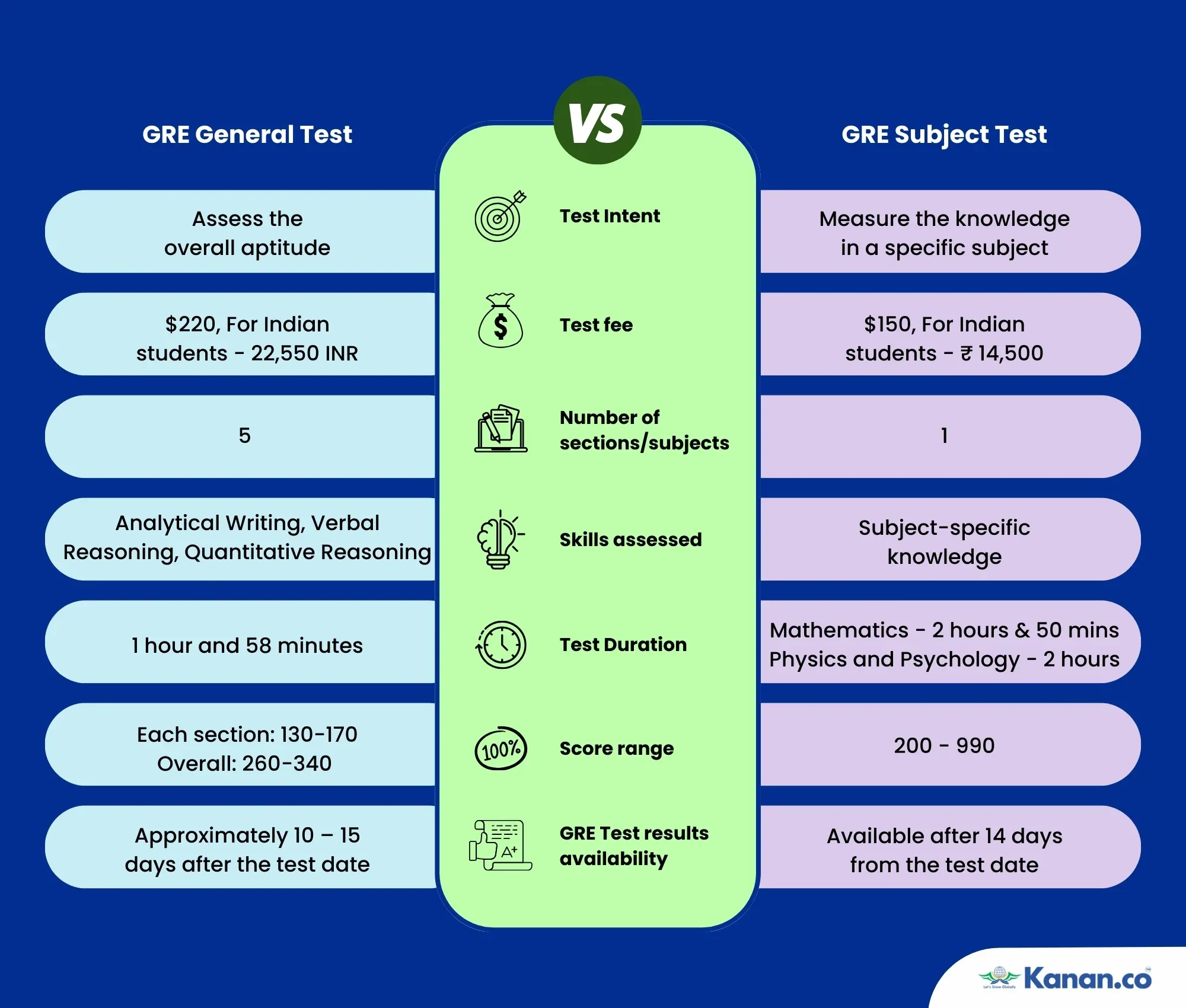
Let’s discuss more differences in the below table:
| S. No | Components | GRE General Test | GRE Subject Test |
| 1 | GRE test intent | To assess the overall aptitude of the test takers | To measure the knowledge in a specific subject |
| 2 | Test mode | Computer-based | Before September 2023, it was paper-based. Note: After September 2023, the GRE subject test changed to computer-based. |
| 3 | GRE fee | $220 For Indian students - 22,550 INR |
$150 For Indian students - ₹ 14,500 |
| 4 | Number of sections/subjects | 5 | 1 |
| 5 | Skills assessed | Analytical Writing, Verbal Reasoning, Quantitative Reasoning | Subject-specific knowledge |
| 6 | Test Duration | 1 hour and 58 minutes | Mathematics - 2 hours and 50 minutes Physics and Psychology - 2 hours |
| 7 | Score range | Each section - 130-170 Overall - 260-340 | The total score of the GRE Subject Test ranges from 200 to 990. |
| 8 | Test starts at | The GRE starts in September month of every year | The GRE starts in September month of every year |
| 9 | The test required by the programs | Generally required for most graduate programs | Required or recommended by specific programs in the subject field |
| 10 | GRE Test results availability | Scores are available approximately 10–15 days after the test date | Scores are available after 14 days from the test date |
| 11 | Test Centers | Over 1,000 ETS-authorized test centres in 160+ countries. | Ahmedabad, Bangalore, Coimbatore, Kolkata, Mumbai, New Delhi, and Pilani |
| 12 | GRE At Home | You can take the GRE General Test at home if it's offered in your country based on your registered address. | At-home testing is not available in India, Pakistan, Hong Kong, Taiwan and China. |
| 13 | GRE Registration Date | Registration for the GRE General Test will be open all year round. | Registration for the GRE Subject Test opens each July, as the test is conducted only a few times during the year. |
How to Decide? GRE General Test vs Subject Test
Having learned the difference between the GRE General and Subject Tests, it's time to decide which test best fits your academic and career aspirations. The decision largely depends on the program requirements and the university you are applying to. Generally, most graduate programs require the GRE General Test, while certain specialised programs may require a GRE Subject Test to demonstrate proficiency in a specific field.
The following factors will help you decide which test to take:
1. Program Requirements: Review the admission requirements of the programs you are interested in. For example, most MBA programs require the GRE General Test. According to a survey by ETS, 90% of business schools accept the GRE General Test for MBA admissions.
2. Field of Study: If you are applying to a highly specialised program, such as a Master's in Physics or a PhD in Psychology, a GRE Subject Test might be necessary to showcase your subject-specific knowledge. For instance, approximately 75% of master's degree programs in mathematics recommend or require the GRE Mathematics Subject Test.
3. University Preferences: Different universities have different preferences and requirements. It's essential to check each institution's guidelines to ensure you are meeting their criteria.
4. Your Strengths and Interests: Consider your own academic strengths and interests. If you have a strong background in a particular subject, taking the corresponding GRE Subject Test could highlight your expertise. For instance, taking the GRE Psychology Subject Test can enhance your psychology program application due to your strong knowledge of psychological theories and research methods.
5. Competitiveness of the Program: For highly competitive programs, a strong performance on a relevant GRE Subject Test can enhance your application and set you apart from other candidates. As per ETS, applicants scoring in the 90th percentile on a GRE Subject Test are more likely to be accepted into top-tier programs.
By evaluating these factors, you can make an informed decision on whether to take the GRE General Test, a GRE Subject Test, or both to maximize your chances of admission.
Begin your preparation with our GRE coaching in Chennai. Choosing Kanan International means selecting the best coaching classes in chennai for GRE
Conclusion
In conclusion, the GRE General Test and the GRE Subject Test serve different purposes and are designed to assess various skills. Choosing the right test depends on the programs and schools you are applying to. The GRE General Test is generally a better option for flexibility in applying to multiple programs. For highly competitive programs, consider taking both tests to demonstrate strong academic skills in general and academic skills in general and specialised areas. If you are still unsure about choosing the GRE General Test vs Subject Test, take expert advice by contacting Kanan.co. Our expert counsellors are always happy to assist you.
Frequently Asked Questions (FAQs)
1. What is the difference between the GRE general and the GRE subject test?
The GRE General Test assesses general academic abilities across verbal reasoning, quantitative reasoning, and analytical writing. The GRE Subject Tests evaluate knowledge in specific subjects such as Math, Physics, and Psychology.
2. Should I take the GRE General Test or the subject test?
It depends on your target programs. The GRE General Test is widely accepted, while the GRE Subject Test is required for specific fields. Check the requirements of your chosen programs to decide.
3. Is the GRE Subject Test more difficult than the GRE General Test?
The difficulty is subjective and depends on your background. The GRE Subject Test requires specialized knowledge, while the GRE General Test assesses broader skills.
4. How often can I take the GRE General Test?
You can take the GRE General Test once every 21 days, up to five times within any continuous rolling 12-month period.
5. Can I take the GRE if I’m under 18 in India?
Yes, there is no age restriction for taking the GRE in India. However, ensure you meet the identification requirements for the test centre.
6. Can I retake the GRE General or Subject Test?
Yes, you can retake both the GRE General and Subject Tests. You can retake the GRE General Test once every 21 days, up to five times within any 12-month period. You can retake a GRE Subject Test every 14 days if your scores don't reflect your abilities.
7. Should I choose the GRE General Test or the Subject Test for MS?
For most MS programs, the GRE General Test is required. However, some specialized fields may recommend or require a GRE Subject Test. Check the specific requirements of your intended programs.
8. Should I choose the GRE General Test or the Subject Test for PhD?
PhD programs often prefer the GRE General Test, but certain fields, like Physics or Mathematics, may require a GRE Subject Test to demonstrate in-depth knowledge in the subject area.

About Author Manimegalai Samidurai
Manimegalai is a multifaceted professional, excelling as an author, writer, and study-abroad expert. Her vast knowledge of English proficiency exams, including IELTS, GRE, SAT, and PTE, and exceptional content writing skills make her a go-to resource for students seeking guidance and support in their foreign education journey. She is a trusted authority in writing content related to these test-prep exams, making her an invaluable resource for those seeking guidance. With her well-researched and informative blogs, articles, and study materials, Manimegalai has helped countless students achieve their desired band scores and get admissions to top-notch colleges & universities in countries like Canada, USA, UK, Australia, Ireland, etc.
Kanan.co is a trusted study abroad consultancy offering comprehensive services, resources, and solutions for students and education institutions. We support students at every stage of their global education journey, ensuring a smooth and guided experience. Along with test preparation for IELTS, GRE, TOEFL, and SAT, we provide expert services such as SOP writing, visa guidance, accommodation support, scholarship assistance, and education loan support. Our expertise and commitment to excellence make us a reliable partner for students pursuing international education.
Sign Up for a Free GRE Demo Class!
Ace GRE Quant & Verbal with 320+ Score — Join Us!








Global Headquarters
Kanan Int EdTech Inc
320 Bay Street, Suite 321 (Spaces), Toronto ON, Canada M5B 1N9
Indian Headquarters
Kanan International Pvt. Ltd.
D-wing, 2nd Floor, Trident Complex, Ellora Park Vadiwadi Road, Vadodara, Gujarat 390007
IT/ Digital Campus
Kanan International Pvt. Ltd
Old, New No 3, 2nd Floor, 1A, Dr Sadasivam Rd, T. Nagar, Chennai, Tamil Nadu 600017
Our branches
- Bardoli
- Bharuch
- Chennai
- Dehradun
- Gurugram
- Himatnagar
- Karnal
- Nadiad
- Navsari
- Palanpur
- Rajkot
- Vadodara
- Valsad
- Vallabh Vidyanagar
- Vapi
Study Abroad
Test Prep
Top Universities
Consultants
IELTS Centers
GRE Centers
TOEFL Centers
SAT Centers
Language Courses in Vadodara
Study Abroad Calculators
Featured Blogs
Study Abroad Consultants in Chennai
Study Abroad Consultants in Surat
Study Abroad Consultants in Navsari
Study Abroad Consultants in Bardoli
Study Abroad Consultants in Ahmedabad
Study Abroad Consultants in Anand
Study Abroad Consultants in Khanna
Study Abroad Consultants in Nadiad
Study Abroad Consultants in Vadodara
Study abroad consultants in Valsad
Copyright © 2026 KANAN.CO All rights reserved.