- Study Abroad
- / ielts
- / a brief history of london underground reading answers
A Brief History of London Underground Reading Answers


Author
19-09-2025

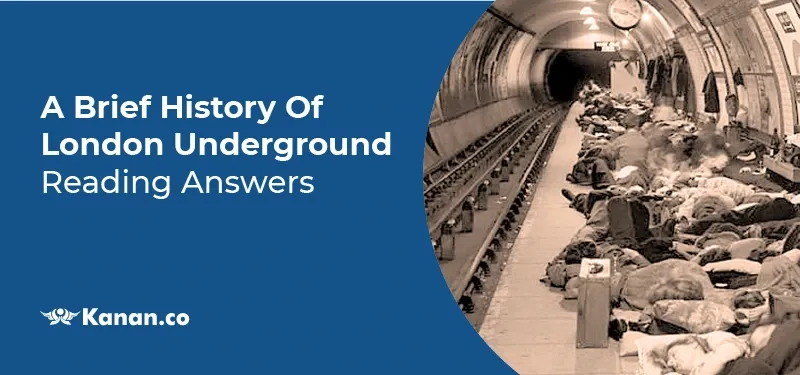
A brief history of London Underground IELTS reading practice test has 13 questions of 3 question types: true/false/not given; Multiple choice questions; and sentence completion. This article will help you with the passage, questions, and answers. Refer to A brief history of London Underground reading answers given below.
Table of contents:
- A brief history of London underground IELTS Reading Practice Test
- Passage
- Questions
- Answers with Explanations

Check out our YouTube Channel to Practice Full-Length IELTS Reading Tests Daily

A brief history of London Underground
A. It is a staple of not just the capital of the UK, but of British culture in general. It is used by more than 1.3 billion people per year, and it is more than 400 kilometres long. It has survived fires, floods, terrorist attacks and two world wars, and it has been described as “form of mild torture”, a “twopenny tube” and a system of “padded cells”. It is the London Underground, and it has been around for more than 150 years. But how did it all start?
B. The idea of an intricate train network running underneath a vibrant and heavily populated city like London might not be such a novelty in contemporary society, but it certainly was one back in the early 19th century when it was first conceived. In fact, the only reason such a notion-at the time described by The Times as an “insult to common sense” – was even entertained in the first place was pure desperation: during the Victorian era, London roads were insufferably overcrowded, and a Royal Commission of 1846 meant that central London was out of bounds for railway companies, whose mainline railways all had to stop just outside the City and West End. A way to connect Paddington, Euston and King’s Cross was, therefore, a necessity to relieve the congested streets, and Charles Pearson, the man who originally envisioned a Fleet Valley rail tunnel just fifteen years after the first steam passenger service was opened in 1830, couldn’t have come up with his plan for what was to become London Underground at a better time.
C. And so the story begins, in 1863, with the opening of the Metropolitan Railway, which ran between Paddington (called Bishop’s Road at the time) and Farringdon, serving a total of eight stations. Five years later, in 1868, the first section of the Metropolitan District Railway (now incorporated into the District and Circle lines) followed, running from South Kensington to Westminster. Within the first fifty years, much of what is known as Zone 1 of the London Underground system today would be built, all funded by private developers. (Unfortunately for them, none would get the financial returns they had been promised.)
D. People nowadays might complain about the atmosphere in London Underground, particularly in the summer, but it is nothing compared to the conditions the Metropolitan Railway’s passengers had to weather during the first years of its operation. So foul was the smell in the tunnels that spread under the city that drivers were allowed to grow beards, in hopes that this would protect them from inhaling the billowing smokes. (According to the account of a civil servant from that time, the stink in the underground was comparable to that of a ‘crocodile’s breath’.) Nevertheless, the line was a smashing success from the very beginning, with more than 11 million passengers in just the first year.
E. The second spate of construction works arrived with the development of electric traction at the end of the 19th century, which meant that trains no longer had to run through shallow tunnels to allow room for the steam produced by the engines to escape. Instead, new tunnels could now be dug, cutting deeper into the belly of the city. The first deep-level electric railway was opened in December 1890 by the City and South London Railway, connecting King William Street to Stockwell. In the following fifty years, the existing tube lines would systematically be extended, branching into London’s various suburbs. Surprisingly, it would take until 1968 for an entirely new line to open again: the Victoria Line (provisionally named the Viking Line), which was followed by the Jubilee Line eleven years later.
F. As I mentioned above, London Underground’s first lines were built by private developers, meaning that each line was owned by different companies. This changed in 1933 when all of those companies were nationalised and merged to form the London Passenger Transport Board, which controlled London’s railway, tram, trolleybus, bus and coach services. (Coincidentally, 1933 was also the year the first diagram of the iconic Underground map was first presented by Harry Beck.) The London Passenger Transport Board itself was nationalised in 1948.
G. The next wave of changes came at the turn of the 21st century, and has continued to unfold well into its second decade: in 2003, the famous Oyster card was introduced-a wireless travel card that can be charged up with the money to be used for single fares or weekly, monthly, and yearly travel tickets. Busking was also legalised the same year. In 2007, London Underground achieved its next important milestone, reaching 1 billion passengers per year, and in 2009 it was named the best Metro system in Europe. In early 2016, a new Crossrail line named after Queen Elizabeth II was announced, which is due to open in late 2018. This will be the first new line in nearly forty years. And the story goes on.
H. So, there you have it. The underground system that every Londoner loves to hate, but without which London never would have become the sort of financial hub and melting pot it is today. A history spanning across three centuries, all of which contributed to the creation of not just a transport system, but a unique, daring brand, and a cultural phenomenon the likes of which the world had never seen before. Perhaps it is, as its critics contend, too busy, too hot, too pricey and too grimy. But it is also a remarkable achievement, for Londoners and non-Londoners alike, and it should be treasured regardless of its shortcomings.
Questions
Questions 1-6
Do the following statements agree with the information given in Reading Passage 1?
In boxes 1-6 on your answer sheet, write
TRUE if the statement is true according to the passage
FALSE if the statement is false according to the passage
NOT GIVEN if the information is not given in the passage
1 More than a billion commuters use London Underground every day.
2 London Underground would not be considered a unique concept were it to be
build today.
3 In the 19th century, railway companies were not allowed to build stations within
central London.
4 Charles Pearson’s London Underground plan was a precursor of his Fleet Valley
rail tunnel idea.
5 The first section of the Metropolitan District Railway, opened in 1868, took five
years to complete.
6 The British government promised great financial returns to private investors to convince them to fund London Underground.
Questions 7-10
Choose the correct letter, A, B, C or D.
Write your answers in boxes 7-10 on your answer sheet.
7 During the first year of its operation, the Metropolitan Railway
A encouraged passengers to grow beards to block the smell.
B was not particularly successful.
C had more than 11 million passengers.
D was as bad as it is nowadays during the summer months.
8 At the end of the 19th century,
A London Underground stopped using shallow tunnels.
B a new London Underground line was completed.
C a new method of moving trains with electricity was invented.
D the City and South London Railway was established.
9 The Victoria Line
A was originally named the Viking Line.
B was the first London Underground line to use electric traction.
C was the fourth London Underground line to be built.
D was built more than 70 years after its predecessor.
10 The London Passenger Transport Board
A replaced the private companies that previously owned London Underground.
B released the first diagram of the Underground map in 1933.
C was established by private developers.
D controlled most of London’s transport services.
Questions 11-13
Complete the sentences below.
Choose NO MORE THAN TWO WORDS from Reading Passage 2 for each answer.
Write your answers in boxes 11-13 on your answer sheet.
Since 2003, London commuters have been able to listen to 11 ………………… in and
outside London Underground stations.
London Underground not only attracted a lot of business to London but also
helped it to become a 12 ………………….
London Underground does have its 13 ………………….. but it’s still a unique and
important cultural phenomenon.
Answers for A brief history of London underground With Explanations
A brief history of the London underground reading answers with explanations is given below. Refer to the following answers with an explanation section in order to correct your errors.
(Note: The text in italics mentions the location and referring lines written in the reading passage.)
1. Answer: False
Explanation: In the fifth and sixth lines of paragraph G, “London Underground achieved its next important milestone, reaching 1 billion passengers per year, and in 2009 it was named the best Metro system in Europe”.
2. Answer: True
Explanation: In the first three lines of paragraph B, “The idea of an intricate train network running underneath a vibrant and heavily populated city like London might not be such a novelty in contemporary society, but it certainly was one back in the early 19th century when it was first conceived”.
3. Answer: True
Explanation: In the second, third and fourth lines of paragraph F, “This changed in 1933 when all of those companies were nationalised and merged to form the London Passenger Transport Board, which controlled London’s railway, tram, trolleybus, bus and coach services”.
4. Answer: False
Explanation: In the last three lines of paragraph B, “Charles Pearson, the man who originally envisioned a Fleet Valley rail tunnel just fifteen years after the first steam passenger service was opened in 1830, couldn’t have come up with his plan for what was to become London Underground at a better time”.
5. Answer: Not given
Explanation: —
6. Answer: Not given
Explanation: —
7. Answer: C
Explanation: In the first three lines of paragraph C, “And so the story begins, in 1863, with the opening of the Metropolitan Railway, which ran between Paddington (called Bishop’s Road at the time) and Farringdon, serving a total of eight stations”.
8. Answer: B
Explanation: In the first three lines E, “The second spate of construction works arrived with the development of electric traction at the end of the 19th century, which meant that trains no longer had to run through shallow tunnels to allow room for the steam produced by the engines to escape”.
9. Answer: D
Explanation: In the last three lines of paragraph E, “Surprisingly, it would take until 1968 for an entirely new line to open again: the Victoria Line (provisionally named the Viking Line), which was followed by the Jubilee Line eleven years later”.
10. Answer: A
Explanation: In the second, third, fourth, fifth and sixth lines F, “This changed in 1933 when all of those companies were nationalised and merged to form the London Passenger Transport Board, which controlled London’s railway, tram, trolleybus, bus and coach services. (Coincidentally, 1933 was also the year the first diagram of the iconic Underground map was first presented by Harry Beck.) The London Passenger Transport Board itself was nationalised in 1948”.
11. Answer: Busking
Explanation: In the fourth of paragraph G, “Busking was also legalised the same year”.
12. Answer: Melting pot
Explanation: In the second line of paragraph H, “ melting pot”.
13. Answer: Shortcomings
Explanation: In the last line of paragraph H, “ and it should be treasured regardless of its shortcomings”.
Other Reading Tests

About Author Gayathri Nagarajan
Gayathri, a trusted study-abroad expert, with expertise in standardized tests like IELTS, TOEFL, PTE, GRE, and GMAT. With a strong tech background from SASTRA University, she excels in software testing and has a passion for content writing and digital marketing. She aids students in finding the perfect academic fit, offering guidance on course selection, LOR and SOP writing. She remains up-to-date with the latest trends in higher education, delivering credible, accurate information on international education, including courses and test prep materials. As a trusted Study abroad expert at Kanan International, explore her latest blogs and articles for comprehensive insights into studying abroad and realizing your academic aspirations.
Kanan.co is a trusted study abroad consultancy offering comprehensive services, resources, and solutions for students and education institutions. We support students at every stage of their global education journey, ensuring a smooth and guided experience. Along with test preparation for IELTS, GRE, TOEFL, and SAT, we provide expert services such as SOP writing, visa guidance, accommodation support, scholarship assistance, and education loan support. Our expertise and commitment to excellence make us a reliable partner for students pursuing international education.
Free Online Mock Test 2026
Practice our mock test worth Rs. 25000 for Free and know your IELTS score!








Global Headquarters
Kanan Int EdTech Inc
320 Bay Street, Suite 321 (Spaces), Toronto ON, Canada M5B 1N9
Indian Headquarters
Kanan International Pvt. Ltd.
D-wing, 2nd Floor, Trident Complex, Ellora Park Vadiwadi Road, Vadodara, Gujarat 390007
IT/ Digital Campus
Kanan International Pvt. Ltd
Old, New No 3, 2nd Floor, 1A, Dr Sadasivam Rd, T. Nagar, Chennai, Tamil Nadu 600017
Our branches
- Bardoli
- Bharuch
- Chennai
- Dehradun
- Gurugram
- Himatnagar
- Karnal
- Nadiad
- Navsari
- Palanpur
- Rajkot
- Vadodara
- Valsad
- Vallabh Vidyanagar
- Vapi
Study Abroad
Test Prep
Top Universities
Consultants
IELTS Centers
GRE Centers
TOEFL Centers
SAT Centers
Language Courses in Vadodara
Study Abroad Calculators
Featured Blogs
Study Abroad Consultants in Chennai
Study Abroad Consultants in Surat
Study Abroad Consultants in Navsari
Study Abroad Consultants in Bardoli
Study Abroad Consultants in Ahmedabad
Study Abroad Consultants in Anand
Study Abroad Consultants in Khanna
Study Abroad Consultants in Nadiad
Study Abroad Consultants in Vadodara
Study abroad consultants in Valsad
Copyright © 2026 KANAN.CO All rights reserved.