- Study Abroad
- / ielts
- / a remarkable beetle reading answers
A Remarkable Beetle - Cambridge 3 Test 2 Reading Passage 1


Author
19-09-2025


This ‘a remarkable beetle’ topic appears in Cambridge 3 Test 2 Reading Passage 1. This passage comes under the academic reading module which contains 3 different types of questions such as yes/no/not given, diagram labelling, and table completion. Practice the question types and refer to the table below to know the answers for a remarkable beetle reading passage.
Answers
| 1. Not Given | 6. South African | 11. 2-5 // two to five |
| 2. No | 7. French | 12. sub-tropical |
| 3. Yes | 8. Spanish | 13. South African tunneling/ tunnelling/ tunneler/ tunneller |
| 4. Yes | 9. temperate | |
| 5. No | 10. early spring NOT spring |

A Remarkable Beetle
Check out our YouTube Channel to Practice Full-Length IELTS Reading Tests Daily

You should spend about 20 minutes on Questions 1-13 which are based on Reading Passage 1 below.
Reading Passage 1
More than 4,000 species of these remarkable creatures have evolved and adapted to the world’s different climates and the dung of its many animals. Australia’s native dung beetles are scrub and woodland dwellers, specialising in coarse marsupial droppings and avoiding the soft cattle dung in which bush flies and buffalo flies breed.Some of the most remarkable beetles are the dung beetles, which spend almost their whole lives eating and breeding in dung’.
In the early 1960s George Bornemissza, then a scientist at the Australian Government’s premier research organisation, the Commonwealth Scientific and Industrial Research Organisation (CSIRO), suggested that dung beetles should be introduced to Australia to control dung-breeding flies. Between 1968 and 1982, the CSIRO imported insects from about 50 different species of dung beetle, from Asia, Europe and Africa, aiming to match them to different climatic zones in Australia. Of the 26 species that are known to have become successfully integrated into the local environment, only one, an African species released in northern Australia, has reached its natural boundary.
Introducing dung beetles into a pasture is a simple process: approximately 1,500 beetles are released, a handful at a time, into fresh cow pats2 in the cow pasture.
The beetles immediately disappear beneath the pats digging and tunnelling and, if they successfully adapt to their new environment, soon become a permanent, self sustaining part of the local ecology. In time they multiply and within three or four years the benefits to the pasture are obvious.
Dung beetles work from the inside of the pat so they are sheltered from predators such as birds and foxes. Most species burrow into the soil and bury dung in tunnels directly underneath the pats, which are hollowed out from within. Some large species originating from France excavate tunnels to a depth of approximately 30 cm below the dung pat. These beetles make sausage-shaped brood chambers along the tunnels. The shallowest tunnels belong to a much smaller Spanish species that buries dung in chambers that hang like fruit from the branches of a pear tree. South African beetles dig narrow tunnels of approximately 20 cm below the surface of the pat. Some surface-dwelling beetles, including a South African species, cut perfectly-shaped balls from the pat, which are rolled away and attached to the bases of plants.
For maximum dung burial in spring, summer and autumn, farmers require a variety of species with overlapping periods of activity. In the cooler environments of the state of Victoria, the large French species (2.5 cms long) is matched with smaller (half this size), temperate-climate Spanish species. The former are slow to recover from the winter cold and produce only one or two generations of offspring from late spring until autumn. The latter, which multiply rapidly in early spring, produce two to five generations annually. The South African ball-rolling species, being a subtropical beetle, prefers the climate of northern and coastal New South Wales where it commonly works with the South African tunnelling species. In warmer climates, many species are active for longer periods of the year.
Dung beetles were initially introduced in the late 1960s with a view to controlling buffalo flies by removing the dung within a day or two and so preventing flies from breeding. However, other benefits have become evident. Once the beetle larvae have finished pupation, the residue is a first-rate source of fertiliser. The tunnels abandoned by the beetles provide excellent aeration and water channels for root systems. In addition, when the new generation of beetles has left the nest the abandoned burrows are an attractive habitat for soil-enriching earthworms. The digested dung in these burrows is an excellent food supply for the earthworms, which decompose it further to provide essential soil nutrients. If it were not for the dung beetle, chemical fertiliser and dung would be washed by rain into streams and rivers before it could be absorbed into the hard earth, polluting water courses and causing blooms of blue-green algae. Without the beetles to dispose of the dung, cow pats would litter pastures making grass inedible to cattle and depriving the soil of sunlight. Australia’s 30 million cattle each produce 10-12 cow pats a day. This amounts to 1.7 billion tonnes a year, enough to smother about 110,000 sq km of pasture, half the area of Victoria.
Dung beetles have become an integral part of the successful management of dairy farms in Australia over the past few decades. A number of species are available from the CSIRO or through a small number of private breeders, most of whom were entomologists with the CSIRO’s dung beetle unit who have taken their specialised knowledge of the insect and opened small businesses in direct competition with their former employer.
Glossary
1. dung: the droppings or excreta of animals
2. cow pats: droppings of cows
Questions
Questions 1-5
Do the following statements reflect the claims of the writer in Reading Passage 1?
In boxes 1-5 on your answer sheet write
YES if the statement reflects the claims of the writer
NO if the statement contradicts the claims of the writer
NOT GIVEN if it is impossible to say what the writer thinks about this
1. Bush flies are easier to control than buffalo flies.
2. Four thousand species of dung beetle were initially brought to Australia by the CSIRO.
3. Dung beetles were brought to Australia by the CSIRO over a fourteen-year period.
4. At least twenty-six of the introduced species have become established in Australia.
5. The dung beetles cause an immediate improvement to the quality of a cow pasture.
Questions 6-8
Label the tunnels on the diagram below.
Choose your labels from the box below the diagram.
Write your answers in boxes 6-8 on your answer sheet.
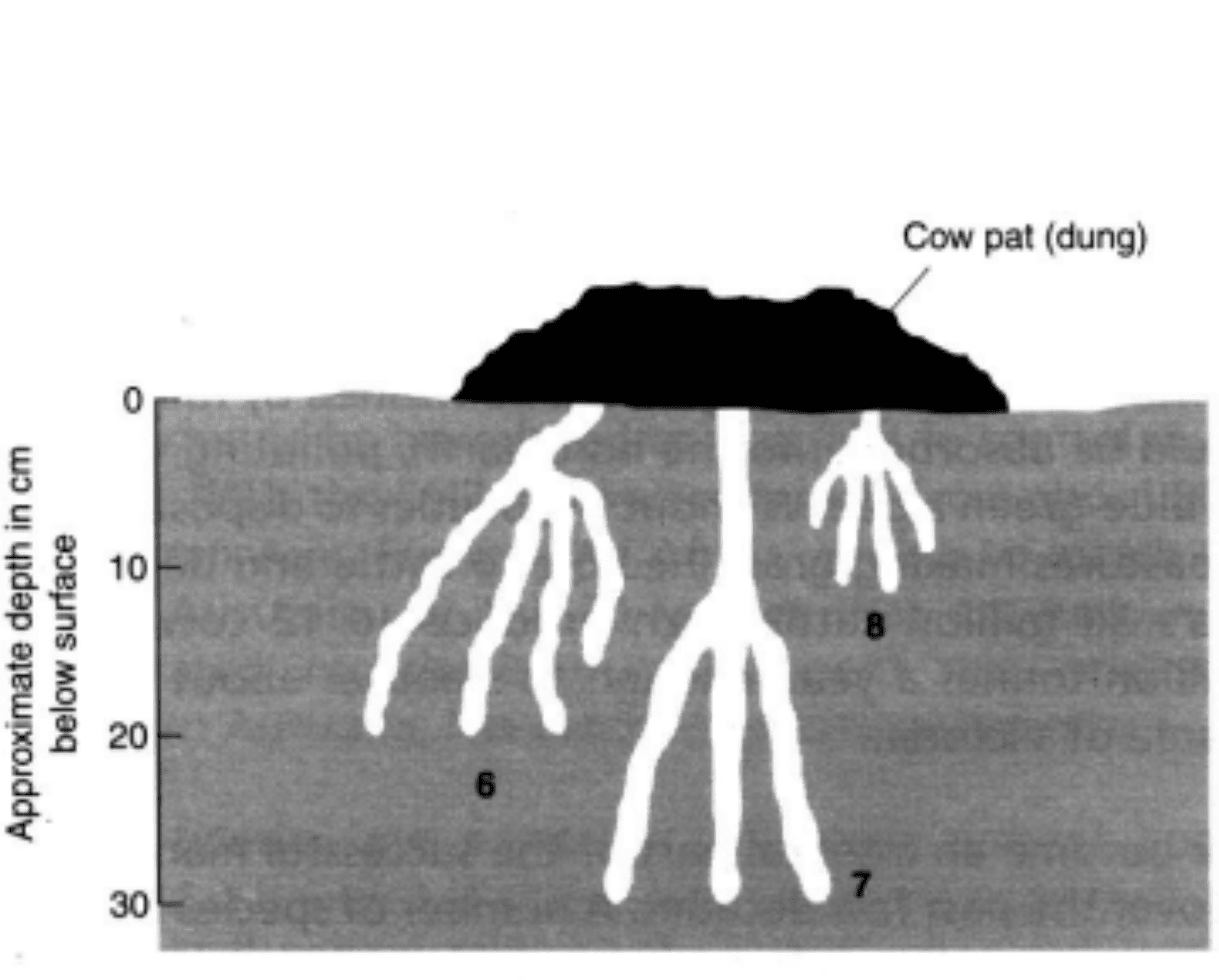
6. _____
7. _____
8. _____
| Dung Beetle Types | |
| French | Spanish |
| Mediterranean | South African |
| Australian native | South African ball roller |
Questions 9-13
Complete the table below.
Choose NO MORE THAN THREE WORDS OR A NUMBER from Reading Passage 1 for each answer.
Write your answers in boxes 9—13 on your answer sheet.
| Species | Size | Preferred Climate |
Complementary Species |
Start of Active period |
Number of generations per year |
| French | 2.5 cm | Cool | Spanish | Late spring | 1-2 |
| Spanish | 1.25 cm | 9_____ | 10____ | 11____ | |
| South African ball roller | 12_____ | 13_____ |
A Remarkable Beetle Reading Answers with Explanation
1. Not Given
Explanation: Bush flies and buffalo flies are mentioned in the second paragraph of the passage. But, the comparison between them is not made in the passage. Hence, the answer is Not Given.
2. No
Explanation: In the third paragraph, you can see the following line: “Between 1968 and 1982, the CSIRO imported insects from about 50 different species of dung beetle, from Asia, Europe and Africa, aiming to match them to different climatic zones in Australia.” In the question, it is mentioned that 4000 species of dung beetle are brought to Australia by the CSIRO. But, in the passage, only 50 different species are mentioned. Therefore, the answer is NO.
3. Yes
Explanation: In the third paragraph, “Between 1968 and 1982, the CSIRO imported insects from about 50 different species of dung beetle, from Asia, Europe and Africa, aiming to match them to different climatic zones in Australia” is mentioned. Between 1968 and 1982 means fourteen year period. It agrees with the information in the question statement. Hence, the answer is Yes.
4. Yes
Explanation: A line from the third Paragraph: “Of the 26 species that are known to have become successfully integrated into the local environment, only one, an African species released in northern Australia, has reached its natural boundary”. This line agrees with the information of the fourth question. So, the answer is Yes.
5. No
Explanation: Fourth Paragraph line: “In time they multiply and within three or four years the benefits to the pasture are obvious”. It means it takes a long time (three or four years) to improve the quality of a cow pasture. Therefore, the answer is No.
6. South African
Explanation: Fifth Paragraph line: “South African beetles dig narrow tunnels of approximately 20 cm below the surface of the pat”. This line itself justifies the answer: South African
7. French
Explanation: You can find the answer in the fifth paragraph: “Some large species originating from France excavate tunnels to a depth of approximately 30 cm below the dung pat”. Hence, the answer is, French
8. Spanish
Explanation: 5th Paragraph Line: “The shallowest tunnels belong to a much smaller Spanish species that buries dung in chambers that hang like fruit\ from the branches of a pear tree.” The Answer is Spanish.
9. Temperate
Explanation: 6th paragraph line: “…the large French species (2.5 cms long) is matched with smaller (half this size), temperate-climate Spanish species.” Answer is temperature
10. Early spring Not Spring
Explanation: A line from the sixth paragraph: “The former are slow to recover from the winter cold and produce only one or two generations of offspring from late spring until autumn. The latter, which multiply rapidly in early spring, produce two to five generations annually”. In this line, you can find the answer, early spring. Do not answer merely spring.
11. 2-5//two to five
Explanation: Again from the sixth paragraph: “The latter, which multiply rapidly in early spring, produce two to five generations annually”. The Answer is 2-5 or two-five.
12. sub-tropical
Explanation: In paragraph no. 6: “The South African ball-rolling species, being a sub-tropical beetle, prefers the climate of northern and coastal New South Wales where it commonly works with the South African tunnelling species”. Answer is sub-tropical
13. South African tunneling/tunnelling/tunneler/tunneller
Explanation: Again from paragraph 6: “The South African ball-rolling species, being a subtropical beetle, prefers the climate of northern and coastal New South Wales where it commonly works with the South African tunnelling species”. Hence, the answer is South African Tunnelling.
Also, check

About Author Arivarasi
Arivarasi is an experienced author with expertise in the study abroad industry and preparing test materials for exams like IELTS, TOEFL, GRE, SAT, PTE, etc. She stays up-to-date with university and college requirements for international students which allows her to provide guidance on course selection, documents like SOP, LOR, and scholarship opportunities. She has written numerous articles on study abroad exams, destinations, universities & colleges requirements, admission procedures, and the entire process of studying abroad. Collaborating with industry experts and counselors, she crafts informative articles that make students take the right decisions.
Kanan.co is a trusted study abroad consultancy offering comprehensive services, resources, and solutions for students and education institutions. We support students at every stage of their global education journey, ensuring a smooth and guided experience. Along with test preparation for IELTS, GRE, TOEFL, and SAT, we provide expert services such as SOP writing, visa guidance, accommodation support, scholarship assistance, and education loan support. Our expertise and commitment to excellence make us a reliable partner for students pursuing international education.
Free Online Mock Test 2026
Practice our mock test worth Rs. 25000 for Free and know your IELTS score!








Global Headquarters
Kanan Int EdTech Inc
320 Bay Street, Suite 321 (Spaces), Toronto ON, Canada M5B 1N9
Indian Headquarters
Kanan International Pvt. Ltd.
D-wing, 2nd Floor, Trident Complex, Ellora Park Vadiwadi Road, Vadodara, Gujarat 390007
IT/ Digital Campus
Kanan International Pvt. Ltd
Old, New No 3, 2nd Floor, 1A, Dr Sadasivam Rd, T. Nagar, Chennai, Tamil Nadu 600017
Our branches
- Bardoli
- Bharuch
- Chennai
- Dehradun
- Gurugram
- Himatnagar
- Karnal
- Nadiad
- Navsari
- Palanpur
- Rajkot
- Vadodara
- Valsad
- Vallabh Vidyanagar
- Vapi
Study Abroad
Test Prep
Top Universities
Consultants
IELTS Centers
GRE Centers
TOEFL Centers
SAT Centers
Language Courses in Vadodara
Study Abroad Calculators
Featured Blogs
Study Abroad Consultants in Chennai
Study Abroad Consultants in Surat
Study Abroad Consultants in Navsari
Study Abroad Consultants in Bardoli
Study Abroad Consultants in Ahmedabad
Study Abroad Consultants in Anand
Study Abroad Consultants in Khanna
Study Abroad Consultants in Nadiad
Study Abroad Consultants in Vadodara
Study abroad consultants in Valsad
Copyright © 2026 KANAN.CO All rights reserved.