- Study Abroad
- / ielts
- / a very brief history of time reading answers
A very brief history of time reading answers


Author
16-09-2025


We have provided A very brief history of time reading answers in this article. It contains 15 questions out of which 8 questions are about matching features, 4 questions are based on diagram completion and other 3 are based on summary completion question type.
Table of contents:
- Solution for A very brief history of time
- A very brief history of time IELTS Reading Practice Test
- Passage
- Questions
- Answers with Explanations
Solution for A very brief history of time
The following table comprises of A very brief history of time reading answers. You may cross-check your answers.
Answer Table
| 1. C | 5. B | 9. HEADBOARD | 13. CHEAPER |
| 2. G | 6. H | 10. WEIGHT | 14. ACCURATE |
| 3. E | 7. D | 11. PENDULUM | 15. MOVING PARTS |
| 4. F | 8. A | 12. BELLOWS |

A very brief history of time IELTS Reading Practice Test - Exam Review
Check out our YouTube Channel to Practice Full-Length IELTS Reading Tests Daily

The test takers must attempt all 15 questions to write A very brief history of time Reading Answers. You can follow the instructions in this article to comprehend how answers are cracked quickly and easily. Finding IELTS Reading solutions is a process that must be done step-by-step, and this post will assist you in doing so.
Passage
We have provided a A very brief history of time reading passage below, read it carefully and answer the questions 1-15. Make sure to check the a very brief history of time reading answers with locations.
A very brief history of time
- These days, time is everything. We worry about being late, we rush to get things done or to be somewhere and our daily schedules are often planned down to the minute. Of course, none of this would have been possible without the humble clock. The internationally accepted division of time into regular, predictable units has become an essential aspect of almost all modern societies yet the history of time keeping is almost as old as civilisation itself. Nearly 3000 years ago, societies were using the stars in order to keep track of time to indicate agricultural cycles. Then came the sundial, an Egyptian invention in which the shadow cast by the sun was used to measure the time not of the seasons but of the day.
- The first manufactured clock, believed to have come from Persia, was a system which recreated the movements of the stars. All the celestial bodies which had been used to tell the time of year were plotted unto an intricate system in which the planets rotated around each other. Not being dependent on either sunlight or a clear night, this was one of the earliest systems to divide a complete day. Although ingenious for its time, this method suffered from incorrect astrological assumptions of the period in which it was believed that the Earth was the centre of the universe.
- The Greeks were next to develop a more accurate clock using water to power a mechanism that counted out the divisions of the day. The simplest water clock consisted of a large urn that had a small hole located near the base and a graduated stick attached to a floating base. The hole would be plugged while the urn was being filled with water, and then the stick would be inserted into the urn. The stick would float perpendicular to the surface of the water, and when the hole at the base of the urn was unplugged the passage of time was measured as the stick descended farther into the urn.
- Then, for nearly one thousand years, there was little in the way of progress in time keeping until the European invention of spring-powered clocks in the late fourteenth century. Unreliable and inaccurate, the early models of these clocks were useful in that they gave direction to new advances. In 1656 Christiaan Huygens, a Dutch scientist, made the first pendulum clock, which had an error of less than one minute a day, the first time such accuracy had been achieved. His later refinements reduced his clock’s error to less than 10 seconds a day. Some years later, Huygens abandoned the pendulum for a balance wheel and spring assembly which allowed for a whole new generation of time piece – the wristwatch. Still found in some of today’s wrist watches, this improvement allowed portable seventeenth- century watches to keep time to 10 minutes a day.
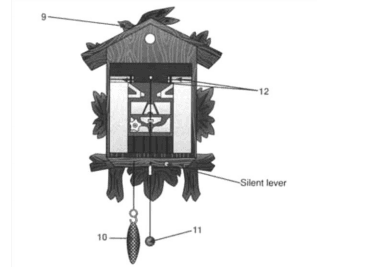
- While clock making and musical chime clocks became increasingly popular, it was the invention of the cuckoo clock, designed and made by Franz Anton Ketterer, which really caught people’s imagination. The design was not particularly complex. The clock was mounted on a headboard, normally a very elaborate carving reflecting the tastes of the artist. Many of the original cuckoo clocks are still kept today because of the artwork on the headboard. Using the traditional circular pendulum design, the clock could run accurately or up to a week, using a weight to keep the pendulum in motion. Again, the weight was often carved with a design making it as much an art form as a timepiece. The most innovative feature of these cuckoo clocks, as the name implies, is that a small carved cuckoo came out of the clock to chime the hour. Particularly ingenious was the placement of bellows inside the clock, which were designed to recreate the sound made by the bird, although later models included a lever on the bottom of the clock which could be used to stop this hourly chime.
- Refinements to this original pendulum concept meant that by 1721 the pendulum clock remained accurate to within one second per day by compensating for changes in the pendulum’s length due to temperature variations. Over the next century, further refinements reduced this to a hundredth of a second a day. In the l920s, a new era of clock making began which is still popular today – the quartz clock. When under pressure, quartz generates an electric field of relatively constant frequency, and it was discovered that this electric signal was sufficient to power a clock. Quartz crystal clocks were better because they had fewer moving parts to disturb their regular frequency. Even so, they still rely on a mechanical vibration and this depends on the size of the crystal, and as no two crystals can be exactly alike, there is a degree of difference in every quartz watch.
- Comparing performance to price, it is understandable that quartz clocks still dominate the market. Yet they are no longer the most accurate. Scientists had long realised that each chemical element in the universe absorbs and emits electromagnetic radiation at its own specific frequencies. These resonances are inherently stable, thus forming the basis for a reliable system of time measurement, all the more so because no moving parts are needed to record these resonances. Yet the cost of these atomic clocks mean that such timekeeping precision is a long way from becoming common.
Questions
Questions 1-8
Match a type of clock with a description.
1 . Quartz clock
2 . Cuckoo clock
3 . Sundial
4 . Persian clock
5 . Wristwatch
6 . Pendulum
7 . Atomic clock
8 . Water clock
A . Relied on basic scientific principles
B . was the first to replace the pendulum
C . Is the most common method of timekeeping
D . Is the most accurate clock
E . Is the earliest known method of measuring time during the day
F . Was inaccurate because of misconceptions of the age
G . Was often highly ornamental
H . Had only a 10-second margin of error per day
Questions 9-12
Label the diagram using words from the text.
Questions 13-15
Complete the following summary using NO MORE THAN TWO WORDS.
Although quartz clocks are 13 …………………., the atomic clock is the most 14 …………………… as it does not rely on any 15 ……………………………….
Answers for A very brief history of time with Explanations
The A very brief history of time answers with Explanations are given below. It will assist you in understanding the format of the reading test and will allow you to correct your errors.
(Note: We have provided the referring lines extracted from the passage in the Explanation part)
1. Answer: C
Explanation: The quartz clock, a new age in clockmaking that continues to be popular today, emerged in the 1920s. It was discovered that the electric signal generated by the pressure-generated electric field in quartz was adequate to power a clock.
2. Answer: G
Explanation: While melodic chime clocks and clockmaking gained popularity, it was Franz Anton Ketterer's creation of the cuckoo clock that captured the public's attention the most. The design wasn't all that complicated. A9The headboard, which was usually carved with great detail and reflected the artist's preferences, had the clock hung on it.
3. Answer: E
Explanation: The sundial was a creation of the Egyptians, who utilized the sun's shadow to measure the length of the day rather than the passing of the seasons.
4. Answer: F
Explanation: The first mechanical clock, which is said to have originated in Persia, was a mechanism that mimicked the motion of the stars. All of the celestial objects that had previously been utilized to determine the season were put into a complex system in which the planets revolved around one another.
5. Answer: B
Explanation: Huygens gave up the pendulum in favor of a balance wheel and spring assembly, which led to the invention of a whole new type of timepiece—the wristwatch. This advancement, which is still present in certain wristwatches today, allowed portable timepieces from the seventeenth century to accurately maintain time to 10 minutes each day.
6. Answer: H
Explanation: A Dutch scientist named Christiaan Huygens created the first pendulum clock in 1656. It had the first-ever precision of less than one minute per day. Later improvements brought the daily inaccuracy of his clock down to less than 10 seconds.
7. Answer: D
Explanation: Every chemical element in the cosmos absorbs and emits electromagnetic radiation at its own unique frequencies, as scientists have long known. Since there are no moving components required to record these resonances, their inherent stability serves as the foundation for a trustworthy method of time measurement. However, due to their high price, atomic clocks are still a long way from being widely used for accurate timekeeping.
8. Answer: A
Explanation: The next civilization to create a more precise clock was the Greeks, who used water to power a device that counted out the hours of the day.
9. Answer: HEADBOARD
Explanation: The clock was fixed to a headboard, which is often carved in an incredibly detailed manner and reflects the likes of the artist.
10. Answer: WEIGHT
Explanation: The passage's paragraph A addresses fingerprinting as a trustworthy and unfailing means of identity verification. The ability to recognize someone merely based on their fingerprints is a useful weapon in the battle against crime. As a result, the claim is untrue.
11. Answer: PENDULUM
Explanation:The clock could operate accurately for up to a week if it had a classic circular pendulum design and used a weight to keep the pendulum moving.
12. Answer: BELLOWS
Explanation: The clock could operate accurately for up to a week if it had a classic circular pendulum design and used a weight to keep the pendulum moving.
13. Answer: CHEAPER
Explanation: When performance and cost are compared, it makes sense why quartz clocks continue to rule the market.
14. Answer: ACCURATE
Explanation: Comparing performance to price, it is understandable that quartz clocks still dominate the market. Yet they are no longer the most accurate.
15. Answer: MOVING PARTS
Explanation: Every chemical element in the cosmos absorbs and emits electromagnetic radiation at its own unique frequencies, as scientists have long known. Since there are no moving components required to record these resonances, their inherent stability serves as the foundation for a trustworthy method of time measurement.
Other Reading Tests

About Author Dinesh Pandiyan
Dinesh is a highly experienced content writer who specializes in language proficiency tests like IELTS, GRE, PTE, TOEFL, and study abroad. He provides valuable insights and tips to students on various modules of these tests, including reading, writing, speaking, and listening. His articles are well-researched, informative, and engaging, offering practical guidance to students looking to succeed in their academic pursuits. Additionally, Dinesh has coordinated with IELTS trainers to prepare test preparation materials, guides, practice tests, and mock tests, and worked closely with counsellors for study abroad consultancy, providing guidance on choosing the right institution, preparing for interviews, and writing effective statements of purpose (SOP) and letters of recommendation (LOR). Students can benefit from Dinesh's comprehensive knowledge and experience by checking out his articles.
Kanan International is a study abroad consultancy that offers reliable services, products, and solutions for students and education institutions. We support students throughout their study abroad journey, ensuring a hassle-free experience. Our expertise and commitment to excellence make us the go-to partner for expanding global horizons. The company provides coaching for IELTS, GRE, TOEFL, and SAT exams and services like visa consultation, accommodation, scholarship assistance, and education loans.
Free Online Mock Test 2026
Practice our mock test worth Rs. 25000 for Free and know your IELTS score!








Global Headquarters
Kanan Int EdTech Inc
320 Bay Street, Suite 321 (Spaces), Toronto ON, Canada M5B 1N9
Indian Headquarters
Kanan International Pvt. Ltd.
D-wing, 2nd Floor, Trident Complex, Ellora Park Vadiwadi Road, Vadodara, Gujarat 390007
IT/ Digital Campus
Kanan International Pvt. Ltd
Old, New No 3, 2nd Floor, 1A, Dr Sadasivam Rd, T. Nagar, Chennai, Tamil Nadu 600017
Our branches
- Bardoli
- Bharuch
- Chennai
- Dehradun
- Gurugram
- Himatnagar
- Karnal
- Nadiad
- Navsari
- Palanpur
- Rajkot
- Vadodara
- Valsad
- Vallabh Vidyanagar
- Vapi
Study Abroad
Test Prep
Top Universities
Consultants
IELTS Centers
GRE Centers
TOEFL Centers
SAT Centers
Language Courses in Vadodara
SOP Blogs
Featured Blogs
Study Abroad Consultants in Chennai
Study Abroad Consultants in Surat
Study Abroad Consultants in Navsari
Study Abroad Consultants in Bardoli
Study Abroad Consultants in Ahmedabad
Study Abroad Consultants in Anand
Study Abroad Consultants in Khanna
Study Abroad Consultants in Nadiad
Study Abroad Consultants in Vadodara
Study abroad consultants in Valsad
Copyright © 2026 KANAN.CO All rights reserved.