- Study Abroad
- / ielts
- / answers for passage coinage in ancient greece
Coinage in Ancient Greece Reading Answers


Author
19-09-2025

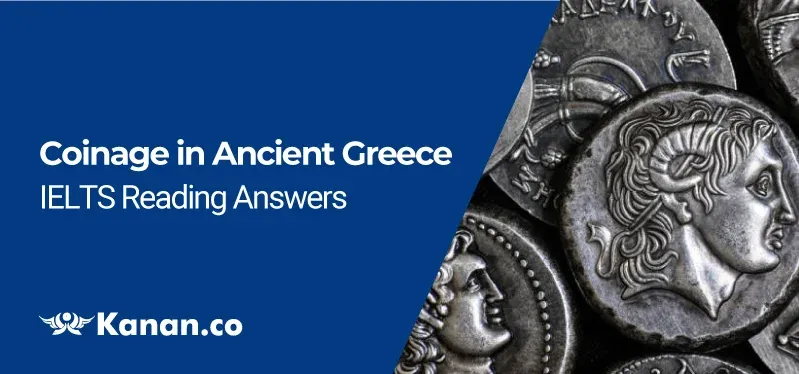
Coinage in Ancient Greece, IELTS Reading passage is given below. This passage comprises 12 questions divided into three question types - matching headings, no more than 2 words answers completion, and multiple choice questions. Ideally, you should not spend more than 20 minutes on this test. To improve your answering skills, practice Coinage in Ancient Greece reading answers given below.

Check out our YouTube Channel to Practice Full-Length IELTS Reading Tests Daily

Coinage in Ancient Greece
A. There are more than 170 official national currencies currently in circulation around the world - and while they may differ greatly in value, most show a high degree of commonality when it comes to their design. Typically, a coin or banknote will feature the effigy of a notable politician, monarch or other personality from the country of origin on one side and a recognisable state symbol (e.g. a building or an animal) on the reverse. This pattern, which has been around for more than 21 centuries, originated in ancient Greece.
B. Prior to the invention of legal tender, most transactions in the ancient world took the form of trading a product or service for another. As sea trade grew in the Mediterranean, however, the once popular barter system became hard to maintain for two reasons: firstly, because it was tricky to calculate the value of each item or service in relation to another, and secondly, because carrying large goods (such as animals) on boats to do trade with neighboring cities was difficult and inconvenient. Therefore, the need soon arose for a commonly recognised unit that would represent a set value - what is known today as a currency. As Aristotle explains in Politics, metal coins naturally became the most popular option due to the fact that they were easy to carry, and didn't run the risk of expiring. According to ancient Greek historian Herodotus, the first coins were invented in 620 BC in the town of Lydia, although some theorize that they actually originated in the city of lonia. (Coins had already existed for nearly 400 years in China, unbeknownst to Europeans.)
C. Much like with every other form of ancient Greek art, the history of ancient Greek coins can be divided into three distinct chronological periods: the Archaic (600-480 BC), the Classic (480-330 BC) and the Hellenistic Period (330-Ist century BC). As ancient Greece was not a united country like today, but rather comprised of many independent city-states known as poleis, each state produced its own coins. The island of Aegina was the first to mint silver coins, perhaps adopting the new system upon witnessing how successfully it had facilitated trade for the lonians. Aegina being the head of a confederation of seven states, it quickly influenced other city-states in the Mediterranean and the new method of trade soon became widespread. Up until approximately 510 BC, when Athens began producing its own coin, the Aegina coin - which featured a turtle on its surface - was the most predominant in the region.
D. The tetradrachm, Athens's new coin bearing the picture of an owl on its obverse as a tribute to the city's protector, the goddess Athena, brought with it a shift in the world of coinage. Prior to the tetradrachm, Athenians had been using simple iron rods known as 'obols' for currency. As the average human hand could grasp about six obols, that number soon came to represent a 'drachma' (from the Greek verb 'dratto", which means 'to grasp) - so the new tetradrachm had the same value as 24 obols. With Athens continually growing in power, the tetradrachm soon replaced the Aegina 'turtle' as the most preponderant coin in the region. It was around that time that an agreement akin to way the EU's euro currency functions also appeared, with different coins from all over the Mediterranean being made to the same standards as the Athenian coin (albeit with each city's own symbols on them) and being used interchangeably among the trading city-states.
E. Coinage soon spread beyond those city-states. Romans abandoned the bronze bars they'd been using in favor of coins around the year 300 BC, and Alexander the Great and his father King Philip of Macedonia began to produce massive quantities of coins to fund their military escapades around the same time. It was with the death of the latter, in 336 BC, that the Hellenistic Period began. Two things characterize the Hellenistic Period: the introduction of a "type" (the design that coins were stamped with) on the reverse of the coins, and mass production, which mostly took place in kingdoms beyond the Greek city-states, such as Egypt, Syria and the far east. Another new feature, which was heavily criticized by the Greeks, was the introduction of profiles of kings and other important living figures as stamps in lieu of the traditional symbols of animals and buildings. Athens, still a powerful city at the time, eschewed these designs and continued to produce its own tetradrachm coins, even introducing - a new style coin characterized by broad, thin flans - a design which became popular across the Aegean and lasted until the spread of Roman rule over Greece.
F. It's not difficult to see why ancient Greek coins continue to fascinate coin collectors and historians today. They marked the beginning of a new era in business and introduced a model of trade in Europe that is still present nowadays; they greatly influenced the design of modern coinage, with symbols such as the owl (which can be seen on the Greek version of the euro today) and portraits of important personalities; and, since they were hand-made to high technical standards representative of ancient Greek perfectionism, many are even remarkable in their own right, as tiny metal works of art.
Questions
Questions 1-6
The reading passage has six paragraphs, A-F. Choose the correct heading for paragraphs A-F from the list of headings below.
Guidelines/Tip for Answering These Types of Questions: Candidates need to read through the text and then make the suitable choice.
List of Headings
I. The beginning of the Archaic period
II. The Athenian obol replaces the turtle
III. How product exchange became insufficient
IV. Roman and Macedonian coins
V. The relevance of ancient Greek coins today
VI. New cities introduce new design rules
VII. A precursor of the modern euro
VIII. The difference between lonian and Lydian coins
IX. Modern coin designs and their origin
1. Paragraph A
2. Paragraph B
3. Paragraph C
4. Paragraph D
5. Paragraph E
6. Paragraph F
Questions 7-10
With reference to the given passage,try to answer the following questions in not more than two words
Guidelines/Tip for Answering These Types of Questions: Candidates need to understand each section of the text in detail and then answer in not more than two words.
7. What were the ancient Greek city-states commonly known as?
8. Which type did the Aegina coin use?
9. What was the value of a drachma in ancient Athens?
10. What did the Romans use prior to the introduction of coins?
Questions 11-12
Choose the correct letter, A, B, C or D from the given options according to the information in the given passage.
Guidelines/Tip for Answering These Types of Questions: Candidates need to read through the text and then choose the correct answer.
11. The Athenian Hellenistic-period tetradrachm coin
A. replaced the owl type with the profile of a king.
B. was a thin, wide metal disk.
C. remained popular under Roman rule.
D. was massively produced in Syria and Egypt.
12. Ancient Greek coins
A. are still a method of trade in Europe nowadays.
B. are remarkably different from modern coins.
C. are a fine example of ancient Greek art
D. were a tribute to the goddess Athena, protector of Athens
Answers for Coinage in Ancient Greece
1. IX
2. III
3. I
4. VII
5. VI
6. V
7. Poleis
8. Turtle
9. Six Obols
10. Bronze Bars
11. B
11. C
Other Reading Tests

About Author Tejaswini Kota
Tejaswini is an enthusiastic writer, reader and a passionate learner. Additionally, she was a research fellow and holds a grip in English writings and research/paper publications. She holds bachelors and masters degrees in engineering. She spent three years in the education industry and is currently working as a full-time content writer at Kanan International, writing articles for study abroad projects. She is proficient in creating good quality content that helps the students for language proficiency tests like IELTS, GRE, TOEFL etc. and can help in advising you the right choice of college for admission.
Kanan.co is a trusted study abroad consultancy offering comprehensive services, resources, and solutions for students and education institutions. We support students at every stage of their global education journey, ensuring a smooth and guided experience. Along with test preparation for IELTS, GRE, TOEFL, and SAT, we provide expert services such as SOP writing, visa guidance, accommodation support, scholarship assistance, and education loan support. Our expertise and commitment to excellence make us a reliable partner for students pursuing international education.
Free Online Mock Test 2026
Practice our mock test worth Rs. 25000 for Free and know your IELTS score!








Global Headquarters
Kanan Int EdTech Inc
320 Bay Street, Suite 321 (Spaces), Toronto ON, Canada M5B 1N9
Indian Headquarters
Kanan International Pvt. Ltd.
D-wing, 2nd Floor, Trident Complex, Ellora Park Vadiwadi Road, Vadodara, Gujarat 390007
IT/ Digital Campus
Kanan International Pvt. Ltd
Old, New No 3, 2nd Floor, 1A, Dr Sadasivam Rd, T. Nagar, Chennai, Tamil Nadu 600017
Our branches
- Bardoli
- Bharuch
- Chennai
- Dehradun
- Gurugram
- Himatnagar
- Karnal
- Nadiad
- Navsari
- Palanpur
- Rajkot
- Vadodara
- Valsad
- Vallabh Vidyanagar
- Vapi
Study Abroad
Test Prep
Top Universities
Consultants
IELTS Centers
GRE Centers
TOEFL Centers
SAT Centers
Language Courses in Vadodara
Study Abroad Calculators
Featured Blogs
Study Abroad Consultants in Chennai
Study Abroad Consultants in Surat
Study Abroad Consultants in Navsari
Study Abroad Consultants in Bardoli
Study Abroad Consultants in Ahmedabad
Study Abroad Consultants in Anand
Study Abroad Consultants in Khanna
Study Abroad Consultants in Nadiad
Study Abroad Consultants in Vadodara
Study abroad consultants in Valsad
Copyright © 2026 KANAN.CO All rights reserved.