- Study Abroad
- / ielts
- / bismarck a master of political and diplomatic juggling reading answers
Bismarck: A Master of Political and Diplomatic Juggling? Reading answers


Author
17-09-2025

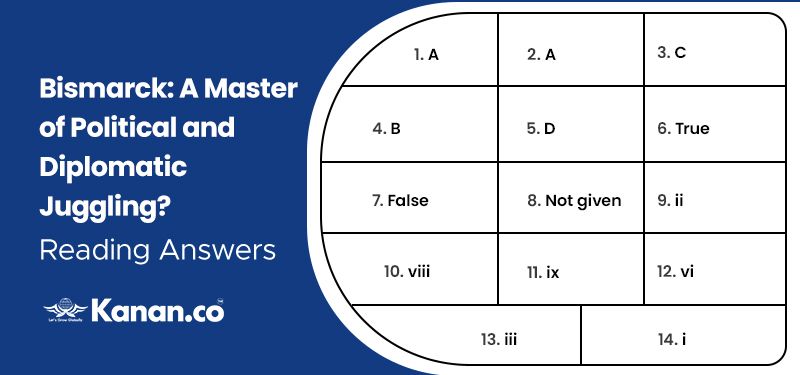
Here you can find “Bismarck: A Master of Political and Diplomatic Juggling?” reading answers along with questions, answers, and explanations. The given passage has 14 questions in 3 different types namely - 5 questions as multiple choice, 3 questions as true, false, or not given, and 6 questions as matching headings.
Check out our YouTube Channel to Practice Full-Length IELTS Reading Tests Daily

Table of contents:
- Solution for Bismarck: A Master of Political and Diplomatic Juggling?
- Bismarck: A Master of Political and Diplomatic Juggling? IELTS reading practice test
- Passage
- Questions
- Answers with explanation
Solution for Bismarck: A Master of Political and Diplomatic Juggling?
Below, we have given the answers for Bismarck: A Master of Political and Diplomatic Juggling? reading answers in table form.

Answer Table
| 1. A | 4. B | 7. False | 10. viii | 13. iii |
| 2. A | 5. D | 8. Not given | 11. ix | 14. i |
| 3. C | 6. True | 9. ii | 12. vi |
Bismarck: A Master of Political and Diplomatic Juggling? IELTS Reading Practice Test - Exam Review
We have provided Bismarck: A Master of Political and Diplomatic Juggling? IELTS reading practice test, with questions and answers. Use this article to crack your exam with band scores. Before answering the questions, go through the given passage thoroughly.
Passage
Here we have given Bismarck: A Master of Political and Diplomatic Juggling? Reading answers with location. Read the given passage and start answering your questions.
A Master of Political and Diplomatic Juggling? Reading answers
- Otto Von Bismarck’s rise up the political ladder was swift and relentless. Having entered parliament in 1847, he always harboured lofty ambitions, chief among them perhaps being the reunification of Germany into one strong, centrally controlled state, though his own personal thirst for power was arguably even stronger. On becoming Prussian Chancellor, he set about fulfilling his ambitions and in doing so proved himself to be a diplomat of some considerable skill. Victory in the Austro-Prussian war effectively ended Austria as a factor in German affairs. His political and military juggling was taken a step further when he orchestrated a situation where France declared war on Germany in 1.870, making the French seem responsible for a conflict he had always intended to create. And following another swift military triumph, this time over the French, the German empire was proclaimed in January 1871.
- In little more than nine years, Bismarck realised his lifelong ambition, steering Germany to reunification. And by defeating Austria and France in quick succession, he also created a power vacuum on mainland Europe which he was determined to fulfill himself. This was another opportunity for Bismarck to demonstrate his political and diplomatic cunning. He set about creating a dictatorial Germany in which he, as head of the Prussian parliament, would automatically become chancellor of the German empire. He drafted a new German constitution to suit his own purposes and, despite maintaining a veneer of democracy, the German parliament was effectively powerless to oppose him. Provinces that were slow to support him were enticed with bribes and before long the German empire was his to command.
- It is testament to his political skill that Bismarck achieved so much so quickly. At this point in his colourful political career he did appear, for all intents and purposes, a master of political and diplomatic juggling. But challenges lay ahead and Bismarck’s next target was the Catholic church, which he deemed too powerful and a threat to his political dominance. He proceeded to enact a series of laws which seriously eroded the power of the church. However, his plans backfired and Bismarck was forced to make a political U-turn. Though here again, he somehow managed to save face. The damage to his reputation was limited and indeed by the late 1870s he had even managed to win over the church whose support he now needed.
- Bismarck viewed the growing popularity of the Socialist Democratic Party as a serious threat. He bided his time and used the attempted assassination of the Kaiser as an excuse to attack the socialists in 1878, blaming them for the attempt on the Kaiser’s life. He immediately arrested the leaders, banned party meetings and suppressed socialist newspapers. But despite his efforts to destroy the socialist movement, its popularity had trebled by 1890. Just as his interventions with the church had not gone as planned, Bismarck once again failed to achieve his objective; though, to his credit, he held on to power.
- His domestic position was relatively secure after 1871, Bismarck devoted a lot of his time to foreign policy. Having used war to unite Germany and make her great, Bismarck now believed that his ambitions were best served by peace. His plan to isolate a hostile France would require all his considerable diplomatic skills. The Dreikaiserbund agreement of 1873 between Germany, Austria-Hungary and Russia was a first step towards doing just that. The Balkan crisis, a conflict involving Russia and Austria-Hungary, severely tested his diplomatic credentials, but his answer was to offer himself as an ‘honest broker’ to help resolve the dispute. The subsequent Congress of Berlin which he hosted was an outstanding success and only served to reinforce Bismarck’s reputation as a shrewd diplomat. Bismarck’s foreign policy would continue in this vein throughout his reign as Chancellor. He built up strategic alliances with the big powers, Russia, Italy and Austria-Hungary, in the hope that he could keep his main threats, France and Britain, isolated.
- In truth, Bismarck’s reign as chancellor of the German empire does seem to confirm him as a shrewd and wily diplomat and politician, one whose objectives were broadly achieved. Does this mean his so-called juggling was a success? Perhaps, but Bismarck left a less than perfect legacy. He created a Germany in which the Kaiser had the ultimate say in domestic affairs and enjoyed far too much power should he choose to wield it. This meant that the future of the empire largely depended on the strength and character of just one man, the Kaiser. A weak Kaiser would be disastrous for the country’s welfare, and so it would soon prove. In the final analysts, Bismarck put Germany back on the map again as a great power during his reign, but we should not forget that he created the political situation that would be the downfall of his country in the end. His political and diplomatic juggling, therefore, simply cannot be considered a total success.
Questions
Questions 1-5
- Choose the correct answer A,B, C or D
1. In little more than nine years as Prussian Chancellor Bismarck had
- succeeded in reuniting Germany and defeating Austria and France.
- divided his country and lost two wars.
- succeeded in suppressing the Socialist party.
- abolished the parliament.
2. What happened after Bismarck enacted laws to weaken the Catholic church?
- He changed his policy and made the church an ally.
- The church’s influence weakened.
- France declared war on Germany.
- He didn’t succeed and his influence was severely weakened.
3. What had happened to the Socialist party by 1890?
- It had taken power from Bismarck.
- It had lost its influence.
- Its popularity had risen three-fold.
- It became very powerful in parliament.
4. After reuniting Germany what was Bismarck’s belief on foreign policy?
- He needed to wage war with all countries that posed a military threat.
- Preserving the peace and isolating France would benefit him.
- Germany needed to befriend France to form a powerful alliance.
- He wanted to form an alliance with Britain and France.
5. The article concludes that Bismarck
- Made a few mistakes and left a positive legacy.
- Was not at all successful.
- Was always tolerant of those who had different opinions.
- Was not actually a master of political juggling.
Questions 6 -8
- Do the following statements agree with the information given in the reading passage?
- In boxes 6-8 on your answer sheet, write
- True if the statement agrees with the information
- False if the statement contradicts the information
- Not given if there is no information on this
6. The Congress of Berlin was a great personal success for Bismarck.
7. Bismarck refused to build alliances with Russia or Austria.
8. Bismarck considered his reign as German chancellor a failure.
Questions 9 – 13
- Reading passage has six paragraphs A-F
- Choose the correct heading i-ix, from the list of headings below.
- Write the correct number, i-ix, in boxes 9-13 on your answer sheet.
9. Paragraph A
10. Paragraph B
11. Paragraph C
12. Paragraph D
13. Paragraph E
14. Paragraph F
List of Headings
i A critical analysis
ii Early career and rise to power
iii Foreign policy
iv Powerful friends
v Separating church and state
vi Socialist threat
vii Political decline
viii Creating a virtual dictatorship
ix A change of mind
Answers for Bismarck: A Master of Political and Diplomatic Juggling? With Explanation
In this section we have given the answers for “Bismarck: A Master of Political and Diplomatic Juggling? Reading answers with explanation”. Use this portion to correct your errors while answering.
1. Answer: A
Explanation: “In little more than nine years, Bismarck realised his lifelong ambition, steering Germany to reunification. And by defeating Austria and France in quick succession, he also created a power vacuum on mainland Europe which he was determined to fulfill himself. This was another opportunity for Bismarck to demonstrate his political and diplomatic cunning”. With this line it is clear that in little more than nine years as Prussian Chancellor Bismarck had succeeded in reuniting Germany and defeating Austria and France. Hence the given answer is located in the first 5 lines of paragraph B.
2. Answer: A
Explanation: “But challenges lay ahead and Bismarck’s next target was the Catholic church, which he deemed too powerful and a threat to his political dominance. He proceeded to enact a series of laws which seriously eroded the power of the church”. With this line it is clear that after Bismarck enacted laws to weaken the Catholic church he changed his policy and made the church an ally. Hence the given answer is located in the 3-6 lines of paragraph C.
3. Answer: C
Explanation: “But despite his efforts to destroy the socialist movement, its popularity had trebled by 1890. Just as his interventions with the church had not gone as planned, Bismarck once again failed to achieve his objective; though, to his credit, he held on to power”. With this line it is clear that Its popularity had risen three-fold . Hence the given answer is located in the last 3 lines of paragraph D.
4. Answer: B
Explanation: “Having used war to unite Germany and make her great, Bismarck now believed that his ambitions were best served by peace. His plan to isolate a hostile France would require all his considerable diplomatic skills”. With this line it is clear that after reuniting Germany Bismarck's belief on foreign policy that preserving the peace and isolating France would benefit him. Hence the given answer is located in the 2-4 lines of paragraph E.
5. Answer: D
Explanation: “His political and diplomatic juggling, therefore, simply cannot be considered a total success”. With this line it is clear that the article concludes that Bismarck Was not actually a master of political juggling. Hence the given answer is located in the last 2 lines of paragraph F.
6. Answer: True
Explanation: “The subsequent Congress of Berlin which he hosted was an outstanding success and only served to reinforce Bismarck’s reputation as a shrewd diplomat”. With this line it is clear that the Congress of Berlin was a great personal success for Bismarck. Hence the given answer is located in the 9-11 lines of paragraph E.
7. Answer: False
Explanation: “He built up strategic alliances with the big powers, Russia, Italy and Austria-Hungary, in the hope that he could keep his main threats, France and Britain, isolated”. With this line it is clear that he built up a strategic alliance with the big powers, Russia, Italy and Austria-Hungary. Hence the given answer is located in the last 3 lines of paragraph E.
8. Answer: Not given
9. Answer: ii
Explanation: “Having entered parliament in 1847, he always harboured lofty ambitions, chief among them perhaps being the reunification of Germany into one strong, centrally controlled state, though his own personal thirst for power was arguably even stronger. On becoming Prussian Chancellor, he set about fulfilling his ambitions and in doing so proved himself to be a diplomat of some considerable skill. Victory in the Austro-Prussian war effectively ended Austria as a factor in German affairs. His political and military juggling was taken a step further when he orchestrated a situation where France declared war on Germany in 1.870, making the French seem responsible for a conflict he had always intended to create”. Hence the given answer is located in paragraph A and this paragraph states about Bismarck’s participation in parliament and what made him come to power.
10. Answer: viii
Explanation: “He set about creating a dictatorial Germany in which he, as head of the Prussian parliament, would automatically become chancellor of the German empire”. Hence the given answer is located in the 5-7 lines of paragraph B and this paragraph states about Bismarck who reunited and defeated many countries to create his own veneer of democracy that is a dictatorial Germany.
11. Answer: ix
Explanation: “However, his plans backfired and Bismarck was forced to make a political U-turn. Though here again, he somehow managed to save face. The damage to his reputation was limited and indeed by the late 1870s he had even managed to win over the church whose support he now needed”. Hence the given answer is located in the last 4 lines of paragraph C and this paragraph states about Bismarck’s plan to erode the power of the church and what change he made.
12. Answer: vi
Explanation: “Bismarck viewed the growing popularity of the Socialist Democratic Party as a serious threat”. Hence the given answer is located in the first 2 lines of paragraph D. and this paragraph states that the socialist Democratic Party was seen as a serious threat.
13. Answer: iii
Explanation: “Bismarck devoted a lot of his time to foreign policy”. and “He built up strategic alliances with the big powers, Russia, Italy and Austria-Hungary, in the hope that he could keep his main threats, France and Britain, isolated”. Hence the given answer is located in the first 2 lines and last 3 lines of paragraph E and this paragraph states foreign policy hence the answer is iii.
14. Answer: i
Explanation: “His political and diplomatic juggling, therefore, simply cannot be considered a total success”. With this line it is clear that paragraph F states about the political and diplomatic juggling of Bismarck cannot be considered as a total success. Hence the given answer is located in the last 2 lines of paragraph F.
Other reading answers

About Author Roshan Sunthar
Roshan Sunthar is a study abroad expert as well as a renowned writer and author in international education. His academic excellence and 5+ years of work experience give him in-depth knowledge of international standardised exams and test preparation in IELTS, TOEFL, GRE, PTE, SAT, etc. The study materials he prepares incorporate exam-like questions. He’s also an expert in writing Statement of Purposes (SOPs) and Letter of Recommendations (LORs) for college admissions. He usually spends his leisure time watching English classics and documentaries, travelling, etc.
Kanan.co is a trusted study abroad consultancy offering comprehensive services, resources, and solutions for students and education institutions. We support students at every stage of their global education journey, ensuring a smooth and guided experience. Along with test preparation for IELTS, GRE, TOEFL, and SAT, we provide expert services such as SOP writing, visa guidance, accommodation support, scholarship assistance, and education loan support. Our expertise and commitment to excellence make us a reliable partner for students pursuing international education.
Free Online Mock Test 2026
Practice our mock test worth Rs. 25000 for Free and know your IELTS score!








Global Headquarters
Kanan Int EdTech Inc
320 Bay Street, Suite 321 (Spaces), Toronto ON, Canada M5B 1N9
Indian Headquarters
Kanan International Pvt. Ltd.
D-wing, 2nd Floor, Trident Complex, Ellora Park Vadiwadi Road, Vadodara, Gujarat 390007
IT/ Digital Campus
Kanan International Pvt. Ltd
Old, New No 3, 2nd Floor, 1A, Dr Sadasivam Rd, T. Nagar, Chennai, Tamil Nadu 600017
Our branches
- Bardoli
- Bharuch
- Chennai
- Dehradun
- Gurugram
- Himatnagar
- Karnal
- Nadiad
- Navsari
- Palanpur
- Rajkot
- Vadodara
- Valsad
- Vallabh Vidyanagar
- Vapi
Study Abroad
Test Prep
Top Universities
Consultants
IELTS Centers
GRE Centers
TOEFL Centers
SAT Centers
Language Courses in Vadodara
Study Abroad Calculators
Featured Blogs
Study Abroad Consultants in Chennai
Study Abroad Consultants in Surat
Study Abroad Consultants in Navsari
Study Abroad Consultants in Bardoli
Study Abroad Consultants in Ahmedabad
Study Abroad Consultants in Anand
Study Abroad Consultants in Khanna
Study Abroad Consultants in Nadiad
Study Abroad Consultants in Vadodara
Study abroad consultants in Valsad
Copyright © 2026 KANAN.CO All rights reserved.