- Study Abroad
- / ielts
- / brand loyalty runs deep reading answers
Brand Loyalty runs deep Reading Answers


Author
19-09-2025


Brand Loyalty runs deep Reading Answers practice test and answers with explanations are given here for your knowledge. The academic reading passage has eight paragraphs along with 13 questions. The questions are divided into three categories: multiple-choice form, locating information, and matching features form.
Table of contents:
- Solution for Brand Loyalty runs deep Reading Answers
- Brand Loyalty runs deep Reading Answers IELTS Reading Practice Test
- Passage
- Questions
- Answers with Explanations
Solution for Brand Loyalty runs deep Reading Answers
For your reference, we have given the Brand Loyalty runs deep Reading Answers in the table below.
Answer Table
| D | 18. D | 22. B | 26. C |
| A | 19. B | 23. A | |
| B | 20. C | 24. A | 1 |
| D | 21. C | 25. C |

Brand Loyalty runs deep IELTS Reading Practice Test - Exam Review
Check out our YouTube Channel to Practice Full-Length IELTS Reading Tests Daily

Brand Loyalty runs deep Reading Answers are given here for your knowledge, and it will help you improve your critical thinking and time management skills. To solve the questions easily, highlight the keywords and important details provided in the passage. You can easily excel in your IELTS reading module with necessary tips and tricks.
Passage
We have given the Brand Loyalty runs deep Reading reading passage. Read the passage and answer all the questions (14-26). Check your answers with Brand Loyalty runs deep Reading Answers with location.
Brand Loyalty runs deep
- At almost any supermarket in Sydney, Australia, food from all over the world fills the shelves. Perhaps you fancy some Tick Tock Rooibos tea made in South Africa or Maharaja’s Choice Rogan Josh sauce from India. Alongside local Foster’s beer, Chinese Tsingtao and Indonesian Bintang are both to be found. For homesick Britons, the confectionary aisle is stocked with Mars Bars and Bountys, while for pining Poles sweets manufactured by firms like Wawel or Solidarposc are available. Restaurants in Sydney range from Afghan to Zambian, catering to different ethnic groups as well as the rest of the curious general public.
- All of this variety results from population movement and changes in global trade, and, to a lesser extent, reduced production and transportation costs. While Australia can claim around 40% of its population as the first generation, other countries, like Switzerland, may have fewer international migrants, but still, have people who move from city to city in search of work. Even since the 1990s, taxes or tariffs on imported goods have decreased dramatically. The World Trade Organisation, for example, has promulgated the idea of zero tariffs, which has been adopted into legislation by many member states. It is estimated that within a century, agriculture worldwide has increased its efficiency five-fold. Faster and better-integrated road and rail services, containerization, and the ubiquitous airplane have sped up transport immeasurably.
- Even with this rise in the availability of non-local products, recent studies suggest that supermarkets should do more to increase their number to match more closely the proportion of shoppers from those countries or regions. Thus, if 10% of a supermarket’s customers originate in Vietnam, there ought to be 10% of Vietnamese products in the store. If Americans from southern states dominate in one northern neighborhood, southern brands should also be conspicuous. Admittedly, there are already specialist shops that cater to minority groups, but minorities do frequent supermarkets.
- Two separate studies by Americans Bart Bronnenberg and David Atkin have found that brand loyalty (choosing Maharaja’s Choice over Patak’s, or Cadbury’s over Nestlé) is not only determined by advertising but also by a consumer’s past. If a product is featured in a person’s early life in one place, then, as a migrant, he or she is likely to buy that same product even though it is more expensive than an otherwise identical locally-produced one.
- In the US context, between 2006 and 2008, Bronnenberg analyzed data from 38,000 families who had bought 238 different kinds of packaged goods. Although the same brands could be found across America, there were clear differences in what people purchased. In general, there were two leading brands in each kind of packaged good, but there were smaller brands that assumed a greater proportion of consumers’ purchases than was statistically likely. One explanation for this is that 16% of people surveyed came from interstate, and these people preferred products from their home states. Over time, they did buy more products from their adopted state, but, surprisingly, it took two decades for their brand loyalty to halve. Even people who had moved interstate 50 years previously maintained a preference for home-state brands. It seems the habits of food buying change more slowly than we think.
- Bronnenberg’s findings were confirmed by Atkin’s in India although there was something more unexpected that Atkin discovered. Firstly, during the period of his survey, the cost of all consumables rose considerably in India. As a result, families reduced their spending on food, and their calorific intake fell accordingly. It is also worth noting that although India is one country, states impose tariffs or taxes on products from other Indian states, ensuring that locally-produced goods remain cheaper. As in the US, internal migrants bought food from their native place even when it was considerably more expensive than local alternatives, and at a time when you might expect families to be economizing. This element made the brand-loyalty theory even more convincing.
- There is one downside to these findings. In relatively closed economies, such as India’s, people develop tastes that they take with them wherever they go; in a more globalized economy, such as America’s, what people eat may be more varied, but still dependent on early exposure to brands. Therefore, according to both researchers, more advertising may now be directed at minors since brand loyalty is established in childhood and lasts a lifetime. In a media-driven world where children are already bombarded with information, their parents may not consider it appropriate yet more advertising is hardly welcome.
- For supermarkets, this means that wherever there are large communities of expatriates or immigrants, it is essential to calculate the demographics carefully in order to supply those shoppers with their favorite brands as in light of Atkin and Bronnenberg’s research, advertising and price are not the sole motivating factors for purchase as was previously thought.
Questions
Questions 14-18
Choose the correct letter: A, B, C, or D.
Write the correct letter in boxes 14-18 on your answer sheet.
14. In this article, the writer refers to food products that are sold
- at markets
- Wholesale
- online
- retail
15. In Sydney, shoppers can buy beer from
- China and Indonesia
- India and South Africa
- Poland
- Vietnam
16. The greater variety of goods and brands now available is mainly due to
- cheaper production and more migration
- changes in migration and international trade
- cheaper production and transport
- changes in migration and transport
17. The writer thinks supermarkets ………… should change their products slightly.
- in Australia
- in India and the US
- in Switzerland
- worldwide
18. The writer suggests that
- the quality of products at specialist shops will always be better than at supermarkets
- specialist shops will close down because supermarkets will be cheaper
- specialist shops already supply minority groups, so supermarkets shouldn’t bother
- specialist shops already supply minority groups, yet supermarkets should compete with them
Question 19
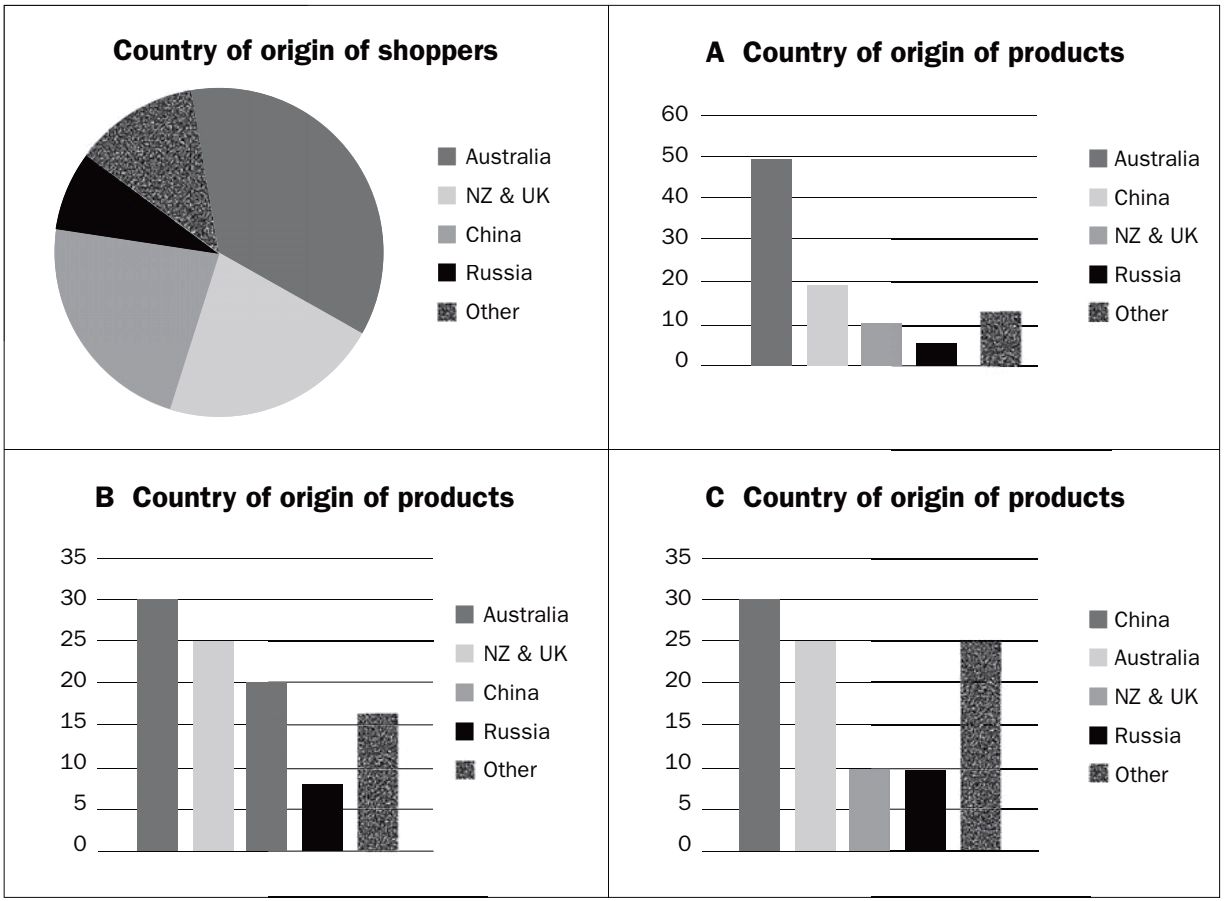
Which chart below A, B, or C, best describes the relationship between shoppers at one Sydney supermarket, and what research suggests that the same supermarket should sell?
Write your answer in box 19 on your answer sheet.
19. _____
Questions 20-26
Which study/studies do the following statements relate to?
In boxes 20-26 on your answer sheet, write
- if the information relates only to Atkin’s study
- if the information relates only to Bronnenberg’s study
- if the information relates to both Atkin’s and Bronnenberg’s studies
20. There was a correlation between brands a shopper used in childhood, and his or her
preferences as an adult.
21. One reason for the popularity of smaller brands was that many people surveyed came from another state where those brands were bigger.
22. Even living in a new state for a very long time did not mean that shoppers chose new brands.
23. In general, food became more expensive during the time of the study. Despite this, families bought their favorite brands and ate less.
24. Taxes on products from other states also increased the cost of food. This did not stop migrants from buying what they were used to.
25. Children may be the target of more food advertising now.
26. Advertising and price were once thought to be the main reasons for buying products. This theory has been modified now.
Answers for Brand Loyalty runs deep with Explanations
Brand Loyalty runs deep Reading Answers with explanations are given below for your reference.
(Note: The text in Bold mentions the location and keywords for the justification. The lines in italics show the referring lines of the passage.)
14. Answer: D
Explanation: 1st line of paragraph A tells that At almost any supermarket in Sydney, Australia, food from all over the world fills the shelves.
15. Answer: A
Explanation: 3rd line of paragraph A describes that Alongside local Foster’s beer, Chinese Tsingtao and Indonesian Bintang are both to be found.
16. Answer: B
Explanation: 1st line of paragraph B explains that All of this variety results from population movement and changes in global trade, and, to a lesser extent, reduced production and transportation costs.
17. Answer: D
Explanation: 1st line of paragraph C mentions that Even with this rise in the availability of non-local products, recent studies suggest that supermarkets should do more to increase their number to match more closely the proportion of shoppers from those countries or regions.
18. Answer: D
Explanation: The last line of paragraph C notifies that Admittedly, there are already specialist shops that cater to minority groups, but minorities do frequent supermarkets.
19. Answer: B
Explanation: Chart B shows the correct representation of the relationship between shoppers at one Sydney supermarket i.e. Australia with the leading 30%, NZ and UK with 25%, China with the third largest 20%, other countries with 17%, and Russia with the lowest of 8%.
20. Answer: C
Explanation: The whole paragraph D indicates that Two separate studies by Americans Bart Bronnenberg and David Atkin have found that brand loyalty (choosing Maharaja’s Choice over Patak’s, or Cadbury’s over Nestlé) is not only determined by advertising but also by a consumer’s past. If a product is featured in a person’s early life in one place, then, as a migrant, he or she is likely to buy that same product even though it is more expensive than an otherwise identical locally-produced one.
21. Answer: C
Explanation: 3rd, and 4th, line of paragraph E states that In general, there were two leading brands in each kind of packaged good, but there were smaller brands that assumed a greater proportion of consumers’ purchases than was statistically likely. One explanation for this is that 16% of people surveyed came from interstate, and these people preferred products from their home states.
22. Answer: B
Explanation: 6th line of paragraph E depicts that Even people who had moved interstate 50 years previously maintained a preference for home-state brands. It seems the habits of food buying change more slowly than we think.
23. Answer: A
Explanation: 1st, 2nd, and 3rd line of paragraph F justifies that Bronnenberg’s findings were confirmed by Atkin’s in India although there was something more unexpected that Atkin discovered. Firstly, during the period of his survey, the cost of all consumables rose considerably in India. As a result, families reduced their spending on food, and their calorific intake fell accordingly.
24. Answer: A
Explanation: 5th and 6th lines of paragraph F narrates that As in the US, internal migrants bought food from their native place even when it was considerably more expensive than local alternatives, and at a time when you might expect families to be economizing. This element made the brand-loyalty theory even more convincing.
25. Answer: C
Explanation: 2nd and 3rd lines of paragraph G notifies that Therefore, according to both researchers, more advertising may now be directed at minors since brand loyalty is established in childhood and lasts a lifetime. In a media-driven world where children are already bombarded with information, their parents may not consider it appropriate yet more advertising is hardly welcome.
26. Answer: C
Explanation: The whole paragraph H cites that For supermarkets, this means that wherever there are large communities of expatriates or immigrants, it is essential to calculate the demographics carefully in order to supply those shoppers with their favorite brands as in light of Atkin and Bronnenberg’s research, advertising and price are not the sole motivating factors for purchase as was previously thought.
Other Reading Tests

About Author Tejaswini Kota
Tejaswini is an enthusiastic writer, reader and a passionate learner. Additionally, she was a research fellow and holds a grip in English writings and research/paper publications. She holds bachelors and masters degrees in engineering. She spent three years in the education industry and is currently working as a full-time content writer at Kanan International, writing articles for study abroad projects. She is proficient in creating good quality content that helps the students for language proficiency tests like IELTS, GRE, TOEFL etc. and can help in advising you the right choice of college for admission.
Kanan.co is a trusted study abroad consultancy offering comprehensive services, resources, and solutions for students and education institutions. We support students at every stage of their global education journey, ensuring a smooth and guided experience. Along with test preparation for IELTS, GRE, TOEFL, and SAT, we provide expert services such as SOP writing, visa guidance, accommodation support, scholarship assistance, and education loan support. Our expertise and commitment to excellence make us a reliable partner for students pursuing international education.
Free Online Mock Test 2026
Practice our mock test worth Rs. 25000 for Free and know your IELTS score!








Global Headquarters
Kanan Int EdTech Inc
320 Bay Street, Suite 321 (Spaces), Toronto ON, Canada M5B 1N9
Indian Headquarters
Kanan International Pvt. Ltd.
D-wing, 2nd Floor, Trident Complex, Ellora Park Vadiwadi Road, Vadodara, Gujarat 390007
IT/ Digital Campus
Kanan International Pvt. Ltd
Old, New No 3, 2nd Floor, 1A, Dr Sadasivam Rd, T. Nagar, Chennai, Tamil Nadu 600017
Our branches
- Bardoli
- Bharuch
- Chennai
- Dehradun
- Gurugram
- Himatnagar
- Karnal
- Nadiad
- Navsari
- Palanpur
- Rajkot
- Vadodara
- Valsad
- Vallabh Vidyanagar
- Vapi
Study Abroad
Test Prep
Top Universities
Consultants
IELTS Centers
GRE Centers
TOEFL Centers
SAT Centers
Language Courses in Vadodara
Study Abroad Calculators
Featured Blogs
Study Abroad Consultants in Chennai
Study Abroad Consultants in Surat
Study Abroad Consultants in Navsari
Study Abroad Consultants in Bardoli
Study Abroad Consultants in Ahmedabad
Study Abroad Consultants in Anand
Study Abroad Consultants in Khanna
Study Abroad Consultants in Nadiad
Study Abroad Consultants in Vadodara
Study abroad consultants in Valsad
Copyright © 2026 KANAN.CO All rights reserved.