- Study Abroad
- / ielts
- / british universities seek quantity and quality reading answers
British Universities Seek Quantity and Quality Reading Answers


Author
17-09-2025

Here, you can find British Universities Seek Quantity and Quality reading answers as an illustration for the IELTS reading practice test along with questions, answers and explanation. This article has 13 questions in 3 different types namely- 4 questions as matching heading, 5 questions as multiple choice questions , 4 questions as multiple choice questions.
Check out our YouTube Channel to Practice Full-Length IELTS Reading Tests Daily

Table of content:
- Solution for British Universities Seek Quantity and Quality
- British Universities Seek Quantity and Quality IELTS reading practice test
- Passage
- Questions
- Answers with explanation
Solution for British Universities Seek Quantity and Quality
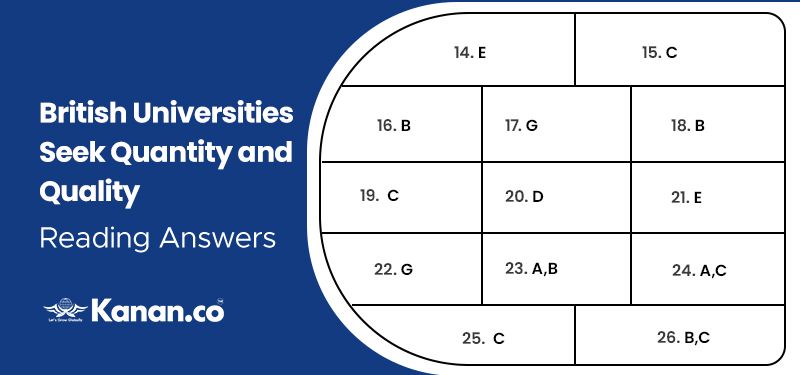
Below, we have given the answers for British Universities Seek Quantity and Quality reading answers in table form.

Answer Table
| 14. E | 17. G | 20. D | 23. A,B | 26. B,C |
| 15. C | 18. B | 21. E | 24. A,C | |
| 16. B | 19. C | 22. G | 25. C |
British Universities Seek Quantity and Quality IELTS reading practice test - Exam Review
We have given British Universities Seek Quantity and Quality IELTS reading answers, this article helps to crack your exams with band scores. Go through the given passage completely and answer the questions.
Passage
Here we have given the British Universities Seek Quantity and Quality reading answers with location. Read the entire passage and start answering your questions.
British Universities Seek Quantity and Quality Reading Answers
A. Pity the poor British professor. Once upon a time in the halcyon 1960s, his students were a privileged few, an academic elite drawn from the top four per cent of the population. New university arrivals were literate and numerate; crimes against grammar were the exception rather than the rule. According to a new comprehensive survey of British university faculty and staff, all that has changed. "They [incoming students] don't know how to write essays; they just assemble bits from the Internet," commented a disgruntled Oxford tutor. Even the cream of candidates do not necessarily know how to use an apostrophe," added another.
B. The decline in student competence parallels a dramatic increase in British university and college enrolment over the past decade, spurred in recent years by Prime Minister Tony Blair's push to get half of all young Britons a university degree. As professors and business owners alike decry the quality of university students and graduates, more than a few observers are questioning the wisdom of packing ivory towers with the masses. Students themselves may begin to question whether higher education is overvalued, with tuition rates set to rise steeply next fall.
C. British universities and colleges are teeming with almost 2.5 million young adults, a 12- fold increase of 1960s numbers, and up almost fifty per cent over the past decade alone. A report published last month for the Association of Graduate Recruiters found that almost half of the top 200 employers of university graduates were unhappy with the calibre of candidates. The recent survey, conducted by Oxford University and Universities & Colleges Admissions Service (UCAS), listed a catalogue of complaints about freshmen which had led in some cases to year long courses being deferred by a year.
D. "You are getting students going to higher education now who wouldn't have done so 20 years ago, and in some ways that's a good thing, as it widens opportunity," says Geoff Hayward, lecturer at Oxford University’s educational studies department. There were, he adds, "genuine concerns about young people and their capacity to benefit from higher education". Part of the problem, Mr. Hayward says, lies in the way teenagers are taught in school, prepped assiduously for exams at the expense of broader understanding. Despite the students' academic failings, the Oxford/UCAS survey did find they were more tech-savvy and better at oral communication than their predecessors.
E. Nevertheless, concerns about the state of Britain's university system are deepening this year as its funding faces one of its biggest shake-ups in decades. Following the lead of America, Australia, and New Zealand among others, universities will introduce a new annual £3,000 ($6,000) tuition fee for students next year - nearly triple the current fee. The charge, brought in by the government to drum up cash for a perennially under-funded sector, is expected to saddle graduates with debts of at least £12,000 ($24,000), according to the National Union of Students (NUS), making some think twice about whether to study. Already, official figures show the number of university applicants fell this year for the first time in six years, by 3.4 per cent.
F. "We've said all along that this policy will deter prospective students from going to university," says Julian Nicholds, NUS vice president for education. "About 13,000 fewer prospective students have applied this year, and that is only attributable to the threat of debt in the future." For the government, the fall in applicants is slightly awkward. Tony Blair's Labour administration has committed itself to boosting the number of young people in higher education to fifty per cent by 2010. That might prove tricky if teenagers - and their parents - are deterred by the burgeoning cost of study.
G. Alison Wolf, an expert at King's College London and author of a book called "Does Education Matter," concedes that the added fees might make students think twice but says the price increase won't turn them away. "When a degree has become as important as ours, all the evidence is that fees will not have an impact because it's still economically worthwhile to get a degree," says Ms. Wolf. Estimates suggest graduates will still earn as much as £400,000 ($800,000) more over a lifetime than non- graduates: A little debt will be worth it in the long run, she says.
H. Bill Rammell, higher education minister, says Blair's target of fifty per cent enrolment is "an economic and social necessity". He also points out that by 2012, an estimated 6.8 million graduate jobs will have been created, requiring increasing numbers of university- educated workers. "It is therefore crucial that we are able to produce sufficient numbers of highly skilled, employable graduates to fill those posts," says Mr. Rammell. "Most industrialised countries have targets to expand university numbers."
I. However, Wolf says the government's fifty per cent target is "nuts". "There is no evidence that it is important for economic growth," she contends. "Switzerland is the richest country in Europe and has one of the lowest numbers of graduates." A market based society, she says, is capable of working out what kind of workers it needs without government-mandated quotas, which may end up encouraging people to go to university who might do better pursuing vocational endeavours. "It would make more sense for society if lots of people didn't go to university for the wrong reasons," she says, "but as long as employers continue to use degrees as a filter device for screening candidates, demand for degrees will remain high."
Questions
Questions 14-17
- The text has 9 paragraphs (A -I).
- Which paragraph does each of the following headings best fit?
14.________ Higher fees
15.________ Many employers unhappy
16.________ Government’s push for numbers
17.________ Paying is worth it.
Questions 18-22
- According to the text, FIVE of the following statements are true.
- Write the corresponding letters in answer boxes 18 to 22 in any order.
A Higher education is overvalued.
B Certain students have had to postpone taking courses.
C Students nowadays are better at using technology.
D The number of university applications has declined this year.
E The government wants 50% of young people in higher education.
F Alison Wolf agrees with Julian Nicholds.
G Bill Rammell agrees with Tony Blair.
H Switzerland is following Britain’s example.
Questions 23-26
- According to the information given in the text, choose the correct answer or answers from the choices given.
23. University students nowadays are criticised for their lack of
- Mathematical ability.
- Essay writing ability.
- Criminal behaviour.
24. Geoff Hayward is concerned about
- The quality of students.
- The ability of students to communicate properly.
- There being too much focus on examinations at schools.
25. Bill Rammell points out that
- Britain doesn’t have enough graduates.
- There are 6.8 million graduates in Britain.
- Other countries want to increase the number of graduates.
26. Wolf believes
- Switzerland is better than Britain.
- Market forces should determine how many people go to university.
- Employers use degrees to shorten lists of applicants.
Answers for British Universities Seek Quantity and Quality with Explanation
In this section we have given the answers for British Universities Seek Quantity and Quality reading answers with explanation, use this portion to correct your errors while answering.
14. Answer: E
Explanation: “Universities will introduce a new annual £3,000 ($6,000) tuition fee for students next year - nearly triple the current fee”. With this line it is clear that paragraph E talks about some universities have raised their tuition fees. Hence the given answer is located in the 4-6 lines of paragraph E.
15. Answer: C
Explanation: “Almost half of the top 200 employers of university graduates were unhappy with the calibre of candidates. The recent survey, conducted by Oxford University and Universities & Colleges Admissions Service (UCAS), listed a catalogue of complaints about freshmen which had led in some cases to year long courses being deferred by a year”. With this line it is clear that lots of employers are unhappy with universities graduates. Hence the given answer is located in the last 4 lines of paragraph C.
16. Answer: B
Explanation: “The decline in student competence parallels a dramatic increase in British university and college enrolment over the past decade, spurred in recent years by Prime Minister Tony Blair's push to get half of all young Britons a university degree”. With this line it is clear that the decline in student competence, together with the increase in British university and college enrolment, which is the result of a push from Prime Minister Tony Blair. Hence the given answer is located in the first 3 lines of paragraph B.
17. Answer: G
Explanation: "When a degree has become as important as ours, all the evidence is that fees will not have an impact because it's still economically worthwhile to get a degree," says Ms. Wolf. Estimates suggest graduates will still earn as much as £400,000 ($800,000) more over a lifetime than non- graduates: A little debt will be worth it in the long run, she says”. With this line it is clear that paragraph G, states that students who have a degree earn much more than those without. Hence the given answer is located in the last 5 lines of paragraph G.
18. Answer: B
Explanation: “The recent survey, conducted by Oxford University and Universities & Colleges Admissions Service (UCAS), listed a catalogue of complaints about freshmen which had led in some cases to year long courses being deferred by a year”. With this line it is clear that some freshmen had to postpone courses due to the complaints. Hence the given answer is located in the last 3 lines of paragraph C.
19. Answer: C
Explanation: “Despite the students' academic failings, the Oxford/UCAS survey did find they were more tech-savvy and better at oral communication than their predecessors”. With this line it is clear that students are better at using new technology. Hence the given answer is located in the last 3 lines of paragraph D.
20. Answer: D
Explanation: “Already, official figures show the number of university applicants fell this year for the first time in six years, by 3.4 per cent”. With this line it is clear that the number of university applicants fell this year. Hence the given answer is located in the last 2 lines of paragraph E.
21. Answer: E
Explanation: “For the government, the fall in applicants is slightly awkward. Tony Blair's Labour administration has committed itself to boosting the number of young people in higher education to fifty per cent by 2010”. With this line it is clear that the government wants to boost the number of students in higher education to fifty per cent by 2010. Hence the given answer is located in the 4-6 lines of paragraph F.
22. Answer: G
Explanation: “Bill Rammell, higher education minister, says Blair's target of fifty per cent enrolment is "an economic and social necessity". With this line it is clear that Bill agrees with Blair’s target "an economic and social necessity". Hence the given answer is located in the first 2 lines of paragraph H.
23. Answer: A,B
Explanation: “According to a new comprehensive survey of British university faculty and staff, all that has changed. "They [incoming students] don't know how to write essays; they just assemble bits from the Internet," commented a disgruntled Oxford tutor”. With this line it is clear that University students nowadays are criticised for their lack of mathematical ability and essay writing ability. Hence the given answer is located in the 4-7 lines of paragraph A.
24. Answer: A,C
Explanation: “There were, he adds, "genuine concerns about young people and their capacity to benefit from higher education". and “prepped assiduously for exams at the expense of broader understanding. Despite the students' academic failings, the Oxford/UCAS survey did find they were more tech-savvy and better at oral communication than their predecessors”. With this line it is clear that Hayward was concerned about whether students would be about to benefit from higher education, which is their quality, and he is also concerned with the way students were taught at school, with too much focus on exams. Hence the given answer is located in the 4-5 lines and last 4 lines of paragraph D.
25. Answer: C
Explanation: “Most industrialised countries have targets to expand university numbers." With this line it is clear that Bill Rammell points out that other countries want to increase the number of graduates. Hence the given answer is located in the last line of paragraph H.
26. Answer: B,C
Explanation: “Switzerland is the richest country in Europe and has one of the lowest numbers of graduates." A market based society, she says, is capable of working out what kind of workers it needs without government-mandated quotas” and “employers continue to use degrees as a filter device for screening candidates”. With this line it is clear that Wolf believes market forces should determine how many people go to university and employers use degrees to shorten lists of applicants. Hence the given answer is located in the 2-5 lines and last 2 lines of paragraph I.
Other reading answers

About Author Manimegalai Samidurai
Manimegalai is a multifaceted professional, excelling as an author, writer, and study-abroad expert. Her vast knowledge of English proficiency exams, including IELTS, GRE, SAT, and PTE, and exceptional content writing skills make her a go-to resource for students seeking guidance and support in their foreign education journey. She is a trusted authority in writing content related to these test-prep exams, making her an invaluable resource for those seeking guidance. With her well-researched and informative blogs, articles, and study materials, Manimegalai has helped countless students achieve their desired band scores and get admissions to top-notch colleges & universities in countries like Canada, USA, UK, Australia, Ireland, etc.
Kanan.co is a trusted study abroad consultancy offering comprehensive services, resources, and solutions for students and education institutions. We support students at every stage of their global education journey, ensuring a smooth and guided experience. Along with test preparation for IELTS, GRE, TOEFL, and SAT, we provide expert services such as SOP writing, visa guidance, accommodation support, scholarship assistance, and education loan support. Our expertise and commitment to excellence make us a reliable partner for students pursuing international education.
Free Online Mock Test 2026
Practice our mock test worth Rs. 25000 for Free and know your IELTS score!








Global Headquarters
Kanan Int EdTech Inc
320 Bay Street, Suite 321 (Spaces), Toronto ON, Canada M5B 1N9
Indian Headquarters
Kanan International Pvt. Ltd.
D-wing, 2nd Floor, Trident Complex, Ellora Park Vadiwadi Road, Vadodara, Gujarat 390007
IT/ Digital Campus
Kanan International Pvt. Ltd
Old, New No 3, 2nd Floor, 1A, Dr Sadasivam Rd, T. Nagar, Chennai, Tamil Nadu 600017
Our branches
- Bardoli
- Bharuch
- Chennai
- Dehradun
- Gurugram
- Himatnagar
- Karnal
- Nadiad
- Navsari
- Palanpur
- Rajkot
- Vadodara
- Valsad
- Vallabh Vidyanagar
- Vapi
Study Abroad
Test Prep
Top Universities
Consultants
IELTS Centers
GRE Centers
TOEFL Centers
SAT Centers
Language Courses in Vadodara
SOP Blogs
Featured Blogs
Study Abroad Consultants in Chennai
Study Abroad Consultants in Surat
Study Abroad Consultants in Navsari
Study Abroad Consultants in Bardoli
Study Abroad Consultants in Ahmedabad
Study Abroad Consultants in Anand
Study Abroad Consultants in Khanna
Study Abroad Consultants in Nadiad
Study Abroad Consultants in Vadodara
Study abroad consultants in Valsad
Copyright © 2026 KANAN.CO All rights reserved.