- Study Abroad
- / ielts
- / can hurricanes be moderated or diverted reading answers
Can Hurricanes be Moderated or Diverted Reading Answers


Author
17-09-2025

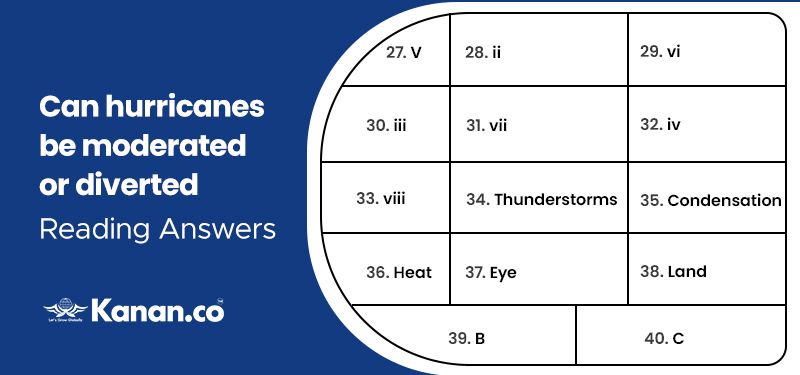
Here you can find the Can hurricanes be moderated or diverted reading answers for your IELTS practice, along with answers and explanations. It consists of 14 questions in 3 different types - 7 questions as matching headings, 5 questions as summary completions and 2 questions as multiple choice. Read through the paragraphs and answer the questions carefully.
Check out our YouTube Channel to Practice Full-Length IELTS Reading Tests Daily

Table of contents:
Solutions for can hurricanes be moderated or diverted
Here we have given Can hurricanes be moderated or diverted reading answers, in the table given below.

Answer Table
| 27. V | 30. iii | 33. viii | 36. Heat | 39. B |
| 28. ii | 31. vii | 34. Thunderstorms | 37. Eye | 40. C |
| 29. vi | 32. iv | 35. Condensation | 38. Land |
Can hurricanes be moderated or diverted IELTS reading practice test-Exam Review
In this article we have given can hurricanes be moderated or diverted IELTS reading answers as a sample article for the IELTS reading practice test. This article will help you attain a band score in your exams. Check out the given passage to answer the questions.
Passage
Here we have given can hurricanes be moderated or diverted reading answers with location, be attentive while reading the passage and answer the given questions.
Can hurricanes be moderated or diverted reading answers
A
Each year, massive swirling storms bringing along winds greater than 74 miles per hour wipe across tropical oceans and land on shorelines—usually devastating vast swaths of territory. When these roiling tempests strike densely inhabited territories, they have the power to kill thousands and cause property damage worth of billions of dollars. Besides, absolutely nothing stands in their way. But can we ever find a way to control these formidable forces of nature?
B
To see why hurricanes and other severe tropical storms may be susceptible to human intervention, a researcher must first learn about their nature and origins. Hurricanes grow in the form of thunderstorm clusters above the tropical seas. Oceans in low-latitude areas never stop giving out heat and moisture to the atmosphere, which brings about warm, wet air above the sea surface. When this kind of air rises, the water vapour in it condenses to form clouds and precipitation. Condensation gives out heat in the process the solar heat is used to evaporate the water at the ocean surface. This so-called invisible heat of condensation makes the air more buoyant, leading to it ascending higher while reinforcing itself in the feedback process. At last, the tropical depression starts to form and grow stronger, creating the familiar eye — the calm centre hub that a hurricane spins around. When reaching the land, the hurricane no longer has a continuous supply of warm water, which causes it to swiftly weaken.
C
Our current studies are inspired by my past intuition when I was learning about chaos theory 30 years ago. The reason why long-range forecasting is complicated is that the atmosphere is highly sensitive to small influences and tiny mistakes can compound fast in the weather-forecasting models. However, this sensitivity also made me realise a possibility: if we intentionally applied some slight inputs to a hurricane, we might create a strong influence that could affect the storms, either by steering them away from densely populated areas or by slowing them down. Back then, I was not able to test my ideas, but thanks to the advancement of computer simulation and remote-sensing technologies over the last 10 years, I can now renew my enthusiasm in large-scale weather control.
D
To find out whether the sensitivity of the atmospheric system could be exploited to adjust such robust atmospheric phenomena as hurricanes, our research team ran simulation experiments on computers for a hurricane named Iniki that occurred in 1992. The current forecasting technologies were far from perfect, so it took us by surprise that our first simulation turned out to be an immediate success. With the goal of altering the path of Iniki in mind, we first picked the spot where we wanted the storm to stop after six hours. Then we used this target to generate artificial observations and put these into the computer model.
E
The most significant alteration turned out to be the initial temperatures and winds. Usually, the temperature changes across the grid were only tenths of a degree, but the most noteworthy change, which was an increase of almost two degrees Celsius, took place in the lowest model layer to the west of the storm centre. The calculations produced wind-speed changes of two or three miles per hour. However, in several spots, the rates shifted by as much as 20 mph due to minor redirections of the winds close to the storm’s centre. In terms of structure, the initial and altered versions of Hurricane Iniki seemed almost the same, but the changes in critical variables were so substantial that the latter one went off the track to the west during the first six hours of the simulation and then travelled due north, leaving Kauai untouched.
F
Future earth-orbiting solar power stations, equipped with large mirrors to focus the sun’s rays and panels of photovoltaic cells to gather and send energy to the Earth, might be adapted to beam microwaves which turn to be absorbed by water vapour molecules inside or around the storm. The microwaves would cause the water molecules to vibrate and heat up the surrounding air, which then leads to the hurricane slowing down or moving in a preferred direction.
G
Simulations of hurricanes conducted on a computer have implied that by changing the precipitation, evaporation and air temperature, we could make a difference to a storm’s route or abate its winds. Intervention could be in many different forms: exquisitely targeted clouds bearing silver iodide or other rainfall-inducing elements might deprive a hurricane of the water it needs to grow and multiply from its formidable eyewall, which is the essential characteristic of a severe tropical storm.
Questions
Questions 27-30
- Reading Passage 3 has seven paragraphs, A-G.
- Choose the correct heading for each paragraph from the list of headings below.
- Write the correct number, i-viii, in boxes 27-33 on your answer sheet.
Lists of headings
i Hurricanes in history.
ii How hurricanes form.
iii How a laboratory exercise re-route a hurricane.
iv Exciting ways to utilise future technologies.
v Are hurricanes unbeatable?
vi Re-visit earlier ideas.
vii How lives might have been saved.
viii A range of low-tech methods.
27 Paragraph A
28 Paragraph B
29 Paragraph C
30 Paragraph D
31 Paragraph E
32 Paragraph F
33 Paragraph G
Questions 34-38
- Complete the summary below.
- Choose ONE WORD ONLY from the passage for each answer.
- Write your answers in boxes 34-38 on your answer sheet.
Hurricanes originate as groups of 34 _________ over the tropical oceans. Low-latitude seas continuously provide heat and moisture to the atmosphere, producing warm, humid air above the sea surface. When this air rises, the water vapour in it condenses to form clouds and precipitation. 35 _________ releases heat—the solar heat it took to evaporate the water at the ocean surface. This so-called latent 36 _________ of condensation makes the air more buoyant, causing it to ascend still higher in a self-reinforcing feedback process. Eventually, the tropical depression begins to organise and strengthen, forming the familiar 37 _________ the calm central hub around which a hurricane spins. On passing over 38 _________ the hurricane’s sustaining source of warm water is cut off, which leads to the storm’s rapid weakening.
Questions 39-40
- Choose the correct letter, A, B, C or D.
- Write the correct letter in boxes 39 and 40 on your answer sheet.
39. What encouraged the writer to restart researching hurricane control?
A The huge damage hurricane triggers
B The developments in computer technologies
C The requirement of some local people
D The chaos theory learnt as a student
40. What was the writer’s reaction after their first experiment?
A Surprised that their intervention had not achieve a lot.
B Ecstatic with the achievement the first experiment had
C Surprised that their intervention had the intended effect
D Regretful about the impending success.
Answers for Can hurricanes be moderated or diverted with explanation
We have given Can hurricanes be moderated or diverted reading answers with explanations, this will help you to identify your mistakes in the answering process.
27. Answer: V
Explanation: “They have the power to kill thousands and cause property damage worth of billions of dollars. Besides, absolutely nothing stands in their way. But can we ever find a way to control these formidable forces of nature?”. In these lines it is clear hurricanes have the power to kill thousands and cause property damage worth billions of dollars and it is unbeatable. Hence the given answer is located in the last 4 lines of paragraph A.
28. Answer: ii
Explanation: “Hurricanes grow in the form of thunderstorm clusters above the tropical seas. Oceans in low-latitude areas never stop giving out heat and moisture to the atmosphere, which brings about warm, wet air above the sea surface”. These lines explain how hurricanes form. Hence the given answer is located in the 2-5 lines of paragraph B.
29. Answer: vi
Explanation: “Our current studies are inspired by my past intuition when I was learning about chaos theory 30 years ago”. From this line it is clear the current studies are inspired with the past intuition. Hence the given answer is located in the 1-2 lines of paragraph C.
30. Answer: iii
Explanation: “To find out whether the sensitivity of the atmospheric system could be exploited to adjust such robust atmospheric phenomena as hurricanes, our research team ran simulation experiments on computers for a hurricane named Iniki that occurred in 1992”. These lines explain how laboratory exercise re-routed a hurricane. Hence the given answer is located in the 1-3 lines of paragraph D.
31. Answer: vii
Explanation: “In terms of structure, the initial and altered versions of Hurricane Iniki seemed almost the same, but the changes in critical variables were so substantial that the latter one went off the track to the west during the first six hours of the simulation and then travelled due north, leaving Kauai untouched”. These lines explain how lives have been saved. Hence the given answer is located in the last 4 lines of paragraph E.
32. Answer: iv
Explanation: “The microwaves would cause the water molecules to vibrate and heat up the surrounding air, which then leads to the hurricane slowing down or moving in a preferred direction”. These lines explain exciting ways to utilize the technologies. Hence the given answer is located in the last 3 lines of paragraph F.
33. Answer: viii
Explanation: “Simulations of hurricanes conducted on a computer have implied that by changing the precipitation, evaporation and air temperature, we could make a difference to a storm’s route or abate its winds”. These lines are from paragraph G and it explains about the range of low-tech methods. Hence the given answer is located in the first 3 lines of paragraph G.
34. Answer: thunderstorms
Explanation: “Hurricanes grow in the form of thunderstorm clusters above the tropical seas. Oceans in low-latitude areas never stop giving out heat and moisture to the atmosphere, which brings about warm, wet air above the sea surface”. From these lines it is clear that hurricanes originate in a group of thunderstorms over the tropical seas. Hence the given answer is located in the 2-5 lines of paragraph B.
35. Answer: condensations
Explanation: “Condensation gives out heat in the process the solar heat is used to evaporate the water at the ocean surface”. In this line it is clear that condensation releases heat and the solar heat is used to evaporate the water at the ocean surface. Hence the given answer is located in the 6-7 lines of paragraph B.
36. Answer: heat
Explanation: “So-called invisible heat of condensation makes the air more buoyant, leading to it ascending higher while reinforcing itself in the feedback process”. These lines proved that heat of condensation makes the air more buoyant, and it causes it to ascend higher in a self-reinforcing feedback process. Hence the given answer is located in the 8-9 lines of paragraph B.
37. Answer: eye
Explanation: “At last, the tropical depression starts to form and grow stronger, creating the familiar eye, the calm centre hub that a hurricane spins around”. These lines proved that tropical depression starts to form and grow stronger and creates the familiar eye. Hence the given answer is located in the 9-11 lines of paragraph B.
38. Answer: land
Explanation: “When reaching the land, the hurricane no longer has a continuous supply of warm water, which causes it to swiftly weaken”. From this line it is clear that the hurricane no longer has a continuous supply of warm water in the land. Hence the given answer is located in the last 2 lines of paragraph B.
39. Answer: B
Explanation: “Back then, I was not able to test my ideas, but thanks to the advancement of computer simulation and remote-sensing technologies over the last 10 years, I can now renew my enthusiasm in large-scale weather control”. From this line it is clear that computer technologies have encouraged the writer to restart researching hurricane control. Hence the given answer is located in the last 3 lines of paragraph of C.
40. Answer: C
Explanation: “The current forecasting technologies were far from perfect, so it took us by surprise that our first simulation turned out to be an immediate success”. From this line it is clear that after their first experiment that writer is surprised that their intervention had the intended effect. Hence the given answer is located in the 4-5 lines of paragraph D.
Other reading answers

About Author Arivarasi
Arivarasi is an experienced author with expertise in the study abroad industry and preparing test materials for exams like IELTS, TOEFL, GRE, SAT, PTE, etc. She stays up-to-date with university and college requirements for international students which allows her to provide guidance on course selection, documents like SOP, LOR, and scholarship opportunities. She has written numerous articles on study abroad exams, destinations, universities & colleges requirements, admission procedures, and the entire process of studying abroad. Collaborating with industry experts and counselors, she crafts informative articles that make students take the right decisions.
Kanan.co is a trusted study abroad consultancy offering comprehensive services, resources, and solutions for students and education institutions. We support students at every stage of their global education journey, ensuring a smooth and guided experience. Along with test preparation for IELTS, GRE, TOEFL, and SAT, we provide expert services such as SOP writing, visa guidance, accommodation support, scholarship assistance, and education loan support. Our expertise and commitment to excellence make us a reliable partner for students pursuing international education.
Free Online Mock Test 2026
Practice our mock test worth Rs. 25000 for Free and know your IELTS score!








Global Headquarters
Kanan Int EdTech Inc
320 Bay Street, Suite 321 (Spaces), Toronto ON, Canada M5B 1N9
Indian Headquarters
Kanan International Pvt. Ltd.
D-wing, 2nd Floor, Trident Complex, Ellora Park Vadiwadi Road, Vadodara, Gujarat 390007
IT/ Digital Campus
Kanan International Pvt. Ltd
Old, New No 3, 2nd Floor, 1A, Dr Sadasivam Rd, T. Nagar, Chennai, Tamil Nadu 600017
Our branches
- Bardoli
- Bharuch
- Chennai
- Dehradun
- Gurugram
- Himatnagar
- Karnal
- Nadiad
- Navsari
- Palanpur
- Rajkot
- Vadodara
- Valsad
- Vallabh Vidyanagar
- Vapi
Study Abroad
Test Prep
Top Universities
Consultants
IELTS Centers
GRE Centers
TOEFL Centers
SAT Centers
Language Courses in Vadodara
Study Abroad Calculators
Featured Blogs
Study Abroad Consultants in Chennai
Study Abroad Consultants in Surat
Study Abroad Consultants in Navsari
Study Abroad Consultants in Bardoli
Study Abroad Consultants in Ahmedabad
Study Abroad Consultants in Anand
Study Abroad Consultants in Khanna
Study Abroad Consultants in Nadiad
Study Abroad Consultants in Vadodara
Study abroad consultants in Valsad
Copyright © 2026 KANAN.CO All rights reserved.