- Study Abroad
- / ielts
- / daylight saving time reading answers
Daylight Saving Time Reading Answer


Author
17-09-2025

Here you can find Daylight Saving Time reading practice tests along with answers and explanations. This article contains 13 questions in 2 different types namely 6 questions as true, false or not given and 7 questions as table completion. Before answering your questions, read the given passage thoroughly.
Check out our YouTube Channel to Practice Full-Length IELTS Reading Tests Daily

Table of contents:
- Solution for Daylight Saving Time
- Daylight Saving Time IELTS practice test
- Passage
- Questions
- Answers with explanations
Solution for Daylight Saving Time
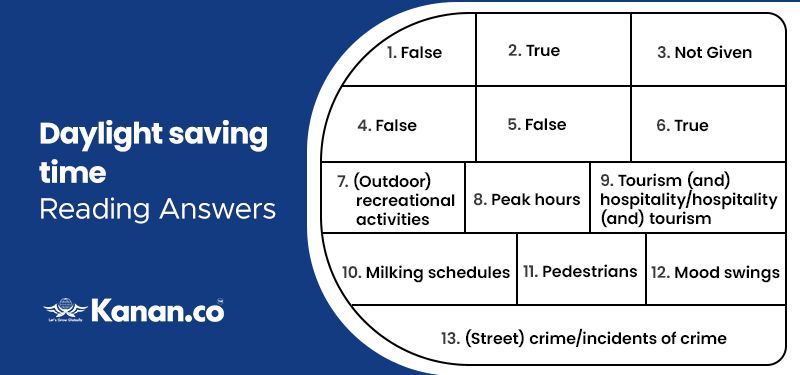
Answers for Daylight Saving Time readings answers are given below in the table form.

Answer Table
| 1. False | 4. False | 7. (Outdoor) recreational activities | 10. Milking schedules | 13. (Street) crime/incidents of crime |
| 2. True | 5. False | 8. Peak hours | 11. Pedestrians | |
| 3. Not given | 6. True | 9. Tourism (and) hospitality/hospitality (and) tourism | 12. Mood swings |
Daylight Saving Time IELTS Reading Practice Test- Exam Review
We have given the Daylight Saving Time IELTS reading answers, as a sample article for the IELTS reading practice test. We ensure that this article will definitely help you to attain a good band score in your major exams. Go through the given passage and answer the questions.
Passage
We have given Daylight Saving Time reading answers with location. Read the passage thoroughly and answer the questions.
Daylight Saving Time Reading Answers
- Each year in many countries around the world, clocks are set forward in spring and then back again in autumn in an effort to ‘save’ daylight hours. Like many modern practices, Daylight Savings Time (DST) dates back to ancient civilisations. The Romans would adjust their routines to the sun’s schedule by using different scales in their water clocks for different months of the year.
- This practice fell out of favor, however, and the concept was renewed only when, in 1784, the American inventor Benjamin Franklin wrote a jocular article for The Journal of Paris exhorting the city’s residents to make more use of daylight hours in order to reduce candle use. In 1895, in a more serious effort, New Zealand entomologist George Vernon Hudson proposed a biannual two-hour shift closely resembling current forms of DST. His cause was not taken up, however, until Germany first pushed their clocks forward in April 1916 as part of a drive to save fuel in World War I.
- Over the next several decades, global use of DST was sporadic and inconsistent. Countries such as the UK and USA adopted DST in World Wars I and II, but reverted to standard time after the wars ended. In the USA, the decision to use DST was determined by states and municipalities between 1945 and 1966, causing widespread confusion for transport and broadcasting schedules until Congress implemented the Uniform Time Act in 1966.
- Today, DST is used in some form by over 70 countries worldwide, affecting around one sixth of the world’s population. There is still no uniform standard, however. Countries such as Egypt and Russia have adjusted their policies on multiple occasions in recent years, in some instances leading to considerable turmoil. Muslim countries often suspend DST for the month of Ramadan. The European Union finally standardized DST in 2000, while the USA’s most recent adjustments were introduced with the Energy Policy Act of 2005.
- In general, the benefits of DST are considerable and well documented. Perhaps the most significant factor in terms of popular support is the chance to make better use of daylight in the evening. With extended daylight hours, office workers coming off a 9 to 5 shift can often take part in outdoor recreational activities for an hour or two. This has other positive effects, such as reducing domestic electricity consumption as more opportunities become available to use sunlight instead of artificial lighting. A further benefit is a reduction in the overall rate of automobile accidents, as DST ensures that streets are well lit at peak hours.
- Many industries are supportive of DST due to the opportunities it provides for increased revenue. Extended daylight hours mean people are more likely to stay out later in the evening and spend more money in bars and restaurants, for example, so tourism and hospitality are two sectors that stand to gain a lot from more daylight. In Queensland, Australia, which elected not to implement DST due to complaints from dairy farmers over disruption to milking schedules, the annual drain on the state’s economy is estimated to be as high as $4 billion.
- Some research casts doubt on the advantages of DST, however. Although the overall incidence of traffic accidents is lower, for pedestrians the risk of being hit by a car in the evening increases by as much as 186 per cent in the weeks after clocks are set back in autumn, possibly because drivers have not yet adjusted to earlier sunsets. Although this shift does in turn make streets safer in early mornings, the risk to pedestrians is not offset simply because fewer pedestrians use the streets at that time.
- A further health concern involves the disruption of our body clock. Setting clocks one hour forward at night can cause many people to lose sleep, resulting in tiredness and all its well-documented effects, such as mood swings, reduced productivity and problems with overall physical well-being. In 2008, a Swedish study found that heart attack rates spike in the few days following the switch to DST for summer. Tiredness may also be a factor behind the increase in road accidents in the week after DST begins.
- Finally, safety issues have arisen in parts of Latin America relating to a suspected relationship between DST and higher incidences of street crime. In 2008, Guatemala chose not to use DST because it forced office workers to leave their homes while it was still dark outside in the morning. This natural cover for criminals was thought to increase incidents of crime at this hour.
Questions
Questions 1-6
- Do the following statements agree with the information given in the reading passage?
- In boxes 1-6 on your answer sheet, write
- True if the statement agrees with the information
- False if the statement contradicts the information
- Not given if there is no information on this.
1. Daylight savings time has been in continual use since ancient times.
2. Today, DST is very similar to how George Vernon Hudson suggested it.
3. DST was not considered successful during World Wars I and II.
4. The USA finalized its DST policy in 1966.
5. Around the world, there is now general agreement on how DST should be used.
6. Frequent changes to DST over a short time span have caused problems in some countries.
Questions 7-13
- Complete the table below.
- Choose no more than three words from the passage for each answer.
- Write your answers in boxes 7-13 on your answer sheet.
Advantages and disadvantages of Daylight Saving Time
| Advantages | Disadvantages |
|
|
Answers for with Daylight Saving Time explanation
In this section we have given Daylight Saving Time reading answers with explanations, this section will help you to identify your errors in the answering process.
1. Answer: False
Explanation: “Daylight Savings Time (DST) dates back to ancient civilisations. The Romans would adjust their routines to the sun’s schedule by using different scales in their water clocks for different months of the year”. With this line it is clear that DST dates back to ancient civilisations. Hence the given answer is located in the last 3 lines of paragraph 1.
2. Answer: True
Explanation: “New Zealand entomologist George Vernon Hudson proposed a biannual two-hour shift closely resembling current forms of DST”. With this line it is clear that it is proved that today DST is very similar to George Vernon Hudson. Hence the given answer is located in the 4-6 lines of paragraph 2.
3. Answer: Not given
4. Answer: False
Explanation: “Over the next several decades, global use of DST was sporadic and inconsistent. Countries such as the UK and USA adopted DST in World Wars I and II, but reverted to standard time after the wars ended. In the USA, the decision to use DST was determined by states and municipalities between 1945 and 1966, causing widespread confusion for transport and broadcasting schedules until Congress implemented the Uniform Time Act in 1966”. With this line it is clear that the USA finalized its DST policy in 1966. Hence the given answer is located in paragraph 3.
5. Answer: False
Explanation: “In the USA, the decision to use DST was determined by states and municipalities between 1945 and 1966, causing widespread confusion for transport and broadcasting schedules until Congress implemented the Uniform Time Act in 1966”. With this line it is clear that the decision to use DST in the USA was determined by states and municipalities between 1945 and 1966, causing confusion for transport and broadcasting schedules. Hence the given answer is located in the last 4 lines of paragraph 3.
6. Answer: True
Explanation: “Today, DST is used in some form by over 70 countries worldwide, affecting around one sixth of the world’s population. There is still no uniform standard, however. Countries such as Egypt and Russia have adjusted their policies on multiple occasions in recent years, in some instances leading to considerable turmoil”. With this line it is clear that frequent changes to DST over a short time span have caused problems in some countries. Hence the given answer is located in the 1-5 lines of paragraph 4.
7. Answer: (Outdoor) recreational activities
Explanation: “With extended daylight hours, office workers coming off a 9 to 5 shift can often take part in outdoor recreational activities for an hour or two”. With this line it is clear that extended daylight hours allows 9-5 shift working workers to engage in outdoor activities. Hence the given answer is located in the 3-5 lines of paragraph 5.
8. Answer: Peak hours
Explanation: “A further benefit is a reduction in the overall rate of automobile accidents, as DST ensures that streets are well lit at peak hours”. With this line it is clear that better lightning during peak hours leads to fewer car crashes following the spring change to DST. Hence the given answer is located in the last 2 lines of paragraph 5.
9. Answer: Tourism (and) hospitality/hospitality (and) tourism
Explanation: “Many industries are supportive of DST due to the opportunities it provides for increased revenue. Extended daylight hours mean people are more likely to stay out later in the evening and spend more money in bars and restaurants, for example, so tourism and hospitality are two sectors that stand to gain a lot from more daylight”. With this line it is clear that some industries like tourism and hospitality earn more money with DST. Hence the given answer is located in the 1-4 lines of paragraph 6.
10. Answer: Milking schedules
Explanation: “In Queensland, Australia, which elected not to implement DST due to complaints from dairy farmers over disruption to milking schedules, the annual drain on the state’s economy is estimated to be as high as $4 billion”.with this line it is clear that dairy farmers find the DST upsets their milking schedules. Hence the given answer is located in the last 3 lines of paragraph 6.
11. Answer: Pedestrians
Explanation: “Although this shift does in turn make streets safer in early mornings, the risk to pedestrians is not offset simply because fewer pedestrians use the streets at that time”. With this line it is clear that it is more dangerous for pedestrians following re-setting of clocks in autumn. Hence the given answer is located in the last 3 lines of paragraph 7.
12. Answer: Mood swings
Explanation: “A further health concern involves the disruption of our body clock. Setting clocks one hour forward at night can cause many people to lose sleep, resulting in tiredness and all its well-documented effects, such as mood swings, reduced productivity and problems with overall physical well-being”. With this line it is clear that loss of sleep can lead to mood swings, inferior performance at work and poorer general health because of fatigue. Hence the given answer is located in the 1-4 lines of paragraph 8.
13. Answer: (Street) crime/incidents of crime
Explanation: “Finally, safety issues have arisen in parts of Latin America relating to a suspected relationship between DST and higher incidences of street crime. In 2008, Guatemala chose not to use DST because it forced office workers to leave their homes while it was still dark outside in the morning. This natural cover for criminals was thought to increase incidents of crime at this hour”. With this line it is clear that darker mornings may lead to more street crime. Hence the given answer is located in paragraph 9.
Other reading answers

About Author Manimegalai Samidurai
Manimegalai is a multifaceted professional, excelling as an author, writer, and study-abroad expert. Her vast knowledge of English proficiency exams, including IELTS, GRE, SAT, and PTE, and exceptional content writing skills make her a go-to resource for students seeking guidance and support in their foreign education journey. She is a trusted authority in writing content related to these test-prep exams, making her an invaluable resource for those seeking guidance. With her well-researched and informative blogs, articles, and study materials, Manimegalai has helped countless students achieve their desired band scores and get admissions to top-notch colleges & universities in countries like Canada, USA, UK, Australia, Ireland, etc.
Kanan.co is a trusted study abroad consultancy offering comprehensive services, resources, and solutions for students and education institutions. We support students at every stage of their global education journey, ensuring a smooth and guided experience. Along with test preparation for IELTS, GRE, TOEFL, and SAT, we provide expert services such as SOP writing, visa guidance, accommodation support, scholarship assistance, and education loan support. Our expertise and commitment to excellence make us a reliable partner for students pursuing international education.
Free Online Mock Test 2026
Practice our mock test worth Rs. 25000 for Free and know your IELTS score!








Global Headquarters
Kanan Int EdTech Inc
320 Bay Street, Suite 321 (Spaces), Toronto ON, Canada M5B 1N9
Indian Headquarters
Kanan International Pvt. Ltd.
D-wing, 2nd Floor, Trident Complex, Ellora Park Vadiwadi Road, Vadodara, Gujarat 390007
IT/ Digital Campus
Kanan International Pvt. Ltd
Old, New No 3, 2nd Floor, 1A, Dr Sadasivam Rd, T. Nagar, Chennai, Tamil Nadu 600017
Our branches
- Bardoli
- Bharuch
- Chennai
- Dehradun
- Gurugram
- Himatnagar
- Karnal
- Nadiad
- Navsari
- Palanpur
- Rajkot
- Vadodara
- Valsad
- Vallabh Vidyanagar
- Vapi
Study Abroad
Test Prep
Top Universities
Consultants
IELTS Centers
GRE Centers
TOEFL Centers
SAT Centers
Language Courses in Vadodara
Study Abroad Calculators
Featured Blogs
Study Abroad Consultants in Chennai
Study Abroad Consultants in Surat
Study Abroad Consultants in Navsari
Study Abroad Consultants in Bardoli
Study Abroad Consultants in Ahmedabad
Study Abroad Consultants in Anand
Study Abroad Consultants in Khanna
Study Abroad Consultants in Nadiad
Study Abroad Consultants in Vadodara
Study abroad consultants in Valsad
Copyright © 2026 KANAN.CO All rights reserved.