- Study Abroad
- / ielts
- / destination for international english students reading answers
Destination for International English Students Reading Answers


Author
18-11-2024


The academic reading passage “Destination for International English Students” is given here along with questions and answers. There will be 15 questions related to passage in three different forms- Table completion, Matching headings, and True/False/Not Given. You should answer these questions in 20 minutes. Use this IELTS Reading practice test to improve your answering skills.
Answers for Destination for International English Students
| 1. British | 5. C | 9. B | 13. True |
| 2. Not given | 6. A | 10. False | 14. Not given |
| 3. Equal 3 | 7. D | 11. Not given | 15. True |
| 4. G | 8. F | 12. True |

Destination for International English Students
You need to spend 20 minutes answering Questions (1-15) given below based on the passage.
Paragraph (i)
At any given time, more than a million international students around the world are engaged in the study of the English language in a predominantly English-speaking country. The five most popular destinations, in order of popularity, are the U. S., Britain, Australia, New Zealand, and Canada. The reasons for choosing to study English abroad differ with each individual, as do the reasons for the choice of destination.
Paragraph (ii)
Numerous studies conducted in Britain and the United States show that the country of choice depends to a large extent on economic factors. While this should not provoke much surprise, careful analysis of the data suggests that students and their parents are most influenced by the preconceptions they have of the countries considered for study abroad, which, in turn, influence the amount they or their parents are prepared to outlay for the experience. The strength of international business connections between countries also gives a good indication of where students will seek tuition. In the main, students tend to follow the traditional pattern of study for their national group.
Paragraph (iii)
The United States attracts the most diverse array of nationalities to its English language classrooms - this heterogeneity being largely due to its immense pulling power as the world's foremost economy and the resulting extensive focus on U.S. culture. Furthermore, throughout the non-European world, in Asia and North and South America especially, the course books used to teach English in most elementary and high schools introduce students to American English and the American accent from a very early age. Canada also benefits from worldwide North American exposure, but has the most homogenous group of students - most with French as their first language. Before furthering their English skills, students in Europe study from predominantly British English material; most Europeans, naturally, opt for neighboring Britain, but many Asian, Middle-Eastern, and African students decide upon the same route too.
Paragraph (iv)
Australia and New Zealand are often overlooked, but hundreds of thousands of international students have discovered the delights of studying in the Southern Hemisphere. The majority are Asian for reasons that are not difficult to comprehend: the proximity of the two countries to Asia, (Jakarta, the capital of Australia's closest Asian neighbor, Indonesia, is only 5506 kilometers from Sydney), the comparatively inexpensive cost of living and tuition, and, perhaps of most importance to many Asian students whose English study is a prelude to tertiary study, the growing awareness that courses at antipodean universities and colleges are of an exceptionally high standard. In addition, revised entry procedures for overseas students have made it possible for an increasing number to attend classes to improve their English for alternative reasons.
Paragraph (v)
Australia and New Zealand have roughly the same mix of students in their language classrooms, but not all students of English who choose these countries are from Asia. The emerging global consciousness of the late twentieth century has meant that students from as far as Sweden and Brazil are choosing to combine a taste for exotic travel with the study of English 'down under' and in 'the land of the long white cloud'. But even the Asian economic downturn in the 1990s has not significantly altered the demographic composition of the majority of English language classrooms within the region.
Paragraph (vi)
Nor have the economic problems in Asia caused appreciable drops in full-time college and university attendances by Asian students in these two countries. This is partly because there has always been a greater demand for enrolment at Australian and New Zealand tertiary institutions than places available to overseas students. In addition, the economic squeeze seems to have had a compensatory effect. It has clearly caused a reduction in the number of students from affected countries who are financially able to study overseas. However, there has been a slight but noticeable shift towards Australia and New Zealand by less wealthy Asian students who might otherwise have chosen the United States for English study.
Paragraph (vii)
The U.S. and Britain will always be the first choice of most students wishing to study the English language abroad, and it is too early to tell whether this trend will continue. However, economic considerations undoubtedly wield great influence upon Asian and non-Asian students alike. If student expectations can be met in less traditional study destinations, and as the world continues to shrink, future international students of English will be advantaged because the choice of viable study destinations will be wider.
Questions
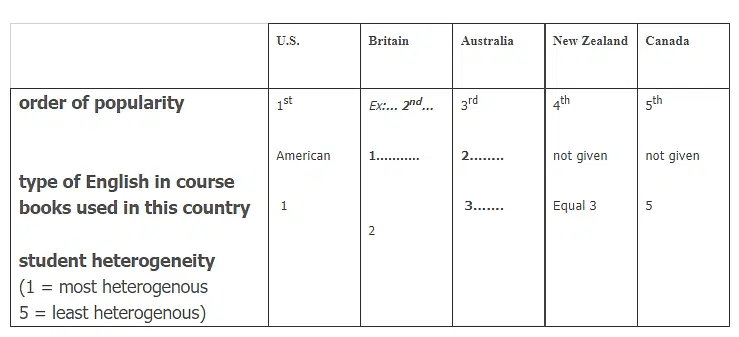
Questions 1-3
- Complete the missing information in the table below.
- Write your answers in boxes 1 – 3 on your Answer Sheet. The first one has been done for you as an example.
Question 4-9
- Choose the most suitable heading from the list of headings below for the seven paragraphs
- Write your answers in boxes 4 – 9 on your Answer Sheet.
List of Heading
A. Heterogeneity in the language classroom
B. Enrollment demand in Australia & New Zealand.
C. Reasons for the choice of destination
D. The attractions of studying in the antipodes
F. Additional student sources
G. Student destinations
Example: E. Conclusion
Example: Paragraph (vii) …… E…………..
4. Paragraph (i) …………… 5. Paragraph (ii) ……………
6. Paragraph (iii)…………… 7. Paragraph (iv)……………
8. Paragraph (v)…………… 9. Paragraph (vi)……………
Questions 10-15
Write your answers in boxes 10 -15 on your Answer Sheet.
Write T if the statement is True;
F if the statement is False;
N if the information is Not Given in the text.
Example: There are presently more than 1,000,000 foreign students of English abroad. TRUE
10. Study destination choices are mostly influenced by proximity to home.
11. Students who wish to study business will probably study English overseas.
12. Students of the same nationality usually make similar study choices.
13. English language classrooms in the U.S. have the widest range of student nationalities.
14. Standards at Australian and New Zealand tertiary institutions are improving.
15. Despite the 1990s Asian economic crisis, Asian students still dominate the English language classrooms of Australia and New Zealand.
Destination for International English students Reading answers with Explanation
In this section we have given the Destination for international English students reading answers with explanations, it will be useful to you to rectify your mistakes.
(Note: The text in italics mentions the location and referring lines written in the reading passage)
1. Answer: British, English, course books, country
Explanation: Before furthering their English skills, students in Europe study from predominantly British English material; The given answer is located in the 8-10 line of paragraph iii.
2. Answer: Not given
3. Answer: Equal 3
Explanation: Australia and New Zealand have roughly the same mix of students in their language classrooms, but not all students of English who choose these countries are from Asia. The given answer is located in the 1-2 lines of paragraph V.
4. Answer: G
Explanation: The five most popular destinations, in order of popularity, are the U. S., Britain, Australia, New Zealand, and Canada. The given answer is located in the 3-4 lines of paragraph i.
5. Answer: C
Explanation: Numerous studies conducted in Britain and the United States show that the country of choice depends to a large extent on economic factors. The given answer is located in the 1-2 lines of paragraph ii.
6. Answer: A
Explanation: Numerous studies conducted in Britain and the United States show that the country of choice depends to a large extent on economic factors. The given answer is located in the 1-2 lines of paragraph ii.
7. Answer: D
Explanation: Asian students whose English study is a prelude to tertiary study, the growing awareness that courses at antipodean universities and colleges are of an exceptionally high standard. The given answer is located in the 6-8 lines of paragraph iv.
8. Answer: F
Explanation: The emerging global consciousness of the late twentieth century has meant that students from as far as Sweden and Brazil are choosing to combine a taste for exotic travel with the study of English 'down under' and in 'the land of the long white cloud'. The given answer is located in the 3-5 lines of paragraph V.
9. Answer: B
Explanation: Nor have the economic problems in Asia caused appreciable drops in full-time college and university attendances by Asian students in these two countries. This is partly because there has always been a greater demand for enrolment at Australian and New Zealand tertiary institutions than places available to overseas students. The given answer is located in the 1-4 lines of paragraph vi.
10. Answer: False
Explanation: Numerous studies conducted in Britain and the United States show that the country of choice depends to a large extent on economic factors. The given answer is located in the 1-2 lines of paragraph ii.
11. Answer: Not given
12. Answer: True
Explanation: In the main, students tend to follow the traditional pattern of study for their national group. The given answer is located in the last 2 lines of paragraph ii.
13. Answer: True
Explanation: The United States attracts the most diverse array of nationalities to its English language classrooms. The given answer is located in the 1-2 lines of paragraph iii.
14. Answer: Not given
15. Answer: True
Explanation: But even the Asian economic downturn in the 1990s has not significantly altered the demographic composition of the majority of English language classrooms within the region. The given answer is located in the last 3 lines of paragraph V.
Other reading test

About Author Gayathri Nagarajan
Gayathri, a trusted study-abroad expert, with expertise in standardized tests like IELTS, TOEFL, PTE, GRE, and GMAT. With a strong tech background from SASTRA University, she excels in software testing and has a passion for content writing and digital marketing. She aids students in finding the perfect academic fit, offering guidance on course selection, LOR and SOP writing. She remains up-to-date with the latest trends in higher education, delivering credible, accurate information on international education, including courses and test prep materials. As a trusted Study abroad expert at Kanan International, explore her latest blogs and articles for comprehensive insights into studying abroad and realizing your academic aspirations.
Kanan.co is a trusted study abroad consultancy offering comprehensive services, resources, and solutions for students and education institutions. We support students at every stage of their global education journey, ensuring a smooth and guided experience. Along with test preparation for IELTS, GRE, TOEFL, and SAT, we provide expert services such as SOP writing, visa guidance, accommodation support, scholarship assistance, and education loan support. Our expertise and commitment to excellence make us a reliable partner for students pursuing international education.
Free Online Mock Test 2026
Practice our mock test worth Rs. 25000 for Free and know your IELTS score!








Global Headquarters
Kanan Int EdTech Inc
320 Bay Street, Suite 321 (Spaces), Toronto ON, Canada M5B 1N9
Indian Headquarters
Kanan International Pvt. Ltd.
D-wing, 2nd Floor, Trident Complex, Ellora Park Vadiwadi Road, Vadodara, Gujarat 390007
IT/ Digital Campus
Kanan International Pvt. Ltd
Old, New No 3, 2nd Floor, 1A, Dr Sadasivam Rd, T. Nagar, Chennai, Tamil Nadu 600017
Our branches
- Bardoli
- Bharuch
- Chennai
- Dehradun
- Gurugram
- Himatnagar
- Karnal
- Nadiad
- Navsari
- Palanpur
- Rajkot
- Vadodara
- Valsad
- Vallabh Vidyanagar
- Vapi
Study Abroad
Test Prep
Top Universities
Consultants
IELTS Centers
GRE Centers
TOEFL Centers
SAT Centers
Language Courses in Vadodara
SOP Blogs
Featured Blogs
Study Abroad Consultants in Chennai
Study Abroad Consultants in Surat
Study Abroad Consultants in Navsari
Study Abroad Consultants in Bardoli
Study Abroad Consultants in Ahmedabad
Study Abroad Consultants in Anand
Study Abroad Consultants in Khanna
Study Abroad Consultants in Nadiad
Study Abroad Consultants in Vadodara
Study abroad consultants in Valsad
Copyright © 2026 KANAN.CO All rights reserved.