- Study Abroad
- / ielts
- / do we need cities any more reading answers
Do We Need Cities Any More? Reading Answers


Author
17-09-2025

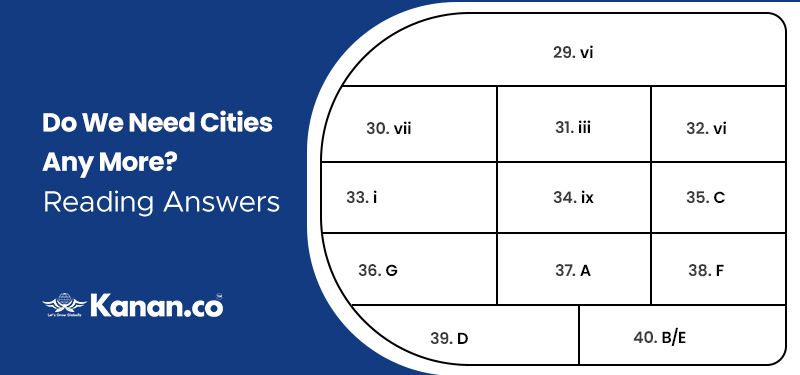
In this article we have given Do we need cities any more? Reading answers, as an illustration for the IELTS reading practice test. This article consists of 12 questions in 2 different forms namely- 6 questions as matching headings and 6 questions as sentence completion.
Check out our YouTube Channel to Practice Full-Length IELTS Reading Tests Daily

Table of content:
- Solution for Do we need cities any more?
- Do we need cities any more? IELTS reading practice test
- Passage
- Questions
- Answers with explanations.
Solution for Do we need cities any more?
Here we have given the answers for Do we need cities any more? Reading answers in the table form below.

Answer Table
| 29. vi | 32. vi | 35. C | 38. F |
| 30. vii | 33. i | 36. G | 39. D |
| 31. iii | 34. ix | 37. A | 40. B/E |
Do We Need Cities Any More? IELTS Reading Practice Test - Exam Review
Here we have given: Do we need cities any more? IELTS reading answers, as a sample article for the IELTS reading practice test. This article will help you to crack your exam with band scores. Scrutinize the given passage to answer the questions.
Passage
We have given: Do we need cities any more? reading answers with location. Be careful while reading the passage and answer the questions.
Do we need cities any more? Reading Answers
A I don't want to live in a city. Perhaps we divide naturally into two types: those for whom cities are vibrant and exciting, a focus for human activity; and those for whom they are dirty, noisy and dangerous. It may be unfashionable, but I'm in the latter camp. I do not believe that we are a species whose behaviour improves in overcrowded conditions.
B A new study proposes a significant increase in the capacity of towns and cities through a combination of increased housing densities, lower on-plot provision for cars and more on-street parking, and the re-use of marginal open space that is 'devoid of any amenity value'. The benefit of this approach is to reduce the loss of green fields and to help 'move towards more sustainable patterns of development'.
C This study suggests that it would be possible to achieve a 25% increase in density in a typical provincial city without changing the traditional street scene, although it would be necessary to reduce the size of the houses and substitute parking spaces for garages. Therefore, the cost of this approach is to have more people living in smaller homes at higher densities, along streets that are lined with parked cars. Can we really accept the notion that space within dwellings may be reduced even further? In times, when, we are told, living standards are rising in real terms, is it realistic to seek to reduce personal space standards?
D The streets of many inner suburbs are already lined with cars on both sides, reducing movement to a single lane. Increasing densities means accepting urban streets that are designed as linear car parks, bounded by even smaller living units and tempered only by occasional trees sprouting from the tarmac. Would the benefits of higher density be worth the disadvantages of increasing on street parking? Can we achieve a satisfactory visual environment from such raw materials? Higher urban densities may be communally good for us, but they will fail to meet the aspirations of many prospective home owners.
E Those without economic choice can be directed to live in this way, but if we are to continue to rely on the private sector to produce this urban housing, it will need to appeal to the private developers' customers. Who will choose to live in these high-density developments of small dwellings, with minimal open space and a chance to park on the highway if you are lucky enough to find a space? The main consumers will be single people, couples without children, and perhaps some 'empty nesters' (people whose children have grown up and left home). These are people who can choose to spend much of their time outside their home, making the most of those urban, cultural opportunities or getting away at weekends to a country cottage or sporting activities.
F The combination of a young family and a mortgage restricts the mobility and spending power of many couples. Most people with a family will try to avoid bringing up their children in a cramped flat or house. Space for independent activity is important in developing the individual and in maintaining family equilibrium. The garden is the secure place where the children can work off excess energy.
G There is a danger that planners may take a dispassionate, logical view of how we should live, and seek to force society into that mould. A few years ago a European Commission study provided a good example of this. It took the view, quite sensibly, that housing should not be under-occupied because this is a waste of resources. Therefore, it would be much better if the many thousands of old ladies who live alone in large detached houses would move into small urban flats, thus releasing the large houses for families. What the study failed to recognise was that many of those old ladies prefer to continue to live in their family home with their familiar surroundings and, most importantly, with their memories. What is good for us is not necessarily what we want.
H The urban housing option may be technically sustainable, but individually unacceptable. There still seems to be a perception among planners that new housing investment can be forced into those areas that planners want to see developed, without proper consideration of where the prospective purchasers want to live. There is a fatal flaw in this premise. Housing developers run businesses. They are not irrevocably committed to building houses and they are not obliged to invest their resources in housing development. Unless there is a reasonable prospect of a profit on the capital at risk in a housing project, they may simply choose to invest in some other activity.
Questions
Questions 29-33
- Reading passage has 8 sections A-H
- Choose the most suitable heading for sections A & C-F and H from the list of headings below.
- Write the appropriate numbers (i-ix) in boxes 29-34 on your answer sheet.
- Note: there are more headings than sections so you will not use all of them.
- You may use any of the heading more than once.
29. Section A
30. Section C
31. Section D
32. Section E
33. Section F
34. Section H
Headings
- Rational city planning
- Family housing
- Parking facilities in the city
- Profit-making housing developments
- Parking your car
- Cities for people?
- Appropriate living space
- High density accommodation in cities
- Housing as a business.
Questions 35-40
- Choose one phrase A-G from the box to complete each of the following key points.
- Write the appropriate letters A-G in boxes 35-40 on your answer sheet.
- The information on the completed sentence should be an accurate summary of points made by the writer.
- You may use any phrase more than once
35. Residential density in cities will be increased…
36. There are two types of…
37. There are three types of…
38. Developers are unlikely to build houses….
39. Planners might try to dictate…
40. Many people will not be happy…
- People likely to want to live in high-density accommodation.
- Living in higher density accommodation.
- If houses are built smaller.
- Where old people should live.
- If residential density in cities is increased.
- Where people do not want to live.
- Attitude towards city living.
Answers for Do we need cities any more? With explanation
In this section we have given the answers for Do we need cities any more? Reading answers with explanations. This will assist you to rectify your errors while answering.
29. Answer: vi
Explanation: “I don't want to live in a city. Perhaps we divide naturally into two types: those for whom cities are vibrant and exciting, a focus for human activity; and those for whom they are dirty, noisy and dangerous”. With this line it is clear that paragraph A states about cities for people?. Hence the given answer is located in the 1-3 lines of paragraph A.
30. Answer: vii
Explanation: “it would be possible to achieve a 25% increase in density in a typical provincial city without changing the traditional street scene, although it would be necessary to reduce the size of the houses and substitute parking spaces for garages”. With this line it is clear that paragraph C states about appropriate living size. Hence the given answer is located in the 1-3 lines of paragraph C.
31. Answer: iii
Explanation: “The streets of many inner suburbs are already lined with cars on both sides, reducing movement to a single lane. Increasing densities means accepting urban streets that are designed as linear car parks, bounded by even smaller living units and tempered only by occasional trees sprouting from the tarmac”. With this line it is clear that paragraph D states about parking facilities in the city. Hence the given answer is located in the first 4 lines of paragraph D.
32. Answer: vi
Explanation: “Those without economic choice can be directed to live in this way, but if we are to continue to rely on the private sector to produce this urban housing, it will need to appeal to the private developers' customers. Who will choose to live in these high-density developments of small dwellings, with minimal open space and a chance to park on the highway if you are lucky enough to find a space? The main consumers will be single people, couples without children, and perhaps some 'empty nesters' (people whose children have grown up and left home)”. With this line it is clear that paragraph E states about cities for people?. Hence the given answer is located in the 1-6 lines of paragraph E.
33. Answer: i
Explanation: “Most people with a family will try to avoid bringing up their children in a cramped flat or house. Space for independent activity is important in developing the individual and in maintaining family equilibrium”. With this line it is clear that paragraph F states about rational city planning. Hence the given answer is located in the 2-4 lines of paragraph F.
34. Answer: ix
Explanation: “They are not irrevocably committed to building houses and they are not obliged to invest their resources in housing development. Unless there is a reasonable prospect of a profit on the capital at risk in a housing project, they may simply choose to invest in some other activity”. With this line it is clear that paragraph H states about housing as a business. Hence the given answer is located in the last 4 lines of paragraph H.
35. Answer: C
Explanation: “This study suggests that it would be possible to achieve a 25% increase in density in a typical provincial city without changing the traditional street scene, although it would be necessary to reduce the size of the houses and substitute parking spaces for garages. Therefore, the cost of this approach is to have more people living in smaller homes at higher densities, along streets that are lined with parked cars”. With this line it is clear that residential density in cities will be increased if houses are built smaller. Hence the given answer is located in the 1-5 lines of paragraph C.
36. Answer: G
Explanation: “I don't want to live in a city. Perhaps we divide naturally into two types: those for whom cities are vibrant and exciting, a focus for human activity; and those for whom they are dirty, noisy and dangerous”. With this line it is clear that there are two types of attitude toward city living. Hence the given answer is located in the 1-3 lines of paragraph A.
37. Answer: A
Explanation: “Who will choose to live in these high-density developments of small dwellings, with minimal open space and a chance to park on the highway if you are lucky enough to find a space? The main consumers will be single people, couples without children, and perhaps some 'empty nesters' (people whose children have grown up and left home). With this line it is clear that there are three types of people likely to want to live in high-density accommodation. Hence the given answer is located in the 3-7 lines of paragraph E.
38. Answer: F
Explanation: “The urban housing option may be technically sustainable, but individually unacceptable. There still seems to be a perception among planners that new housing investment can be forced into those areas that planners want to see developed, without proper consideration of where the prospective purchasers want to live”. With this line it is clear that developers are unlikely to build houses where people do not want to live. Hence the given answer is located in the first 4 lines of paragraph H.
39. Answer: D
Explanation: “There is a danger that planners may take a dispassionate, logical view of how we should live, and seek to force society into that mould. A few years ago a European Commission study provided a good example of this. It took the view, quite sensibly, that housing should not be under-occupied because this is a waste of resources. Therefore, it would be much better if the many thousands of old ladies who live alone in large detached houses would move into small urban flats, thus releasing the large houses for families”. With this line it is clear that planners might try to dictate where old people should live. Hence the given answer is located in the 1-6 lines of paragraph G.
40. Answer: B/E
Explanation: “Most people with a family will try to avoid bringing up their children in a cramped flat or house. Space for independent activity is important in developing the individual and in maintaining family equilibrium. The garden is the secure place where the children can work off excess energy”. With this line it is clear that many people will not be happy if houses are built smaller and they do not want to live there. Hence the given answer is located in the last 4 lines of paragraph F.
Other reading answers

About Author Arivarasi
Arivarasi is an experienced author with expertise in the study abroad industry and preparing test materials for exams like IELTS, TOEFL, GRE, SAT, PTE, etc. She stays up-to-date with university and college requirements for international students which allows her to provide guidance on course selection, documents like SOP, LOR, and scholarship opportunities. She has written numerous articles on study abroad exams, destinations, universities & colleges requirements, admission procedures, and the entire process of studying abroad. Collaborating with industry experts and counselors, she crafts informative articles that make students take the right decisions.
Kanan.co is a trusted study abroad consultancy offering comprehensive services, resources, and solutions for students and education institutions. We support students at every stage of their global education journey, ensuring a smooth and guided experience. Along with test preparation for IELTS, GRE, TOEFL, and SAT, we provide expert services such as SOP writing, visa guidance, accommodation support, scholarship assistance, and education loan support. Our expertise and commitment to excellence make us a reliable partner for students pursuing international education.
Free Online Mock Test 2026
Practice our mock test worth Rs. 25000 for Free and know your IELTS score!








Global Headquarters
Kanan Int EdTech Inc
320 Bay Street, Suite 321 (Spaces), Toronto ON, Canada M5B 1N9
Indian Headquarters
Kanan International Pvt. Ltd.
D-wing, 2nd Floor, Trident Complex, Ellora Park Vadiwadi Road, Vadodara, Gujarat 390007
IT/ Digital Campus
Kanan International Pvt. Ltd
Old, New No 3, 2nd Floor, 1A, Dr Sadasivam Rd, T. Nagar, Chennai, Tamil Nadu 600017
Our branches
- Bardoli
- Bharuch
- Chennai
- Dehradun
- Gurugram
- Himatnagar
- Karnal
- Nadiad
- Navsari
- Palanpur
- Rajkot
- Vadodara
- Valsad
- Vallabh Vidyanagar
- Vapi
Study Abroad
Test Prep
Top Universities
Consultants
IELTS Centers
GRE Centers
TOEFL Centers
SAT Centers
Language Courses in Vadodara
Study Abroad Calculators
Featured Blogs
Study Abroad Consultants in Chennai
Study Abroad Consultants in Surat
Study Abroad Consultants in Navsari
Study Abroad Consultants in Bardoli
Study Abroad Consultants in Ahmedabad
Study Abroad Consultants in Anand
Study Abroad Consultants in Khanna
Study Abroad Consultants in Nadiad
Study Abroad Consultants in Vadodara
Study abroad consultants in Valsad
Copyright © 2026 KANAN.CO All rights reserved.