- Study Abroad
- / ielts
- / extinct the giant deer reading answers
Extinct: The Giant Deer reading answers


Author
16-09-2025
Answers Verified By
Senior IELTS Trainer | Content Creator

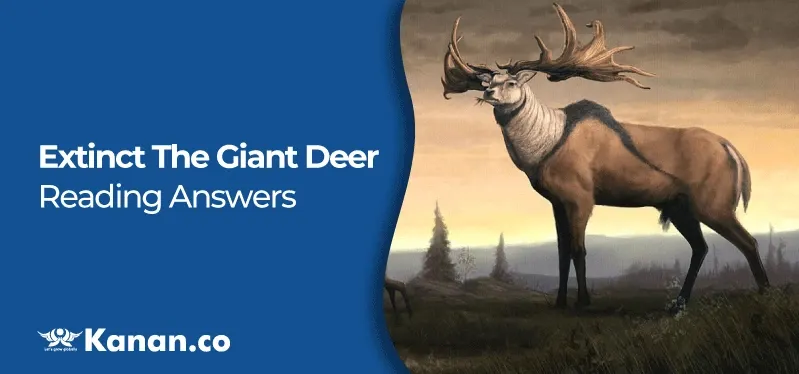
We have provided Extinct: The Giant Deer Reading Answers along with the practice test. It contains 13 questions with 3 reading question types - IELTS Reading True False Not Given, IELTS Reading Summary Completion, and IELTS Reading Sentence Question.
Check out our YouTube Channel to Practice Full-Length IELTS Reading Tests Daily

Table of Contents:
- Solution for Extinct: The Giant Deer Reading Answers
- Extinct: The Giant Deer IELTS Reading Practice Test
- Passage
- Questions
- Answers with Explanations
Solution for Extinct: The Giant Deer
Check out the given answer table which contains Extinct the Giant Deer reading answers. Use it to correct your mistakes.
Answer Table
| 1. 400,000 years ago | 8. habitat destruction |
| 2. 8000 years ago | 9. B |
| 3. 7000 years ago | 10. D |
| 4.wooded interglacials | 11. A |
| 5. 10500 years ago | 12. C |
| 6. Male’s huge antlers | 13. C |
| 7. minerals |

Extinct the giant deer IELTS Reading Practice Test - Exam Review
We have given this Extinct the giant deer reading answers practice test to improve your reading skills. Read the following passage carefully and answer the questions. After you completed the practice test, check the Extinct the giant deer reading answers with explanations.
Passage
Read the complete passage and answer the given questions (1-13).
Extinct: the Giant Deer
Toothed cats, wooly rhinos, mastodons, giant sloths and a lot of other big, long-haired mammals are generally thought to have died out on all sides by the end of the rearmost ice age, some 10,500 years ago.
A. The megaloceros giganteus is otherwise called the Irish elk (giant deer). Studies of decrepit bones and teeth by analysts based in Britain and Russia show the enormous herbivore lived until about 5,000 B.C.—exceeding three renaissances later than formerly trusted. The investigation panel says this hints at more aspects, apart from climate change, probably rushed the Irish elk’s final disappearance. The aspects could comprehend hunting or environmental demolition by humans.
B. The giant deer, so-called as its well-kept debris are frequently found in lake dregs under morass in Ireland, first emerged about 400,000 years ago in Europe and central Asia. via an amalgamation of carbon-14 dating of skeletal remains and the aligning of spots where the remains were excavated, the crew shows the giant deers was excited across Europe before the last “big freeze.” The deer’s span later shrinks to the Ural Mountains, in present-day Russia, which divided Europe from Asia.
C. The Irish elk made its last stand in western Siberia, some 3,000 years after the ice sheets retreated, said the study’s co-author, Adrian Lister, lecturer of palaeobiology at University college London, England. “The eastern highlands of the Urals became very thickly forested about 8,000 years ago, which could have pushed them on to the plain,” he said. He combined that antigen inquiry to designate the region then became very parched in reaction to farther climate swap, leading to the loss of chief food plants. “In amalgamation with human pressures, this could have eventually extinguished them out,” Lister said.
D. Stalking by humans has frequently been placed forward as a conducive cause of destruction of the pleistocene megafauna. The crew, even though, said their new date for the Irish elk’s annihilation clue at an additional human-made issue-environmental demolition. Lister said, “we haven’t got just hunting 7,000 years ago-this was also about the time the first Medieval people lived in the region. They were farmers who would have discharged the land.” The existence of humans may help describe why the Irish elk was helpless to resilient out the latest of many climatic oscillation-periods it had alive in the past.
E. Meanwhile, Lister cast uncertainty on other feasible clarification for the deer’s death-the male’s vast horn. Some chemists have advised this overemphasized characteristic-the outcome of females preferring stags with the biggest horns, perhaps because they published a male’s fitness- donated to the mammal’s downfall. They say such horns would have been a serious trouble in the thick forests that spread northward after the last ice age. But, Lister said, “ That’s a compelling argument to make because the deer formerly survived finely well via wooded glaciation [ a warm period between glacial epochs].” Some analysts have advised that an inadequacy of enough high-quality fodder caused the annihilation of the elk. High amounts of calcium and sodium phosphate compounds are needed to form horns, and therefore huge quantities of these minerals are needed for the huge structures of the Irish Elk. The males(and male deer in general) met this necessity partly from their bones, refill them from food plants after the horns were developed or recoup the nutrients from discarded horns( as has been noticed in surviving deer). Thus, in the horn growth stage. Irish elk were aching from a condition alike to silent disease. When the climate swapped at the end of the last ice age, the flora in the animal’s environment also changed against species that probably could not deliver enough amounts of the needed minerals. At least in the western part of its range.
F. The annihilation of megafauna all over the world was almost concluded by the end of the last glacial period. It is trusted that megafauna at first came into continuation in reaction to icy conditions and vanished with the onset of warmer climates. Tropical and subtropical areas have gone through less radical climate swap. The most dramatic of these swaps was the change of a huge area of north Africa into the world’s biggest desert. Notably, Africa avoided major faunal annihilation as did tropical and subtropical Asia. The human evacuation from Africa and our access into the Americans and Australia were also caused by climate change. Australia’s climate swapped from cold-dry to warm-dry. As a outcome, surface water becomes scant. Most inland lakes become totally dry or dry in the warmer seasons. Most large, mainly peruse animals lost their environment and retired to a narrow band in eastern Australia, where there was lasting water and better flora. Some animals may have lived until about 7000 years ago. If people have been in Australia for up to 60000 years, then megafauna must have accompanied humans for at least 30 000 years. Frequently hunted modem kangaroos lived not only 10 000 years of indigenous hunting, but also an assault of trade shooters.
G. The crew of analysts led by A.J. Stuart concentrated on northern Eurasia, which he was taking as Europe, plus Siberia, basically, where they have got the best data that animals vanished in Europe during the Late pleistocene. Some cold-adapted animals experienced the last part of the cold stage, and then vanished up there. So you have usually got two phases of vanishing. Now, neither of these concur— these are Neanderthals here being replaced by modernized humans. There’s no clear accident between the arrival of humans or climatic swap alone and these destruction. There’s a climate swap here, so there’s a dual effect here. Again, as animals come via to the last part of the icy stage, here there’s a basic swap in the climate restructuring of flora, and the amalgamation of the climatic change and the existence. There’s a heartfelt variance between the North American data and that of Europe, which abridge that the destruction in northern Eurasia, in Europe, are average and lurch, and in North America acute and sudden. And these things relate to the variance in the timing of human arrival. The destruction follows from human depredation but only at times of basis swaps in the habitat.
Questions
Questions 1-5
- Complete the following summary of the paragraphs of Reading Passage.
- Using NO MORE THAN THREE WORDS from the Reading Passage for each answer.
- Write your answers in boxes 28-32 on your answer sheet.
Having been preserved well in Europe and Central Asia, the remains of the Irish elk were initially found approximately 1.______ Around 2.______ , they were driven to live in the plain after being restricted to the Ural Mountains. Hunting was considered as one of the important factors of Irish elk’s extinction; people did not start hunting until 3.______ when Irish elk used to get through under a variety of climatic fluctuations.
The huge antlers may possibly contribute to the reason why Irish elk became extinct, which was highly controversial as they live pleasantly over the span of 4.______ . Generally, it is well-known that, at the last maximum ice age, mammals became extinct about 5._______ .
Questions 6-8
Answer the questions below.
Choose NO MORE THAN THREE WORDS AND/OR A NUMBER from the passage for each answer.
6. What kind of physical characteristics eventually contributed to the extinction of Irish elk?
7. What kind of nutrient substance is needed in maintaining the huge size of Irish elk?
8. What geographical evidence suggested the advent of humans resulted in the extinction of Irish elk?
Questions 9-12
Choose the letter A-D and write your answers in boxes 36-39 on your answer sheet.
A. Eurasia
B. Australia
C. Asia
D. Africa
9. The continents where humans imposed a little impact on large mammals extinction
10. The continents where the climatic change was mild and fauna remains
11. The continents where both humans and climatic change are the causes
12. The continents where the climatic change along caused a massive extinction
Question13
13. Which statement is true according to the Stuart team’s finding?
A. Neanderthals rather than modern humans caused the extinction in Europe
B. Paleolithic humans in Europe along kill the big animals such as Giant deer
C. climatic change was not solely responsible for the megafauna extinction in Europe
D. moderate and staggered extinction was mainly the result of fundamental climatic change
Answers for Extinct: the Giant Deer with Explanation
Below we have given extinct the giant deer reading answers with explanations, examine it to assess your answers.
1. Answer: 400,000 years ago
Explanation: The giant deer, so-called as its well-kept debris are frequently found in lake dregs under morass in Ireland, first emerged about 400,000 years ago . The given answer is located in paragraph B in the 1-2 lines.
2. Answer: 8000 years ago
Explanation:“The eastern highlands of the Urals became very thickly forested about 8,000 years ago, The given answer is located in paragraph C in the 3-4 lines.
3. Answer: 7000 years ago
Explanation:“we haven’t got just hunted 7,000 years ago . The given answer is located in paragraph D in the 4-5 lines.
4. Answer: Wooded interglacials
Explanation: But, Lister said, “ That’s a compelling argument to make because the deer formerly survived finely well via wooded glaciation [ a warm period between glacial epochs] The given answer is located in paragraph E in the 7-9 lines.
5. Answer: 10500 years ago
Explanation: 10,500 years ago. The given answer is located in the last line of 1st paragraph.
6. Answer: Male’s huge antlers
Explanation:Meanwhile, Lister cast uncertainty on other feasible clarification for the deer’s death-the male’s vast horn. The given answer is located in paragraph E in the 1-2 lines.
7. Answer: Minerals
Explanation:High amounts of calcium and sodium phosphate compounds are needed to form horns, and therefore huge quantities of these minerals are needed for the huge structures of the Irish Elk. The given answer is located in paragraph E in the 11-13 lines.
8. Answer: Habitat destruction
Explanation:
- The investigation panel says this hints at more aspects, apart from climate change, probably rushed the Irish elk’s final disappearance. The aspects could comprehend hunting or environmental demolition by humans. The given answer is located in the last 4 lines Of paragraph A.
- The crew, even though, said their new date for the Irish elk’s annihilation clue at an additional human-made issue-environmental demolition. The given answer is located in paragraph D in the 3-5 lines.
9. Answer: B
Explanation: Australia’s climate swapped from cold-dry to warm-dry. As a outcome, surface water becomes scant. Most inland lakes become totally dry or dry in the warmer seasons. Most large, mainly peruse animals lost their environment and retired to a narrow band in eastern Australia, where there was lasting water and better flora. The given answer is located in paragraph F in the 10-15 lines.
10. Answer: D
Explanation:The most dramatic of these swaps was the change of a huge area of north Africa into the world’s biggest desert. Notably, Africa avoided major faunal annihilation as did tropical and subtropical Asia. The given answer is located in paragraph F in the 7-8 lines.
11. Answer: A
Explanation:The crew of analysts led by A.J. Stuart concentrated on northern Eurasia, which he was taking as Europe, plus Siberia, basically, where they have got the best data that animals vanished in Europe during the Late pleistocene. Some cold-adapted animals experienced the last part of the cold stage, and then vanished up there. So you have usually got two phases of vanishing. Now, neither of these concur— these are Neanderthals here being replaced by modernized humans. There’s no clear accident between the arrival of humans or climatic swap alone and these destruction. The given answer is located in paragraph G in the 1-9 lines.
12. Answer: C
Explanation:The most dramatic of these swaps was the change of a huge area of north Africa into the world’s biggest desert. Notably, Africa avoided major faunal annihilation as did tropical and subtropical Asia. The given answer is located in paragraph F in the 7-8 lines.
13. Answer: C
Explanation:The crew of analysts led by A.J. Stuart concentrated on northern Eurasia, which he was taking as Europe, plus Siberia, basically, where they have got the best data that animals vanished in Europe during the Late pleistocene. The given answer is located in the first 4 lines of paragraph G.
Other Reading Answers
- It's only a cockroach reading answers
- The battle of towton reading answers
- Communicating in colour reading answers
Conclusion
This article for “Extinct the giant deer reading answers”, can help you to know about the pattern of IELTS reading test. Hence we have given our version of practice test along with key answers and explanation, use it to enhance your reading and answering skill.

About Author Dinesh Pandiyan
Dinesh is a highly experienced content writer who specializes in language proficiency tests like IELTS, GRE, PTE, TOEFL, and study abroad. He provides valuable insights and tips to students on various modules of these tests, including reading, writing, speaking, and listening. His articles are well-researched, informative, and engaging, offering practical guidance to students looking to succeed in their academic pursuits. Additionally, Dinesh has coordinated with IELTS trainers to prepare test preparation materials, guides, practice tests, and mock tests, and worked closely with counsellors for study abroad consultancy, providing guidance on choosing the right institution, preparing for interviews, and writing effective statements of purpose (SOP) and letters of recommendation (LOR). Students can benefit from Dinesh's comprehensive knowledge and experience by checking out his articles.
Kanan International is a study abroad consultancy that offers reliable services, products, and solutions for students and education institutions. We support students throughout their study abroad journey, ensuring a hassle-free experience. Our expertise and commitment to excellence make us the go-to partner for expanding global horizons. The company provides coaching for IELTS, GRE, TOEFL, and SAT exams and services like visa consultation, accommodation, scholarship assistance, and education loans.
Free Online Mock Test 2026
Practice our mock test worth Rs. 25000 for Free and know your IELTS score!








Global Headquarters
Kanan Int EdTech Inc
320 Bay Street, Suite 321 (Spaces), Toronto ON, Canada M5B 1N9
Indian Headquarters
Kanan International Pvt. Ltd.
D-wing, 2nd Floor, Trident Complex, Ellora Park Vadiwadi Road, Vadodara, Gujarat 390007
IT/ Digital Campus
Kanan International Pvt. Ltd
Old, New No 3, 2nd Floor, 1A, Dr Sadasivam Rd, T. Nagar, Chennai, Tamil Nadu 600017
Our branches
- Bardoli
- Bharuch
- Chennai
- Dehradun
- Gurugram
- Himatnagar
- Karnal
- Nadiad
- Navsari
- Palanpur
- Rajkot
- Vadodara
- Valsad
- Vallabh Vidyanagar
- Vapi
Study Abroad
Test Prep
Top Universities
Consultants
IELTS Centers
GRE Centers
TOEFL Centers
SAT Centers
Language Courses in Vadodara
Study Abroad Calculators
Featured Blogs
Study Abroad Consultants in Chennai
Study Abroad Consultants in Surat
Study Abroad Consultants in Navsari
Study Abroad Consultants in Bardoli
Study Abroad Consultants in Ahmedabad
Study Abroad Consultants in Anand
Study Abroad Consultants in Khanna
Study Abroad Consultants in Nadiad
Study Abroad Consultants in Vadodara
Study abroad consultants in Valsad
Copyright © 2026 KANAN.CO All rights reserved.