- Study Abroad
- / ielts
- / facial expression reading answers
Facial Expression Reading Answers


Author
16-09-2025

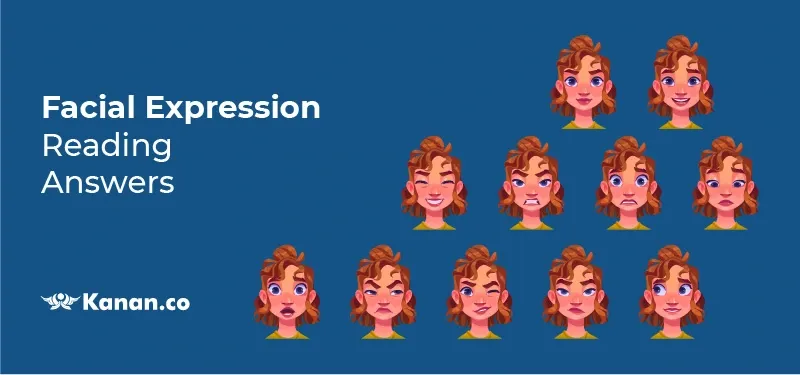
Facial expression reading practice tests is provided with answers and explanations. This passage comprises 13 questions divided into three question types - summary completion, locating information and choose the correct letter. Facial expression reading answers with explanation.
Check out our YouTube Channel to Practice Full-Length IELTS Reading Tests Daily

Table of contents:
- Solution for Facial expression
- Facial expression IELTS Reading Practice Test
- Passage
- Questions
- Answers with Explanations
Solution for Facial expression
Facial expression reading answers are listed in the table below. Verify your answers against our answer table, then correct any inaccuracies.
Answer Table
| 1. Misidentified | 5. Exposed | 9. H | 13. D |
| 2. Emotions | 6. C | 10. D | |
| 3. Cultural background | 7. A | 11. B | |
| 4. Isolated | 8. D | 12. B |

Facial expression IELTS Reading Practice Test - Exam Review
Facial expression IELTS reading answers are given here, which will help you excel in the reading practice test to challenge your reading skills. Paraphrasing can help you to understand the ideas clearly which makes you able to answer the questions efficiently.
Passage
We’ve provided the reading passage of Facial expression. Read the passage and carefully complete the questions. Check the answers with our Facial expression reading answers with locations.
Facial expression
- A facial expression is one or more motions or positions of the muscles in the skin. These movements convey the emotional state of the individual to observers. Facial expressions are a form of nonverbal communication. They are a primary means of conveying social information among aliens, but also occur in most other mammals and some other animal species. Facial expressions and their significance in the perceiver can, to some extent, vary between cultures with evidence from descriptions in the works of Charles Darwin.
- Humans can adopt a facial expression to read as a voluntary action. However, because expressions are closely tied to emotion, they are more often involuntary. It can be nearly impossible to avoid expressions for certain emotions, even when it would be strongly desirable to do so; a person who is trying to avoid insulting an individual he or she finds highly unattractive might, nevertheless, show a brief expression of disgust before being able to reassume a neutral expression. Microexpressions are one example of this phenomenon. The close link between emotion and expression can also work in the order direction; it has been observed that voluntarily assuming an expression can actually cause the associated emotion.
- Some expressions can be accurately interpreted even between members of different species – anger and extreme contentment being the primary examples. Others, however, are difficult to interpret even in familiar individuals. For instance, disgust and fear can be tough to tell apart. Because faces have only a limited range of movement, expressions rely upon fairly minuscule differences in the proportion and relative position of facial features, and reading them requires considerable sensitivity to the same. Some faces are often falsely read as expressing some emotion, even when they are neutral because their proportions naturally resemble those another face would temporarily assume when emoting.
- Also, a person’s eyes reveal much about hos they are feeling, or what they are thinking. Blink rate can reveal how nervous or at ease a person maybe. Research by Boston College professor Joe Tecce suggests that stress levels are revealed by blink rates. He supports his data with statistics on the relation between the blink rates of presidential candidates and their success in their races. Tecce claims that the faster blinker in the presidential debates has lost every election since 1980. Though Tecce’s data is interesting, it is important to recognize that non-verbal communication is multi-channelled, and focusing on only one aspect is reckless. Nervousness can also be measured by examining each candidates’ perspiration, eye contact and stiffness.
- As Charles Darwin noted in his book The Expression of the Emotions in Man and Animals: the young and the old of widely different races, both with man and animals, express the same state of mind by the same movements. Still, up to the mid-20th century, most anthropologists believed that facial expressions were entirely learned and could, therefore, differ among cultures. Studies conducted in the 1960s by Paul Ekman eventually supported Darwin’s belief to a large degree.
- Ekman’s work on facial expressions had its starting point in the work of psychologist Silvan Tomkins. Ekman showed that contrary to the belief of some anthropologists including Margaret Mead, facial expressions of emotion are not culturally determined, but universal across human cultures. The South Fore people of New Guinea were chosen as subjects for one such survey. The study consisted of 189 adults and 130 children from among a very isolated population, as well as twenty-three members of the culture who lived a less isolated lifestyle as a control group. Participants were told a story that described one particular emotion; they were then shown three pictures (two for children) of facial expressions and asked to match the picture which expressed the story’s emotion.
- While the isolated South Fore people could identify emotions with the same accuracy as the non-isolated control group, problems associated with the study include the fact that both fear and surprise were constantly misidentified. The study concluded that certain facial expressions correspond to particular emotions and can not be covered, regardless of cultural background, and regardless of whether or not the culture has been isolated or exposed to the mainstream.
- Expressions Ekman found to be universally included those indicating anger, disgust, fear, joy, sadness, and surprise (not that none of these emotions has a definitive social component, such as shame, pride, or schadenfreude). Findings on contempt (which is social) are less clear, though there is at least some preliminary evidence that this emotion and its expression are universally recognized. This may suggest that the facial expressions are largely related to the mind and each part on the face can express specific emotions.
Questions
Questions 1-5
Summary
Complete the Summary paragraph below.
In boxes 1-5 on your answer sheet, write the correct answer with NO MORE THAN TWO WORDS
The result of Ekman’s study demonstrates that fear and surprise are persistently 1._______________and made a conclusion that some facial expressions have something to do with certain 2. _______________Which is impossible to cover, despite of 3._______________and whether the culture has been 4._______________ or 5._______________
Questions 6-11
The reading Passage has seven paragraphs A-H
Which paragraph contains the following information?
Write the correct letter A-H, in boxes 6-11 on your answer sheet.
NB: You may use any letter more than once
6. the difficulty identifying the actual meaning of facial expressions
7. the importance of culture on facial expressions is initially described
8. collected data for the research on the relation between blink and the success in elections
9. the features on the sociality of several facial expressions
10. an indicator to reflect one’s extent of nervousness
11. the relation between emotion and facial expressions
Questions 12-13
Choose two letters from the A-E
Write your answers in boxes 12-13 on your answer sheet
Which Two of the following statements are true according to Ekman’s theory?
A. No evidence shows animals have their own facial expressions.
B. The potential relationship between facial expression and state of mind exists
C. Facial expressions are concerning different cultures.
D. Different areas on face convey a certain state of mind.
E. Mind controls men’s facial expressions more obvious than women’s
12. _______________
13. _______________
Answers for Facial Expression With Explanations
Facial expression reading answers with explanations is given below. Refer to the following answers with an explanation section in order to correct your errors.
(Note: The text in italics mentions the location and referring lines written in the reading passage.)
1. Answer: Misidentified
Explanation: Located in the 1st line of paragraph G, “While the isolated South Fore people could identify emotions with the same accuracy as the non-isolated control group, problems associated with the study include the fact that both fear and surprise were constantly misidentified”.
2. Answer: Emotions
Explanation: Located in the 2nd line of paragraph G, “The study concluded that certain facial expressions correspond to particular emotions and can not be covered, regardless of cultural background, and regardless of whether or not the culture has been isolated or exposed to the mainstream”.
3. Answer: Cultural background
Explanation: Located in the 2nd line of paragraph G, “The study concluded that certain facial expressions correspond to particular emotions and can not be covered, regardless of cultural background, and regardless of whether or not the culture has been isolated or exposed to the mainstream”.
4. Answer: Isolated
Explanation: Located in the 2nd line of paragraph G, “The study concluded that certain facial expressions correspond to particular emotions and can not be covered, regardless of cultural background, and regardless of whether or not the culture has been isolated or exposed to the mainstream”.
5. Answer: Exposed
Explanation: Located in the 2nd line of paragraph G, “The study concluded that certain facial expressions correspond to particular emotions and can not be covered, regardless of cultural background, and regardless of whether or not the culture has been isolated or exposed to the mainstream”.
6. Answer: C
Explanation: Located in 2nd line of paragraph G, “Others, however, are difficult to interpret even in familiar individuals”.
7. Answer: A
Explanation: Located in the last line of paragraph A, “Facial expressions and their significance in the perceiver can, to some extent, vary between cultures with evidence from descriptions in the works of Charles Darwin”.
8. Answer: D
Explanation: Located in the first 4 lines of paragraph D, “Also, a person’s eyes reveal much about hos they are feeling, or what they are thinking. Blink rate can reveal how nervous or at ease a person maybe. Research by Boston College professor Joe Tecce suggests that stress levels are revealed by blink rates. He supports his data with statistics on the relation between the blink rates of presidential candidates and their success in their races”.
9. Answer: H
Explanation: Located in the first 2 lines of paragraph H, “Expressions Ekman found to be universally included those indicating anger, disgust, fear, joy, sadness, and surprise (not that none of these emotions has a definitive social component, such as shame, pride, or schadenfreude). Findings on contempt (which is social) are less clear, though there is at least some preliminary evidence that this emotion and its expression are universally recognized”.
10. Answer: D
Explanation: Located in the last line of paragraph D, “Nervousness can also be measured by examining each candidates’ perspiration, eye contact and stiffness”.
11. Answer: B
Explanation: Located in the 2nd line of paragraph B, “However, because expressions are closely tied to emotion, they are more often involuntary”.
12. Answer: B
Explanation: Located in the 2nd line of paragraph H, “Findings on contempt (which is social) are less clear, though there is at least some preliminary evidence that this emotion and its expression are universally recognized”.
13. Answer: D
Explanation: Located in the last line of paragraph H, “This may suggest that the facial expressions are largely related to the mind and each part on the face can express specific emotions”.
Other Reading Tests

About Author Tejaswini Kota
Tejaswini is an enthusiastic writer, reader and a passionate learner. Additionally, she was a research fellow and holds a grip in English writings and research/paper publications. She holds bachelors and masters degrees in engineering. She spent three years in the education industry and is currently working as a full-time content writer at Kanan International, writing articles for study abroad projects. She is proficient in creating good quality content that helps the students for language proficiency tests like IELTS, GRE, TOEFL etc. and can help in advising you the right choice of college for admission.
Kanan.co is a trusted study abroad consultancy offering comprehensive services, resources, and solutions for students and education institutions. We support students at every stage of their global education journey, ensuring a smooth and guided experience. Along with test preparation for IELTS, GRE, TOEFL, and SAT, we provide expert services such as SOP writing, visa guidance, accommodation support, scholarship assistance, and education loan support. Our expertise and commitment to excellence make us a reliable partner for students pursuing international education.
Free Online Mock Test 2026
Practice our mock test worth Rs. 25000 for Free and know your IELTS score!








Global Headquarters
Kanan Int EdTech Inc
320 Bay Street, Suite 321 (Spaces), Toronto ON, Canada M5B 1N9
Indian Headquarters
Kanan International Pvt. Ltd.
D-wing, 2nd Floor, Trident Complex, Ellora Park Vadiwadi Road, Vadodara, Gujarat 390007
IT/ Digital Campus
Kanan International Pvt. Ltd
Old, New No 3, 2nd Floor, 1A, Dr Sadasivam Rd, T. Nagar, Chennai, Tamil Nadu 600017
Our branches
- Bardoli
- Bharuch
- Chennai
- Dehradun
- Gurugram
- Himatnagar
- Karnal
- Nadiad
- Navsari
- Palanpur
- Rajkot
- Vadodara
- Valsad
- Vallabh Vidyanagar
- Vapi
Study Abroad
Test Prep
Top Universities
Consultants
IELTS Centers
GRE Centers
TOEFL Centers
SAT Centers
Language Courses in Vadodara
Study Abroad Calculators
Featured Blogs
Study Abroad Consultants in Chennai
Study Abroad Consultants in Surat
Study Abroad Consultants in Navsari
Study Abroad Consultants in Bardoli
Study Abroad Consultants in Ahmedabad
Study Abroad Consultants in Anand
Study Abroad Consultants in Khanna
Study Abroad Consultants in Nadiad
Study Abroad Consultants in Vadodara
Study abroad consultants in Valsad
Copyright © 2026 KANAN.CO All rights reserved.