- Study Abroad
- / ielts
- / fluoridation of public water supplies reading answers
Fluoridation of Public Water Supplies Reading Answers


Author
17-09-2025

Here you can find the “Fluoridation of Public Water Supplies” reading passage as a practice test along with answers and explanation. This topic consists of 13 questions in 3 different types namely- 6 questions as short answer questions, 5 questions as matching features, and 2 questions as multiple choice questions. Go through the given passage completely and answer the questions.
Check out our YouTube Channel to Practice Full-Length IELTS Reading Tests Daily

Table of contents:
- Solution for Fluoridation of Public Water Supplies
- Fluoridation of Public Water Supplies IELTS reading practice test
- Passage
- Questions
- Answers with explanation
Solution for Fluoridation of Public Water Supplies
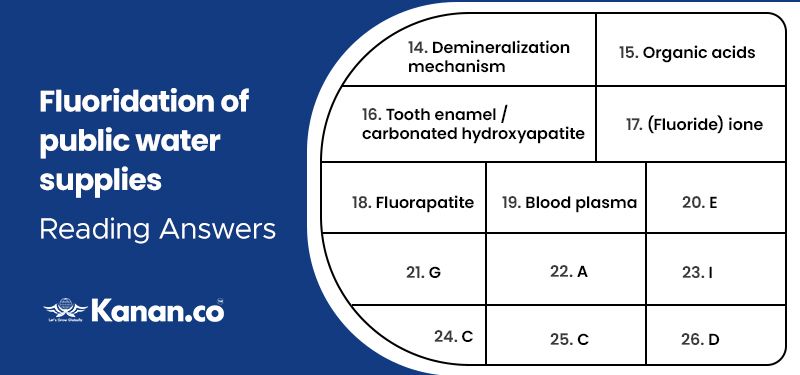
The answers for Fluoridation of Public Water Supplies reading answers are given below in the table form.

Answer Table
| 14. Demineralization mechanism | 17. (Fluoride) ione | 20. E | 23. I | 26. D |
| 15. Organic acids | 18. Fluorapatite | 21. G | 24. C | |
| 16. Tooth enamel/ carbonated hydroxyapatite | 19. Blood plasma | 22. A | 25. C |
Fluoridation of Public Water Supplies IELTS reading practice test -Exam Review
We have given Fluoridation of Public Water Supplies IELTS reading answers. This article will aid you to crack your major with band scores. Read the passage carefully and answer your questions.
Passage
Here we have given Fluoridation of Public Water Supplies reading answers with location. Before answering your question, go through the passage thoroughly.
Fluoridation of Public Water Supplies Reading Answers
- Water fluoridation is the process of releasing small amounts of fluoride into the public water supply as a way to reduce dental health problems. The process of reducing tooth decay through fluoridation is clearly understood, and research confirms water fluoridation’s effect on limiting instances of tooth decay. Nevertheless, fluoride is not harmless in all quantities. At levels moderately above those desired, it can result in something known as fluorosis, and at very high levels acute fluoride poisoning can occur.
- Fluoride"s function is to intervene in the demineralisation mechanism of tooth decay. Demineralisation is a process that begins when sugary carbohydrates are eaten, and organic acids are subsequently generated by bacteria within the dental plaque. When a certain level of acidity is produced (pH in the oral cavity dips below 5.5), the acids waste away the main component of tooth enamel, a substance known as carbonated hydroxyapatite. If this erosion persists for months and years without adequate remineralisation, then tooth decay occurs, and dental cavities form.
- Fluoride can greatly assist the mouth with the remineralisation of decaying enamel. Fluoridation creates fluoride ions in saliva that can restore some of the lost mineral content from enamel after sugary acids have left the oral cavity. When these ions exist in plaque fluid alongside dissolved carbonated hydroxyapatite, and the pH is higher than 4.5, a fluorapatite veneer covers the dental enamel. This veneer has the benefit of being more acid-resistant than the tooth’s hydroxyapatite, and is formed more quickly than by the natural remineralisation mechanism. Blood plasma transports any fluoride that has been ingested to calcium -rich areas such as the teeth, supporting dental infrastructure from the inside as well.
- The U.S. Center for Disease Control has listed fluoridation of the water supply as one of the greatest public health achievements of the 20th century. While tooth decay is rarely a threat to mortality, it is one of the most prevalent chronic diseases globally and affects 60-90 percent of children across industrialised countries. Research suggests that the presence of fluoride in saliva at all times (but in small quantities) is the single most effective preventative measure of tooth decay. Water fluoridation is perfectly geared towards helping to ensure this. Drinking water is the largest source of fluoride for people globally, and evidence demonstrates its efficacy in reducing cavities, particularly among poorer households without regular access to dentists.
- Although not considered to be an essential ingredient (a substance necessary to perpetuate human life and biological development), fluoride can be considered a nutrient that counteracts harmful processes from lifestyle or environmental factors. Nevertheless, in doses higher than those desirable, a side effect known as dental fluorosis can occur. Its primary symptoms—pale streaking across the incisors-are considered a cosmetic problem for many people. The key risk period for developing fluorosis is ages one to four, with any likelihood of getting it having been depleted by age eight. Young children are therefore encouraged to have their fluoride ingestion monitored-reduction of fluoride in infant formula and children’s toothpaste has assisted this process.
- Far more serious than mild dental fluorosis, however, yet much rarer, is a condition known as acute fluoride poisoning. This does not happen very often, as it is unlikely that most people would ever come into contact with large amounts of fluoride. When it does happen, it is typically a consequence of water technicians accidentally allowing excess amounts of fluoride into the system, which is then ingested by an unsuspecting public. In one of the worst instances of fluoride poisoning, 262 people became ill and one person died in Alaska in 1992. During 2010 in Asheboro, North Carolina, 60 gallons of fluoride were released into the water supply in 90 minutes; this amount was intended for release over a 24-hour period. These incidents highlight the importance of careful monitoring to ensure public safety.
- Not everyone supports water fluoridation. Paul Connett, a chemistry professor from St. Lawrence University, has listed many reasons to oppose the practice. Firstly, he suggests, studies that have tracked the effects of discontinuing fluoridation in communities from Canada, Germany, Cuba and Finland have found that instances of dental decay actually dropped considerably as a result of halting the practice. Secondly, Connett finds that once water supplies are fluoridated it is impossible to control individual doses. This is because some people (manual labourers, athletes, diabetics, and people with kidney disease) drink more water than others, and we also receive goonde from sources outer than top water.
- Connett also expresses concern for purely ethical reasons, believing fluoridation to contradict the medical ethic of informed consentInformed consent requires patients to be fully informed about medical operations before consenting to them-fluoridation evades this process. Finally, Connett points to the World Health Organisation"s acknowledgement that fluoride"s benefits are prima achieved topically, that is. aoolied to the surface of teeth. rather than sustemicaliv (ingested).
Questions
Questions 14-19
- Answer the following questions below using no more than two words from the passage for each answer.
- Write your answers in boxes 14-19 on the answer sheet.
14. What does fluoridation affect to prevent tooth decay?
15. What do dental bacteria produce?
16. When mouth pH goes below 5.5, what is dissolved?
17. What does fluoridation form in the mouth to restore mineral density in teeth?
18. What is the coating that remineralization ferns on teeth?
19. Through what mechanism does swallow fluoride go-to teeth?
Questions 20-24
- Complete each sentence with the correct ending A-J, below.
- Write the correct answers, A-I, in boxes 20-24 on your answer sheet.
20. Tooth decay.
21. A constant, low level of fluoride in the mouth.
22. Drinking water.
23. Dental fluorosis.
24. Acute fluoride poisoning.
A Is the way most people around the world get fluoride.
B Is a threat to public safety.
C Can occur as a result of mishaps in adding fluoride to water.
D Can be regarded as nutritious.
E Is a widespread health issue in developed countries.
F Is not as common in infants.
G Is the best protection against tooth decay.
H Is required to sustain our material survival and biological growth.
I Is visible as faint lines across the teeth.
J Is difficult to achieve amongst poorer people.
Questions 25-26
- Choose two letters A-E.
- Write your answers in boxes 25-26 on your answer sheet.
Which TWO of the following statements form part of Connett’s opposition to fluoridation?
A Fluoridation is proven to be poisonous.
B Individuals react differently to fluoride.
C People may be fluoridated against their knowledge or will.
D Drinking water is not the most effective way to fluoridate teeth.
E When fluoridation stops, occurrences of tooth decay increase only slightly.
Answers for with Fluoridation of Public Water Supplies explanation
We have given Fluoridation of Public Water Supplies reading answers with explanations, this section will assist you to identify your errors in the answering process.
14. Answer: Demineralization mechanism
Explanation: “Fluoride"s function is to intervene in the demineralisation mechanism of tooth decay. Demineralisation is a process that begins when sugary carbohydrates are eaten, and organic acids are subsequently generated by bacteria within the dental plaque”. These lines explain the fluoridation affect to prevent tooth decay Hence the given answer is located in the 1-3 lines of paragraph 2.
15. Answer: Organic acids
Explanation: “Demineralisation is a process that begins when sugary carbohydrates are eaten, and organic acids are subsequently generated by bacteria within the dental plaque”. From this line it is clear that organic acids are subsequently generated by bacteria within the dental plaque. Hence the given answer is located in the 2-3 lines of paragraph 2.
16. Answer: Tooth enamel/ carbonated hydroxyapatite
Explanation: “When a certain level of acidity is produced (pH in the oral cavity dips below 5.5), the acids waste away the main component of tooth enamel, a substance known as carbonated hydroxyapatite”. From this line it is clear that When mouth pH goes below 5.5 the acids waste away the main component of tooth enamel. Hence the given answer is located in the 3-5 lines of paragraph 2.
17. Answer: (Fluoride) ione
Explanation: “Fluoride can greatly assist the mouth with the remineralisation of decaying enamel. Fluoridation creates fluoride ions in saliva that can restore some of the lost mineral content from enamel after sugary acids have left the oral cavity”. Fluoridation creates fluoride ions in saliva that can restore some of the lost mineral content from enamel after sugary acids have left the oral cavity. Hence the given answer is located in the first 3 lines of paragraph 3.
18. Answer: Fluorapatite
Explanation: “When these ions exist in plaque fluid alongside dissolved carbonated hydroxyapatite, and the pH is higher than 4.5, a fluorapatite veneer covers the dental enamel”. From this line it is a fluorapatite is the coating that remineralization ferns on teeth. Hence the given answer is located in the 3-5 lines of paragraph 3.
19. Answer: Blood plasma
Explanation: “Blood plasma transports any fluoride that has been ingested to calcium -rich areas such as the teeth, supporting dental infrastructure from the inside as well”. From this line it is clear that through blood plasma that mechanism swallows fluoride go-to teeth. Hence the given answer is located in the last 3 lines of paragraph 3.
20. Answer: E
Explanation: “While tooth decay is rarely a threat to mortality, it is one of the most prevalent chronic diseases globally and affects 60-90 percent of children across industrialized countries”. From this line it is clear that tooth decay is one of the most prevalent chronic diseases globally. Hence the given answer is located in the 2-4 lines of paragraph 4
21. Answer: G
Explanation: “Research suggests that the presence of fluoride in saliva at all times (but in small quantities) is the single most effective preventative measure of tooth decay”. From this line it is clear that the presence of fluoride in saliva in small quantities is the most effective measure to prevent tooth decay. Hence the given answer is located in the 4-6 lines of paragraph 4.
22. Answer: A
Explanation: “Drinking water is the largest source of fluoride for people globally, and evidence demonstrates its efficacy in reducing cavities, particularly among poorer households without regular access to dentists”. From this line it is clear that drinking water is the one source of fluoride for people globally. Hence the given answer is located in the last 3 lines of paragraph 4.
23. Answer: I
Explanation: “Nevertheless, in doses higher than those desirable, a side effect known as dental fluorosis can occur. Its primary symptoms—pale streaking across the incisors-are considered a cosmetic problem for many people”. From this line it is clear that the primary symptoms for dental fluorosis is a pale streaking can be visible across the incisors. Hence the given answer is located in the 4-5 lines of paragraph 5.
24. Answer: C
Explanation: “Far more serious than mild dental fluorosis, however, yet much rarer, is a condition known as acute fluoride poisoning. This does not happen very often, as it is unlikely that most people would ever come into contact with large amounts of fluoride”. From this line it is clear that acute fluoride poisoning can occur as a result of mishaps in adding fluoride to water. Hence the given answer is located in the first 3 lines of paragraph 6.
25. Answer: C
Explanation: “Not everyone supports water fluoridation”. With this line it is clear that people may be fluoridated against their will or knowledge. Hence the given answer is located in the first line of paragraph 7.
26. Answer: D
Explanation: “Connett finds that once water supplies are fluoridated it is impossible to control individual doses. This is because some people (manual labourers, athletes, diabetics, and people with kidney disease) drink more water than others, and we also receive goonde from sources other than top water”. These lines describe that drinking water is not the most effective way to fluoridate teeth. Hence the given answer is located in the last 4 lines of paragraph 7.
Other reading answers

About Author Gayathri Nagarajan
Gayathri, a trusted study-abroad expert, with expertise in standardized tests like IELTS, TOEFL, PTE, GRE, and GMAT. With a strong tech background from SASTRA University, she excels in software testing and has a passion for content writing and digital marketing. She aids students in finding the perfect academic fit, offering guidance on course selection, LOR and SOP writing. She remains up-to-date with the latest trends in higher education, delivering credible, accurate information on international education, including courses and test prep materials. As a trusted Study abroad expert at Kanan International, explore her latest blogs and articles for comprehensive insights into studying abroad and realizing your academic aspirations.
Kanan.co is a trusted study abroad consultancy offering comprehensive services, resources, and solutions for students and education institutions. We support students at every stage of their global education journey, ensuring a smooth and guided experience. Along with test preparation for IELTS, GRE, TOEFL, and SAT, we provide expert services such as SOP writing, visa guidance, accommodation support, scholarship assistance, and education loan support. Our expertise and commitment to excellence make us a reliable partner for students pursuing international education.
Free Online Mock Test 2026
Practice our mock test worth Rs. 25000 for Free and know your IELTS score!








Global Headquarters
Kanan Int EdTech Inc
320 Bay Street, Suite 321 (Spaces), Toronto ON, Canada M5B 1N9
Indian Headquarters
Kanan International Pvt. Ltd.
D-wing, 2nd Floor, Trident Complex, Ellora Park Vadiwadi Road, Vadodara, Gujarat 390007
IT/ Digital Campus
Kanan International Pvt. Ltd
Old, New No 3, 2nd Floor, 1A, Dr Sadasivam Rd, T. Nagar, Chennai, Tamil Nadu 600017
Our branches
- Bardoli
- Bharuch
- Chennai
- Dehradun
- Gurugram
- Himatnagar
- Karnal
- Nadiad
- Navsari
- Palanpur
- Rajkot
- Vadodara
- Valsad
- Vallabh Vidyanagar
- Vapi
Study Abroad
Test Prep
Top Universities
Consultants
IELTS Centers
GRE Centers
TOEFL Centers
SAT Centers
Language Courses in Vadodara
Study Abroad Calculators
Featured Blogs
Study Abroad Consultants in Chennai
Study Abroad Consultants in Surat
Study Abroad Consultants in Navsari
Study Abroad Consultants in Bardoli
Study Abroad Consultants in Ahmedabad
Study Abroad Consultants in Anand
Study Abroad Consultants in Khanna
Study Abroad Consultants in Nadiad
Study Abroad Consultants in Vadodara
Study abroad consultants in Valsad
Copyright © 2026 KANAN.CO All rights reserved.