- Study Abroad
- / ielts
- / gesture reading answers
Gesture Reading Answers


Author
16-09-2025

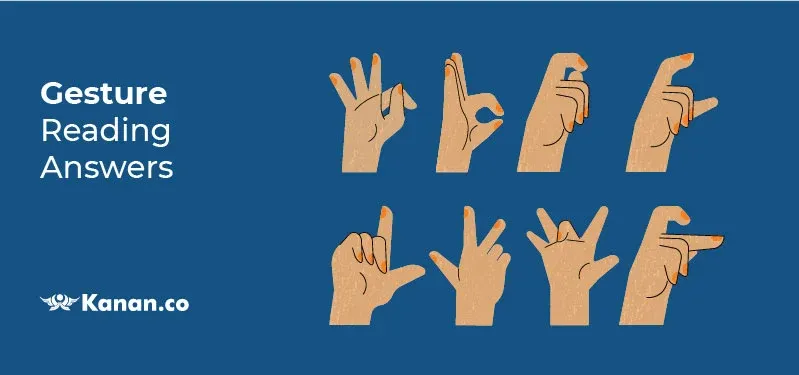
We have given the gesture reading practice tests and answers with explanations. It has 13 questions in 4 different question types- 6 questions are matching headings, 2 questions are multiple choice questions, 3 questions are true, false or not given, and 1 question as multiple choice question.
Check out our YouTube Channel to Practice Full-Length IELTS Reading Tests Daily

Table of contents:
- Solution for gesture
- Gesture IELTS reading practice test
- Passage
- Questions
- Answers with explanations
Solution for gesture
We have given the gesture reading answers, in the table given below.
Answer Table
| 14. iii | 18. ii | 22. A | 26. D |
| 15. Viii | 19. ix | 23. Not given | |
| 16. V | 20. B | 24. True | |
| 17. X | 21. C | 25. True |

Gesture IELTS reading practice test - Exam Review
We have provided a gesture IELTS reading answers. This article will help you to be excellent in the IELTS reading practice to challenge your reading skill and read the given passage to answer the questions.
Passage
We have provided gesture reading answers with location. Scrutinize the passage carefully and answer the questions.
Gesture
- Gesture is any action that sends a visual signal to an onlooker. To become a gesture, an act has to be seen by someone else and has to communicate some pieces of information to them. It can do this either because the gesturer deliberately sets out to send a signal or it can do it only incidentally. The hand-wave is a Primary Gesture, because it has no other existence or function. Therefore, to make it a gesture, first, it should be clear and unambiguous. Others would be able to understand it instantly when it is shown to them. Nor may any component of a gesture, its force, its direction and amplitude of movement, be altered: otherwise, confusion or misunderstanding may occur.
- Most people tend to limit their use of the term “gesture” to the primary form the hand-wave type—but this misses an important point. What matters with gesturing is not what signals we think we are sending out, but what signals are being received. The observers of our acts will make no distinction between our intentional primary gestures and our unintentional, incidental ones. This is why it is preferable to use the term “gesture” in its wider meaning as an “observed action”. This can be compared to the ring of a telephone. The speed, tone and intensity of a telephone remain the same for any phone call. Even the length of time before being told that the number you are dialing is not answering, unless the caller hangs up, is the same.
- Some gestures people use are universal. The shoulder shrug is a case in point. The shrug is done by bringing the shoulders up, drawing the head in, and turning the palms upwards so as to reveal that nothing is hidden. The shoulder shrug can also demonstrate submission or that what is being said isn’t understood. Another example is that an angry person usually expresses his rage by waving his clenched fist rapidly and forcefully. Surprisingly, you may find that people of different cultures will do the same when they are offended. That is to say, a commonly accepted gesture is shared by them. But if the way the hand is clenched changes, or the amplitude of force and the direction the fist is waved alters, the gesture no longer means the same.
- So, is gesture born with us or is it developed as we grow up? Recent research found that gesture is more like a spontaneous reaction when we face certain situations. And we just do that automatically. When people talk, they almost always gesture with their hands. This expressive movement can be coaxed into a choreographic form if observed carefully. People can practice spontaneous gesture by forming pairs, then observing and questioning each other. They then show the group what they have collected from their partners. It is fun to surprise a group using this technique. Because spontaneous gestures are often unconscious, people will sometimes be surprised to have their gestures mirrored back to them, saying “Did I really do that?”
- The attention of research was also drawn to cultural themes. Researchers discovered that if a person has a good set of teeth, he or she would be prone to have a bigger smile than he or she should when good things happen. And if a person possesses a bad set of teeth, he or she would tend to have his or her mouth shut when being teased. And people’s reaction to the same joke also varies: some laugh out loud while others titter. However, this does not cause confusion and it helps to develop our “behavioural”, which is an important aspect of our identity. It was referred to as a Gesture Variant, which indicates that individuals’ gesture production is a complex process, in which speakers’ internal and external factors and interactions could play a role in multi-modal communication.
- During the research, an interesting phenomenon soon caught researchers’ attention. A hand purse gesture, which is formed by straightening the fingers and thumb of one hand and bringing them together so the tips touch, pointing upwards and shaping like a cone, carries different meanings in different countries. In Malta, it means heavy sarcasm: “you may seem good, but you are really bad.”; in Tunisia, it is against recklessness, saying “slow down”; in Italy, it means “What’s the matter?” or “What are you trying to say?”; in France, it means “I am afraid”. However, this gesture has no clear meaning in American culture. And of course, the way the gesture is conducted is similar in different countries.
- But what will happen if the gestures of different countries confront each other? The situation is further complicated by the fact that some gestures mean totally different things in different countries. To take one example, in Saudi Arabia, stupidity can be signalled by touching the lower eyelid with the tip of the forefinger. But this same gesture, in various other countries, can mean disbelief, approval, agreement, mistrust, scepticism, alertness, secrecy, craftiness, danger, or criminality. So people are faced with two basic problems where certain gestures are concerned: either one meaning may be signalled by different actions, or several meanings may be signalled by the same action, as we move from culture to culture. The only solution is to approach each culture with an open mind and learn their gestures as one would learn their vocabulary. These all require considerable skill and training and belong in a totally different world from the familiar gestures we employ in everyday life.
Questions
Questions 14-19
- Reading Passage 2 has seven paragraphs, A-G.
- Choose the correct heading for paragraph A-C and from the list of headings below.
- Write the correct number, i-x, in boxes 14-19 on your answer sheet.
List of Headings
i The subconscious nature of gestures
ii The example of regional differences
iii The key factors of gestures
iv Sending out important signals
v How a well-known gesture loses its meaning
vi Performance in a specific setting
vii Recent research of Gesture Variant
viii Comparison to an everyday-use object
ix How will conflict be handled
x Individual deviation of cultural norms
14 Paragraph A
15 Paragraph B
16 Paragraph C
Example Answer
Paragraph D i
17 Paragraph E
18 Paragraph F
19 Paragraph G
Questions 20 – 22
- Choose the correct letter, A, B, C or D.
- Write your answers in boxes 20-22 on your answer sheet.
20 According to the passage, which aspect of the ringing of a telephone is compared with gestures?
A The length of the ringing.
B The unchanging sound of the ringing.
C The telephone ringing intrudes upon our life.
D The speed of ringing signals the urgency.
21 Which of the diagrams below shows the gesture “Hand Purse”?
22 In which country should the gesture “Hand Purse” be used with caution?
A Malta
B Tunisia
C Italy
D France
Questions 23 – 25
- Do the following statements agree with the information given in Reading Passage 2?
- In boxes 23-25 on your answer sheet, write
- TRUE if the statement agrees with the information
- FALSE if the statement contradicts the information
- NOT GIVEN if there is no information on this
23 Angry people are often in the same age range or group.
24 Personal physical characteristics may affect the gesture used.
25 A Gesture Variant can still be understood by the members of the same culture.
Question 26
- According to the passage, what is the writer’s purpose in writing this passage?
- Choose the correct letter A, B, C or D
- Write your answer in box 26 on your answer sheet.
A to clarify the origin of gesture-based communication
B to promote the worldwide use of gestures
C to investigate whether gesture use affects information content
D to explain the concept of gesture
Answers for gesture with explanation
We have offered Gesture reading answers with explanations, It will help you to rectify your errors in the answering process.
(Note: The text in italics mentions the location and referring lines written in the reading passage)
14. Answer: iii
Explanation: To become a gesture, an act has to be seen by someone else and has to communicate some pieces of information to them. It can do this either because the gesturer deliberately sets out to send a signal or it can do it only incidentally. The hand-wave is a Primary Gesture, because it has no other existence or function. Therefore, to make it a gesture, first, it should be clear and unambiguous. The given answer is located in the 1-6 lines of paragraph A.
15. Answer: Viii
Explanation: This can be compared to the ring of a telephone. The speed, tone and intensity of a telephone remain the same for any phone call. Even the length of time before being told that the number you are dialing is not answering, unless the caller hangs up, is the same. The given answer is located in the last 4 lines of paragraph B.
16. Answer: V
Explanation: The shoulder shrug can also demonstrate submission or that what is being said isn’t understood. Another example is that an angry person usually expresses his rage by waving his clenched fist rapidly and forcefully. Surprisingly, you may find that people of different cultures will do the same when they are offended. The given answer is located in the 3-7 lines of paragraph C.
17. Answer: X
Explanation: The attention of research was also drawn to cultural themes. Researchers discovered that if a person has a good set of teeth, he or she would be prone to have a bigger smile than he or she should when good things happen. And if a person possesses a bad set of teeth, he or she would tend to have his or her mouth shut when being teased. The given answer is located in the 1-4 lines of paragraph E.
18. Answer: ii
Explanation: A hand purse gesture, which is formed by straightening the fingers and thumb of one hand and bringing them together so the tips touch, pointing upwards and shaping like a cone, carries different meanings in different countries. The given answer is located in the 1-4 lines of paragraph F.
19. Answer: ix
Explanation: The situation is further complicated by the fact that some gestures mean totally different things in different countries. To take one example, in Saudi Arabia, stupidity can be signalled by touching the lower eyelid with the tip of the forefinger. The given answer is located in the 1-4 lines of paragraph G.
20. Answer: B
Explanation: This can be compared to the ring of a telephone. The speed, tone and intensity of a telephone remain the same for any phone call. Even the length of time before being told that the number you are dialing is not answering, unless the caller hangs up, is the same. The given answer is located in the last 4 lines of paragraph B.
21. Answer: C
Explanation: A hand purse gesture, which is formed by straightening the fingers and thumb of one hand and bringing them together so the tips touch, pointing upwards and shaping like a cone, carries different meanings in different countries. The given answer is located in the 1-4 lines of paragraph F.
22. Answer: A
Explanation: In Malta, it means heavy sarcasm: “you may seem good, but you are really bad.”; in Tunisia, it is against recklessness, saying “slow down”; in Italy, it means “What’s the matter?” or “What are you trying to say?”; in France, it means “I am afraid”. The given answer is located in the 4-7 lines of paragraph F.
23. Answer: Not given
Explanation: Not Avaliable
24. Answer: True
Explanation: A hand purse gesture, which is formed by straightening the fingers and thumb of one hand and bringing them together so the tips touch, pointing upwards and shaping like a cone, carries different meanings in different countries. The given answer is located in the 1-4 lines of paragraph F.
25. Answer: True
Explanation: It was referred to as a Gesture Variant, which indicates that individuals’ gesture production is a complex process, in which speakers’ internal and external factors and interactions could play a role in multi-modal communication. The given answer is located in the last 4 lines of paragraph E.
26. Answer:D
Explanation: This expressive movement can be coaxed into a choreographic form if observed carefully. People can practice spontaneous gesture by forming pairs, then observing and questioning each other. They then show the group what they have collected from their partners. It is fun to surprise a group using this technique. The given answer is located in the 4-7 lines of paragraph D.
Other Reading Tests

About Author Roshan Sunthar
Roshan Sunthar is a study abroad expert as well as a renowned writer and author in international education. His academic excellence and 5+ years of work experience give him in-depth knowledge of international standardised exams and test preparation in IELTS, TOEFL, GRE, PTE, SAT, etc. The study materials he prepares incorporate exam-like questions. He’s also an expert in writing Statement of Purposes (SOPs) and Letter of Recommendations (LORs) for college admissions. He usually spends his leisure time watching English classics and documentaries, travelling, etc.
Kanan.co is a trusted study abroad consultancy offering comprehensive services, resources, and solutions for students and education institutions. We support students at every stage of their global education journey, ensuring a smooth and guided experience. Along with test preparation for IELTS, GRE, TOEFL, and SAT, we provide expert services such as SOP writing, visa guidance, accommodation support, scholarship assistance, and education loan support. Our expertise and commitment to excellence make us a reliable partner for students pursuing international education.
Free Online Mock Test 2026
Practice our mock test worth Rs. 25000 for Free and know your IELTS score!








Global Headquarters
Kanan Int EdTech Inc
320 Bay Street, Suite 321 (Spaces), Toronto ON, Canada M5B 1N9
Indian Headquarters
Kanan International Pvt. Ltd.
D-wing, 2nd Floor, Trident Complex, Ellora Park Vadiwadi Road, Vadodara, Gujarat 390007
IT/ Digital Campus
Kanan International Pvt. Ltd
Old, New No 3, 2nd Floor, 1A, Dr Sadasivam Rd, T. Nagar, Chennai, Tamil Nadu 600017
Our branches
- Bardoli
- Bharuch
- Chennai
- Dehradun
- Gurugram
- Himatnagar
- Karnal
- Nadiad
- Navsari
- Palanpur
- Rajkot
- Vadodara
- Valsad
- Vallabh Vidyanagar
- Vapi
Study Abroad
Test Prep
Top Universities
Consultants
IELTS Centers
GRE Centers
TOEFL Centers
SAT Centers
Language Courses in Vadodara
Study Abroad Calculators
Featured Blogs
Study Abroad Consultants in Chennai
Study Abroad Consultants in Surat
Study Abroad Consultants in Navsari
Study Abroad Consultants in Bardoli
Study Abroad Consultants in Ahmedabad
Study Abroad Consultants in Anand
Study Abroad Consultants in Khanna
Study Abroad Consultants in Nadiad
Study Abroad Consultants in Vadodara
Study abroad consultants in Valsad
Copyright © 2026 KANAN.CO All rights reserved.