- Study Abroad
- / ielts
- / if you can get used to the taste reading answers
If You Can Get Used To The Taste reading Answers


Author
19-09-2025

If You Can Get Used To The Taste Reading answers’ practice test is provided with answers and explanations. This passage comprises 13 questions divided into three question types - true false not given, table completion, and multiple choice questions.
Table of contents:
- Solution for If You Can Get Used To The Taste
- If You Can Get Used To The Taste IELTS Reading Practice Test
- Passage
- Questions
- Answers with Explanations
Solution for If You Can Get Used To The Taste
We have given If You Can Get Used To The Taste Reading answers in the table below. Verify your answers with our answer table, then correct any inaccuracies.
Answer Table
| 1. False | 5. Calcium | 9. Southern China | 13. D |
| 2. True | 6. Thailand | 10. Eight-Legged Arachnid | |
| 3. False | 7. Indigenous Africans | 11. D | |
| 4. Not given | 8. Mopane Leaves | 12. A |

If You Can Get Used To The Taste IELTS Reading Practice Test - Exam Review
Check out our YouTube Channel to Practice Full-Length IELTS Reading Tests Daily

If You Can Get Used To The Taste Reading answers are given here, which will help you practise your reading module. Do not read the entire passage, instead skim and scan the passages and the lines, find the keywords from the questions in order to find the answers before time.
Passage
We’ve provided the reading passage of If You Can Get Used To The Taste. Read the passage and carefully complete the questions. Check the answers with our If You Can Get Used To The Taste reading answers with locations.
If You Can Get Used To The Taste
A. There is a formal word for it: entomophagy. It means the consumption of insects by us, human beings. Okay, we are not insectivores (eaters of insects), although, it must be admitted, our primate cousins regularly feast on insects. Sure, but those relatives live in trees, and swing from branches, and we don’t. Okay, you say, snails, those slimy garden pests, are relished as a gourmet food, most famously by the French, who are otherwise not interested in garden life. But, I counter, snails are not insects. They are mollusks, and I’d like to think that makes a difference.
B. What I’m talking about is eating true insects, those with six legs, three body parts, hard exoskeleton, and two antennae. We can extend this definition to our eight-legged arachnids (spiders and scorpions), as well. These are creatures people just don’t eat. At least, that was what I thought, until I met a personally as well as ecologically-friendly young man, Peter Ferguson, who advocates insects as the ultimate in culinary delight. Why? Peter explains, ‘For a start, there are many insects, about 10 million species, and a huge biomass of high quality calories, and we just ignore them. In a world having trouble feeding itself, that doesn’t make sense.’
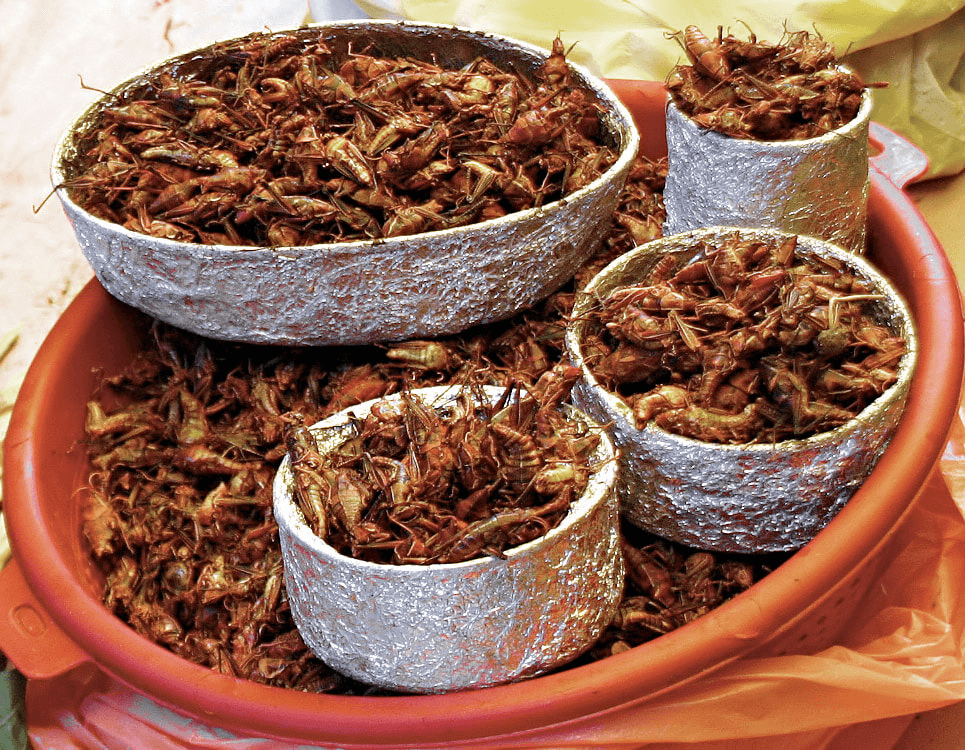
C. Ignore them we do, at least in Western culture, where we have long had much better alternatives. Animal husbandry has characterised our societies, giving us pork, poultry, and cattle, upon which we regularly feast. Yet other cultures don’t have it so lucky, in Africa, in Asia, and among aboriginal or ethnic groups in Oceania, insects have an equally long history as an important dietary supplement, from butterflies and moths, to bees and wasps, cockroaches and ants, beetle grubs or larvae, caterpillars and worms, scorpions (a delicacy in southern China) and tarantulas. Even the Christian Bible states that John the Baptist lived on locusts and wild honey, locusts being grasshoppers in their swarming stage. These same insects, incidentally, are commonly eaten in Thailand, where a visit to a market there will reveal multitudes, deep-fried in glistening piles for the delectation of passing shoppers.
D. Consider the African mopane worm, for example. To begin with, the name is a misnomer. The creature is actually a large colourful caterpillar, which, in the fullness of time, turns into a rather dull-looking moth, although most never reach that stage. The hairy yellow- striped creatures are eagerly sought after, hand-picked from trees in the wild, pinched by the tail-end to squeeze out the slimy green intestinal tract, after which they are most often sun-dried or smoked, thereafter ready for consumption. Tins of mopane worms in brine, or in tomato or chili sauce are common in supermarkets. They can be eaten straight from the can, fried into crunchy snacks, or added as an ingredient to conventional dishes. The harvest and sale of wild mopane worms is now a multi-million dollar industry, feeding millions of people, mostly indigenous Africans.
E. Peter is enthusiastically telling me why he does it. ‘Insects have protein, and all the vitamins, minerals, and fat you could want.’ When I remain skeptical, Peter holds up a fried grasshopper. ‘This has lots of calcium’. Then comes the (you guessed it) termite paste, a black smear with the look, smell, and consistency, of an industrial solvent. ‘Iron. Very rich.’ Then comes the grublike larvae of some form of moth. ‘Essential trace elements such as zinc and copper.’ Anything else? ‘Insects don’t produce greenhouse gases, and don’t need antibiotics.’ Peter even cites my mopane worm example. ‘Three kilograms of mopane leaves will feed a kilogram of worms—-a 30% payback. With cattle, it’s less than 10%. Insects are cheap to buy, cheap to breed, and easy to manage.’
F. One can’t argue with that. The phenomenal rate at which insects breed is well known, and more than makes up for their small size. A female cricket might be a fraction of the weight of a huge beef cow, but lays up to 1,500 eggs a month, converted into food at 20 times the rate of beef, whilst using only a fraction of the space and water. The ecological argument for entomophagy is undeniable, although there are significant concerns about internal parasites, and the accumulation of pesticides and toxins inside many wild insects. Allergic reactions have also been reported. Cooking insects well is recommended, and their consumption should, of course, be avoided, after intensive pesticide use or commercial spraying of local agricultural lands.
G. But what about the taste? Here, Peter hesitates. He finally comes out with a suspicion, ‘You get used to it.’ When I nod sceptically, he comes out with a far more confident, ‘Actually, you’re eating insects already, all the time.’ Yes, apparently, insects find their way into the human food chain, whether we like it or not. For example, most of those who eat rice (as I do) are inadvertently eating not just a few rice weevil larvae, and probably benefited by this, given the additional vitamins these larvae supply. Whole insects, insect parts, insect detritus, larvae, and excrement, appear in all our food, but in such small quantities that they are basically unnoticed and insignificant. Peter smiles. ‘In that sense, we’re already insectivores. We’ve just got to take the next logical step.’
Questions
Questions 1-4
Do the following statements agree with the information given in Reading Passage One?
Write:
TRUE
if the statement agrees with the information
FALSE
if the statement contradicts the information
NOT GIVEN
If there is no information on this
- The French are well known for eating insects.
- Peter Ferguson is a nature-friendly person.
- Insect eating by people is a modern phenomenon.
- Some insects are used for religious purposes.
Questions 5-10
Complete the table.
Choose NO MORE THAN TWO WORDS from the passage for each answer.-
| Insect | One Fact | Another Fact |
| grasshoppers | contain 5. ______ | popular in 6. _______ |
| mopane worms | primarily eaten by 7. _______ | eat 8. _______ |
| scorpions | are popular in 9. ________ | are a type of 10. _______ |
Questions 11-13
Choose the correct letter, A, B, C, or D.
11. Mopane worms
- are appropriately named.
- usually reach their moth form.
- are extensively raised for profit.
- are usually treated before being eaten.
12. Insects
- multiply quickly.
- are best eaten raw.
- are mostly safe to eat.
- produce small amounts of greenhouse gas.
13. The author
- likes snails.
- probably eats mopane worms.
- believes insects can taste good.
- probably eats rice weevil larvae.
Answers for If You Can Get Used To The Taste With Explanations
If You Can Get Used To The Taste Reading answers with explanations is given below. Refer to the following answers with an explanation section in order to correct your errors.
(Note: The text in italics mentions the location and referring lines written in the reading passage.)
1. Answer: False
Explanation: In the last three lines of paragraph A, “snails, those slimy garden pests, are relished as a gourmet food, most famously by the French, who are otherwise not interested in garden life. But, I counter, snails are not insects”.
2. Answer: True
Explanation: In the fifth line of paragraph B, “ecologically-friendly young man, Peter Ferguson”.
3. Answer: False
Explanation: In the last three lines of paragraph F, “Cooking insects well is recommended, and their consumption should, of course, be avoided, after intensive pesticide use or commercial spraying of local agricultural lands”.
4. Answer: Not given
Explanation: —
5. Answer: Calcium
Explanation: In the third line of paragraph E, “This has lots of calcium”.
6. Answer: Thailand
Explanation: In the second last last line of paragraph C, “Commonly eaten in Thailand”.
7. Answer: Indigenous Africans
Explanation: In the last line of paragraph D “mostly indigenous Africans”.
8. Answer: Mopane Leaves
Explanation: In the last third line of paragraph E, “Peter even cites my mopane worm example”.
9. Answer: Southern China
Explanation: In the eight line of paragraph C, “a delicacy in southern China) and tarantulas”.
10. Answer: Eight-Legged Arachnid
Explanation: In the third line of paragraph B, “eight-legged arachnids”.
11. Answer: D
Explanation: In the sixth line of paragraph D, “they are most often sun-dried or smoked”.
12. Answer: A
Explanation: In the first two lines of paragraph F, “The phenomenal rate at which insects breed is well known, and more than makes up for their small size”.
13. Answer: D
Explanation: In the fifth, sixth and seventh lines of paragraph G, “For example, most of those who eat rice (as I do) are inadvertently eating not just a few rice weevil larvae, and probably benefited by this, given the additional vitamins these larvae supply”.
Other Reading Tests

About Author Dinesh Pandiyan
Dinesh is a highly experienced content writer who specializes in language proficiency tests like IELTS, GRE, PTE, TOEFL, and study abroad. He provides valuable insights and tips to students on various modules of these tests, including reading, writing, speaking, and listening. His articles are well-researched, informative, and engaging, offering practical guidance to students looking to succeed in their academic pursuits. Additionally, Dinesh has coordinated with IELTS trainers to prepare test preparation materials, guides, practice tests, and mock tests, and worked closely with counsellors for study abroad consultancy, providing guidance on choosing the right institution, preparing for interviews, and writing effective statements of purpose (SOP) and letters of recommendation (LOR). Students can benefit from Dinesh's comprehensive knowledge and experience by checking out his articles.
Kanan International is a study abroad consultancy that offers reliable services, products, and solutions for students and education institutions. We support students throughout their study abroad journey, ensuring a hassle-free experience. Our expertise and commitment to excellence make us the go-to partner for expanding global horizons. The company provides coaching for IELTS, GRE, TOEFL, and SAT exams and services like visa consultation, accommodation, scholarship assistance, and education loans.
Free Online Mock Test 2026
Practice our mock test worth Rs. 25000 for Free and know your IELTS score!








Global Headquarters
Kanan Int EdTech Inc
320 Bay Street, Suite 321 (Spaces), Toronto ON, Canada M5B 1N9
Indian Headquarters
Kanan International Pvt. Ltd.
D-wing, 2nd Floor, Trident Complex, Ellora Park Vadiwadi Road, Vadodara, Gujarat 390007
IT/ Digital Campus
Kanan International Pvt. Ltd
Old, New No 3, 2nd Floor, 1A, Dr Sadasivam Rd, T. Nagar, Chennai, Tamil Nadu 600017
Our branches
- Bardoli
- Bharuch
- Chennai
- Dehradun
- Gurugram
- Himatnagar
- Karnal
- Nadiad
- Navsari
- Palanpur
- Rajkot
- Vadodara
- Valsad
- Vallabh Vidyanagar
- Vapi
Study Abroad
Test Prep
Top Universities
Consultants
IELTS Centers
GRE Centers
TOEFL Centers
SAT Centers
Language Courses in Vadodara
Study Abroad Calculators
Featured Blogs
Study Abroad Consultants in Chennai
Study Abroad Consultants in Surat
Study Abroad Consultants in Navsari
Study Abroad Consultants in Bardoli
Study Abroad Consultants in Ahmedabad
Study Abroad Consultants in Anand
Study Abroad Consultants in Khanna
Study Abroad Consultants in Nadiad
Study Abroad Consultants in Vadodara
Study abroad consultants in Valsad
Copyright © 2026 KANAN.CO All rights reserved.