- Study Abroad
- / ielts
- / inspired by mimicking mother nature reading answers
Inspired by Mimicking Mother Nature Reading Answers


Author
17-09-2025

We have given “Inspired by Mimicking Mother Nature” reading passage as practice test along with answers and explanations. It has 14 questions that are asked based on the paragraph. There are 2 different question forms where - 6 questions as multiple choice, and 8 questions as yes, no or not given type. Read the passage carefully and answer the questions.
Check out our YouTube Channel to Practice Full-Length IELTS Reading Tests Daily

Table of Contents:
- Solution for Inspired by Mimicking Mother Nature
- Inspired by Mimicking Mother Nature IELTS reading practice test
- Passage
- Questions
- Answers with explanation
Solution for Inspired by Mimicking Mother Nature
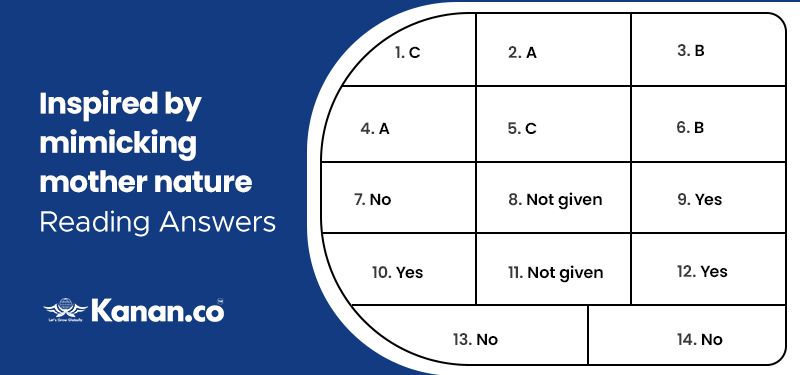
Here the answers for Inspired by Mimicking Mother Nature reading answers are given below in the table form.

Answer Table
| 1. C | 4. A | 7. No | 10. Yes | 13. No |
| 2. A | 5. C | 8. Not given | 11. Not given | 14. No |
| 3. B | 6. B | 9. Yes | 12. Yes |
Inspired by Mimicking Mother Nature IELTS reading practice test - Exam Review
We have given Inspired by Mimicking Mother Nature IELTS reading answers. This article will aid you to be excellent in the IELTS reading practice to challenge your reading skill and go through the given passage and answer the questions.
Passage
Here we have given Inspired by Mimicking Mother Nature reading answers with location. Read the complete passage carefully and answer the questions.
Inspired by Mimicking Mother Nature reading answers
{A} Researchers and designers around the globe endeavor to create new technologies that, by honoring the tenets of life, are both highly efficient and often environmentally friendly. And while biomimicry is not a new concept (Leonardo da Vinci looked to nature to design his flying machines, for example, and pharmaceutical companies have long been miming plant organisms in synthetic drugs), there is a greater need for products and manufacturing processes that use a minimum of energy, materials, and toxins. What’s more, due to technological advancements and a newfound spirit of innovation among designers, there are now myriad ways to mimic Mother Nature’s best assets.
{B} “We have a perfect storm happening right now,” says Jay Harman, an inventor and CEO of PAX Scientific, which designs fans, mixers, and pumps to achieve maximum efficiency by imitating the natural flow of fluids. “Shapes in nature are extremely simple once you understand them, but to understand what geometries are at play, and to adapt them, is a very complex process. We only just recently have had the computer power and manufacturing capability to produce these types of shapes.” “If we could capture nature’s efficiencies across the board, we could decrease dependency on fuel by at least 50 percent,” Harman says. “What we’re finding already with the tools and methodology we have right now is that we can reduce energy consumption by between 30 and 40 percent.”
{C} It’s only recently that mainstream companies have begun to equate biomimicry with the bottom line. DaimlerChrysler, for example, introduced a prototype car modeled on a coral reef fish. Despite its boxy, cube-shaped body, which defies a long-held aerodynamic standard in automotive design (the raindrop shape), the streamlined boxfish proved to be aerodynamically ideal and the unique construction of its skin—numerous hexagonal, bony plates—a perfect recipe for designing a car of maximum strength with minimal weight.
{D} Companies and communities are flocking to Janine Benyus, author of the landmark book Biomimicry: Innovation Inspired by Nature (Perennial, 2002) and cofounder of the Biomimicry Guild, which seats biologists at the table with researchers and designers at companies such as Nike, Interface carpets, Novell, and Procter & Gamble. Their objective is to marry industrial problems with natural solutions.
{E} Benyus, who hopes companies will ultimately transcend mere product design to embrace nature on a more holistic level, breaks biomimicry into three tiers. On a basic (albeit complicated) level, industry will mimic nature’s precise and efficient shapes, structures, and geometries. The microstructure of the lotus leaf, for example, causes raindrops to bead and run off immediately, while self-cleaning and drying its surface—a discovery that the British paint company Sto has exploited in a line of building paints. The layered structure of a butterfly wing or a peacock plume, which creates iridescent color by refracting light, is being mimicked by cosmetics giant L’Oreal in a soon-to-be-released line of eye shadow, lipstick, and nail varnish.
{F} The next level of biomimicry involves imitating natural processes and biochemical “recipes”: Engineers and scientists are now looking at the nasal glands of seabirds to solve the problem of desalination; the abalone’s ability to self-assemble its incredibly durable shell in water, using local ingredients, has inspired an alternative to the conventional, and often toxic, “heat, beat, and treat” manufacturing method. How other organisms deal with harmful bacteria can also be instructive: Researchers for the Australian company Biosignal, for instance, observed a seaweed that lives in an environment teeming with microbes to figure out how it kept free of the same sorts of bacterial colonies, called biofilms, that cause plaque on your teeth and clog up your bathroom drain. They determined that the seaweed uses natural chemicals, called furanones, that jam the cell-to-cell signaling systems that allow bacteria to communicate and gather.
{G} Ultimately, the most sophisticated application of biomimicry, according to Benyus, is when a company starts seeing itself as an organism in an economic ecosystem that must make thrifty use of limited resources and creates symbiotic relationships with other organisms. A boardroom approach at this level begins with imagining any given company, or collection of industries, as a forest, prairie, or coral reef, with its own “food web”(manufacturing inputs and outputs) and asking whether waste products from one manufacturing process can be used, or perhaps sold, as an ingredient for another industrial activity. For instance, Geoffrey Coates, a chemist at Cornell, has developed a biodegradable plastic synthesized from carbon dioxide and limonene (a major component in the oil extracted from citrus rind) and is working with a cement factory to trap their waste CO2 and use it as an ingredient.
{H} Zero Emissions Research and Initiatives (ZERI), a global network of scientists, entrepreneurs, and educators, has initiated eco-industrial projects that attempt to find ways to reuse all wastes as raw materials for other processes. Storm Brewing in Newfoundland, Canada – in one of a growing number of projects around the world applying ZERI principles – is using spent grains, a by-product of the beer-making process, to make bread and grow mushrooms.
As industries continue to adopt nature’s models, entire manufacturing processes could operate locally, with local ingredients like the factories that use liquefied beach sand to make windshields. As more scientists and engineers begin to embrace biomimicry, natural organisms will come to be regarded as mentors, their processes deemed masterful.
Answers for Inspired by Mimicking Mother Nature with explanation
In this section we have given Inspired by Mimicking Mother Nature reading answers with explanations, use this section as refers to correct your errors in the answering process.
1. Answer:
Explanation: “For instance, Geoffrey Coates, a chemist at Cornell, has developed a biodegradable plastic synthesized from carbon dioxide and limonene (a major component in the oil extracted from citrus rind) and is working with a cement factory to trap their waste CO2 and use it as an ingredient”. With this line it is clear that Synthesized Plastic, developed together with cement factories, can recycle waste gas CO2. Hence the given answer is located in the last 4 lines of paragraph G.
2. Answer: A
Explanation: “On a basic (albeit complicated) level, industry will mimic nature’s precise and efficient shapes, structures, and geometries” and “the layered structure of a butterfly wing or a peacock plume, which creates iridescent color by refracting light, is being mimicked by cosmetics giant L’Oreal in a soon-to-be-released line of eye shadow, lipstick, and nail varnish”. With this line it is clear that cosmetics giants are trying to launch products mimicking butterfly wings or peacock plume. It designs geometric patterns occurring in nature, so this is mimicry of nature’s geometry. Hence the given answer is located in paragraph E.
3. Answer: B
Explanation: “The next level of biomimicry involves imitating natural processes and biochemical “recipes”: Engineers and scientists are now looking at the nasal glands of seabirds to solve the problem of desalination; the abalone’s ability to self-assemble it's incredibly durable shell in water, using local ingredients, has inspired an alternative to the conventional, and often toxic, “heat, beat, and treat” manufacturing method”. With this line it is clear that people are looking at the nasal glands of seabirds to solve the problem of desalination. Hence the given answer is located in the first 5 lines of paragraph F.
4. Answer: A
Explanation: “DaimlerChrysler, for example, introduced a prototype car modeled on a coral reef fish”. With this line it is clear that daimler Chrysler introduced a fish-shaped car. Hence the given answer is located in the 2nd and 3rd line of paragraph C.
5. Answer: C
Explanation: “Ultimately, the most sophisticated application of biomimicry, according to Benyus, is when a company starts seeing itself as an organism in an economic ecosystem that must make thrifty use of limited resources and creates symbiotic relationships with other organisms”. From this line it is clear that when a company starts seeing itself as an organism in an economic ecosystem and this paragraph states with an example as coral reefs, which refers to marine. Hence the given answer is located in the first 3 lines of paragraph G.
6. Answer: B
Explanation: “How other organisms deal with harmful bacteria can also be instructive: Researchers for the Australian company Biosignal, for instance, observed a seaweed that lives in an environment teeming with microbes to figure out how it kept free of the same sorts of bacterial colonies, called biofilms, that cause plaque on your teeth and clog up your bathroom drain”. With this line it is clear that other organisms that deal with harmful bacteria can also be instructive researchers for the Australian company Biosignal for instance, observed a seaweed that lives in an environment teeming with microbes. Hence the given answer is located in the 5-10 lines of paragraph F.
7. Answer: No
Explanation: “And while biomimicry is not a new concept (Leonardo da Vinci looked to nature to design his flying machines, for example, and pharmaceutical companies have long been miming plant organisms in synthetic drugs), there is a greater need for products and manufacturing processes that use a minimum of energy, materials, and toxins”. From this line it is clear that biomimicry is not a new concept. Hence the given answer is located in the 3-6 lines of paragraph A.
8. Answer: Not given
9. Answer: Yes
Explanation: “Shapes in nature are extremely simple once you understand them, but to understand what geometries are at play, and to adapt them, is a very complex process”. With this line it is clear that scientists believe it involves more than mimicking the shape to capture the design in nature. Hence the given answer is located in the 3-5 lines of paragraph B.
10. Answer: Yes
Explanation: “If we could capture nature’s efficiencies across the board, we could decrease dependency on fuel by at least 50 percent,” Harman says. “What we’re finding already with the tools and methodology we have right now is that we can reduce energy consumption by between 30 and 40 percent”. With this line it is clear that we can save the utilization of energy by up to 40% if we take advantage of the current findings. Hence the given answer is located in the last 4 lines of paragraph B.
11. Answer: Not given
12. Answer: Yes
Explanation: “Companies and communities are flocking to Janine Benyus, author of the landmark book Biomimicry: Innovation Inspired by Nature (Perennial, 2002) and cofounder of the Biomimicry Guild, which seats biologists at the table with researchers and designers at companies such as Nike, Interface carpets, Novell, and Procter & Gamble”. With this line it is clear that some great companies and communities themselves are seeking solutions beyond their own industrial scope. Hence the given answer is located in the first 4 lines of paragraph D.
13. Answer: No
Explanation: “The microstructure of the lotus leaf, for example, causes raindrops to bead and run off immediately, while self-cleaning and drying its surface—a discovery that the British paint company Sto has exploited in a line of building paints”. With this line it is clear that Sto did make the microstructure of lotus leaf applicable in a line of building paints. Hence the given answer is located in the 4-6 lines of paragraph E.
14. Answer: No
Explanation: “Storm Brewing in Newfoundland, Canada – in one of a growing number of projects around the world applying ZERI principles – is using spent grains, a by-product of the beer-making process, to make bread and grow mushrooms”. With this line it is clear that ZERI principles company is able to use its by-products for bread and mushrooms and not increase production. Hence the given answer is located in the last 4 lines of paragraph H.
Other reading answers

About Author Arivarasi
Arivarasi is an experienced author with expertise in the study abroad industry and preparing test materials for exams like IELTS, TOEFL, GRE, SAT, PTE, etc. She stays up-to-date with university and college requirements for international students which allows her to provide guidance on course selection, documents like SOP, LOR, and scholarship opportunities. She has written numerous articles on study abroad exams, destinations, universities & colleges requirements, admission procedures, and the entire process of studying abroad. Collaborating with industry experts and counselors, she crafts informative articles that make students take the right decisions.
Kanan.co is a trusted study abroad consultancy offering comprehensive services, resources, and solutions for students and education institutions. We support students at every stage of their global education journey, ensuring a smooth and guided experience. Along with test preparation for IELTS, GRE, TOEFL, and SAT, we provide expert services such as SOP writing, visa guidance, accommodation support, scholarship assistance, and education loan support. Our expertise and commitment to excellence make us a reliable partner for students pursuing international education.
Free Online Mock Test 2026
Practice our mock test worth Rs. 25000 for Free and know your IELTS score!








Global Headquarters
Kanan Int EdTech Inc
320 Bay Street, Suite 321 (Spaces), Toronto ON, Canada M5B 1N9
Indian Headquarters
Kanan International Pvt. Ltd.
D-wing, 2nd Floor, Trident Complex, Ellora Park Vadiwadi Road, Vadodara, Gujarat 390007
IT/ Digital Campus
Kanan International Pvt. Ltd
Old, New No 3, 2nd Floor, 1A, Dr Sadasivam Rd, T. Nagar, Chennai, Tamil Nadu 600017
Our branches
- Bardoli
- Bharuch
- Chennai
- Dehradun
- Gurugram
- Himatnagar
- Karnal
- Nadiad
- Navsari
- Palanpur
- Rajkot
- Vadodara
- Valsad
- Vallabh Vidyanagar
- Vapi
Study Abroad
Test Prep
Top Universities
Consultants
IELTS Centers
GRE Centers
TOEFL Centers
SAT Centers
Language Courses in Vadodara
Study Abroad Calculators
Featured Blogs
Study Abroad Consultants in Chennai
Study Abroad Consultants in Surat
Study Abroad Consultants in Navsari
Study Abroad Consultants in Bardoli
Study Abroad Consultants in Ahmedabad
Study Abroad Consultants in Anand
Study Abroad Consultants in Khanna
Study Abroad Consultants in Nadiad
Study Abroad Consultants in Vadodara
Study abroad consultants in Valsad
Copyright © 2026 KANAN.CO All rights reserved.