- Study Abroad
- / ielts
- / islands that float reading answers
Islands That Float Reading Answers


Author
19-09-2025

Here are the Islands That Float reading answers. Eight paragraphs constitute the reading passage from Islands That Float. The 13 different question types that compose Islands That Float Reading Answers are as follows: Matching Features, True/False/Not Given, and Diagram Labelling.
Table of Contents:
- Solution for Islands That Float
- Islands That Float IELTS Reading Practice Test
- Passage
- Questions
- Answers with Explanations
Solution for Islands That Float
For convenience, we have provided Islands That Float reading answers in the table below.
Answer Table
| 1. Not Given | 5. True | 9. C | 13. C |
| 2. True | 6. F | 10. F | |
| 3. False | 7. A | 11. B | |
| 4. Not Given | 8. G | 12. D |

Islands That Float IELTS Reading Practice Test - Exam Review
Check out our YouTube Channel to Practice Full-Length IELTS Reading Tests Daily

Islands That Float Reading Answers provided here will enhance your ability to manage your time strategically and solve reading tasks. It will also help you improve your reading and analytical abilities. For the IELTS reading section, use the appropriate tricks and techniques.
Passage
You should spend 20 minutes answering questions 1–13 for the Islands That Float reading passage. For your convenience, we have provided Islands That Float reading answers with locations.
Islands That Float
Islands are not known for their mobility but occasionally it occurs. Natural floating islands have been recorded in many parts of the world (Burns et al 1985). Longevity studies in lakes have been carried out by Hesser, and in rivers and the open sea by Boughey (Smithsonian Institute 1970). They can form in two common ways: landslides of (usually vegetated) peaty soils into lakes or seawater or as a flotation of peat soils (usually hound by roots of woody vegetation) after storm surges, river floods or lake level rising.
The capacity of the living part of a floating island to maintain its equilibrium in the face of destructive forces, such as fire, wave attack or hogging and sagging while riding sea or swell waves is a major obstacle. In general, ocean-going floating islands are most likely to be short-lived; wave wash-over gradually eliminates enough of the island’s store of fresh water to deplete soil air and kill vegetation around the edges which, in turn, causes erosion and diminishes buoyancy and horizontal mobility.
The forces acting on a floating island determine the speed and direction of movement and are very similar to those which act on floating mobile ice chunks during the partially open-water season (Peterson 1965). In contrast to such ice rafts, many floating islands carry vegetation, perhaps including trees which act as sails. In addition, Burns et al examined the forces acting and concluded that comparatively low wind velocities are required to establish free-floating islands with vegetation standing two metres or more tall.
The sighting of floating islands at sea is a rare event; such a thing is unscheduled, short-lived and usually undocumented. On July 4th, 1969- an island some 15 metres in diameter with 10-15 trees 10-12 metres tall was included in the daily notice to mariners as posing a shipping navigation hazard between Cuba and Haiti. McWhirter described the island as looking “…as though it were held together by a mangrove-type matting; there was some earth on it but it looked kind of bushy around the bottom, like there was dead foliage, grass-like material or something on the island itself. The trees were coming up out of that. It looked like the trees came right out of the surface brown layer. No roots were visible”. By the 14th of July the island had apparently broken up and the parts had partially submerged so that only the upper tree trunks were above the water. By July 19th, no trace of the island was found after an intensive six hour search.
Another example, albeit freshwater, can be found in Victoria, Australia – the floating islands of Pirron Yallock. Accounts of how the floating islands were formed have been given by local residents. These accounts have not been disputed in scientific literature. Prior to 1938, the lake was an intermittent swamp which usually dried out in summer. A drainage channel had been excavated at the lowest point of the swamp at the northern part of its perimeter. This is likely to have encouraged the development or enlargement of a peat mat on the floor of the depression. Potatoes were grown in the centre of the depression where the peat rose to a slight mound. The peat was ignited by a fire in 1938 which burned from the dry edges towards a central damp section. A track was laid through the swamp last century and pavement work was carried out in 1929-30. This causeway restricted flow between the depression and its former southern arm. These roadworks, plus collapse and partial infilling of the northern drainage channel, created drainage conditions conducive to a transition from swamp to permanent lake.
The transformation from swamp to lake was dramatic, occurring over the winter of 1952 when rainfall of around 250 nun was well above average. Peat is very buoyant and the central raised section which had been isolated by the fire, broke away from the rocky, basalt floor as the water level rose in winter. The main island then broke up into several smaller islands which drifted slowly for up to 200 metres within the confines of the lake and ranged in size from 2 to 30 metres in diameter. The years immediately following experienced average or above average rainfall and the water level was maintained. Re-alignment of the highway in 1963 completely blocked the former south-east outlet of the depression, further enhancing its ability to retain water. The road surface also provided an additional source of runoff to the depression.
Anecdotal evidence indicates that the islands floated uninterrupted for 30 years following their formation. They generally moved between the NW and NE sides of the lake in response to the prevailing winds. In 1980, the Rural Water Commission issued a nearby motel a domestic licence to remove water from the lake and occasionally water is taken for the purpose of firefighting. The most significant amount taken for firefighting was during severe fires in February 1983. Since then, the Pirron Yallock islands have ceased to float, and this is thought to be related to a drop in the water level of approximately 600 nun over the past 10-15 years. The islands have either run aground on the bed or the lagoon or vegetation has attached them to the bed.
Floating islands have attracted attention because they are uncommon and their behaviour has provided not only explanations for events in myth and legend but also great scope for discussion and speculation amongst scientific and other observers.
Questions
Questions 1-5
Do the following statements agree with the information given in the Reading Passage?
In boxes 1-5 on your answer sheet write-
TRUE if the statement agrees with the information
FALSE if the statement contradicts the information
NOT GIVEN if there is no information on this
- Natural floating islands occur mostly in lakes.
- Floating Islands occur after a heavy storm or landslide.
- The details of the floating island at sea near Cuba and Haiti were one of many sea-going islands in that area.
- Floating islands at sea sink because the plants on them eventually die.
- Scientists and local residents agree on how the Pirron Yallock Islands were formed.
Questions 6-9
Look at the following people (questions 6-9) and the list of statements below.
Match each person to the correct statement.
Write the correct letter A-G in boxes 6-9 on your answer sheet.
6. Burns
7. Peterson
8. McWhirter
9. Hesser
A. Compared floating islands to floating blocks of ice.
B. Documented the breakup of a sea-going island.
C. Examined floating islands in a confined area.
D. Studied the effect of rivers on floating islands.
E. Like floating islands, floating mobile ice chunks carry vegetation.
F. Even comparatively light winds can create a floating island.
G. Recorded the appearance of a sea-going floating island.
H. Tall trees increase floating island mobility.
Questions 10-13
Complete the labels on the Diagram below.
Write the correct letter A-H in boxes 10-13 on your answer sheet.
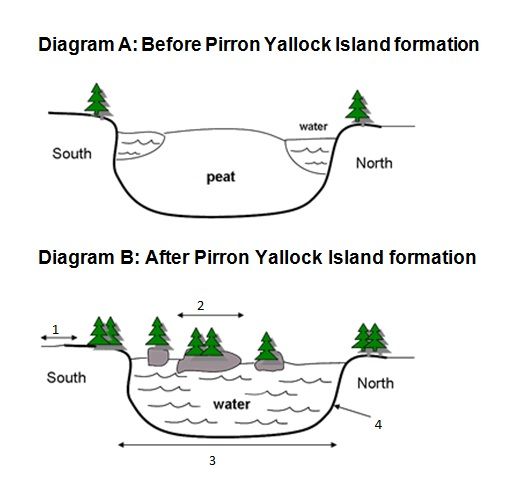
| 5 metres | 30 metres | Basalt | 200 metres |
| 250 metres | Causeway | Highway | Drainage channel |
Answers for Islands That Float With Explanations
We have delivered Islands That Float reading answers with explanations below. Rectifying the answers will be beneficial in your answering process.
(Note: The text highlighted in bold refers to the location and answer in the passage. The explanatory sentences from the reading passage are shown in italics.)
1. Answer: Not Given
Explanation: There is no context for the following sentence, and it is not included in the text.
2. Answer: True
Explanation: In Paragraph 1, it is clearly stated in the study of longevity that they can form in two common ways: landslides of (usually vegetated) peaty soils into lakes or seawater or as a flotation of peat soils (usually hound by roots of woody vegetation) after storm surges, river floods, or lake level rising. It can be interpreted from this that floating Islands occur after a heavy storm or landslide. Therefore, the statement is accurate.
3. Answer: False
Explanation: According to Paragraph 4, the introductory line, the details of the floating island at sea near Cuba and Haiti were one of many sea-going islands in that area. This statement is untrue because it's unusual to see a floating island, as shown by the data that goes with it. The event is sudden, short, and largely undiagnosed. Consequently, the statement that the details of the floating island at sea near Cuba and Haiti were one of many sea-going islands in that area contradicts the provided information. Hence, the correct answer is False.
4. Answer: Not Given
Explanation: There is no context for the following sentence, and it is not included in the text.
5. Answer: True
Explanation: It is illustrated in Paragraph 5, initial lines, that albeit freshwater, it can be found in Victoria, Australia, on the floating islands of Pirron Yallock. Accounts of how the floating islands were formed have been given by local residents. These accounts have not been disputed in the scientific literature. Before 1938, the lake was an intermittent swamp that usually dried out in the summer. On this account, the statement is accurate, as before 1938, accounts of how the Pirron Yallock floating islands were formed were given by local people.
6. Answer: F
Explanation: It is mentioned by Burns in Paragraph 3, last lines, that et al. examined the forces acting and concluded that comparatively low wind velocities are required to establish free-floating islands with vegetation standing two metres or more tall. So, the statement that even comparatively light winds can create a floating island is made by Burns.
7. Answer: A
Explanation: The information is revealed in Paragraph 3, first line, by Peterson that the forces acting on a floating island determine the speed and direction of movement and are very similar to those that act on floating mobile ice chunks during the partially open-water season. Hence, Peterson stated that he compared floating islands to floating blocks of ice.
8. Answer: G
Explanation: In Paragraph 4, the fourth line, it is described by McWhirter that the island looked "as though it were held together by a mangrove-type matting; there was some earth on it, but it looked kind of bushy around the bottom like there was dead foliage, grass-like material, or something on the island itself. Thus, in this paragraph, McWhirter has quoted the recorded appearance of a sea-going floating island.
9. Answer: C
Explanation: Paragraph 1 narrates about the longevity studies carried out in lakes, rivers, and the open sea by Hesser, which say that they can form in two common ways: landslides of (usually vegetated) peaty soils into lakes or seawater or as a flotation of peat soils (usually hound by roots of woody vegetation) after storm surges, river floods, or lake level rising. From this information, it can be understood that Hesser examined floating islands in a confined area.
10. Answer: F
Explanation: It is demonstrated in Paragraph 5, last lines, that the causeway restricted flow between the depression and its former southern arm. These roadworks, plus the collapse and partial infilling of the northern drainage channel, created drainage conditions conducive to a transition from a swamp to a permanent lake. So, after the Pirron Yallock Island formation, the causeway restricted flow in the southern arm.
11. Answer: B
Explanation: It is clearly stated in Paragraph 6, fourth line, that the main island then broke up into several smaller islands, which drifted slowly for up to 200 metres within the confines of the lake and ranged in size from 2 to 30 metres in diameter. This suggests that after the development of Pirron Yallock Island, the larger island disintegrated into smaller ones, ranging in size from 2 to 30 metres, for up to 200 metres in diameter.
12. Answer: D
Explanation: It is pointed out in Paragraph 6, fourth line, that the main island then broke up into several smaller islands, which drifted slowly for up to 200 metres within the confines of the lake and ranged in size from 2 to 30 metres in diameter. This implies that after the formation of Pirron Yallock Island, the main island disintegrated into a smaller island, ranging in size from 2 to 30 metres, for up to 200 metres in diameter.
13. Answer: C
Explanation: It is visible in Paragraph 6, second line, that Peat is very buoyant, and the central raised section, which had been isolated by the fire, broke away from the rocky basalt floor as the water level rose in winter. As per the sentence, it is evident that Peat is quite floating, and as the water level increased in the winter, the central raised area, which had been isolated by the fire, separated from the rocky basalt floor.
Other Reading Tests

About Author Roshan Sunthar
Roshan Sunthar is a study abroad expert as well as a renowned writer and author in international education. His academic excellence and 5+ years of work experience give him in-depth knowledge of international standardised exams and test preparation in IELTS, TOEFL, GRE, PTE, SAT, etc. The study materials he prepares incorporate exam-like questions. He’s also an expert in writing Statement of Purposes (SOPs) and Letter of Recommendations (LORs) for college admissions. He usually spends his leisure time watching English classics and documentaries, travelling, etc.
Kanan.co is a trusted study abroad consultancy offering comprehensive services, resources, and solutions for students and education institutions. We support students at every stage of their global education journey, ensuring a smooth and guided experience. Along with test preparation for IELTS, GRE, TOEFL, and SAT, we provide expert services such as SOP writing, visa guidance, accommodation support, scholarship assistance, and education loan support. Our expertise and commitment to excellence make us a reliable partner for students pursuing international education.
Free Online Mock Test 2026
Practice our mock test worth Rs. 25000 for Free and know your IELTS score!








Global Headquarters
Kanan Int EdTech Inc
320 Bay Street, Suite 321 (Spaces), Toronto ON, Canada M5B 1N9
Indian Headquarters
Kanan International Pvt. Ltd.
D-wing, 2nd Floor, Trident Complex, Ellora Park Vadiwadi Road, Vadodara, Gujarat 390007
IT/ Digital Campus
Kanan International Pvt. Ltd
Old, New No 3, 2nd Floor, 1A, Dr Sadasivam Rd, T. Nagar, Chennai, Tamil Nadu 600017
Our branches
- Bardoli
- Bharuch
- Chennai
- Dehradun
- Gurugram
- Himatnagar
- Karnal
- Nadiad
- Navsari
- Palanpur
- Rajkot
- Vadodara
- Valsad
- Vallabh Vidyanagar
- Vapi
Study Abroad
Test Prep
Top Universities
Consultants
IELTS Centers
GRE Centers
TOEFL Centers
SAT Centers
Language Courses in Vadodara
Study Abroad Calculators
Featured Blogs
Study Abroad Consultants in Chennai
Study Abroad Consultants in Surat
Study Abroad Consultants in Navsari
Study Abroad Consultants in Bardoli
Study Abroad Consultants in Ahmedabad
Study Abroad Consultants in Anand
Study Abroad Consultants in Khanna
Study Abroad Consultants in Nadiad
Study Abroad Consultants in Vadodara
Study abroad consultants in Valsad
Copyright © 2026 KANAN.CO All rights reserved.