- Study Abroad
- / ielts
- / lotte and wytze hellinga reading answers
Lotte and Wytze Hellinga Reading Answer


Author
17-09-2025

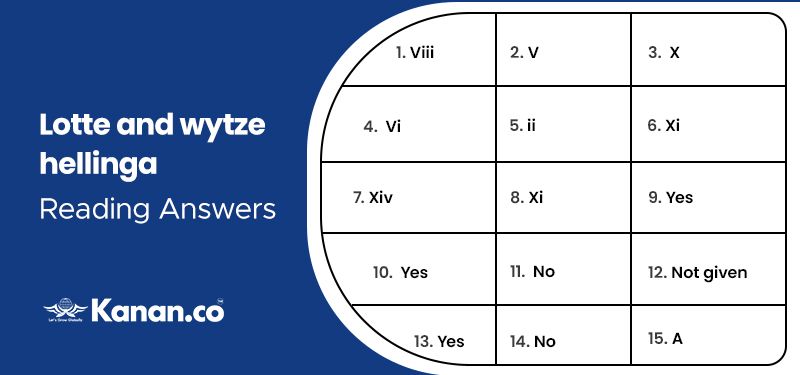
Here Lotte and Wytze Hellinga reading answers is given as a practice test for the with answers and explanations. This article contains 15 questions in 3 different types namely-8 questions as matching headings, 6 questions as yes, no or not given and 1 question as multiple choice. Before answering your questions, go through the given passage completely.
Check out our YouTube Channel to Practice Full-Length IELTS Reading Tests Daily

Table of contents:
- Solution for Lotte and Wytze Hellinga
- Lotte and Wytze Hellinga IELTS practice test
- Passage
- Questions
- Answers with explanation
Solution for Lotte and Wytze Hellinga
Answers for the Lotte and Wytze Hellinga reading answers, are given here in the table form below.

Answer Table
| 1. Viii | 4. Vi | 7. Xiv | 10. Yes | 13. Yes |
| 2. V | 5. ii | 8. Xi | 11. No | 14. No |
| 3. X | 6. Xi | 9. Yes | 12. Not given | 15. A |
Lotte and Wytze Hellinga IELTS Reading Practice Test- Exam Review
We have given the Lotte and Wytze Hellinga IELTS reading answers, as a sample one for the IELTS reading practice test. This article will definitely assist you to be excellent in your major exam. Make sure that before answering the questions, read the given passage thoroughly.
Passage
We have given Lotte and Wytze Hellinga reading answers with location. Be careful while reading the passage and answer the questions.
Lotte and Wytze Hellinga reading answers
- As a student at the University of Amsterdam after the Second World War, Lotte found herself stimulated first by the teaching of Herman de la Fontaine Verwey and then by that of the forceful personality of Wytze Hellinga, at that time Professor of Dutch Philology at the university. Wytze Hellinga’s teaching was grounded in the idea of situating what he taught in its context. Obliged to teach Gothic, for example, he tried to convey a sense of the language rooted in its own time and environment.
- Study of the book was becoming increasingly important at the University of Amsterdam during this period, as the work of de la Fontaine Verwey and Gerrit Willem Ovink testifies. Wytze Hellinga’s interests, formerly largely in a socio-linguistic direction, were now leaning more toward texts and to the book as the medium that carried written texts.
- Much of Wytze’s teaching followed his own research interests, as he developed his ideas around the sense that texts should properly be understood in the context of their method of production and dissemination. He was at this time increasingly turning to codicology and to the classic Anglo-Saxon model of bibliography in the realization that the plan to produce a proper critical edition of the works of Pieter Comeliszoon Hooft, the seventeenth-century poet, dramatist, and historian, depended on the application of the skills of analytical bibliography.
- Encouraged by his work, Lotte produced an undergraduate thesis on the printer’s copy of the Otia of Constantijn Huygens (The Hague, 1625). This work, incidentally, has never been published, although an article was regularly announced as forthcoming in Quaerendo during the early 1970s.
- On graduation in 1958, events took a turn that was to prove fateful. Lotte was awarded a postgraduate fellowship by the Nederlandse Oĩ^anisatie voor Zuiver-Wetenschappelijk Onderzoek (or z.w.o.) to go to England to study fifteenth-century printing, and MarieKronenberg, the doyenne of Dutch bibliographers, arranged for her to be “taught in cunabulizing” (as she put it) by Victor Scholderer at the British Museum.
- As an honorary Assistant Keeper at the Museum, then, she came to England in 1959, assisting among other things with the preparation of BMC volume IX (concerning the production of Holland and Belgium) while studying the texts of the Gouda printer Gerard Leeuto see if the sources (and hopefully printer’s copy) for his editions could be identified. Although the subject proved difficult to define immediately so as to lead in a productive direction, most of this work was nonetheless to find its way into print in such collaborative publications as the Hellingas’ Fifteenth-century printing types, the edition of the Bradshaw correspondence and the 1973 Brussels catalog, to each of which we shall return. But during her time at the Museum, Lotte’s attention was also attracted by such things as English provenances on early-printed continental books, an interest which has stayed with her throughout her career.
- Wytze’s attention too was turning towards incunabula at this time, as witnessed by thefifteenth-century examples used in his Copy and Print in the Netherlands (1962), and there began a fruitful period of collaborative work which was issued in a stream of short bibliographical articles on Low Countries incunabula, and culminated triumphantly in the ground-breaking Fifteenth-Century Printing Types of the Low Countries, commissioned (at Wytze’s instance) by Menno Hertzberger in 1961 and published in IELTS Reading Tests 1966. These years saw periods of intensive study in the libraries strongest in the incunabula of the Low Countries, with whole summers passed in Cambridge and Copenhagen as well as shorter visits to libraries from Oxford to Vienna.
- The partnership between Lotte and Wytze was also to lead to marriage and to the birth of their son. Between 1961 and 1975, the Hellingas were in Amsterdam. In 1965, Lotte obtained a research assistantship for Dutch proto typography from the Z.W.O., and from 1967 she was teaching at the Institute of Dutch Studies at the University of Amsterdam. She continued to develop her interest in analytical bibliography in a number of directions, perhaps most strikingly in important work on early Dutch printing and an examination of the Coster question. She also contributed to the catalog which accompanied the exhibition held in Brussels in 1973 to commemorate the quincentenary of the introduction of printing to the Netherlands, a collaborative work that still provides the best presentation of the work of the early printers of the Low Countries.
- The year 1974 saw the award of a doctorate by the University of Amsterdam for her thesis on the relationship between copy and print in a fifteenth-century printing house, Methode enpraktijk bij het zetten van boeken in de vijftiende eeuw. This seminal work, remaining as a Dutch dissertation of limited diffusion, has perhaps not been as widely read as it deserves. There followed a year’s respite from teaching in 1975 with the commission from Enschede, to edit Harry Carter’s translation of Charles Ensched,’s Type Foundries in the Netherlands, at length published in 1978.
Questions
Questions 1-8
- Reading passage has 9 paragraphs (A-I)
- Choose the most suitable heading for each paragraph from the list of headings below.
- Write the appropriate numbers (i-xv) in boxes 1-8 on your answer sheet.
- You may use each heading only once.
One of the headings has been done for you as an example.
- Paragraph A
- Paragraph B
- Paragraph C
- Paragraph D
- Paragraph E
- Paragraph F
- Paragraph G
- Paragraph H
Example: Paragraph i: iii
List of headings
- The classic Anglo-Saxon model
- Lotte to go to England
- More recognition deserved
- Wytze’s research in Oxford
- Wytze’s interest in texts and the book
- Lotte unpublished
- Lotte to be published ‘
- Lotte’s first influences at university
- Lotte’s work in England
- The development of Wytze’s research
- ‘Back in Amsterdam
- A postgraduate student at university.
- A socio-linguistic direction,
- Wytze’s interest in incunabula
- The birth of a son
Questions 9-14
- Do the statements below agree with the information in the reading passage?
- In boxes 9-14, write:
- Yes, if the statement agrees with the information in the passage
- No ig the statement contradicts the information in the passage
- Not given if there is no information about the statement in the passage
9. Lotte studied at the University of Amsterdam after the Second World War.
10. Prior to his interest in the book, Wytze’s interest was mainly in socio-linguistics.
11. According to Wytze Helinga, the production and dissemination of books were not really matters of importance.
12. When Lotte moved to England, she found it difficult to settle in initially.
13. Lotte lived and worked in Amsterdam during part of the 60s and 70s.
14. Lotte’s post-graduate thesis was widely disseminated.
Question 15
- Choose the appropriate letter A-D and write it in box 15 on your answer sheet.
- 15. The passage is an extract from a much larger text.
15. What type of text is it?
- A biography
- A newspaper editorial
- A bibliography
- Aưavelogue
Answers for Lotte and Wytze Hellinga with Explanation
In this section We have given Lotte and Wytze Hellinga reading answers with explanations, this will aid in identifying your errors in the answering process.
1. Answer: Viii
Explanation: “As a student at the University of Amsterdam after the Second World War, Lotte found herself stimulated first by the teaching of Herman de la Fontaine Verwey and then by that of the forceful personality of Wytze Hellinga, at that time Professor of Dutch Philology at the university”. Hence the given answer is located in paragraph A and this paragraph explains about Lotte's first influences at university.
2. Answer: V
Explanation: “Wytze Hellinga’s interests, formerly largely in a socio-linguistic direction, were now leaning more toward texts and to the book as the medium that carried written texts”. With this line it is clear that this paragraph explains Wytze's interest in texts and the book. Hence the given answer is located in the last 3 lines of paragraph B.
3. Answer: X
Explanation: “Much of Wytze’s teaching followed his own research interests, as he developed his ideas around the sense that texts should properly be understood in the context of their method of production and dissemination”. Hence the given answer is located in the first 3 lines of paragraph C and this paragraph explains the development of Wytze’s research.
4. Answer: Vi
Explanation: “Encouraged by his work, Lotte produced an undergraduate thesis on the printer’s copy of the Otia of Constantijn Huygens (The Hague, 1625). This work, incidentally, has never been published, although an article was regularly announced as forthcoming in Quaerendo during the early 1970s”. Hence the given answer is located in paragraph D and this paragraph explains about Lotte's unpublished work.
5. Answer: ii
Explanation: “On graduation in 1958, events took a turn that was to prove fateful. Lotte was awarded a postgraduate fellowship by the Nederlandse Oĩ^anisatie voor Zuiver-Wetenschappelijk Onderzoek (or z.w.o.) to go to England to study fifteenth-century”. Hence the given answer is located in the 1-4 lines of paragraph E and this paragraph states that Lotte’s to go to England.
6. Answer: ix
Explanation: “As an honorary Assistant Keeper at the Museum, then, she came to England in 1959, assisting among other things with the preparation of BMC volume IX (concerning the production of Holland and Belgium) while studying the texts of the Gouda printer Gerard Leeuto see if the sources (and hopefully printer’s copy) for his editions could be identified”. Hence the given answer is located in the first 5 lines of paragraph F and this paragraph shares about Lotte’s work in England.
7. Answer: xiv
Explanation: “Wytze’s attention too was turning towards incunabula at this time, as witnessed by thefifteenth-century examples used in his Copy and Print in the Netherlands (1962)”. Hence the given answer is located in the 1-3 lines of paragraph G and this paragraph states Wytze’s interest in incunabula.
8. Answer: xi
Explanation: “The partnership between Lotte and Wytze was also to lead to marriage and to the birth of their son. Between 1961 and 1975, the Hellingas were in Amsterdam. In 1965, Lotte obtained a research assistantship for Dutch proto typography from the Z.W.O., and from 1967 she was teaching at the Institute of Dutch Studies at the University of Amsterdam”. Hence the given answer is located in the first 6 lines of paragraph H and this paragraph states that Lotte back to Amsterdam.
9. Answer: Yes
Explanation: “As a student at the University of Amsterdam after the Second World War, Lotte found herself stimulated first by the teaching of Herman de la Fontaine Verwey and then by that of the forceful personality of Wytze Hellinga, at that time Professor of Dutch Philology at the university”. With this line it is clear that Lotte studied at the University of Amsterdam after the Second World War. Hence the given answer is located in the first 4 lines of paragraph A.
10. Answer: Yes
Explanation: “Wytze Hellinga’s interests, formerly largely in a socio-linguistic direction, were now leaning more toward texts and to the book as the medium that carried written texts”. With this line it is clear that Prior to his interest in the book, Wytze’s interest was mainly in socio-linguistics. Hence the given answer is located in the last 3 lines of paragraph B.
11. Answer: No
Explanation: “Much of Wytze’s teaching followed his own research interests, as he developed his ideas around the sense that texts should properly be understood in the context of their method of production and dissemination”. With this line ti is clear that according to Wytze Helinga, the production and dissemination of books were not really matters of importance. Hence the given answer is located in the first 3 lines of paragraph C.
12. Answer: Not given
13. Answer: Yes
Explanation: “The partnership between Lotte and Wytze was also to lead to marriage and to the birth of their son. Between 1961 and 1975, the Hellingas were in Amsterdam. In 1965, Lotte obtained a research assistantship for Dutch proto typography from the Z.W.O., and from 1967 she was teaching at the Institute of Dutch Studies at the University of Amsterdam”. With this line it is clear that Lotte lived and worked in Amsterdam during part of the 60s and 70s. Hence the given answer is located in the 1-5 lines of paragraph H.
14. Answer: No
Explanation: “This seminal work, remaining as a Dutch dissertation of limited diffusion, has perhaps not been as widely read as it deserves”. With this line it is clear that Lotte’s post-graduate thesis has not been widely disseminated. Hence the given answer is located in the 4-5 lines of paragraph I.
15. Answer: A
Explanation: Hence the answer is A biography, because the entire passage states about a woman named Lotte and her life.
Other reading answers

About Author Arivarasi
Arivarasi is an experienced author with expertise in the study abroad industry and preparing test materials for exams like IELTS, TOEFL, GRE, SAT, PTE, etc. She stays up-to-date with university and college requirements for international students which allows her to provide guidance on course selection, documents like SOP, LOR, and scholarship opportunities. She has written numerous articles on study abroad exams, destinations, universities & colleges requirements, admission procedures, and the entire process of studying abroad. Collaborating with industry experts and counselors, she crafts informative articles that make students take the right decisions.
Kanan.co is a trusted study abroad consultancy offering comprehensive services, resources, and solutions for students and education institutions. We support students at every stage of their global education journey, ensuring a smooth and guided experience. Along with test preparation for IELTS, GRE, TOEFL, and SAT, we provide expert services such as SOP writing, visa guidance, accommodation support, scholarship assistance, and education loan support. Our expertise and commitment to excellence make us a reliable partner for students pursuing international education.
Free Online Mock Test 2026
Practice our mock test worth Rs. 25000 for Free and know your IELTS score!








Global Headquarters
Kanan Int EdTech Inc
320 Bay Street, Suite 321 (Spaces), Toronto ON, Canada M5B 1N9
Indian Headquarters
Kanan International Pvt. Ltd.
D-wing, 2nd Floor, Trident Complex, Ellora Park Vadiwadi Road, Vadodara, Gujarat 390007
IT/ Digital Campus
Kanan International Pvt. Ltd
Old, New No 3, 2nd Floor, 1A, Dr Sadasivam Rd, T. Nagar, Chennai, Tamil Nadu 600017
Our branches
- Bardoli
- Bharuch
- Chennai
- Dehradun
- Gurugram
- Himatnagar
- Karnal
- Nadiad
- Navsari
- Palanpur
- Rajkot
- Vadodara
- Valsad
- Vallabh Vidyanagar
- Vapi
Study Abroad
Test Prep
Top Universities
Consultants
IELTS Centers
GRE Centers
TOEFL Centers
SAT Centers
Language Courses in Vadodara
Study Abroad Calculators
Featured Blogs
Study Abroad Consultants in Chennai
Study Abroad Consultants in Surat
Study Abroad Consultants in Navsari
Study Abroad Consultants in Bardoli
Study Abroad Consultants in Ahmedabad
Study Abroad Consultants in Anand
Study Abroad Consultants in Khanna
Study Abroad Consultants in Nadiad
Study Abroad Consultants in Vadodara
Study abroad consultants in Valsad
Copyright © 2026 KANAN.CO All rights reserved.