- Study Abroad
- / ielts
- / mass appeal of the manta rays reading answers
Mass Appeal of the Manta Rays Reading Answers


Author
17-09-2025

Below we have given the Mass Appeal of the Manta Rays reading answers with answers and explanations. In the total 13 questions there are 3 different kinds of questions namely- 3 questions as matching information questions, 6 questions as from true, false or not given questions and 4 questions as of summary completion.
Check out our YouTube Channel to Practice Full-Length IELTS Reading Tests Daily

Table of content:
- Solution for Mass Appeal of the Manta Rays
- Mass Appeal of the Manta Rays IELTS reading practice test
- Passage
- Questions
- Answers with explanation
Solution for Mass Appeal of the Manta Rays
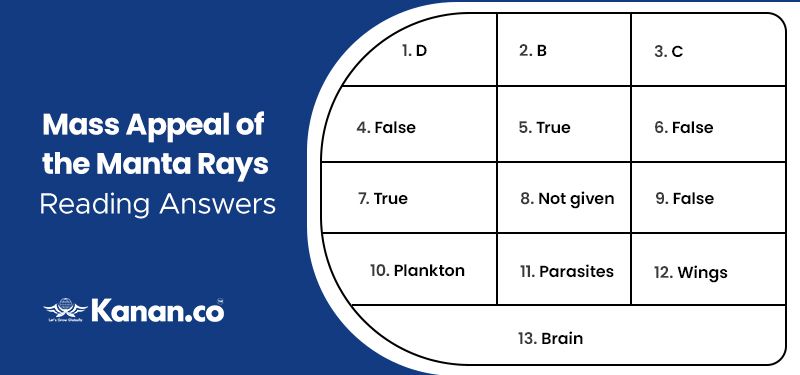
Answers for the Mass Appeal of the Manta Rays reading answers are given below in table format.

Answer Table
| 1. D | 4. False | 7. True | 10. Plankton | 13. Brain |
| 2. B | 5. True | 8. Not given | 11. Parasites | |
| 3. C | 6. False | 9. False | 12. Wings |
Mass Appeal of the Manta Rays IELTS reading practice test - Exam Review
The passage for Mass Appeal of the Manta Rays IELTS reading answers is provided below to enrich your reading skill, with a practice test section which may help you to enhance your answering skill.
Passage
Check out the given passage for a Mass Appeal of the Manta Rays reading answers with location, it helps you to get some important keywords to answer the questions.
Mass Appeal of the Manta Rays
A I am underwater, face to face with a large flat fish which I recognise immediately as being a manta ray. For an instant I look straight into its gaping mouth and see the row of small, flattened teeth in its lower jaw. Close on its tail comes another manta ray, and another and another. The manta rays are unaffected by my being there, cruising past in a leisurely fashion without seeming to expend any great effort.
B From above, the manta rays are great black silhouettes that fishermen called ‘devil fish’, because of the curious horn-like fins hanging down near their mouths. But looking into their eyes you get a sense of their peaceful nature. Unlike stingrays, mantas don’t have venomous spines in their tails, and unlike many fish species they seem to enjoy human company. Once, over-enthusiastically, I swim towards a manta. I am just a few inches away when it senses me. To my surprise, the whole fish twitches in alarm and shoots off, perhaps fearing that I will touch it. I feel ashamed to have given it a fright.
C I have come to Hanifaru, a small lagoon next to an uninhabited island in the Maldives, especially to see manta rays. These great harmless creatures congregate here during the south-west monsoons between May and November and, if the tides and winds are right, enter a shallow cul-de-sac in the reef to hunt for plankton, their main source of nutrition. On certain days the bay can attract more than 100 mantas. I have seen many manta rays on dives around the world, though not in these numbers.
D Guy Stevens is my guide, a British marine biologist who has been studying the mantas for the past five years. Based at the nearby Four Seasons resort, he has identified more than 2,000 individual manta rays, photographing and cataloguing them according to their distinctive skin patterns. Each day we make the 40-minute boat journey from the resort to Hanifaru. Feeding events, as Guy calls them, are never guaranteed, but, during the season, hotel guests can sign up for ‘manta alerts’. If Guy and his research assistants spot significant manta activity, the guests will be brought by fast speedboat to the lagoon to snorkel. When feeding, the mantas of Hanifaru tend to stay near the surface, making them accessible to snorkelers just as much as divers. They seem not to mind the human competition in this quite small space, and indeed they are often joined by other rays and even giant whale sharks, which feed on the same plankton.
E Word among the diving community about the possibility of finding a mass of manta rays at Hanifaru has slowly been spreading over the past year. Outside the shallow lagoon I can see five large safari boats- live-aboard cruisers that take divers around the best underwater sites in the Maldives. It is something that Guy has been monitoring closely. ‘Word is out that Hanifaru is a top manta spot,’ he explains, ‘and although the government has declared the bay a “protected area”, we still don’t have any regulations in force to limit the number of people in the water at any one time’.
F During my stay, the resort received a visit from the then-president of the Maldives, Mohamed Nasheed. Since coming to power in 2008, he had made his interest in the marine environment and concerns about climate change well known. In 2009 he held an underwater cabinet meeting, urging other world leaders to act decisively to combat climate change. The protection of wildlife areas such as Hanifaru was clearly one of his objectives, and I asked him why he took such an interest. ‘Maldivians have lived with the reefs and their fish life since long before there were tourists,’ he said. ‘And while tourist dollars are good for our country, the sea and its produce are even more vital to my people. I have to balance what tourists want to see with preserving the marine environment- and in some cases, like Hanifaru, those objectives coincide’.
G On several dives I am lucky enough to get close to the mantas, sometimes at underwater ‘cleaning stations’. Here, the mantas come in small numbers, or individually, to pause above a coral outcrop and wait while small fish pick at their skin, removing parasites. Adapted for fast swimming with their flattened bodies, they can accelerate rapidly with a twitch of their wings. They gaze at human swimmers with a kind of knowing calm, something people often remark on when they try to capture the emotion they experience after seeing them. ‘The manta rays have the biggest brain of any fish,’ Guy explains, ‘and some manta researchers are convinced that mantas can recognise individual people underwater’.
H I return to the lagoon over the course of several days and learn more from Guy about his hopes for the future. ‘People can visit this place, but I want to be sure that they don’t harass the mantas by touching them or crowding them out while they’re feeding. We’re working to get a full-time ranger station and some kind of permit system to limit the number of boats that can enter the lagoon each day’.
Questions
Questions 1-3
- The reading passage has 8 paragraphs, A-H.
- Which paragraph mentions the following?
- Write the correct letter, A-H, in boxes 1-3 on your answer sheet.
1. A record that is being kept of manta rays in the area
2. Something that the writer regrets
3. The reason for the writer’s visit
Questions 4-9
- Do the following statements agree with the information given in the reading passage?
- In boxes 4-9 on your answer sheet, write
- TRUE – if the statement agrees with the information
- FALSE – if the statement contradicts the information
- NOT GIVEN – if there is no information on this
4. It is difficult to distinguish one manta ray from another.
5. For hotel guests, viewing manta rays feeding has to be arranged at short notice.
6. The manta rays appear to object to the presence of people in the water while they are feeding.
7. Guy Stevens is concerned about the increasing interest in Hanifaru.
8. Mohamed Nasheed succeeded in persuading certain other countries to take steps to protect the environment.
9. A procedure has now been established to control the number of visitors.
Questions 10-13
- Complete the summary below.
- Choose ONE WORD ONLY from the text for each answer.
- Write your answers in boxes 10-13 on your answer sheet.
The Manta Ray
During certain times of year, depending on the weather conditions and the tides, manta rays collect to look for 10……………… to feed on. They eat the same food as other species, such as giant whale sharks. As for keeping clean, they are kept free from 11……………… by smaller fish.
Manta rays have certain characteristics which make them good swimmers; they use their 12……………… to get up speed and they have flattened bodies, which help them to move quickly through the water. The nature of the manta’s 13……………… is of particular interest to scientists.
Answers for Mass Appeal of the Manta Rays with Explanation
Here we have given the answers for Mass Appeal of the Manta Rays reading answers with explanation, use this section to identify your mistakes in the answering process.
1. Answer: D
Explanation: “Based at the nearby Four Seasons resort, he has identified more than 2,000 individual manta rays, photographing and cataloguing them according to their distinctive skin patterns”. With this line it is clear that paragraph D states about a record that is being kept of manta rays in the area. Hence the given answer is located in the 2-4 lines of paragraph D.
2. Answer: B
Explanation: “I feel ashamed to have given it a fright”. With this line it is clear that in paragraph B the author states that he regrets going too near a manta while swimming and alarming it. Hence the given answer is located in the last line of paragraph B.
3. Answer: C
Explanation: “I have come to Hanifaru, a small lagoon next to an uninhabited island in the Maldives, especially to see manta rays”. With this line it is clear that the author states about his reason for the visit. Hence the given answer is located in the first 2 lines of paragraph C.
4. Answer: False
Explanation: “Based at the nearby Four Seasons resort, he has identified more than 2,000 individual manta rays, photographing and cataloguing them according to their distinctive skin patterns”. With this line it is clear that the given statement contradicts with given information. Hence the given answer is located in the 2-4 lines of paragraph D.
5. Answer: True
Explanation: “Feeding events, as Guy calls them, are never guaranteed, but, during the season, hotel guests can sign up for ‘manta alerts’. With this line it is clear that for hotel guests, viewing manta rays feeding has to be arranged at short notice. Hence the given answer is located in the 5-6 lines of paragraph D.
6. Answer: False
Explanation: “When feeding, the mantas of Hanifaru tend to stay near the surface, making them accessible to snorkelers just as much as divers. They seem not to mind the human competition in this quite small space”. With this line it is clear that the given statement contradicts with given information. Hence the given answer is located in the 8-10 lines of paragraph D.
7. Answer: True
Explanation: “ It is something that Guy has been monitoring closely. ‘Word is out that Hanifaru is a top manta spot,’ he explains, ‘and although the government has declared the bay a “protected area”, we still don’t have any regulations in force to limit the number of people in the water at any one time’. With this line it is clear that guy Stevens is concerned about the increasing interest in Hanifaru. Hence the given answer is located in the last 4 lines of paragraph E.
8. Answer: Not given
9. Answer: False
Explanation: “People can visit this place, but I want to be sure that they don’t harass the mantas by touching them or crowding them out while they’re feeding. We’re working to get a full-time ranger station and some kind of permit system to limit the number of boats that can enter the lagoon each day’. With this line it is clear that the given statement contradicts with given information. Hence the given answer is located in the last 4 lines of paragraph H.
10. Answer: Plankton
Explanation: “They seem not to mind the human competition in this quite small space, and indeed they are often joined by other rays and even giant whale sharks, which feed on the same plankton”. With this line it is clear that during certain times of year, depending on the weather conditions and the tides, manta rays collect to look for plankton to feed on. Hence the given answer is located in the last 3 lines of paragraph D.
11. Answer: Parasites
Explanation: “The mantas come in small numbers, or individually, to pause above a coral outcrop and wait while small fish pick at their skin, removing parasites”. With this line it is clear that they eat the same food as other species, such as giant whale sharks. As for keeping clean, they are kept free from parasites by smaller fish. Hence the given answer is located in the 2-4 lines of paragraph G.
12. Answer: Wings
Explanation: “Adapted for fast swimming with their flattened bodies, they can accelerate rapidly with a twitch of their wings”. With this line it is clear that manta rays have certain characteristics which make them good swimmers; they use their wings to get up speed and they have flattened bodies, which help them to move quickly through the water. Hence the given answer is located in the 4-5 lines of paragraph G.
13. Answer: Brain
Explanation: “The manta rays have the biggest brain of any fish,’ Guy explains, ‘and some manta researchers are convinced that mantas can recognise individual people underwater’. With this line it is clear that the nature of the manta’s brain is of particular interest to scientists. Hence the given answer is located in the last 3 lines of paragraph G.
Other reading answers

About Author Arivarasi
Arivarasi is an experienced author with expertise in the study abroad industry and preparing test materials for exams like IELTS, TOEFL, GRE, SAT, PTE, etc. She stays up-to-date with university and college requirements for international students which allows her to provide guidance on course selection, documents like SOP, LOR, and scholarship opportunities. She has written numerous articles on study abroad exams, destinations, universities & colleges requirements, admission procedures, and the entire process of studying abroad. Collaborating with industry experts and counselors, she crafts informative articles that make students take the right decisions.
Kanan.co is a trusted study abroad consultancy offering comprehensive services, resources, and solutions for students and education institutions. We support students at every stage of their global education journey, ensuring a smooth and guided experience. Along with test preparation for IELTS, GRE, TOEFL, and SAT, we provide expert services such as SOP writing, visa guidance, accommodation support, scholarship assistance, and education loan support. Our expertise and commitment to excellence make us a reliable partner for students pursuing international education.
Free Online Mock Test 2026
Practice our mock test worth Rs. 25000 for Free and know your IELTS score!








Global Headquarters
Kanan Int EdTech Inc
320 Bay Street, Suite 321 (Spaces), Toronto ON, Canada M5B 1N9
Indian Headquarters
Kanan International Pvt. Ltd.
D-wing, 2nd Floor, Trident Complex, Ellora Park Vadiwadi Road, Vadodara, Gujarat 390007
IT/ Digital Campus
Kanan International Pvt. Ltd
Old, New No 3, 2nd Floor, 1A, Dr Sadasivam Rd, T. Nagar, Chennai, Tamil Nadu 600017
Our branches
- Bardoli
- Bharuch
- Chennai
- Dehradun
- Gurugram
- Himatnagar
- Karnal
- Nadiad
- Navsari
- Palanpur
- Rajkot
- Vadodara
- Valsad
- Vallabh Vidyanagar
- Vapi
Study Abroad
Test Prep
Top Universities
Consultants
IELTS Centers
GRE Centers
TOEFL Centers
SAT Centers
Language Courses in Vadodara
Study Abroad Calculators
Featured Blogs
Study Abroad Consultants in Chennai
Study Abroad Consultants in Surat
Study Abroad Consultants in Navsari
Study Abroad Consultants in Bardoli
Study Abroad Consultants in Ahmedabad
Study Abroad Consultants in Anand
Study Abroad Consultants in Khanna
Study Abroad Consultants in Nadiad
Study Abroad Consultants in Vadodara
Study abroad consultants in Valsad
Copyright © 2026 KANAN.CO All rights reserved.