- Study Abroad
- / ielts
- / metropolis movies reading answers
Metropolis Movies Reading Answers


Author
19-09-2025

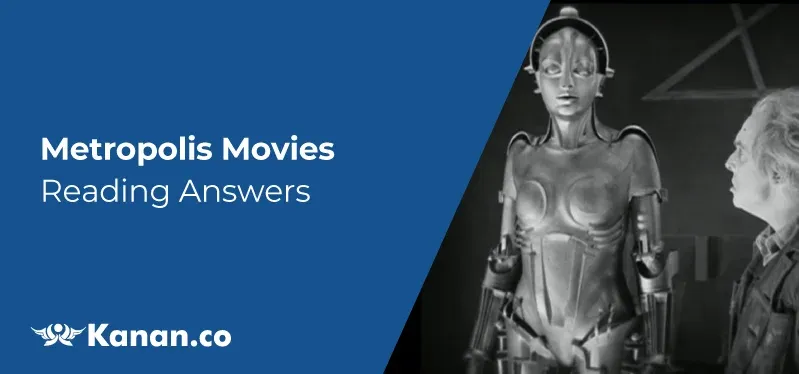
Metropolis Movies Reading Answers are provided below. These will help you evaluate your performance. It has 14 questions of three different question types.
Table of contents:
- Solution for Metropolis Movies
- Metropolis Movies IELTS Reading Practice Test
- Passage
- Questions
- Answers with Explanations
Solution for Metropolis Movies
In the table given below, you have the Metropolis Movies reading answers. Use them to evaluate your band score and performance.
Answer Table
| 27. Yes | 28. Not Given | 29. No | 30. Not Given |
| 31. social divisions | 32. machines | 33. John Frederson | 34. abstract |
| 35. functions | 36. efficiency | 37. C | 38. A |
| 39. B | 40. B |

Metropolis Movies IELTS Reading Practice Test - Exam Review
Check out our YouTube Channel to Practice Full-Length IELTS Reading Tests Daily

The Metropolis Movies IELTS reading practice test is given here. It will help you measure your performance and skills. Read the statement properly to understand it and match it with the line in the passage to identify whether it agrees or contradicts it for the yes/no/not given type of questions. Do not exceed the word limit or the answer will be considered wrong.
Passage
You have been given the Metropolis Movies reading passage below. Spend around 20 minutes solving this passage which consists of 14 questions. Read the passage carefully and swiftly before answering. We have also provided Metropolis Movies reading answers with locations.
Metropolis Movies
- When German director Fritz Lang visited the United States in 1924, his first glimpse of the country was a night-time view of the New York skyline from the deck of an ocean liner. This, he later recalled, was the direct inspiration for what is still probably the most innovative and influential science-fiction film ever made – Metropolis.
- Metropolis is a bleak vision of the early twenty-first century that is at once both chilling and exhilarating. This spectacular city of the future is a technological marvel of high-rise buildings connected by elevated railways and airships. It’s also a world of extreme inequality and social division. The workers live below ground and exist as machines working in an endless routine of mind-numbing 10-hour shifts while the city’s elite lead lives of luxury high above. Presiding over them all is the Master of Metropolis, John Fredersen, whose sole satisfaction seems to lie in the exercise of power.
- Lang’s graphic depiction of the future is conceived in almost totally abstract terms. The function of the individual machines is never defined. Instead, this mass of dials, levers, and gauges symbolically stands for all machines and all industry, with the workers as slave-live extensions of the equipment they have to operate. Lang emphasizes this idea in the famous shift-change sequence at the start of the movie when the workers walk in zombie-like geometric ranks, all dressed in the same dark overalls and all exhibiting the same bowed head and dead-eyed stare. An extraordinary fantasy sequence sees one machine transformed into a huge open-jawed statue which then literally swallows them up.
- On one level the machines and the exploited workers simply provide the wealth and services which allow the elite to live their lives of leisure, but on a more profound level, the purpose of all this demented industry is to serve itself. Power, control, and the continuance of the system from one 10-hour shift to the next is all that counts. The city consumes people and their labor and in the process becomes a perverse parody of a living being.
- It is enlightening, I think, to relate the film to the modern global economy in which multinational corporations now routinely close their factories in one continent so that they can take advantage of cheap labor in another. Like the industry in Metropolis, these corporations’ goals of increased efficiency and profits have little to do with the welfare of the majority of their employees or that of the population at large. Instead, their aims are to sustain the momentum of their own growth and to increase the monetary rewards to a tiny elite – their executives and shareholders. Fredersen himself is the essence of the big company boss: Rupert Murdoch would probably feel perfectly at home in his huge skyscraper office with its panoramic view of the city below. And it is important that there is never any mention of government in Metropolis – the whole concept is by implication obsolete. The only people who have power are the supreme industrialist, Fredersen, and his magician/scientist cohort Rotwang.
- So far so good: when the images are allowed to speak for themselves the film is impeccable both in its symbolism and in its cynicism. The problem with Metropolis is its sentimental storyline, which sees Freder, Fredersen’s son, instantly falling in love with the visionary Maria. Maria leads an underground pseudo-religious movement and preaches that the workers should not rebel but should await the arrival of a ‘Mediator’ between the ‘Head’ (capital) and the ‘Hands’ (labor). That mediator is the ‘Heart’ – love, as embodied, finally, by Freder’s love of Maria and his father’s love of him.
- Lang wrote the screenplay in collaboration with his then-wife Thea von Harbou. In 1933 he fled from the Nazis (and continued a very successful career in Hollywood). She stayed in Germany and continued to make films under the Hitler regime. There is a constant tension within the film between the too-tidy platitudes of von Harbou’s script and the uncompromisingly caustic vigor of Lang’s imagery.
- To my mind, both in Metropolis and in the real world, it’s not so much that the ‘Head’ and ‘Hands’ require a ‘Heart’ to mediate between them but that the ‘Hands’ need to develop their own ‘Head’, their own political consciousness, and act accordingly – through the ballot box, through buying power and through a skeptical resistance to the materialistic fantasies of the Fredersens.
- All the same, Metropolis is probably more accurate now as a representation of industrial and social relations than it has been at any time since its original release. And Fredersen is certainly still the most potent movie symbol of the handful of elusive corporate figureheads who increasingly treat the world as a Metropolis-like global village.
Questions
Questions 27 - 30
Do the following statements agree with the claims of the writer in Reading Passage?
In boxes 27 - 30 on your answer sheet, write
YES: if the statement is true
NO: if the statement is false
NOT GIVEN: if the information is not given in the passage
27. The inspiration for the movie Metropolis comes from the director’s visit to the USA in 1924.
28. The Master of Metropolis, John Fredersen, is portrayed by an industrialist that the director met in the US.
29. The start of the movie exhibits the workers working with full energy.
30. The director and his wife got divorced because his wife decided to stay in Germany.
Questions 31 - 36
Complete the summary below. Use NO MORE THAN TWO WORDS from the Reading Passage for each answer.
Write your answers in boxes 31 - 36 on your answer sheet.
The director depicts a world of inequality and 31. ____________. In the future, the mindless masses of workers living underground are treated as 32. ___________. And the master of them is 33. ___________, who is in charge of the whole city. The writer claims that the director, Fritz Lang, presents the movie in a 34. ___________ term, where the 35. _____________ of the individual machines is not defined. Besides, the writer compares the film to the modern global economy in which multinational corporations concern more about the growing 36. ___________ and money.
Questions 37 - 40
Choose the correct letter, A, B, C, or D.
Write your answers in boxes 37 - 40 on your answer sheet.
37. The first sentence in paragraph B indicates
- the author’s fear of technology
- the inspiration from the director
- the contradictory feelings toward future
- the city elite’s well management of the workers
38. Why the function of the individual machines is not defined?
- Because Lang symbolically sticks to the theme.
- Because workers are more important to exploit.
- Because the fantasy sequence is difficult to take.
- Because the focus of the movie is not about machines.
39 The writer’s purpose in paragraph five is to
- emphasize the multinational corporations’ profit-oriented goal.
- compare the movie with the reality in the modern global economy
- exploit the difference between fantasy and reality
- enlighten the undeveloped industry
40 What is the writer’s opinion about the movie?
- The movie’s storyline is excellent.
- The movie has poor implications in symbolism.
- The movie is perfect in all aspects.
- The movie is good but could be better.
Answers for Making a Sound Investment Decision with Explanations
The Making a Sound Investment Decision reading answers with explanations is provided below. They will help you in assessing your reading skills and band score. As well as help you in rectifying your mistakes.
27. Answer: Yes
Explanation: Paragraph A, Line 1. When German director Fritz Lang visited the United States in 1924, his first glimpse of the country was a night-time view of the New York skyline from the deck of an ocean liner. This, he later recalled, was the direct inspiration for what is still probably the most innovative and influential science-fiction film ever made – Metropolis.
28. Answer: Not Given
Explanation: Not Available. No relevant information regarding this is provided in the passage. Therefore, the answer is not given.
29. Answer: No
Explanation: Paragraph B, Line 2. This spectacular city of the future is a technological marvel of high-rise buildings connected by elevated railways and airships. It’s also a world of extreme inequality and social division. The workers live below ground and exist as machines working in an endless routine of mind-numbing 10-hour shifts while the city’s elite lead lives of luxury high above. The phrase “exist as machine workers” indicates that the workers were not actually working with full energy.
30. Answer: Not Given
Explanation: Not Available. No relevant information regarding this is provided in the passage. Therefore, the answer is not given.
31. Answer: social divisions
Explanation: Paragraph B, Line 2. This spectacular city of the future is a technological marvel of high-rise buildings connected by elevated railways and airships. It’s also a world of extreme inequality and social division.
32. Answer: machines
Explanation: Paragraph B, Line 4. The workers live below ground and exist as machines working in an endless routine of mind-numbing 10-hour shifts while the city’s elite lead lives of luxury high above.
33. Answer: John Frederson
Explanation: Paragraph B, Line 6. Presiding over them all is the Master of Metropolis, John Fredersen, whose sole satisfaction seems to lie in the exercise of power.
34. Answer: abstract
Explanation: Paragraph C, Line 1. Lang’s graphic depiction of the future is conceived in almost totally abstract terms.
35. Answer: functions
Explanation: Paragraph C, Line 2. The function of the individual machines is never defined. Instead, this mass of dials, levers, and gauges symbolically stands for all machines and all industry, with the workers as slave-live extensions of the equipment they have to operate.
36. Answer: efficiency
Explanation: Paragraph E, Line 3. Like the industry in Metropolis, these corporations’ goals of increased efficiency and profits have little to do with the welfare of the majority of their employees or that of the population at large. Instead, their aims are to sustain the momentum of their own growth and to increase the monetary rewards to a tiny elite – their executives and shareholders.
37. Answer: C
Explanation: Paragraph B, Line 1. Metropolis is a bleak vision of the early twenty-first century that is at once both chilling and exhilarating. This spectacular city of the future is a technological marvel of high-rise buildings connected by elevated railways and airships. It’s also a world of extreme inequality and social division. The lines above are indicating that the author has seen an exhilarating city in the future, but it also consists of inequality and social division between people, these are two contradicting visions. Therefore, the answer is option C.
38. Answer: A
Explanation: Paragraph C, Line 1. Lang’s graphic depiction of the future is conceived in almost totally abstract terms. The function of the individual machines is never defined. Instead, this mass of dials, levers, and gauges symbolically stands for all machines and all industry, with the workers as slave-live extensions of the equipment they have to operate. Lang did not explain the functions of the machines, because he wanted to portray the machine and human labor. Hence, it is clear that the correct answer is option A.
39. Answer: B
Explanation: Paragraph E, Line 1. It is enlightening, I think, to relate the film to the modern global economy in which multinational corporations now routinely close their factories in one continent so that they can take advantage of cheap labor in another.
40. Answer: D
Explanation: Paragraph F, Line 1. So far so good: when the images are allowed to speak for themselves the film is impeccable both in its symbolism and in its cynicism. The problem with Metropolis is its sentimental storyline, which sees Freder, Fredersen’s son, instantly falling in love with the visionary Maria. The line clearly shows that the author understood that there were some points of the film which were not up to the mark and thought they could be improved.
Other Reading Tests

About Author Roshan Sunthar
Roshan Sunthar is a study abroad expert as well as a renowned writer and author in international education. His academic excellence and 5+ years of work experience give him in-depth knowledge of international standardised exams and test preparation in IELTS, TOEFL, GRE, PTE, SAT, etc. The study materials he prepares incorporate exam-like questions. He’s also an expert in writing Statement of Purposes (SOPs) and Letter of Recommendations (LORs) for college admissions. He usually spends his leisure time watching English classics and documentaries, travelling, etc.
Kanan.co is a trusted study abroad consultancy offering comprehensive services, resources, and solutions for students and education institutions. We support students at every stage of their global education journey, ensuring a smooth and guided experience. Along with test preparation for IELTS, GRE, TOEFL, and SAT, we provide expert services such as SOP writing, visa guidance, accommodation support, scholarship assistance, and education loan support. Our expertise and commitment to excellence make us a reliable partner for students pursuing international education.
Free Online Mock Test 2026
Practice our mock test worth Rs. 25000 for Free and know your IELTS score!








Global Headquarters
Kanan Int EdTech Inc
320 Bay Street, Suite 321 (Spaces), Toronto ON, Canada M5B 1N9
Indian Headquarters
Kanan International Pvt. Ltd.
D-wing, 2nd Floor, Trident Complex, Ellora Park Vadiwadi Road, Vadodara, Gujarat 390007
IT/ Digital Campus
Kanan International Pvt. Ltd
Old, New No 3, 2nd Floor, 1A, Dr Sadasivam Rd, T. Nagar, Chennai, Tamil Nadu 600017
Our branches
- Bardoli
- Bharuch
- Chennai
- Dehradun
- Gurugram
- Himatnagar
- Karnal
- Nadiad
- Navsari
- Palanpur
- Rajkot
- Vadodara
- Valsad
- Vallabh Vidyanagar
- Vapi
Study Abroad
Test Prep
Top Universities
Consultants
IELTS Centers
GRE Centers
TOEFL Centers
SAT Centers
Language Courses in Vadodara
Study Abroad Calculators
Featured Blogs
Study Abroad Consultants in Chennai
Study Abroad Consultants in Surat
Study Abroad Consultants in Navsari
Study Abroad Consultants in Bardoli
Study Abroad Consultants in Ahmedabad
Study Abroad Consultants in Anand
Study Abroad Consultants in Khanna
Study Abroad Consultants in Nadiad
Study Abroad Consultants in Vadodara
Study abroad consultants in Valsad
Copyright © 2026 KANAN.CO All rights reserved.