- Study Abroad
- / ielts
- / paleolithic cave art reading answers
Paleolithic Cave Art Reading Answers


Author
18-09-2025

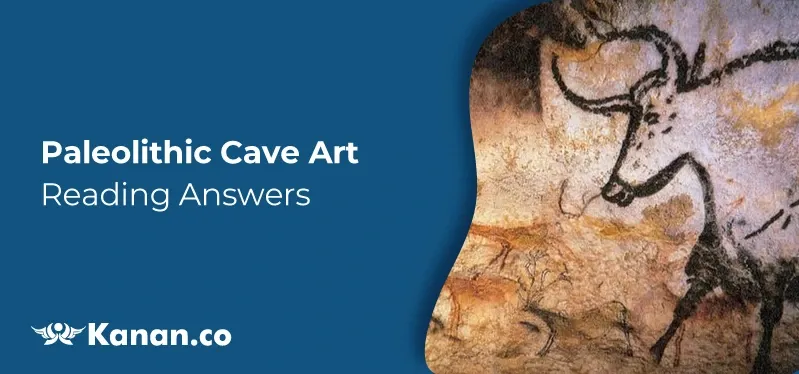
The Paleolithic cave art reading practice test consists of 13 questions. It encompasses two different question types, accompanied by their corresponding answers, locations within the passage, and detailed explanations.
Given question types are, Multiple Choice Questions, and Sentence Completion Questions.
Table of contents:
- Solution for Paleolithic cave art
- Paleolithic cave art IELTS reading practice Test
- Passage
- Questions
- Answers with Explanations
Solution for Paleolithic Cave Art
You are encouraged to refer to the Paleolithic cave art reading answers to evaluate your own responses or identify any possible mistakes you may have made.
Answer Table
| 1. A | 5. B | 9. Engravings | 13. Detailed/realistic |
| 2. C | 6. A | 10. Geometrical desists | |
| 3. A | 7. C | 11. Hands | |
| 4. B | 8. Cave | 12. (full)Human |

Paleolithic cave art IELTS Reading Practice Test - Exam Review
Check out our YouTube Channel to Practice Full-Length IELTS Reading Tests Daily

The answers provided for the IELTS reading module on Paleolithic cave art IELTS reading answers will serve as a valuable resource for your IELTS examination. By committing to more practice and focused preparation, you can work towards achieving your desired score.
Passage
The reading passage of Paleolithic cave art is provided here. Read the whole passage and respond to the questions carefully, and check your responses with Paleolithic cave art reading answers with location.
Paleolithic Cave Art
- Students of art history tend to be familiar with the image of horses and bison discovered in the famous cave art site in Lascaux, France, in 1940. Less well known but vitally important to understanding Ice Age art and culture is the art discovered by three cave explorers in the Chauvet Cave near Vallon-Pont-d’Arc in Southern France 1994.
- The Cauvat cave hosts one of the largest group of Paleolithic drawings yet discovered on one site, as well as the fossilised remains of a number of now extinct animals. The art found in the Chauvet Cave differs from that found in the most other European cave differs from that found in the most other European cave art sites, which primarily feature prey animals such as horses, bison, wild cattle, and reindeer. The Chauvet paintings include many animals that humans would have feared: panthers, bears, lions, hyenas, and rhinoceroses. While, the Chauvet paintings also include many species that would have been hunted by the artists - horses, aurochs, bison, and extinct species of moose and deer - the presence of non-prey animals calls into question a common theory that the primary purpose of cave art was to magically ensure plentiful game. Perhaps the discovery of the Chauvet art points to a shift in emphasis from the hunters’ predators to the hunters’ prey over time, but more evidence is needed.
- Carbon-14 dating has established three of the paintings (one bison and two rhinoceroses) as being 31,000 years old. This discovery pushes the common understanding of the date range for European cave art much further back than what had been assumed. It has also clearly disproved theories that earlier cave art was cruder and more primitive because these older images are equally sophisticated in execution.
- In addition to the hundreds of animal paintings, the Chauvet cave also has an image of a being, referred to as the Sorcerer, with the body of a human and the head of a bison. There is also part of an image of a woman. In addition, explorers found the skull of a cave bear placed on a squared-off altar like rock. The cave had been untouched for thousands of years due to a rock slide that had sealed off the cave; the floor of the cave contains the footprints of humans and cave bears, and fire pits, stone tools, remnants of torches, and bones from meals. After scientists collected data and recorded images, the site was placed off-limits to prevent the damage that has occurred at many other caves known for their rock art.
- Ice Age paintings in certain European caves have been externally well preserved and have reached iconic status because of their beauty and the artists’ skill in execution. As a result, many people assume that the art of early hunters and gatherers was limited to cave paintings. While the artwork in the deep caves has been the best preserved, artwork was also done on the walls of rock shelters and on rock faces out in open light. Paleolithic artists not only painted with pigments but also created engravings by scratching designs into rock with pointed tools, as well as creating low-relief sculpture. Often the artists seemed to have seen a suggestion of an animal's shape in a rock, and then added detail through incising lines, incorporating clay, or applying pigment. In addition to animal images, most sites also have geometrical designs, including dots and quadrangles. Archeologists 1 have also discovered small sculpted figures from the same time period.
- Images of hands, created either by wetting the palm of the hand with paint and pressing the hand onto rock or by applying paint around the hand, perhaps by spitting pigment from the mouth, are common. However, full images of humans are rare in the European caves. Images combining human and animal elements such as the Chauvet cave Sorcerer have been found in various sites as having partial images of women, but portrayals of a full human are few and far between, and they tend to be simple abstract depictions. Most of the animal images, on the other hand, are detailed, realistic portrayals of an individual animal species, not simply an abstract symbol meant to depict an animal such as a horse or bison.
Questions
Questions 1-7
Choose the correct letter.
Write the correct letter A,B, or C, on lines 1-7 on your answer sheet.
1. As compared with the Chauvet Cave, the cave art site in Lascaux is
- more well known.
- less important.
- more difficult to explore.
2. The art discovered in the Chauvet Cave differs from other European cave art because
- it does not include images of horses and bison.
- it shows images of now-extinct animals.
- it includes images of predatory animals.
3. According to the passage, a common belief about the function of cave art is that
- it was meant to bring animals to be hunted.
- it was intended to drive animals to be hunted.
- it was used to warn others about the presence of fearsome animals.
4. As compared with other European cave art sites, the art in the Chauvet Cave is
- cruder and more primitive.
- significantly older.
- more sophisticated in subject matter.
5. Images found in the Chauvet Cave include
- a crude map.
- a part-human, part-animal being.
- a complete drawing of a women
6. In addition to art, other discoveries in the Chauvet Cave include
- implements made of stone.
- human bones.
- bison pelts.
7. No humans had visited the Chauvet Cave for thousands of years because
- cave bears lived inside it.
- it was declared off limits.
- the entrance was blocked by rocks.
Questions 8-13
Complete the sentence below.
Choose NO MORE THAN TWO WORDS from the passage for each answer.
8. People often believe that Paleolithic art considered on rock of ________
9. Ice Age artists used pointed tools to make _________ and sculptures on rocks.
10. As well as pictures of animals, _________ are common in most sites.
11. Pictures of __________ were sometimes made by wetting the palm with paint.
12. It is unusual to see an image of a _________ in European cave art.
13. Rather than being symbolic, paintings of animals are __________ images.
Answers For Paleolithic cave art With Explanations
Paleolithic cave art reading answers with explanations provided here. Prefer this to identify your responses and to recognize your mistakes as well because the answers are given with the proper explanation.
(Note: The text in the italics mentions the location and referring lines written in the reading passage.)
1. Answer: A
Explanation: In the 1st Paragraph, the writers mentioned that, ‘Students of art history tend to be familiar with the image of horses and bison discovered in the famous cave art site in Lascaux, France, in 1940.’ This indicates that it is more well known compared to the Chauvet Cave.
2. Answer: C
Explanation: In the 2nd Paragraph, the writers mentioned that, ‘The Chauvet paintings include many animals that humans would have feared: panthers, bears, lions, hyenas, and rhinoceroses. While, the Chauvet paintings also include many species that would have been hunted by the artists - horses, aurochs, bison, and extinct species of moose and deer - the presence of non-prey animals calls into question a common theory that the primary purpose of cave art was to magically ensure plentiful game.’ The passage states that the Chauvet paintings include many animals that humans would have feared, which suggests the presence of non-prey animals.
3. Answer: A
Explanation: In the 2nd Paragraph, the writers mentioned that, ‘the presence of non-prey animals calls into question a common theory that the primary purpose of cave art was to magically ensure plentiful game.’ This suggests that the purpose of cave art was to attract or bring animals to be hunted.
4. Answer: C
Explanation: In the 3rd Paragraph, the writers mentioned that, ‘This discovery pushes the common understanding of the date range for European cave art much further back than what had been assumed. It has also clearly disproved theories that earlier cave art was cruder and more primitive because these older images are equally sophisticated in execution.’ Based on this information, we can conclude that the art in the Chauvet Cave is not cruder or more primitive, but rather more sophisticated in execution.’
5. Answer: B
Explanation: In the 4th Paragraph, the writers mentioned that, ‘In addition to the hundreds of animal paintings, the Chauvet cave also has an image of a being, referred to as the Sorcerer, with the body of a human and the head of a bison.’ According to these lines, we can conclude that the Chauvet Cave contains images of a part-human, part-animal being.
6. Answer: A
Explanation: In the 4th Paragraph, the writers mentioned that, ‘After scientists collected data and recorded images, the site was placed off-limits to prevent the damage that has occurred at many other caves known for their rock art.’
7. Answer: C
Explanation: In the 4th Paragraph, the writers mentioned that, ‘The cave had been untouched for thousands of years due to a rock slide that had sealed off the cave; the floor of the cave contains the footprints of humans and cave bears, and fire pits, stone tools, remnants of torches, and bones from meals.’ Based on this information, we can conclude that the entrance to the Chauvet Cave was blocked by rocks, preventing human access for thousands of years.
8. Answer: cave
Explanation: In the 5th Paragraph, the writers mentioned that, ‘While the artwork in the deep caves has been the best preserved, artwork was also done on the walls of rock shelters and on rock faces out in open light.’
9. Answer: engravings
Explanation: In the 5th Paragraph, the writers mentioned that, ‘Paleolithic artists not only painted with pigments but also created engravings by scratching designs into rock with pointed tools, as well as creating low-relief sculpture.’
10. Answer: geometrical desists
Explanation: In the 5th Paragraph, the writers mentioned that, ‘In addition to animal images, most sites also have geometrical designs, including dots and quadrangles.’
11. Answer: hands
Explanation: In the 6th Paragraph, the writers mentioned that, ‘Images of hands, created either by wetting the palm of the hand with paint and pressing the hand onto rock or by applying paint around the hand, perhaps by spitting pigment from the mouth, are common.’
12. Answer: (full) human
Explanation: In the 6th Paragraph, the writers mentioned that, ‘Images of hands, created either by wetting the palm of the hand with paint and pressing the hand onto rock or by applying paint around the hand, perhaps by spitting pigment from the mouth, are common. However, full images of humans are rare in the European caves.’
13. Answer: detailed/ realistic
Explanation: In the 6th Paragraph, the writers mentioned that, ‘Most of the animal images, on the other hand, are detailed, realistic portrayals of an individual animal species, not simply an abstract symbol meant to depict an animal such as a horse or bison.’
Other Reading Tests

About Author Roshan Sunthar
Roshan Sunthar is a study abroad expert as well as a renowned writer and author in international education. His academic excellence and 5+ years of work experience give him in-depth knowledge of international standardised exams and test preparation in IELTS, TOEFL, GRE, PTE, SAT, etc. The study materials he prepares incorporate exam-like questions. He’s also an expert in writing Statement of Purposes (SOPs) and Letter of Recommendations (LORs) for college admissions. He usually spends his leisure time watching English classics and documentaries, travelling, etc.
Kanan.co is a trusted study abroad consultancy offering comprehensive services, resources, and solutions for students and education institutions. We support students at every stage of their global education journey, ensuring a smooth and guided experience. Along with test preparation for IELTS, GRE, TOEFL, and SAT, we provide expert services such as SOP writing, visa guidance, accommodation support, scholarship assistance, and education loan support. Our expertise and commitment to excellence make us a reliable partner for students pursuing international education.
Free Online Mock Test 2026
Practice our mock test worth Rs. 25000 for Free and know your IELTS score!








Global Headquarters
Kanan Int EdTech Inc
320 Bay Street, Suite 321 (Spaces), Toronto ON, Canada M5B 1N9
Indian Headquarters
Kanan International Pvt. Ltd.
D-wing, 2nd Floor, Trident Complex, Ellora Park Vadiwadi Road, Vadodara, Gujarat 390007
IT/ Digital Campus
Kanan International Pvt. Ltd
Old, New No 3, 2nd Floor, 1A, Dr Sadasivam Rd, T. Nagar, Chennai, Tamil Nadu 600017
Our branches
- Bardoli
- Bharuch
- Chennai
- Dehradun
- Gurugram
- Himatnagar
- Karnal
- Nadiad
- Navsari
- Palanpur
- Rajkot
- Vadodara
- Valsad
- Vallabh Vidyanagar
- Vapi
Study Abroad
Test Prep
Top Universities
Consultants
IELTS Centers
GRE Centers
TOEFL Centers
SAT Centers
Language Courses in Vadodara
Study Abroad Calculators
Featured Blogs
Study Abroad Consultants in Chennai
Study Abroad Consultants in Surat
Study Abroad Consultants in Navsari
Study Abroad Consultants in Bardoli
Study Abroad Consultants in Ahmedabad
Study Abroad Consultants in Anand
Study Abroad Consultants in Khanna
Study Abroad Consultants in Nadiad
Study Abroad Consultants in Vadodara
Study abroad consultants in Valsad
Copyright © 2026 KANAN.CO All rights reserved.