- Study Abroad
- / ielts
- / population growth sentencing millions to hydrological poverty reading answers
Population Growth Sentencing Millions to Hydrological Poverty Reading Answers


Author
17-09-2025

Here we have given the “Population Growth Sentencing Millions to Hydrological Poverty” reading passage as a practice test along with answers and explanations. This topic consists of 14 questions in 3 different types namely- 6 questions as true, false, or not given questions, 4 questions as locating information, and 4 questions as multiple choice questions. Read the passage completely and answer the questions.
Check out our YouTube Channel to Practice Full-Length IELTS Reading Tests Daily

Table of contents
- Solutions for Population Growth Sentencing Millions to Hydrological Poverty
- Population growth sentencing millions to hydrological Poverty IELTS reading practice test
- Passage
- Questions
- Answers with explanation
Solutions for population growth sentencing millions to hydrological poverty
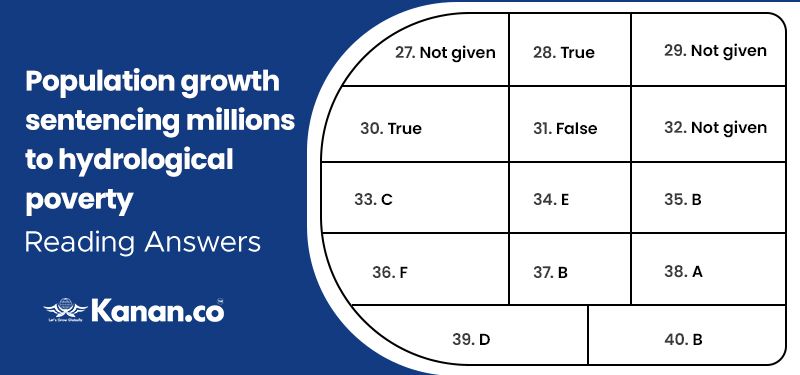
Below, we have given the answers for Population growth sentencing millions to hydrological poverty reading answers in table form.

Answer Table
| 27. Not given | 30. True | 33. C | 36. F | 39. D |
| 28. True | 31. False | 34. E | 37. B | 40. B |
| 29. Not given | 32. Not given | 35. B | 38. A |
Population Growth Sentencing Millions to Hydrological Poverty IELTS reading practice test -Exam Review
Here we have given the Population growth sentencing millions to hydrological poverty IELTS reading answers. This article will definitely help you to attain a band score in main exams.
Passage
We have given Population growth sentencing millions to hydrological poverty reading answers with location. Before answering your question, go through the passage thoroughly.
Population Growth Sentencing Millions to Hydrological Poverty Reading Answers
- At a time when drought in the United States, Ethiopia, and Afghanistan is in the news, it is easy to forget that far more serious water shortages are emerging as the demand for water in many countries simply outruns the supply. Water tables are now falling on every continent; literally, scores of countries are facing water shortages as the tables fall and wells go dry. We live in a water-challenged world, one that is becoming more so each year as 80 million additional people stake their claims to the Earth’s water resources. Unfortunately, nearly all the projected 3 billion people to be added over the next half century will be born in countries that are already experiencing water shortages. Even now, many in these countries lack enough water to drink to satisfy cleanliness needs and to produce food.
- By 2050, India is projected to have added 519 million people and China 211 million. Pakistan is projected to have added nearly 200 million, going from 151 million at present to 348 million. Egypt, Iran, and Mexico are slated to increase their populations by more than half by 2050. In these and other water-short countries, population growth is sentencing millions of people to hydro-logical poverty, a local form of poverty that is difficult to escape.
- Even with today’s 6 billion people, the world has a huge water deficit. Using data on over-pumping for China, India, Saudi Arabia, North Africa and the United States, Sandra Postel, author of Pillar of Sand: Can the Irrigation Miracle Last? Reports the annual depletion of the aquifer to be at 160 billion cubic meters or 160 billion tons. Using the rule of thumb that it takes 1,000 tons of water to produce 1 ton of grain, this 160-billion-ton water deficit is equal to 160 million tons of grain or one-half the US grain harvest.
- Average world grain consumption is just over 300 kilograms per person per annum- one-third of a ton per person per year grain reserves directly or indirectly feed 480 million people globally. Stated otherwise, 480 million of the world’s 6 billion people are being fed with grain produced with the unsustainable use of water.
- Over-pumping is a new phenomenon, one largely confined to the last half-century. Only since the development of powerful diesel-and electrically-driven pumps have we had the capacity to pull water out of the aquifer faster than it is replaced by precipitation. Some 70 percent of the water consumed worldwide, including both that diverted from rivers and that pumped from underground, is used for irrigation, while some 20 percent is used by industry, and 10 percent for residential purposes. In the increasingly intense competition for water among sectors, agriculture almost always loses. The 1,000 tons of water used in India to produce 1 ton of wheat worth perhaps $200 can also be used to expand industrial output by easily $10,000, or 50 times as much. This ratio helps explain why, in the American West, the sale of irrigation water rights by farmers to cities is an almost daily occurrence.
- In addition to population growth, urbanization and industrialization also expand the demand for water. As developing country villagers, traditionally reliant on the village well, move to urban high-rise apartment buildings with indoor plumbing, their residential water use can easily triple. Industrialization takes even more water than urbanization. Rising affluence in itself generates additional demand for water. As people move up the food chain, consuming more beef, pork, poultry, eggs and dairy products, they use more grain. A US diet rich in livestock products requires 800 kilograms of grain per person a year, whereas diets in India, dominated by a starchy food staple such as rice, typically need only 200 kilograms. Using four times as much grain per person means using four times as much water.
- Once a localized phenomenon, water scarcity is now crossing national borders via the international grain trade. The world’s fastest-growing grain import market is North Africa and the Middle East; an area that includes Morocco, Algeria, Tunisia, Libya, Egypt and Iran. Virtually every county in this region is simultaneously experiencing water shortages and rapid population growth.
- As the demand for water in the region’s cities and industries increases, it is typically satisfied by diverting water from irrigation. The loss in food production capacity is then offset by importing grain from abroad. Since 1 ton of grain represents 1,000 tons of water, this becomes the most efficient way to import water.
- Last year, Iran imported 7 million tons of wheat, eclipsing Japan to become the world’s leading wheat importer. This year, Egypt is also projected to move ahead of Japan. Iran and Egypt have nearly 70 million people each. Both populations are increasing by more than a million a year and both are pressing the limits of their water supplies.
- The water required to produce the grain and other foodstuffs imported into North Africa and the Middle East last year was roughly equal to the annual flow of the Nile RIver. Stated otherwise, the fast growing water deficit of this region is equal to another Nile flowing into the region in the form of imported grain.
- It is now often said that future wars in the region will more likely be fought over water than oil. Perhaps, but given the difficulty in winning a water war, the competition for water seems more likely to take place in world grain markets. The countries that will “win” in this competition will be those that are financially strongest, not those that are militarily strongest. The world water deficit grows larger with each year, making it potentially more difficult to manage. If we decided abruptly to stabilize water tables everywhere by simply pumping less water, the world grain harvest would fall by some 160 million tons, or percent, and grain prices would go off the chart. If the deficit continues to widen, the eventual adjustment will be even greater.
- Unless governments in water-short countries act quickly to stabilize their populations and to raise water productivity their water shortages may soon become food shortages. The risk is that the growing number of water-short countries, including population giants China and India, with rising grain-import needs will overwhelm the exportable supply in food surplus countries, such as the United States, Canad, and Australia. This in turn could destabilize world grain markets. Another risk of delay in dealing with the deficit is that some low-income, water-short countries will not be able to afford to import needed grain, trapping millions of their people in hydrological poverty; thirsty and hungry, unable to escape.
- Although there are still some opportunities for developing new water resources, restoring the balance between water use and developing a sustainable supply will depend primarily on demand-side initiatives, such as stabilizing population and raising water productivity. Governments can no longer separate population policy from the supply of water. And just as the world turned to raising land productivity a half century ago when the frontiers of agricultural settlement disappeared, so it must now turn to raising water productivity. The first step toward this goal is to eliminate the water subsidies that foster inefficiency. The second step is to raise the price of water to reflect its cost. Shifting to more water-efficient technologies, more water-efficient crops, and more water-efficient forms of animal protein offers a huge potential for raising water productivity. These shifts will move faster if the price of water more closely reflects its real value.
Questions
Questions 27-32
- Do the following statements agree with the information given in Reading Passage 3?
- In spaces 27-32 below, write.
- True if the statement agrees with the information.
- False if the statement contradicts the information.
- Not given if there is no information on this.
27. Vegetarians drink less water than meat eaters.
28. A typical Indian diet requires less grain than a typical USA diet.
29. Growing grain uses more water than raising beef.
30. People that move from the country to the city may increase their water consumption considerably.
31. Future conflicts will be fought as much over food as they will over oil.
32. Egypt and Japan also import 7 million tons of oil annually.
Questions 33-36
- Reading Passage 3 has 13 paragraphs A - M.
- Which paragraph contains information about the following threats to water supplies?
- Write the correct letter A - M in spaces 33-36 below.
33. The volume of water that is needed for irrigation in grain production.
34. Over-pumping our underground water supplies.
35. Population growth will be responsible for a new type of water-related poverty.
36. Industrialisation demands greater water supplies.
Questions 37-40
- Choose the correct letter A, B, C or D.
37. Our water supply is running low because
A Grain is now exported globally.
B The world’s population is increasing rapidly.
C More people are moving to cities.
D People waste water foolishly.
38. People who have a high-meat diet cause more water to be used because
A It takes more grain to feed livestock than it does a human.
B The industrial processes to produce meat require a lot of water.
C Livestock drink a lot of water.
D Packaging of meat products goes through an intensive washing process.
39. What would reduce the use of water without adversely affecting the food supply?
A Growing fewer crops
B Increasing water subsidies
C Diverting water from irrigation
D Falling population levels
40. If there is a water war, who will win?
A The driest countries
B The richest countries
C The countries that are more forceful
D The countries that have the biggest population
Answers for Population growth sentencing millions to hydrological poverty with Explanation
We have given Population growth sentencing millions to hydrological poverty reading answers with explanations, this section will help you to correct your mistakes in your answering process.
27. Answer: Not given
28. Answer: True
Explanation: “A US diet rich in livestock products requires 800 kilograms of grain per person a year, whereas diets in India, dominated by a starchy food staple such as rice, typically need only 200 kilograms. Using four times as much grain per person means using four times as much water”. With this line it is clear that a typical Indian diet requires less grain than a typical USA diet. Hence the given answer is located in the last 4 lines of paragraph F.
29. Answer: Not given
30. Answer: True
Explanation: “In addition to population growth, urbanization and industrialisation also expand the demand for water. As developing country villagers, traditionally reliant on the village well, move to urban high-rise apartment buildings with indoor plumbing, their residential water use can easily triple”. With this line it is clear that people that move from the country to the city may increase their water consumption considerably. Hence the given answer is located in the first 4 lines of paragraph F.
31. Answer: False
Explanation: “It is now often said that future wars in the region will more likely be fought over water than oil”. With this line it is clear that future conflicts will be fought as much over water as they will over oil. Hence the given answer is located in the first 2 lines of paragraph K.
32. Answer: Not given
33. Answer: C
Explanation: “Can the Irrigation Miracle Last? Reports the annual depletion of the aquifer to be at 160 billion cubic meters or 160 billion tons. Using the rule of thumb that it takes 1,000 tons of water to produce 1 ton of grain”. With this line it is clear that the volume of water that is needed for irrigation in grain production is at 160 billion cubic meters or 160 billion tons. Using the rule of thumb that it takes 1,000 tons of water to produce 1 ton of grain. Hence the given answer is located in the 3-5 lines of paragraph C.
34. Answer: E
Explanation: “Some 70 percent of the water consumed worldwide, including both that diverted from rivers and that pumped from underground”. With this line it is clear that 70 percent of the water consumed worldwide. Hence the given answer is located in the 4-5 lines of paragraph E.
35. Answer: B
Explanation: “Population growth is sentencing millions of people to hydro-logical poverty, a local form of poverty that is difficult to escape”. With this line it is clear that population growth will be responsible for a new type of water-related poverty. Hence the given answer is located in the last 2 lines of paragraph B.
36. Answer: F
Explanation: “In addition to population growth, urbanization and industrialisation also expand the demand for water. As developing country villagers, traditionally reliant on the village well, move to urban high-rise apartment buildings with indoor plumbing, their residential water use can easily triple”. With this line it is clear that industrialisation demands greater water supplies. Hence the given answer is located in the first 4 lines of paragraph F.
37. Answer: B
Explanation: “80 million additional people stake their claims to the Earth’s water resources. Unfortunately, nearly all the projected 3 billion people to be added over the next half century will be born in countries that are already experiencing water shortages”. With this line it is clear that our water supply is running low because the world’s population is increasing rapidly. Hence the given answer is located in the 6-8 lines of paragraph A.
38. Answer: A
Explanation: “Beef, pork, poultry, eggs and dairy products, they use more grain. A US diet rich in livestock products requires 800 kilograms of grain per person a year, whereas diets in India, dominated by a starchy food staple such as rice, typically need only 200 kilograms. Using four times as much grain per person means using four times as much water”. With this line it is clear that people who have a high-meat diet cause more water to be used because it takes more grain to feed livestock than it does a human. Hence the given answer is located in the last 5 lines of paragraph F.
39. Answer: D
Explanation: “water-short countries act quickly to stabilize their populations and to raise water productivity their water shortages may soon become food shortages” and “Another risk of delay in dealing with the deficit is that some low-income, water-short countries will not be able to afford to import needed grain, trapping millions of their people in hydrological poverty; thirsty and hungry, unable to escape”. With this line it is clear that falling population levels reduce the use of water without adversely affecting the food supply. Hence the given answer is located in the first 3 lines and last 4 lines of paragraph L.
40. Answer: B
Explanation: “It is now often said that future wars in the region will more likely be fought over water than oil. Perhaps, but given the difficulty in winning a water war, the competition for water seems more likely to take place in world grain markets. The countries that will “win” in this competition will be those that are financially strongest, not those that are militarily strongest”. With this line it is clear that the richest countries will win if there is a water war. Hence the given answer is located in the first 5 lines of paragraph K.
Other reading answers

About Author Gayathri Nagarajan
Gayathri, a trusted study-abroad expert, with expertise in standardized tests like IELTS, TOEFL, PTE, GRE, and GMAT. With a strong tech background from SASTRA University, she excels in software testing and has a passion for content writing and digital marketing. She aids students in finding the perfect academic fit, offering guidance on course selection, LOR and SOP writing. She remains up-to-date with the latest trends in higher education, delivering credible, accurate information on international education, including courses and test prep materials. As a trusted Study abroad expert at Kanan International, explore her latest blogs and articles for comprehensive insights into studying abroad and realizing your academic aspirations.
Kanan.co is a trusted study abroad consultancy offering comprehensive services, resources, and solutions for students and education institutions. We support students at every stage of their global education journey, ensuring a smooth and guided experience. Along with test preparation for IELTS, GRE, TOEFL, and SAT, we provide expert services such as SOP writing, visa guidance, accommodation support, scholarship assistance, and education loan support. Our expertise and commitment to excellence make us a reliable partner for students pursuing international education.
Free Online Mock Test 2026
Practice our mock test worth Rs. 25000 for Free and know your IELTS score!








Global Headquarters
Kanan Int EdTech Inc
320 Bay Street, Suite 321 (Spaces), Toronto ON, Canada M5B 1N9
Indian Headquarters
Kanan International Pvt. Ltd.
D-wing, 2nd Floor, Trident Complex, Ellora Park Vadiwadi Road, Vadodara, Gujarat 390007
IT/ Digital Campus
Kanan International Pvt. Ltd
Old, New No 3, 2nd Floor, 1A, Dr Sadasivam Rd, T. Nagar, Chennai, Tamil Nadu 600017
Our branches
- Bardoli
- Bharuch
- Chennai
- Dehradun
- Gurugram
- Himatnagar
- Karnal
- Nadiad
- Navsari
- Palanpur
- Rajkot
- Vadodara
- Valsad
- Vallabh Vidyanagar
- Vapi
Study Abroad
Test Prep
Top Universities
Consultants
IELTS Centers
GRE Centers
TOEFL Centers
SAT Centers
Language Courses in Vadodara
Study Abroad Calculators
Featured Blogs
Study Abroad Consultants in Chennai
Study Abroad Consultants in Surat
Study Abroad Consultants in Navsari
Study Abroad Consultants in Bardoli
Study Abroad Consultants in Ahmedabad
Study Abroad Consultants in Anand
Study Abroad Consultants in Khanna
Study Abroad Consultants in Nadiad
Study Abroad Consultants in Vadodara
Study abroad consultants in Valsad
Copyright © 2026 KANAN.CO All rights reserved.