- Study Abroad
- / ielts
- / reading practice test
IELTS Academic Reading Test 23 Questions and Answers


Author
19-09-2025

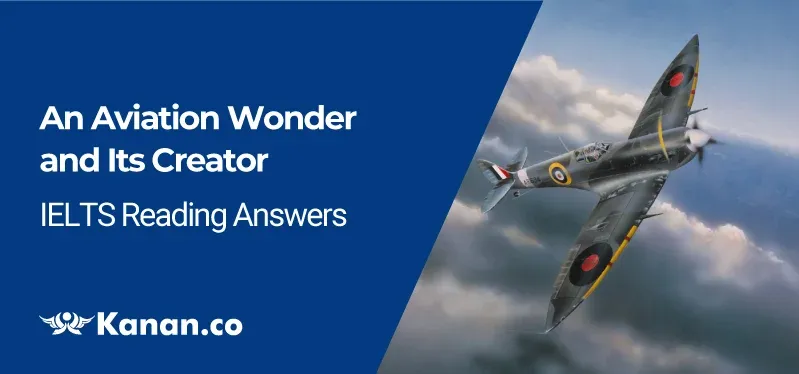
An aviation wonder and its creator, the Academic reading passage has 14 questions in three different types flow chart completion, multiple choice questions, and locating information. For your reference, we have given an aviation wonder and its creator reading answers below. Practice this test and verify your answers with original the ones.

Check out our YouTube Channel to Practice Full-Length IELTS Reading Tests Daily

An Aviation Wonder and its Creator.
A. The Supermarine Spitfire was a single-seater fighter plane used by the British Royal Airforce and pilots from a number of the country’s allies during the Second World War. The first flight of a Spitfire prototype was on 5 March 1936 and usage of the plane continued until the 1950s. It was said to be one of the most effective fighter planes available during that period and was produced by
Vickers-Armstrongs, a British engineering corporation which was formed in 1927 as a result of the merger of Vickers Limited and Sir W G Armstrong Whitworth & Company.
B. The Spitfire was designed by aeronautical engineer Reginald Joseph Mitchell. His career began when he joined a locomotive engineering company in 1911 at the age of 16. However, in 1917 he moved from his hometown to join the Supermarine Aviation works in Southampton and was promoted to Chief Designer within his first year of employment. By the time the company was taken over by Vickers-Armstrongs in 1928, Mitchell had held the post of Technical Director for a year; and his capabilities and contributions were deemed so significant Vickers-Armstrong made his continual employment for a five year period a condition of the purchase of the company.
C. In the fifteen years prior to 1936 Mitchell designed 24 aircraft of different categories including fighter planes, bombers and seaplanes. The first predecessor of the Spitfire in the fighter plane category to gain him national acclaim was the Supermarine S.B for which he won the Schneider Trophy (a cup and monetary award for technical advances in aviation which came to focus mainly on speed) in 1931. Despite the withdrawal of financial support from the British Government that year, the Supermarine S.B. was able to compete for the Schneider Trophy as a result of a private donation of 100,000 pounds. Mitchell’s team won outright on September 13th their aircraft achieving a new world speed record of 606 km/h; within days the Supermarine S.B. went on to break its own newly achieved record when on the 29th of the same month it became the first aircraft ever to achieve speeds of over 400 miles per hour (640 kilometres) when it reached 407.5 mph (640 kilometres per hour).
D. Reginald Joseph Mitchell was awarded a CBE in 1932 for his contributions to high-speed flight. CBEs are awarded by the British Monarch and reserved to recognise individuals who have ‘fulfilled a conspicuous leading role in regional affairs, through achievement or service to the community, or making a highly distinguished, innovative contribution in his or her area of activity’. Mitchell’s achievements with the Supermarine S.B. also prompted the Air Ministry to contract his company for the design of a new fighter aircraft, despite the organisation’s reputation being built predominantly on sea-plane and not fighter plane manufacturing.
E. The first type, the 224, was to prove unsuccessful and it was eventually rejected by the Royal Air Force due to unsatisfactory performance; however, private sponsorship enabled research, development and modifications which led to the creation of the Type 300 which would eventually become the Spitfire. Soon after the first flight of the Spitfire prototype (trial version) and prior to completion of all stages of its official trials, convinced by its potential, the British Royal Air Force ordered 310 models. With its smooth lines, load-bearing metal shell, and a heavy eight-machine gun armament, the Spitfire was considered revolutionary. In 1938, the aircraft was first put into official service; however, Mitchell, who died from cancer in 1937 at the age of 42, was not to witness this or the extensive impact and longevity of use the aircraft would have. In total 20,351 spitfires of different versions were produced making it the most produced British aircraft of the Second World War.
F. After Mitchell’s death, his former Chief Draughtsman Joe Smith took over the position of Technical Director and led the subsequent development of the Spitfire which would keep it at the forefront of aircraft technology while many other designs quickly became obsolete; 24 models of spitfire were designed along with many sub-variants containing different engine types and possessing different wing configurations; the most widely used being the Spitfire Mark V, of which 6,479 were built. The original version first used for active service in 1938 had a top speed of approximately 580 km per hour; while one of the last models used in the later stages of the Second World War – the Spitfire XIV – had a top speed capability of 710 km per hour. Spitfires were used continually by the Royal Air Force, later purely as surveillance planes (to monitor activity overhead though carrying no armament), until 1954 when the last model was retired.
G. In his hometown, Reginald Joseph Mitchell C.B.E. is today remembered in a number of ways. A combined theatre and education centre ‘The Mitchell Memorial Theatre’ bears his name, and the city museum, at the entrance of which stands a bronze statue of Mitchell, displays an authentic and complete Spitfire as part of its collection. In addition, a local high school is named after him; as is a major roadway and he is locally recognised as one of the most significant historical sons of the town.
Questions
Questions 1-6
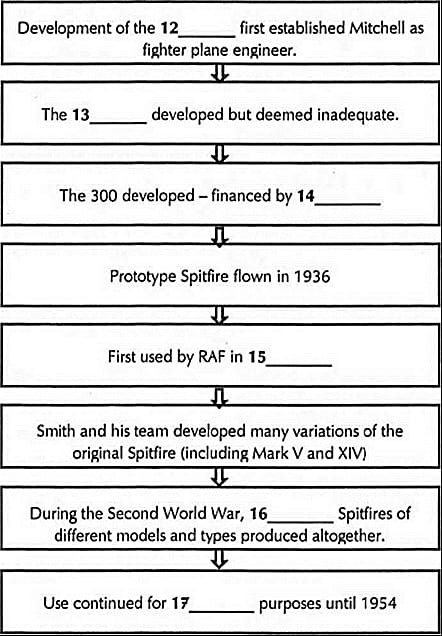
Complete the flowchart below.
Choose No more than two words from the passage for each answer.
Write your answers in the blank spaces next to 1 and 6 on your answer sheet.
Questions 7-9
According to the information in the passage, classify the following information as relating to:
A The Supermarine SB
B The Spitfire
C Neither the Supermarine SB or the Spitfire
D Both the Supermarine SB and the Spitfire
Write the correct letter, A, B, C or D in boxes 7-9 on your answer sheet.
7. Its development was commissioned by the Air Ministry_______
8. Mitchell was awarded the CBE due to its development_______
9. It was innovative for its time.________
Questions 10-14
Reading passage 2 has seven paragraphs A-G.
Which paragraph contains the following information?
Write the correct letter A-G in boxes 10-14 on your answer sheet.
NB you may use any letter more than once.
10. Where did the Royal Air Force show faith in Mitchell’s engineering capability without complete evidence?_____
11. Where does Mitchell's involvement influence a business purchase?____
12. How Mitchell has been honored since his death>____
13. Details of specific differences between spitfire models_____
14. Details of what differentiated the Spitfire from other alternatives_____
Aviation Wonder and its Creator Reading Answers
1. Supermarine S.B.
2. 224
3. Private sponsorship
4. 1938
5. 20,351 Spitfires (17 types).
6. Surveillance
7. C
8. A
9. D
10. E
11. B
12. G
13. F
14. E
Other reading answers

About Author Arivarasi
Arivarasi is an experienced author with expertise in the study abroad industry and preparing test materials for exams like IELTS, TOEFL, GRE, SAT, PTE, etc. She stays up-to-date with university and college requirements for international students which allows her to provide guidance on course selection, documents like SOP, LOR, and scholarship opportunities. She has written numerous articles on study abroad exams, destinations, universities & colleges requirements, admission procedures, and the entire process of studying abroad. Collaborating with industry experts and counselors, she crafts informative articles that make students take the right decisions.
Kanan.co is a trusted study abroad consultancy offering comprehensive services, resources, and solutions for students and education institutions. We support students at every stage of their global education journey, ensuring a smooth and guided experience. Along with test preparation for IELTS, GRE, TOEFL, and SAT, we provide expert services such as SOP writing, visa guidance, accommodation support, scholarship assistance, and education loan support. Our expertise and commitment to excellence make us a reliable partner for students pursuing international education.
Free Online Mock Test 2026
Practice our mock test worth Rs. 25000 for Free and know your IELTS score!








Global Headquarters
Kanan Int EdTech Inc
320 Bay Street, Suite 321 (Spaces), Toronto ON, Canada M5B 1N9
Indian Headquarters
Kanan International Pvt. Ltd.
D-wing, 2nd Floor, Trident Complex, Ellora Park Vadiwadi Road, Vadodara, Gujarat 390007
IT/ Digital Campus
Kanan International Pvt. Ltd
Old, New No 3, 2nd Floor, 1A, Dr Sadasivam Rd, T. Nagar, Chennai, Tamil Nadu 600017
Our branches
- Bardoli
- Bharuch
- Chennai
- Dehradun
- Gurugram
- Himatnagar
- Karnal
- Nadiad
- Navsari
- Palanpur
- Rajkot
- Vadodara
- Valsad
- Vallabh Vidyanagar
- Vapi
Study Abroad
Test Prep
Top Universities
Consultants
IELTS Centers
GRE Centers
TOEFL Centers
SAT Centers
Language Courses in Vadodara
Study Abroad Calculators
Featured Blogs
Study Abroad Consultants in Chennai
Study Abroad Consultants in Surat
Study Abroad Consultants in Navsari
Study Abroad Consultants in Bardoli
Study Abroad Consultants in Ahmedabad
Study Abroad Consultants in Anand
Study Abroad Consultants in Khanna
Study Abroad Consultants in Nadiad
Study Abroad Consultants in Vadodara
Study abroad consultants in Valsad
Copyright © 2026 KANAN.CO All rights reserved.