- Study Abroad
- / ielts
- / reading practice test
Solution for the IELTS Reading Passage


Author
16-09-2025

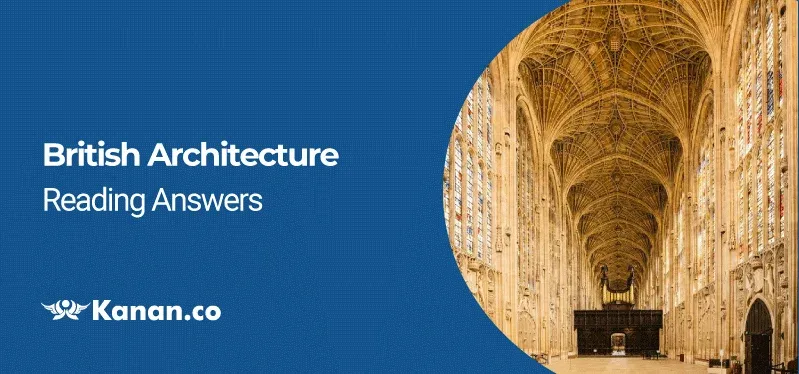
In this article we have given an IELTS Reading Passage for your Practise. It has13 questions in 2 different kinds of questions -7 questions as sentence completion questions form, 6 questions as multiple choice questions form. Read the passage and figure out your own answers. Compare your answers with our table below. For detailed explanation of the answer scroll down!
Check out our YouTube Channel to Practice Full-Length IELTS Reading Tests Daily

Solution Table
| 1. Wood | 5. Furniture and textiles | 9. A | 13. C |
| 2. Status and wealth | 6. Edwin Lutyens | 10. D | |
| 3. Expensive commodity | 7. Local authorities | 11. A | |
| 4. Classical | 8. B | 12. C |

British architecture IELTS Reading Passage
A. Architecture is about evolution, not revolution. It used to be thought that once the Romans pulled out of Britain in the fifth century, their elegant villas, carefully-planned towns and engineering marvels like Hadrian’s Wall simply fell into decay as British culture was plunged into the Dark Ages. It took the Norman Conquest of 1066 to bring back the light, and the Gothic cathedral-builders of the Middle Ages played an important part in the revival of British culture. However, the truth is not as simple as that Romano-British culture – and that included architecture along with language, religion, political organization and the arts – survived long after the Roman withdrawal. And although the Anglo- Saxons had a sophisticated building style of their own, little survives to bear witness to their achievements as the vast majority of Anglo-Saxon buildings were made of wood.
B. Even so, the period between the Norman landing at Pevensey in 1066 and the day in 1485 when Richard III lost his horse and his head at Bosworth, ushering in the Tudors and the Early Modern period, marks a rare flowering of British building. And it is all the more remarkable because the underlying ethos of medieval architecture was ‘fitness for purpose’. The great cathedrals and parish churches that lifted up their towers to heaven were not only acts of devotion in stone; they were also fiercely functional buildings. Castles served their particular purpose and their battlements and turrets were for use rather than ornament. In a sense, the buildings of the 16th century were also governed by fitness for purpose – only now, the purpose was very different. In domestic architecture, in particular, buildings were used to display status and wealth.
C. This stately and curious workmanship showed itself in various ways. A greater sense of security led to more outward-looking buildings, as opposed to the medieval arrangement where the need for defense created houses that faced inward onto a courtyard or series of courtyards. This allowed for much more in the way of exterior ornament. The rooms themselves tended to be bigger and lighter – as an expensive commodity, the use of great expanses of glass was in itself a statement of wealth. There was also a general move towards balanced and symmetrical exteriors with central entrances.
D. With the exception of Inigo Jones (1573-1652), whose confident handling of classical detail and proportion set him apart from all other architects of the period, most early 17th century buildings tended to take the innocent exuberance of late Tudor work one step further. But during the 1640s and 50s the Civil War and its aftermath sent many gentlemen and nobles to the Continent either to escape the fighting or, when the war was lost, to follow Charles II into exile. There they came into contact with French, Dutch and Italian architecture and, with Charles’s restoration in 1660, there was a flurry of building activity as royalists reclaimed their property and built themselves houses reflecting the latest European trends. The British Baroque was a reassertion of authority, an expression of absolutist ideology by men who remembered a world turned upside down during the Civil War. The style is heavy and rich, sometimes overblown and melodramatic. The politics which underpin it are questionable, but its products are breath-taking.
E. The huge glass-and-iron Crystal Palace, designed by Joseph Paxton to house the Great Exhibition of 1851, shows another strand to 19th century architecture – one which embraced new industrial processes. But it wasn’t long before even this confidence in progress came to be regarded with suspicion. Mass production resulted in buildings and furnishings that were too perfect, as the individual craftsman no longer had a major role in their creation. Railing against the dehumanizing effects of industrialisation, reformers like John Ruskin and William Morris made a concerted effort to return to hand-crafted, pre-industrial manufacturing techniques. Morris’s influence grew from the production of furniture and textiles, until by the 1880s a generation of principled young architects was following his call for good, honest construction.
F. The most important trends in early 20th century architecture simply passed Britain by. Whilst Gropius was working on cold, hard expanses of glass, and Le Corbusier was experimenting with the use of reinforced concrete frames, we had staid establishment architects like Edwin Lutyens producing Neo-Georgian and Renaissance country houses for an outmoded landed class. In addition there were slightly batty architect-craftsmen, the heirs of William Morris, still trying to turn the clock back to before the Industrial Revolution by making chairs and spurning new technology. Only a handful of Modern Movement buildings of any real merit were produced here during the 1920s and 1930s, and most of these were the work of foreign architects such as Serge Chermayeff, Berthold Lubetkin and Erno Goldfinger who had settled in this country.
G. After the Second World War the situation began to change. The Modern Movement’s belief in progress and the future struck a chord with the mood of post-war Britain and, as reconstruction began under Attlee’s Labour government in 1945, there was a desperate need for cheap housing which could be produced quickly. The use of prefabricated elements, metal frames, concrete cladding and the absence of decoration – all of which had been embraced by Modernists abroad and viewed with suspicion by the British -were adopted to varying degrees for housing developments and schools. Local authorities, charged with the task of rebuilding the city center, became important patrons of architecture. This represented a shift away from the private individuals who had dominated the architectural scene for centuries.
H. Since the War it has been corporate bodies like these local authorities, together with national and multinational companies, and large educational institutions, which have dominated British architecture. By the late 1980s the Modern Movement, unfairly blamed for the social experiments implicit in high- rise housing, had lost out to irony and spectacle in the shape of postmodernism, with its cheerful borrowings from anywhere and any period. But now, in the new Millennium, even postmodernism is showing signs of age. What comes next? Post-post-modernism?
Questions
Questions 1-7
Complete the sentences below.
Choose NO MORE THAN THREE WORDS from the passage for each answer.
Write your answers in boxes 1-7 on your answer sheet.
1. The Anglo-Saxon architecture failed to last because the buildings were constructed in ______.
2. Different from medieval architecture, the buildings of the 16th century represents ______
3. The costly glass was applied widely as an ______ in those years.
4. Inigo Jones was skilled at handling ______style
5. William Morris favored the production of _______ made in pre-industrial manufacturing techniques.
6. The architects such as _______provided the landlord with conservative houses.
7. After World War Two, the architect commission shifted from individual to _______
Questions 8-13
Write the correct letter in boxes 8-13 on your answer sheet.
8. The feature of medieval architecture was
A immense
B useful
C decorative
D bizarre
9. What contributed to the outward-looking buildings in the 16th century?
A safety
B beauty
C quality
D technology
10. Why were the buildings in the 1660s influenced by the latest European trends?
A Because the war was lost.
B Because the craftsmen came from all over Europe.
C Because the property belongs to the gentlemen and nobles.
D Because the monarch came back from the continent.
11. What kind of sense did the British Baroque imply?
A tough
B steady
C mild
D conservative
12. The individual craftsman was no more the key to creation for the appearance of
A Crystal Palace
B pre industrial manufacturing return
C industrial process in scale
D ornament
13. The building style changed after World War Two as a result of
A abundant materials
B local authority
C shortage of cheap housing
D conservative views
Answers With Explanation
(Note: The text in italics mentions the location and referring lines written in the reading passage)
1. Answer: Wood
Explanation: Although the Anglo- Saxons had a sophisticated building style of their own, little survives to bear witness to their achievements as the vast majority of Anglo-Saxon buildings were made of wood. The given answer is located in the last 3 lines of paragraph A, where it is implied that Anglo-Saxon buildings cannot last long, as it is made of wood. Hence the answer wood.
2. Answer: Status and wealth
Explanation: The buildings of the 16th century were also governed by fitness for purpose – only now, the purpose was very different. In domestic architecture, in particular, buildings were used to display status and wealth. The given answer is located in the last 3 lines of paragraph B, where it is stated that these buildings represents the status and wealth.
3. Answer: Expensive commodity
Explanation: The rooms themselves tended to be bigger and lighter – as an expensive commodity, the use of great expanses of glass was in itself a statement of wealth. The given answer is located in the 5-6 lines of paragraph C, where it indicates that glass is used to represent the statement of wealth and hence it is an expensive commodity.
4. Answer: Classical
Explanation: Inigo Jones (1573-1652), whose confident handling of classical detail. The given answer is located in the 1-2 lines of paragraph D clearly indicates that Jones is very good at handling classical detail. Hence the answer.
5. Answer: Furniture and textile
Explanation: William Morris made a concerted effort to return to hand-crafted, pre-industrial manufacturing techniques. Morris’s influence grew from the production of furniture and textiles. The given answer is located in the 7-9 lines of paragraph E, where William Morris made attempts to bring in hand-crafted materials and pre-industrial techniques in Furniture and Textile Production. Hence the answer.
6. Answer: Edwin Lutyens
Explanation: Staid establishment architects like Edwin Lutyens producing Neo-Georgian and Renaissance country houses for an outmoded landed class. The given answer is located in the 3-5 lines of paragraph F, where Edwin Lutyens wanting to build conservative (Neo-Georgian and Renaissance) buildings for landlords. Hence the answer.
7. Answer: Local authorities
Explanation: Local authorities, charged with the task of rebuilding the city center, became important patrons of architecture. The given answer is located in the 7-8 lines of paragraph G, this confirms that patronage of building houses shifted towards local authorities. Hence the answer.
8. Answer: B
Explanation: The underlying ethos of medieval architecture was ‘fitness for purpose’. The given answer is located in the 4-5 lines of paragraph B, where it states that medival architecture was useful .Hence the answer.
9. Answer: A
Explanation: This stately and curious workmanship showed itself in various ways. A greater sense of security led to more outward-looking buildings, as opposed to the medieval arrangement where the need for defence created houses that faced inward onto a courtyard or series of courtyards. The given answer is located in the 1-2 lines of paragraph C, where it states that these outward looking buildings led to security. Hence the answer.
10. Answer: D
Explanation: With Charles’s restoration in 1660, there was a flurry of building activity as royalists reclaimed their property and built themselves houses reflecting the latest European trends. The given answer is located in the 7-9 lines of paragraph D. Charles restoration indicates that "Because the monarch came back from the continent."
11. Answer: A
Explanation: The British Baroque was a reassertion of authority, an expression of absolutist ideology by men who remembered a world turned upside down during the Civil War. The given answer is located in the 9-11 lines of paragraph D. Here ot states that British Baroque style of architecture was heavy and hence it is tough. Hence the answer.
12. Answer: C
Explanation: Mass production resulted in buildings and furnishings that were too perfect, as the individual craftsman no longer had a major role in their creation. The given answer is located in the 4-6 lines of paragraph E. Since the craftsmen has no longer needed in their creation, hence the answer industrial process in scale.
13. Answer: C
Explanation: After the Second World War the situation began to change. The Modern Movement’s belief in progress and the future struck a chord with the mood of post-war Britain and, as reconstruction began under Attlee’s Labour government in 1945, there was a desperate need for cheap housing which could be produced quickly. The given answer is located in the 1-4 lines of paragraph G, from these lines it is understood that after World war II, there is shortage for cheap housing. Hence the answer.
Other reading answers

About Author Manimegalai Samidurai
Manimegalai is a multifaceted professional, excelling as an author, writer, and study-abroad expert. Her vast knowledge of English proficiency exams, including IELTS, GRE, SAT, and PTE, and exceptional content writing skills make her a go-to resource for students seeking guidance and support in their foreign education journey. She is a trusted authority in writing content related to these test-prep exams, making her an invaluable resource for those seeking guidance. With her well-researched and informative blogs, articles, and study materials, Manimegalai has helped countless students achieve their desired band scores and get admissions to top-notch colleges & universities in countries like Canada, USA, UK, Australia, Ireland, etc.
Kanan.co is a trusted study abroad consultancy offering comprehensive services, resources, and solutions for students and education institutions. We support students at every stage of their global education journey, ensuring a smooth and guided experience. Along with test preparation for IELTS, GRE, TOEFL, and SAT, we provide expert services such as SOP writing, visa guidance, accommodation support, scholarship assistance, and education loan support. Our expertise and commitment to excellence make us a reliable partner for students pursuing international education.
Free Online Mock Test 2026
Practice our mock test worth Rs. 25000 for Free and know your IELTS score!








Global Headquarters
Kanan Int EdTech Inc
320 Bay Street, Suite 321 (Spaces), Toronto ON, Canada M5B 1N9
Indian Headquarters
Kanan International Pvt. Ltd.
D-wing, 2nd Floor, Trident Complex, Ellora Park Vadiwadi Road, Vadodara, Gujarat 390007
IT/ Digital Campus
Kanan International Pvt. Ltd
Old, New No 3, 2nd Floor, 1A, Dr Sadasivam Rd, T. Nagar, Chennai, Tamil Nadu 600017
Our branches
- Bardoli
- Bharuch
- Chennai
- Dehradun
- Gurugram
- Himatnagar
- Karnal
- Nadiad
- Navsari
- Palanpur
- Rajkot
- Vadodara
- Valsad
- Vallabh Vidyanagar
- Vapi
Study Abroad
Test Prep
Top Universities
Consultants
IELTS Centers
GRE Centers
TOEFL Centers
SAT Centers
Language Courses in Vadodara
Study Abroad Calculators
Featured Blogs
Study Abroad Consultants in Chennai
Study Abroad Consultants in Surat
Study Abroad Consultants in Navsari
Study Abroad Consultants in Bardoli
Study Abroad Consultants in Ahmedabad
Study Abroad Consultants in Anand
Study Abroad Consultants in Khanna
Study Abroad Consultants in Nadiad
Study Abroad Consultants in Vadodara
Study abroad consultants in Valsad
Copyright © 2026 KANAN.CO All rights reserved.