- Study Abroad
- / ielts
- / sugar and other sweeteners reading answers
Sugar And Other Sweeteners Reading Answers


Author
17-09-2025

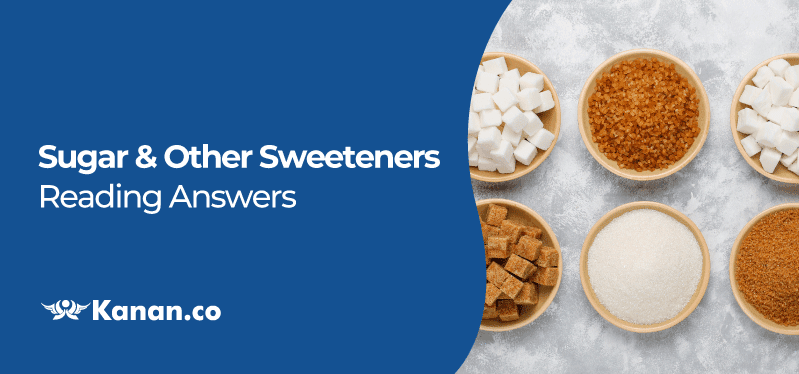
Sugar and other sweeteners reading answers are listed in tabular form. Check your answers to make sure they are accurate and to look for any mistakes.
| 1. Fructose | 5. Cyclamate | 9. Glucose | 13. Maximum |
| 2. Glucose | 6. Mystery | 10. Technologies | 14. Similar |
| 3. White sugar/ Sucrose | 7.Fructose | 11. Substances | 15. Chemical |
|
4. Aspartame (Nutrasweet) |
8. Fruit | 12. Discovered |
To evaluate your performance on the IELTS reading test, consult "Sugar and other sweeteners reading answers." To find the right answers, make an effort to identify the keywords from each question and have a firm command of vocabulary. Start using the skimming and scanning method to find the answers as well, as it will not only make it easier for you to find the right ones. As a result, you have plenty of time to check your answers at the end.
On the completion of the passage "Sugar and other sweeteners reading answers," you can practise all IELTS reading question types. Question types such as Yes/No/Not given and True/False/Not given, short answers, and matching features will not have the answers in sequence; whereas, question types such as list of headings, sentence completion, notes completion, flowchart completion, short will have the answers in the sequence.
IELTS Reading Yes/No/Not given
IELTS Reading Summary Completion
IELTS Reading Short Answers
Check out our YouTube Channel to Practice Full-Length IELTS Reading Tests Daily
IELTS Reading Passage: Sugar and other sweeteners
These are 13 questions based on the information provided; you should set aside 20 minutes to complete them. Sugar and other sweeteners IELTS reading answers with locations are accessible for review once the test has been completed.
Sugar and other sweeteners
A. A substance gains its sweetness when it physically comes into contact with the thousands of taste buds on the tongue. The taste buds are grouped together around a large number of tiny, fleshy protrusions called taste papilla that give the taste buds a large surface area and guarantee maximum contact with a substance.
B. Food technologists theorise that this is due to the strong pleasure relationship between the brain and food, which exists despite the fact that there are many millions of olfactory cells in the nose, since taste is a more intense experience than smell. Additionally, everyone agrees that sweetness is the most pleasurable taste sensation. For instance, the famous French author Marcel Proust made use of this concept in his work when he had the narrator of his epic In Search of Past Time recall vivid childhood memories after accidentally eating a particular cake. Lover's terms of endearment include "sugar," "honey," and "sweetie." Often, pregnant women who eat something sweet can prevent morning sickness. In Tudor times*Having teeth that were blackened from sugar consumption decay was regarded as a desirable quality reserved for the wealthy and aristocratic upper class. With the slogan "naughty but nice," advertisers have been able to generate demand for sweet-tasting cakes even more recently, when the damage that sugar can do is much better understood. Despite the allure of sugary foods, no one is exactly sure what makes something sweet.
C. The most prevalent naturally occurring sugar in nature is fructose, which can be found in almost all fruits and berries as well as being the primary ingredient in honey. Naturally, once consumed, every food contains one or more of the three basic food groups: protein, fat, and carbohydrates. These three eventually break down (if and when necessary) to provide the body with the glucose, an essential sugar. Sucrose, a naturally occurring sugar found in the sugar cane plant that was discovered and used in ancient times B.C., is another resource provided by nature. Within the body, sucrose decomposes into glucose. The benchmark against which all other sweet tastes are measured in the modern food industry is this white sugar. In the United States, high-fructose corn syrup (HFCS), which is produced by a method developed in the late 1960s from corn starch, is frequently used to sweeten a variety of foods, most notably soft drinks. And to satisfy his sweet tooth, man has created a dozen or so artificial sweeteners that are safe, inactive chemicals with the additional property of sweetness (see Figure 1). This adds to nature's repertoire.
D. In fact, humans (and some animals) have an innate desire to seek out and enjoy sweet-tasting foods. Sweet things have always been highly valued because they give life energy and support it. By flavouring the majority of processed foods with precisely calculated amounts of sugar in one form or another, food manufacturers everywhere take advantage of consumers' desire for sweetness. In every case, trial and error is used to determine the maximum amount of sweetness that can be added without losing or significantly reducing the original food's flavour.
E. In addition, the ideal level of pleasure for the majority of people—the most acceptable level of sweetness for every product—remains surprisingly constant, even across completely dissimilar cultures. This likely goes a long way toward explaining Coca-Cola's appeal, which is essentially universal. (Although the type of sugar used in soft drinks differs from group to group, the intensity and, therefore, pleasure invoked by such drinks remains fixed within a fairly narrow range of agreement.)
F. Artificial sweeteners fall short in comparison to white sugar's opulent smoothness and mouthfeel. Even corn syrup leaves behind a faint aftertaste. It is easy to understand why food technologists haven't yet succeeded in developing a perfect substitute for sucrose—presumably one that doesn't produce kilojoules. There is currently no known molecular structure that favours sweetness. In actuality, it is impossible to predict whether a substance will taste sweet or even have any flavour at all. All of the artificial sweeteners we currently have were all accidentally discovered to be sweet.
*The Tudor era, which encompasses the Elizabethan era from Elizabeth I's reign until 1603 in England and Wales, spans the years 1485 to 1603.
Sugar and other sweeteners Reading Questions
Questions 1-3
Do the following statements agree with the writer’s views in the Reading Passage? Write:
YES if the statement agrees with the views of the writer
NO, if the state does not agree with the views of the writer
NOT GIVEN if there is no information about this in the passage
(1). The substance only acquires sweetness when it comes into contact with the taste buds located on the tongue.
(2). Despite the nose having thousands of olfactory cells, taste is a more potent sensation than smell.
(3). Each and every human has different shaped tongues.
Click to know more about IELTS reading Yes/No/Not given
Questions 4-10
The following paragraphs summarise the reading passage. Choose the ONE most appropriate word from the box below the paragraphs to complete each blank space.
Write your answers in boxes 4- 10 on your answer sheet.
The first one has been done for you as an example.
NB. NO WORD CAN BE USED MORE THAN ONCE.
Numerous tongue receptors connect the taste of sugar with the brain, making it appear sweet. Everyone enjoys sweetness in their food.(Ex:) ...... as the most enjoyable experience, even though there are......(4)...... as to why a substance tastes sweet. The most naturally occurring sugar is......(5)....., and sources of......(6)..... include honey. The sugar-cane plant is used to extract sucrose, which the body uses as......(7)...... White sugar, or pure sucrose, is what is used in food (8)_________.To gauge someone else's sweetness, use the following formula: (9)________ There have been about a dozen artificial sweeteners developed; Sorbitol from France was (10)_______one of the first.
Glucose Sweetened Different Technology Fructose
Mystery Artificially Technologies Maximum Commonly
Chemical Best Substances Discovered Accepted
Fruit Chemist Similar
Click to know more about IELTS reading Summary completion
Questions 11-13
Refer to Reading Passage "Sugar and Other Sweeteners", and look at Questions 11 - 13 below.
Write your answers in boxes 1 on your Answer Sheet.
The first one has been done for you as an example.
Example: What do the letters HFCS stand for?
Answer: ......High Fructose Corn Syrup......
(11). & (12). Other than sucrose, TWO naturally occurring sugars are mentioned in the article. Describe them.
(13). What sweetener is regarded by the food industry as ideal?
Click to know more about IELTS reading Short answers
Sugar and other sweeteners Reading answers with Explanation
Sugar and other sweeteners Reading answers with explanations can help you correct errors and identify the information needed for your answer.
(Note: The text in italics from the reading passage shows the location from where the answer is taken or inferred.)
1. Yes
Explanation: In the first two lines of paragraph A, “A substance gains its sweetness when it physically comes into contact with the thousands of taste buds on the tongue”.
2. No
Explanation: In the second and third lines of paragraph B, “which exists despite the fact that there are many millions of olfactory cells in the nose, since taste is a more intense experience than smell”.
3. Not given
Explanation: —
4. Mystery
Explanation: In the last line of paragraph B, “Despite the allure of sugary foods, no one is exactly sure what makes something sweet”.
5. Fructose
Explanation: In the first line of paragraph C, “The most prevalent naturally occurring sugar in nature is fructose”.
6. Fruit
Explanation: In the second line of paragraph C, “almost all fruits and berries as well as being the primary ingredient in honey”.
7. Glucose
Explanation: In the fourth, fifth and sixth lines of paragraph C, These three eventually break down (if and when necessary) to provide the body with the glucose, an essential sugar. Sucrose, a naturally occurring sugar found in the sugar cane plant”.
8. Technologists
Explanation: In the second and third lines of paragraph F, “It is easy to understand why food technologists”.
9. Substance
Explanation: In the fifth and sixth lines of paragraph F, “it is impossible to predict whether a substance will taste sweet or even have any flavour at all”.
10. Discovered
Explanation: In the last line of paragraph F, “sweeteners we currently have were all accidentally discovered to be sweet”.
11. Fructose
Explanation: In the first line of paragraph C, “The most prevalent naturally occurring sugar in nature is fructose”.
12. Glucose
Explanation: In the fifth line of paragraph C, “ to provide the body with the glucose, an essential sugar”.
13. White sugar
Explanation: In the eighth and ninth lines of paragraph C, “The benchmark against which all other sweet tastes are measured in the modern food industry is this white sugar”.
Check the other reading passages
- Why does skin wrinkle in water reading answer
- Its dynamite reading answer
- Space travel and health reading answers
Conclusion
The article "Sugar and other sweeteners Reading Answers" is an excellent IELTS reading resource. You can use the materials and sample tests available at the aforementioned locations to prepare for the IELTS. As a result, this page was created as a resource for those studying for the IELTS reading exam.

About Author Abishek Babu M
Abishek is a seasoned expert in the study abroad processes and IELTS, GRE, TOEFL, and SAT subjects. With over 2.5 years of experience in helping students achieve their foreign education goals, he has become a trusted individual in the industry. His extensive knowledge and authority in the IELTS test have earned him a reputation as a go-to resource for students seeking to excel in their exams. Abishek's exceptional track record has earned him the trust of countless students who rely on his resources to achieve their study abroad dreams.
Kanan International is a study abroad consultancy that offers reliable services, products, and solutions for students and education institutions. We support students throughout their study abroad journey, ensuring a hassle-free experience. Our expertise and commitment to excellence make us the go-to partner for expanding global horizons. The company provides coaching for IELTS, GRE, TOEFL, and SAT exams and services like visa consultation, accommodation, scholarship assistance, and education loans.
Free Online Mock Test 2026
Practice our mock test worth Rs. 25000 for Free and know your IELTS score!








Global Headquarters
Kanan Int EdTech Inc
320 Bay Street, Suite 321 (Spaces), Toronto ON, Canada M5B 1N9
Indian Headquarters
Kanan International Pvt. Ltd.
D-wing, 2nd Floor, Trident Complex, Ellora Park Vadiwadi Road, Vadodara, Gujarat 390007
IT/ Digital Campus
Kanan International Pvt. Ltd
Old, New No 3, 2nd Floor, 1A, Dr Sadasivam Rd, T. Nagar, Chennai, Tamil Nadu 600017
Our branches
- Bardoli
- Bharuch
- Chennai
- Dehradun
- Gurugram
- Himatnagar
- Karnal
- Nadiad
- Navsari
- Palanpur
- Rajkot
- Vadodara
- Valsad
- Vallabh Vidyanagar
- Vapi
Study Abroad
Test Prep
Top Universities
Consultants
IELTS Centers
GRE Centers
TOEFL Centers
SAT Centers
Language Courses in Vadodara
Study Abroad Calculators
Featured Blogs
Study Abroad Consultants in Chennai
Study Abroad Consultants in Surat
Study Abroad Consultants in Navsari
Study Abroad Consultants in Bardoli
Study Abroad Consultants in Ahmedabad
Study Abroad Consultants in Anand
Study Abroad Consultants in Khanna
Study Abroad Consultants in Nadiad
Study Abroad Consultants in Vadodara
Study abroad consultants in Valsad
Copyright © 2026 KANAN.CO All rights reserved.