- Study Abroad
- / ielts
- / t rex hunter reading answers
T-rex Hunter Reading Answers Reading Answers


Author
19-09-2025

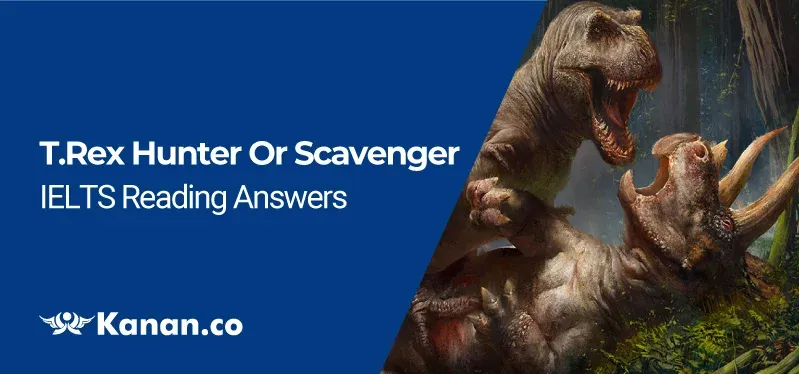
T-rex Hunter Reading Answers Practice tests is provided with answers and explanations. This passage comprises 13 questions divided into three question types - true/false/not given and summary completion. T-rex Hunter Reading Answers reading answers with explanation.
Table of contents:
- Solution for T-rex Hunter Reading Answers
- T-rex Hunter Reading Answers IELTS Reading Practice Test
- Passage
- Questions
- Answers with Explanations
Solution for T-rex Hunter Reading Answers
T-rex Hunter Reading Answers are listed in the table below. Verify your answers against our answer table, then correct any inaccuracies.
Answer Table
| 1. True | 5. True | 9. Slow walker | 13. Crush |
| 2. False | 6. True | 10. Cheetah | |
| 3. Not given | 7. False | 11. Run fast | |
| 4. True | 8. Shine bone | 12. Blunt |

T-rex Hunter Reading Answers IELTS Reading Practice Test - Exam Review
Check out our YouTube Channel to Practice Full-Length IELTS Reading Tests Daily

T-rex Hunter Reading Answers are given here, which will help you excel in the IELTS reading test to challenge your reading skills. Paraphrasing can help you to understand the ideas clearly which makes you able to efficiently answer the questions.
Passage
We’ve provided the reading passage of T-rex Hunter Reading Answers with locations.
Read the passage and carefully complete the questions.
T-Rex Hunter
A
Jack Horner is an unlikely academic: his dyslexia is so bad that he has trouble reading a book. But he can read the imprint of life in sandstone or muddy shale across a distance of 100m years, and it is this gift that has made him curator of palaeontology at Montana State University’s Museum of the Rockies, the leader of a multi-million dollar scientific project to expose a complete slice of life 68m years ago, and a consultant to Steven Spielberg and other Hollywood figures.
B
His father had a sand and gravel quarry in Montana, and the young Horner was a collector of stones and bones, complete with notes about when and where he found them. “My father had owned a ranch when he was younger, in Montana,” he says. “He was enough of a geologist, is a sand and gravel man, to have a pretty good notion that they were dinosaur bones. So when I was eight years old he took me back to the area that had been his ranch, to where he had seen these big old bones. I picked up one. I am pretty sure it was the upper arm bone of a duckbilled dinosaur: it probably wasn’t a maiaosaur but closely related to that. I catalogued it, and took good care of it, and then later when I was in high school, excavated my first dinosaur skeleton. It obviously started earlier than eight and I literally have been driven ever since. I feel like I was born this way.”
C
Horner spent seven years at university but never graduated. “I have a learning disability, I would call it a learning difference – dyslexia, they call it – and I just had a terrible time with English and foreign languages and things like that. For a degree in geology or biology, they required two years of a foreign language. There was no way in the world I could do that. In fact, I didn’t really pass English. So I couldn’t get a degree, I just wasn’t capable of it. But I took all of the courses required and I wrote a thesis and I did all sorts of things. So I have the education, I just don’t have the piece of paper,” he says.
D
In Montana, in those days, everybody had the right to a college education. His grades at high school had been terrible, at university, his advisers recognised that he was having a hard time, and went on helping. The dean who kept readmitting him was to give Horner an honorary doctorate years later. As a young non-graduate, Horner wrote to every museum in the English-speaking world, asking for a job. Los Angeles County Museum and the Royal Ontario Museum in Toronto made offers, but he accepted a post as a technician at Princeton University because of Princeton, New Jersey.
E
“We definitely know we are working on a very broad coastal plain with the streams and rivers bordered by conifers and hardwood plants, and the areas in between these rivers were probably fern-covered. There were no grasses at all: just ferns and bushes – an unusual landscape, kind of taking the south-eastern United States – Georgia, Florida – and mixing it with the moors of England and flattening it out,” he says. “Triceratops is very common: they are the cows of the Cretaceous, they are everywhere. Duckbilled dinosaurs are relatively common but not as common as triceratops and T rex, for a meat-eating dinosaur, is very common. What we would consider the predator-prey ratio seems really off the scale. What is interesting is the little dromaeosaurs, the ones we know for sure were good predators, we haven’t found any of them.”
F
Which is why he sees T rex, not as the lion of the Cretaceous savannah but its vulture. “Look at the wildebeest that migrate in the Serengeti of Africa, a million individuals lose about 200,000 individuals in that annual migration. There is a tremendous carrion base there. And so you have hyenas, you have tremendous numbers of vultures that are scavenging, you don’t have all that many animals that are good predators. If T rex was a top predator, especially considering how big it is, you’d expect it to be extremely rare, much rarer than the little dromaeosaurs, and yet they are everywhere, they are a dime a dozen,” he says. A 12-tonne T rex is a lot of vultures, but he doesn’t see the monster as clumsy. He insisted his theory and finding, dedicated to further research upon it, of course, he would like to reevaluate if there is any case that additional evidence found or explanation raised by others in the future.
G
He examined the leg bones of the T-rex, and compared the length of the thigh bone (upper leg), to the shin bone (lower leg). He found that the thigh bone was equal in length or slightly longer than the shin bone, and much thicker and heavier. Which proves that the animal was built to be a slow walker rather than fast running. On the other hand, the fossils of fast hunting dinosaurs ALWAYS showed that the shin bone was longer than the thigh bone. This same truth can be observed in many animals of today which are designed to run fast: The ostrich, cheetah, etc.
H
He also studied the fossil teeth of the T-rex, and compared them with the teeth of the Velociraptor, and put the nail in the coffin of the “hunter T-rex theory”. The Velociraptor’s teeth were like steak knives: sharp, razor-edged, and capable of tearing through flesh with ease. The T-Rex’s teeth were huge, sharp at their tip, but blunt, propelled by enormous jaw muscles, which enabled them to only crush bones.
I
With the evidence presented in his documentary, Horner was able to prove that the idea of the T-rex as being a hunting and ruthless killing machine is probably just a myth. In light of the scientific clues he was able to unearth, the T-rex was a slow, sluggish animal which had poor vision, an extraordinary sense of smell, that often reached its “prey” after the real hunters were done feeding, and sometimes it had to scare the hunters away from a corpse. In order to do that, the T-rex had to have been ugly, nasty-looking, and stinky. This is actually true of nearly all scavenger animal. They are usually vile and nasty looking.
Questions
Questions 1-7
Do the following statements agree with the information given in Reading Passage 1?
In boxes 1-7 on your answer sheet, write
| TRUE | if the statement is true |
| FALSE | if the statement is false |
| NOT GIVEN | If the information is not given in the passage |
1 Jack Horner knew exactly the bone belonged to a certain dinosaur when he was in my father’s ranch at the age of 8.
2 Jack Horner achieved a distinctive degree in university when he graduated.
3 Jack Horner is the first man to discover a T-Rex’s bone in the world.
4 Jack Horner believes that the number of prey should be more than that of predators.
5 T-rex’s number is equivalent to the number of vultures in the Serengeti.
6 The hypothesis that T-rex is the top predator conflicts with the fact of the predator-prey ratio which Jack found.
7 He refused to accept any other viewpoints about T rex’s category.
Questions 8-13
Complete the following summary of the paragraphs of Reading Passage, using no more than two words from the Reading Passage for each answer. Write your answers in boxes 8-13 on your answer sheet.
Jack Horner found that T-rex’s ______8______is shorter than the thigh bone, which demonstrated that it was actually a ______ 9 ______, unlike other swift animals such as ostrich or ______10______that was built to ______11_____ Another explanation support his idea is that T-rex’s teeth were rather______12______ , which only allowed T-rex to ______13______ hard bones instead of tearing flesh like Velociraptor.
Answers for T-rex Hunter Reading Answers With Explanations
T-rex Hunter Reading Answers reading answers with explanations is given below. Refer to the following answers with an explanation section in order to correct your errors.
(Note: The text in italics mentions the location and referring lines written in the reading passage.)
1. Answer: True
Explanation: Located in the fifth, sixth and seventh lines of paragraph B, “So when I was eight years old he took me back to the area that had been his ranch, to where he had seen these big old bones. I picked up one. I am pretty sure it was the upper arm bone of a duck billed dinosaur: it probably wasn’t a dinosaur but closely related to that ”.
2. Answer: False
Explanation: Located in the first three lines of paragraph C, “Horner spent seven years at university but never graduated. “I have a learning disability, I would call it a learning difference – dyslexia, they call it – and I just had a terrible time with English and foreign languages and things like that”.
3. Answer: Not given
Explanation: Not Avalibale
4. Answer: True
Explanation: Located in the last few lines of paragraph E, “Triceratops is very common: they are the cows of the Cretaceous, they are everywhere. Duck Billed dinosaurs are relatively common but not as common as triceratops and T rex, for a meat-eating dinosaur, is very common. What we would consider the predator-prey ratio seems really off the scale. What is interesting is the little dromaeosaurs, the ones we know for sure were good predators, we haven’t found any of them”.
5. Answer: True
Explanation: Located in the first three lines of paragraph F, “ Which is why he sees T rex, not as the lion of the Cretaceous savannah but its vulture. “Look at the wildebeest that migrate in the Serengeti of Africa, a million individuals lose about 200,000 individuals in that annual migration”.
6. Answer: True
Explanation: Located in the fifth, sixth and seventh lines of paragraph F, “If T rex was a top predator, especially considering how big it is, you’d expect it to be extremely rare, much rarer than the little dromaeosaurs, and yet they are everywhere, they are a dime a dozen,” he says. A 12-tonne T rex is a lot of vultures, but he doesn’t see the monster as clumsy”.
7. Answer: False
Explanation: Located in the last three lines of paragraph F, “He insisted his theory and finding, dedicated to further research upon it, of course, he would like to reevaluate if there is any case that additional evidence found or explanation raised by others in the future”.
8. Answer: Shine bone
Explanation: Located in the second line of paragraph G, “ to the shin bone (lower leg)”.
9. Answer: Slow walker
Explanation: Located in the third line of paragraph G, “built to be a slow walker rather than fast running”.
10. Answer: Cheetah
Explanation: Located in the last line of paragraph G, “ostrich, cheetah, etc”.
11. Answer: Run fast
Explanation: Located in the last line of paragraph G, “today which are designed to run fast”.
12. Answer: Blunt
Explanation: Located in the second last line of paragraph H, “The T-Rex’s teeth were huge, sharp at their tip, but blunt”.
13. Answer: Crush
Explanation: Located in the last line of paragraph H, “which enabled them to only crush bones”.
Other Reading Tests

About Author Arivarasi
Arivarasi is an experienced author with expertise in the study abroad industry and preparing test materials for exams like IELTS, TOEFL, GRE, SAT, PTE, etc. She stays up-to-date with university and college requirements for international students which allows her to provide guidance on course selection, documents like SOP, LOR, and scholarship opportunities. She has written numerous articles on study abroad exams, destinations, universities & colleges requirements, admission procedures, and the entire process of studying abroad. Collaborating with industry experts and counselors, she crafts informative articles that make students take the right decisions.
Kanan.co is a trusted study abroad consultancy offering comprehensive services, resources, and solutions for students and education institutions. We support students at every stage of their global education journey, ensuring a smooth and guided experience. Along with test preparation for IELTS, GRE, TOEFL, and SAT, we provide expert services such as SOP writing, visa guidance, accommodation support, scholarship assistance, and education loan support. Our expertise and commitment to excellence make us a reliable partner for students pursuing international education.
Free Online Mock Test 2026
Practice our mock test worth Rs. 25000 for Free and know your IELTS score!








Global Headquarters
Kanan Int EdTech Inc
320 Bay Street, Suite 321 (Spaces), Toronto ON, Canada M5B 1N9
Indian Headquarters
Kanan International Pvt. Ltd.
D-wing, 2nd Floor, Trident Complex, Ellora Park Vadiwadi Road, Vadodara, Gujarat 390007
IT/ Digital Campus
Kanan International Pvt. Ltd
Old, New No 3, 2nd Floor, 1A, Dr Sadasivam Rd, T. Nagar, Chennai, Tamil Nadu 600017
Our branches
- Bardoli
- Bharuch
- Chennai
- Dehradun
- Gurugram
- Himatnagar
- Karnal
- Nadiad
- Navsari
- Palanpur
- Rajkot
- Vadodara
- Valsad
- Vallabh Vidyanagar
- Vapi
Study Abroad
Test Prep
Top Universities
Consultants
IELTS Centers
GRE Centers
TOEFL Centers
SAT Centers
Language Courses in Vadodara
Study Abroad Calculators
Featured Blogs
Study Abroad Consultants in Chennai
Study Abroad Consultants in Surat
Study Abroad Consultants in Navsari
Study Abroad Consultants in Bardoli
Study Abroad Consultants in Ahmedabad
Study Abroad Consultants in Anand
Study Abroad Consultants in Khanna
Study Abroad Consultants in Nadiad
Study Abroad Consultants in Vadodara
Study abroad consultants in Valsad
Copyright © 2026 KANAN.CO All rights reserved.