- Study Abroad
- / ielts
- / tacoma narrows bridge reading answers
Tacoma narrows bridge Reading Answers


Author
19-09-2025

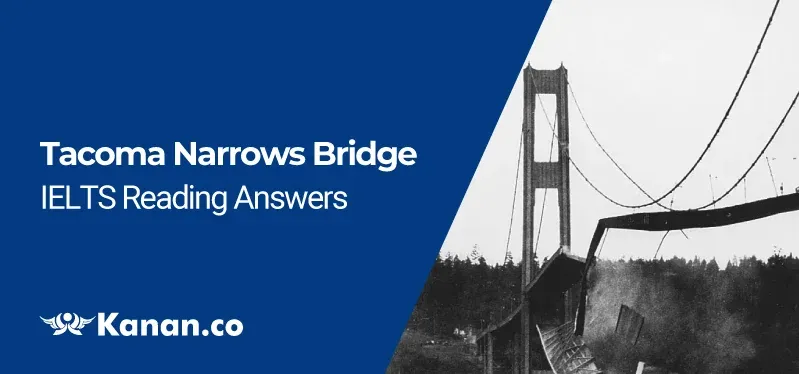
We have given the Tacoma narrows bridge reading practice test and answer with explanations. These are provided here for your convenience and assistance. It has 13 questions of 4 different question types.
Table of contents:
- Solution for Tacoma narrows bridge
- Tacoma narrows bridge IELTS Reading Practice Test
- Passage
- Questions
- Answers with Explanations
Solution for Tacoma narrows bridge
In the table below we have provided Tacoma narrows bridge reading answers. Check your responses against our answer table, then fix any errors.
Answer Table
| 14. tie-down cables | 18. transverse | 22. energy | 26. D |
| 15. bridge deck | 19. butterfly | 23. oscillations/vibrations | |
| 16. hydraulic dampers | 20. aerostatic flutter | 24. strain | |
| 17. longitudinal | 21. wind | 25. B |

Tacoma narrows bridge IELTS Reading Practice Test - Exam Review
Check out our YouTube Channel to Practice Full-Length IELTS Reading Tests Daily

We have given Tacoma narrows bridge IELTS reading practice test to challenge your reading skills. Highlight the keywords while reading the passage to enable a faster answering process. Stay within the word limit, as that will be considered a wrong answer.
Passage
We have provided Tacoma narrows bridge reading passage. Read and answer the questions carefully. Spend around 20 minutes solving this passage which consists of 13 questions and four different question types. We have also provided Tacoma narrows bridge reading answers with locations.
Tacoma Narrows Bridge – Disaster Strikes
- When the Tacoma Narrows Bridge opened for traffic on 1 July 1940, it was celebrated as a major engineering achievement. Even before construction was completed, however, flaws in the design were apparent; workers sucked on lemon slices to avoid motion sickness as the structure swayed in the relatively mild winds. Engineers tried three different revisions during construction to address the vibration problem. Initially, tie-down cables were anchored to fifty-tonne bulkheads on the river banks. These were ineffective, as the cables soon detached. Then, a pair of inclined cable locks was introduced to connect die main cables to the bridge deck at mid-span. These stayed throughout the bridge’s lifespan, but did nothing to reduce vibration. A further measure – the installation of hydraulic dampers between the towers and the floor system – was nullified because die dampers were compromised when the bridge was sandblasted before painting.
- Shortly after opening, the bridge quickly acquired the fond nickname of “Galloping Gertie” because of the way it would roll in either side-to-side or lengthways movements – known in physics terms as the longitudinal and transverse modes of vibration respectively. These movements did not compromise the core integrity of the structure, but did make the crossing a somewhat white-knuckle affair. Many driven reported seeing cars ahead disappear from sight several times as they sank into troughs from transverse vibrations (imagine the ripple across a packed stadium during a Mexican wave). The experience of a longitudinal wave is closely analogous, but more accurately associated with the waves one would encounter in the ocean. On a suspension bridge though, these waves arc a unique experience – some daredevils were happy to pay the 75c toll just for the thrill.
- Four months later, however, a never-before-seen type of vibration began afflicting the bridge in what were still fairly gentle winds (about 40 kmph). Rather than the simple “wave” motion that characterizes longitudinal and transverse vibration, the left side of the bridge would rise while the right side fell, but the center line of the road would remain completely level. This was proved when two men walked along the center of the bridge completely unaffected by the rocking motions around them. Visually, the bridge’s movements seemed to be more like a butterfly flapping its wings than a simple rolling motion. Engineers now understand this to be the torsional mode of vibration, and it is extremely hard to detect. In aeroplane design, for example, even minute shifts of die aircraft’s mass distribution and an alteration in one component can affect a component with which it has no logical connection. In its milder forms, this can cause a light buzzing noise, similar to that which a wasp or a bumble bee makes, but when allowed to develop unchecked, it can eventually cause the total destruction of an aeroplane.
- The torsional mode of vibration is the consequence of a set of actions known as aerostatic flutter. This involves several different elements of a structure oscillating from the effect of wind, with each cycle of fluttering building more energy into the bridge’s movements and neutralizing any structural damping effects. Because the wind pumps in more energy than the structure can dissipate, and the oscillations feed off each other to become progressively stronger, the aerostatic flutter and torsional vibrations were all but assured to destroy the Tacoma Bridge on the morning of 7 November. At 11:00 a.m., the fluttering had increased to such amplitude that the suspender cables were placed under excessive strain. When these budded, the weight of the deck transferred to the adjacent cables which in turn were unable to support the weight. These cables buckled, leaving nothing to stop the central deck breaking off into the Tacoma River.
- It was at around 10:15 a.m. on 7 November that torsional vibration began afflicting the bridge. This made driving treacherous, and newspaper editor Leonard Coatsworth’s car was jammed against the curb in the center of the bridge as he attempted to cross. Coatsworth tried to rescue his daughter’s cocker spaniel from the back seat but was unsuccessful, and fearing for his life, crawled and staggered to safety on his own. At this point, an engineering professor named Beit Farquharson proceeded onto the bridge in an attempt to save the frightened animal. Farqulunoii had been video-recording from the bonks of the river and had just returned from purchasing more rolls of film. As an avowed dog lover, he felt obliged to attempt a rescue. Unfortunately, the professor too was bitten and retreated empty handed, walking off just moments before the cables snapped and the giant concrete mass of the central deck caved inwards and disappeared into the river.
>Questions
Questions 14 - 16
Complete the notes below.
Choose NO MORE THAN TWO WORDS from the passage for each answer.
Write your answers in boxes 14-16 on your answer sheet.
Engineers used various techniques while building the bridge to reduce wobble:
• they attached 14 ______________ to heavy blocks on the shoreline
• they fastened main cables to the middle of the 15___________.
• 16 ____________were placed between the tallest parts of the structure and the deck.
Questions 17 - 19
Complete the table below. Choose ONE WORD ONLY from the passage for each answer.
Write your answers in boxes 17-19 on your answer sheet.
| Mode of Vibration | Description |
| 17. . | moving repeatedly to the left and right |
| 18. . | up and down motion; like a wave |
| torsional | resembling motions of a 19. . |
Questions 20 - 24
Complete the summary below.
Choose NO MORE THAN TWO WORDS from the passage for each answer.
Write your answers in boxes 20-24 on your answer sheet.
20___________ is a series of actions leading to torsional oscillation. Various components move back and
forth from the force of the 21___________ Eventually,the structure absorbs more 22___________ than it is able to
disperse aTacoma narrows bridgend the 23____________ increase in intensity until the structure collapses under the 24______________.
Questions 25 - 26
Choose TWO letters. A—E.
Write your answers in boxes 25-26 on your answer sheet.
Which TWO of the following were on the bridge at the time of the collapse?
- Filming equipment
- A small dog
- Leonard Coatsworth’s daughter
- A vehicle
- Professor farquharson
25____________ .
26____________ .
Answers for Tacoma narrows bridge With Explanations
Tacoma narrows bridge reading answers with explanations are provided here. They will provide assistance to you in your performance evaluation process.
(Note: The text in italics mentions the location and referring lines written in the reading passage.)
14. Answer: tie-down cables
Explanation: Located in Paragraph A 5th line. “Initially, tie-down cables were anchored to fifty-tonne bulkheads on the river banks”. Attaching to heavy blocks in the route is referred to as anchoring to fifty-tonne bulkheads. As a result, tie-down cables are the solution.
15. Answer: bridge deck
Explanation: Located in Paragraph A 7th line. “A pair of inclined cable locks was introduced to connect die main cables to the bridge deck at mid-span”. The bridge deck, according to the text, was connected to the main cables in the center section.
16. Answer: hydraulic dampers
Explanation: Located in Paragraph A 9th line. “A further measure – the installation of hydraulic dampers between the towers and the floor system – was nullified because die dampers were compromised when the bridge was sandblasted before painting”. Hydraulic dampers were constructed between massive towers, according to this text.
17. Answer: longitudinal
Explanation: Located in Paragraph B 2nd line. “it would roll in either side-to-side or lengthways movements – known in physics terms as the longitudinal”. It traveled from left to right, which was transcribed as side-to-side in the paragraph.
18. Answer: transverse
Explanation: Located in Paragraph B 2nd line. “lengthways movements”. It is noted in the text that it moved in an upward and downward manner, which is known as transverse motion.
19. Answer: butterfly
Explanation: Located in Paragraph C 6th line. “Visually, the bridge’s movements seemed to be more like a butterfly flapping its wings than a simple rolling motion”. Thus, It was more like a butterfly motion than a regular one.
20. Answer: aerostatic flutter
Explanation: Located in Paragraph D 1st line. “The torsional mode of vibration is the consequence of a set of actions known as aerostatic flutter”. A series of actions is referred to as a set of actions in the text, so, the answer would be aerostatic flutter.
21. Answer: wind
Explanation: Located in Paragraph D 2nd line. “This involves several different elements of a structure oscillating from the effect of wind”. Due to the force of wind many components moved back and forth.
22. Answer: energy
Explanation: Located in Paragraph D 4th line. “Because the wind pumps in more energy than the structure can dissipate”. Thus, Energy is absorbed.
23. Answer: oscillations/vibrations
Explanation: Located in Paragraph D 5th line. “the oscillations feed off each other to become progressively stronger”. The intensity of the oscillations or vibrations rises as the intensity increases.
24. Answer: strain
Explanation: Located in Paragraph D 8th line. “the fluttering had increased to such amplitude that the suspender cables were placed under excessive strain”. Till the structure collapses under the strain.
25,26. Answer: B,D
Explanation: Located in Paragraph E 2nd & 4th line. “This made driving treacherous, and newspaper editor Leonard Coatsworth’s car was jammed against the curb in the center of the bridge as he attempted to cross”. “Coatsworth tried to rescue his daughter’s cocker spaniel from the back seat but was unsuccessful, and fearing for his life, crawled and staggered to safety on his own. At this point, an engineering professor named Beit Farquharson proceeded onto the bridge in an attempt to save the frightened animal”. This statement proves that at the time of bridge collision, A small dog and a vehicle were stuck on the bridge before their rescue.
Other Reading Tests

About Author Arivarasi
Arivarasi is an experienced author with expertise in the study abroad industry and preparing test materials for exams like IELTS, TOEFL, GRE, SAT, PTE, etc. She stays up-to-date with university and college requirements for international students which allows her to provide guidance on course selection, documents like SOP, LOR, and scholarship opportunities. She has written numerous articles on study abroad exams, destinations, universities & colleges requirements, admission procedures, and the entire process of studying abroad. Collaborating with industry experts and counselors, she crafts informative articles that make students take the right decisions.
Kanan.co is a trusted study abroad consultancy offering comprehensive services, resources, and solutions for students and education institutions. We support students at every stage of their global education journey, ensuring a smooth and guided experience. Along with test preparation for IELTS, GRE, TOEFL, and SAT, we provide expert services such as SOP writing, visa guidance, accommodation support, scholarship assistance, and education loan support. Our expertise and commitment to excellence make us a reliable partner for students pursuing international education.
Free Online Mock Test 2026
Practice our mock test worth Rs. 25000 for Free and know your IELTS score!








Global Headquarters
Kanan Int EdTech Inc
320 Bay Street, Suite 321 (Spaces), Toronto ON, Canada M5B 1N9
Indian Headquarters
Kanan International Pvt. Ltd.
D-wing, 2nd Floor, Trident Complex, Ellora Park Vadiwadi Road, Vadodara, Gujarat 390007
IT/ Digital Campus
Kanan International Pvt. Ltd
Old, New No 3, 2nd Floor, 1A, Dr Sadasivam Rd, T. Nagar, Chennai, Tamil Nadu 600017
Our branches
- Bardoli
- Bharuch
- Chennai
- Dehradun
- Gurugram
- Himatnagar
- Karnal
- Nadiad
- Navsari
- Palanpur
- Rajkot
- Vadodara
- Valsad
- Vallabh Vidyanagar
- Vapi
Study Abroad
Test Prep
Top Universities
Consultants
IELTS Centers
GRE Centers
TOEFL Centers
SAT Centers
Language Courses in Vadodara
Study Abroad Calculators
Featured Blogs
Study Abroad Consultants in Chennai
Study Abroad Consultants in Surat
Study Abroad Consultants in Navsari
Study Abroad Consultants in Bardoli
Study Abroad Consultants in Ahmedabad
Study Abroad Consultants in Anand
Study Abroad Consultants in Khanna
Study Abroad Consultants in Nadiad
Study Abroad Consultants in Vadodara
Study abroad consultants in Valsad
Copyright © 2026 KANAN.CO All rights reserved.