- Study Abroad
- / ielts
- / the braille system ielts reading answers
The Braille System IELTS Reading Answers


Author
18-09-2025

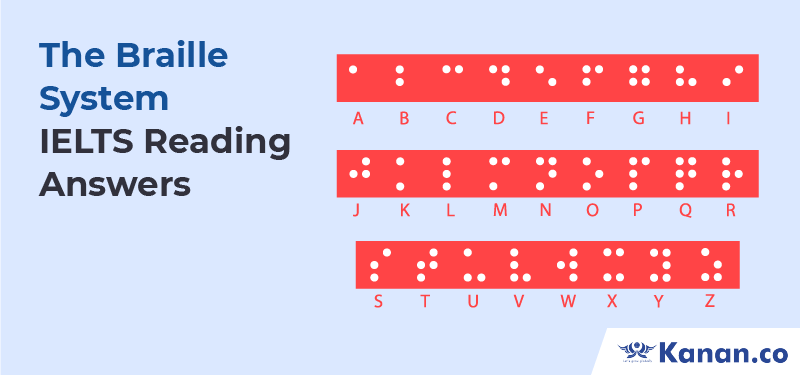
Braille system is a contact reading and writing device for the blind where the dots indicate the letters and numbers. In this reading practice test, you’ll find the braille system reading passage along with answers for the 3 different question types. The question types involved are sentence completion, yes/no/not given, and summary completion.

The Braille System
Check Out our YouTube Channel to Practice Full-Length IELTS Reading Tests Daily

You should spend about 20 minutes on Questions 1-13 which are based on Reading Passage 1 below.
Reading Passage 1
The Braille system is a contact reading and writing device for the blind where the dots indicate the letters and numbers. It also has dots for punctuation marks and markers for showing letter groupings. They read using both hands, but mostly using their index fingers. They can read at a speed of about 125 words per minute on average. Some people can read up to 200 words per minute. Blind people will learn about the written word while using the braille alphabet. They will also learn things like pronunciation, punctuation, paragraph formatting, and footnotes.
Most importantly, braille gives blind people access to a wide variety of items, including leisure and instructional reading, income reports, restaurant menus and critical things in everyday adult life like contracts, laws, insurance plans, indexes, and cookbooks. Using materials such as musical scores, songbooks, card games, and chess, blind people will also enjoy activities and cultural stimulation through braille. Many other methods have been tried over the years to help blind people to read. Many of those were elevated copies of print letters. The braille scheme became a success because it is made on a logical series of signs intended for the fingertips instead of imitating signs designed for the eyes.
Braille has a long tradition that dates back to the beginning of the 18th century. In Bonaparte’s French army, a man named Charles Barbier invented a unique technique known as “night printing” so soldiers could talk peacefully at night. Barbier, a veteran of the military, saw the deaths of several troops who used lights after dark to understand battle signals. Because of the light from the torches, enemy combatants realised where the French soldiers were, causing the death of several men. Barbier’s “night printing” technique is made on an elevated 12-dot cell that is 2 dots wide and 6 dots deep. Inside the cell, each dot or mixture of dots denoted a letter or phonetic sound. The issue with the legal regulations was that the normal fingertip did not recognise any of the dots with a single touch.
Louis Braille was born in a French village called Coupvray on Jan 4, 1809. He went blind at a young age after accidently stabbing himself in the eye with his father’s blade. Braille’s father was a leather maker who used a tool to punch holes in the leather goods he made. At the age of 11, Braille was inspired to change Charles Barbier’s “night printing” code to make an effective written correspondence device for all the blind people. He had joined the National Institute of the Blind in Paris a year before. He spent the best part of the next 9 years designing and making a perfect pattern of raised dots that bears his signature, Braille.
With all of Braille’s efforts, the coding was now directed on cells of just 6 dots rather than 12. This crucial advancement meant that a fingertip could cover the entire cell unit with a single impression and travel quickly from one cell to the next. Braille eventually gained acceptance around the world as the main mode of written communication for blind people. Even today, there is no difference in the braille system from what he invented. However, some small changes have been made to the braille system, most notably the addition of contractions describing groups of letters or entire words that occur regularly in a script. Contractions allow for easier braille reading. It also helped to reduce the scale of braille books, making them even lighter.
In 1853 Braille passed away, at the age of 43, a year before his native France adopted braille as the official correspondence method for the blind. In 1860, Braille made its way “across the pond” to America, where it was used by The Missouri School for the Blind in St. Louis. The legacy of Louis Braille has enriched the lives of millions of people who are blind. As a consequence, blind people from around the world learn from Braille’s work on a regular basis. Today, braille code has been transposed in a variety of languages all over the world. Braille will be proud to know that his work has helped many people get literacy over the years. The effect is largely inspiring and helps them to achieve success in their academics and their career paths.
Questions
Questions 1 – 5
Complete the sentences below.
Choose NO MORE THAN TWO WORDS AND/OR A NUMBERS from the passage for each answer.
1. The Braille system is a contact reading and writing device for the blind where the ________ indicate the letters and numbers.
2. The braille scheme became a success because it is made on a logical series of signs intended for the ________ instead of imitating signs designed for the eyes.
3. Braille eventually gained acceptance around the world as the main mode of ________ for blind people.
4. Braille code has been transposed in a variety of ________ all over the world.
5. The issue with the ________ was that the normal fingertip did not recognise any of the dots with a single touch.
Questions 6 – 10
Do the following statements agree with the information given in the Reading Passage?
Write:
YES if the statement agrees with the claims of the writer
NO if the statement contradicts the claims of the writer
NOT GIVEN if it is impossible to say what the writer thinks about this
6. The average speed of reading using Braille is 125 words per minute.
7. Braille cannot be used for reading contracts, laws, insurance plans, indexes, and cookbooks
8. Braille died in 1835 at the age of 43.
9. Braille’s father was a leather maker.
10. Contractions allow for easier braille reading and help to reduce the scale of braille books, making them even lighter.
Questions 11-15
Complete the summary below.
Write NO MORE THAN TWO WORDS from the passage for each answer.
Louis Braille was born in a French village called 11____ on Jan 4, 1809. With Braille’s efforts, the coding was directed on cells of just 12____ rather than 12. Blind people from around the world learn from Braille’s work on a regular basis. It gave access to a wide variety of everyday items, including leisure and 13____ reading, income reports, restaurant menus and critical things. Today, 14____ has been transposed in a variety of languages all over the world. In 1853 Braille 15____, at the age of 43.
Answers with Explanations
1. dots
Explanation: The initial line of Paragraph 1 shows that “The Braille system is a contact reading and writing device for the blind where the dots indicate the letters and numbers.” Since the sentence was so direct, and the only missing word is "dots," the correct answer is dots.
2. fingertips
Explanation: Paragraph 2 states “The braille scheme became a success because it is made on a logical series of signs intended for the fingertips instead of imitating signs designed for the eyes.” The given sentence matches the question asked with the missing word fingertips, hence the answer is fingertips.
3. written communication
Explanation: Paragraph 5 mentions that “Braille eventually gained acceptance around the world as the main mode of written communication for blind people.” This line clearly states that the answer is written communication.
4. Languages
Explanation: The following line from Paragraph 6 states “Today, braille code has been transposed in a variety of languages all over the world.” The line indicates that the answer is languages.
5. Legal regulations
Explanation: Paragraph 3 states that “The issue with the legal regulations was that the normal fingertip did not recognise any of the dots with a single touch.” The missing word in the given question is legal regulations and hence the answer is ‘legal regulations’.
6. Yes
Explanation: The following line from Paragraph 1 says “They can read at a speed of about 125 words per minute on average.” This statement shows that Braillee can read at the speed of 125 words per minute, hence the answer is Yes.
7. No
Explanation: Paragraph 2 mentions “Most importantly, braille gives blind people access to a wide variety of items, including leisure and instructional reading, income reports, restaurant menus and critical things in everyday adult life like contracts, laws, insurance plans, indexes, and cookbooks.” This paragraph claims that Braille can get access to contracts, laws, insurance plans, etc. Hence the answer is ‘No’.
8. No
Explanation: Paragraph 6 indicates that “In 1853 Braille passed away, at the age of 43, a year before his native France adopted braille as the official correspondence method for the blind.” The year mentioned in the question contradicts the year given in the passage, hence the answer is ‘no’.
9. Yes
Explanation: Paragraph 4 states that “Braille’s father was a leather maker who used a tool to punch holes in the leather goods he made.” This statement matches with the given question and thus the answer is yes.
10. Yes
Explanation: The line from Paragraph 5 says that “Contractions allow for easier braille reading. It also helped to reduce the scale of braille books, making them even lighter.” This statement clearly shows that the answer is yes.
11. Coupvray
Explanation: Paragraph 4 says that “Louis Braille was born in a French village called Coupvray on Jan 4, 1809.” Thus the answer is Coupvray.
12. 6 dots
Explanation: Paragraph 5 mentions that “With all of Braille’s efforts, the coding was now directed on cells of just 6 dots rather than 12.” Hence the answer is 6 dots.
13. instructional
Explanation: In Paragraph 2, it is given that “Most importantly, braille gives blind people access to a wide variety of items, including leisure and instructional reading,…” Hence the answer is instructional.
14. braille code
Explanation: Paragraph 6 shows that “Today, braille code has been transposed in a variety of languages all over the world.” Thus the answer is braille code.
15. passed away
Explanation: The following line from Paragraph 6 says that “In 1853 Braille passed away, at the age of 43, a year before his native France adopted braille as the official correspondence method for the blind.” Hence the answer is passed away.
Check the other reading passages
Click to check the other important reading passages listed below,
- Johnson's Dictionary Reading Answers
- Two Wings And A Toolkit Reading Answers
- Bakelite Reading Answers

About Author Arivarasi
Arivarasi is an experienced author with expertise in the study abroad industry and preparing test materials for exams like IELTS, TOEFL, GRE, SAT, PTE, etc. She stays up-to-date with university and college requirements for international students which allows her to provide guidance on course selection, documents like SOP, LOR, and scholarship opportunities. She has written numerous articles on study abroad exams, destinations, universities & colleges requirements, admission procedures, and the entire process of studying abroad. Collaborating with industry experts and counselors, she crafts informative articles that make students take the right decisions.
Kanan.co is a trusted study abroad consultancy offering comprehensive services, resources, and solutions for students and education institutions. We support students at every stage of their global education journey, ensuring a smooth and guided experience. Along with test preparation for IELTS, GRE, TOEFL, and SAT, we provide expert services such as SOP writing, visa guidance, accommodation support, scholarship assistance, and education loan support. Our expertise and commitment to excellence make us a reliable partner for students pursuing international education.
Free Online Mock Test 2026
Practice our mock test worth Rs. 25000 for Free and know your IELTS score!








Global Headquarters
Kanan Int EdTech Inc
320 Bay Street, Suite 321 (Spaces), Toronto ON, Canada M5B 1N9
Indian Headquarters
Kanan International Pvt. Ltd.
D-wing, 2nd Floor, Trident Complex, Ellora Park Vadiwadi Road, Vadodara, Gujarat 390007
IT/ Digital Campus
Kanan International Pvt. Ltd
Old, New No 3, 2nd Floor, 1A, Dr Sadasivam Rd, T. Nagar, Chennai, Tamil Nadu 600017
Our branches
- Bardoli
- Bharuch
- Chennai
- Dehradun
- Gurugram
- Himatnagar
- Karnal
- Nadiad
- Navsari
- Palanpur
- Rajkot
- Vadodara
- Valsad
- Vallabh Vidyanagar
- Vapi
Study Abroad
Test Prep
Top Universities
Consultants
IELTS Centers
GRE Centers
TOEFL Centers
SAT Centers
Language Courses in Vadodara
Study Abroad Calculators
Featured Blogs
Study Abroad Consultants in Chennai
Study Abroad Consultants in Surat
Study Abroad Consultants in Navsari
Study Abroad Consultants in Bardoli
Study Abroad Consultants in Ahmedabad
Study Abroad Consultants in Anand
Study Abroad Consultants in Khanna
Study Abroad Consultants in Nadiad
Study Abroad Consultants in Vadodara
Study abroad consultants in Valsad
Copyright © 2026 KANAN.CO All rights reserved.