- Study Abroad
- / ielts
- / the decline of angkor wat reading answers
The Decline of Angkor Wat Reading Answers


Author
17-09-2025

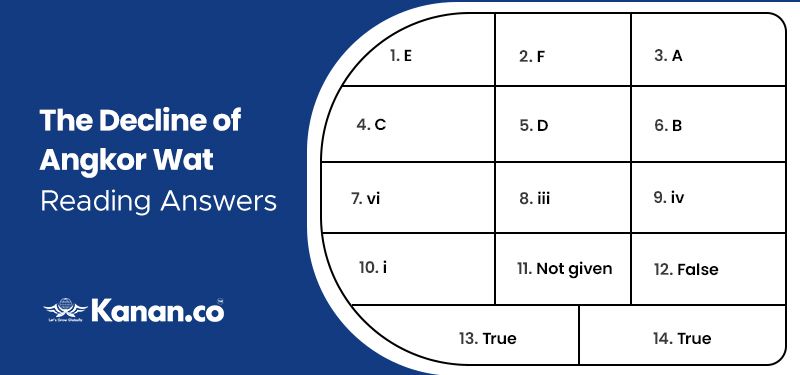
Here we have given the decline of Angkor wat reading answers along with questions, answers and explanations. This article consists of 14 questions in 3 different types namely- 6 questions as locating information, 4 questions as multiple choice and 4 questions as true, false or not given.
Check out our YouTube Channel to Practice Full-Length IELTS Reading Tests Daily

Table of content:
- Solution for the decline of angkor wat
- The decline of angkor wat IELTS reading practice test
- Passage
- Questions
- Answers with explanation
Solution for The Decline of Angkor Wat
Here we have given the answers for the decline of angkor wat reading answers in the table form.

Answer Table
| 1. E | 4. C | 7. vi | 10. i | 13. True |
| 2. F | 5. D | 8. iii | 11. Not given | 14. True |
| 3. A | 6. B | 9. iv | 12. False |
The Decline of Angkor Wat IELTS Reading Practice Test - Exam Review
In this article we have given the decline of angkor wat IELTS reading answers, it will help you to attain a band score in your major exam. Go through the given passage carefully and answer the given questions.
Passage
We have given the decline of angkor wat reading answers with location. Before answering the question, read the passage completely.
The decline of angkor wat reading answers
A
Angkor is the epicentre of one of the greatest vanishing acts of all times. The ancient Khmer kingdom in modern Cambodia lasted from the 9th to 15th century, and at its height dominated a huge area of South-East Asia from today’s Myanmar in the west to Vietnam in the east.
As many as 750,000 people lived in Angkor (capital city), making it the most extensive urban complex of the pre-industrial era by the late 16th century. When Portuguese missionaries came across the lotus-shaped towers of Angkor Wat (world’s largest religious monument), the empire was in its final phase.
B
Exactly what caused the decline is unknown; invaders, a change of religion, a shift to maritime trade that degraded an inland city are all guesswork. The people of Angkor never spoke a single word explaining their kingdoms collapse. Recent excavations are suggesting a new answer. Angkor was doomed by the very ingenuity that originally gave rise to it – control of water slipped away.
C
To ensure a steady water supply, stabilise rice production and control flooding, Khmer engineers had built a full network of canals, moats, reservoirs and ponds. Massive infrastructure slowed the wet-season deluge flowing from the Kulen Hills, moving it into canals that fed the barays (artificial bodies of water).
Spreading across the gently sloping land, the water gets finally drained into the Tonle Sap (the largest freshwater lake in South-East Asia). This system ensured a water supply that did not rely on the monsoon. But this reliability required massive skills of engineering, including a reservoir called the West Baray, which is 8 kilometres long and almost three kilometres wide.
To build this most sophisticated of Angkor’s large reservoirs 1000 years ago, as many as 200,000 Khmer workers were needed to stock nearly 16 million cubic yards of soil in embankments 300 feet wide and three stories tall. Till today, the rectangular reservoir is fed by water diverted from the Siem river.
D
Today’s researchers have been amazed by the ambition of Angkor’s early engineers. “The entire landscape is artificial” say people. Over several centuries, hundreds of miles of canals that relied on subtle differences in the land’s natural inclination were constructed to divert water from three different rivers to the barays.
During the summer monsoons, overflow channels bled off excess water and after the rains petered out in October/November, irrigation channels dispensed the stored water. The barays helped renew soil moisture by allowing water to soak into the earth. In neighbourhood fields, surface evaporation would have drawn up the groundwater to supply crops.
E
The clever water system may have made all the difference between mediocrity and greatness. Most of the kingdom’s rice was grown in fields with embankments that would otherwise have relied on monsoons or the seasonal flow of water on the floodplain. Irrigation may have boosted harvests. The system could also have helped in providing rations during a poor monsoon season.
The ability to divert and hold water flow has afforded a measure of protection from floods. Angkor’s waterworks would have been an extremely valuable asset for the struggling South-East Asian kingdoms.
F
There is strong evidence that says the system was destroyed by Angkor’s own engineers; one of the huge spillways was destroyed that was used to remove excess water. However, why this was done is a mystery. The ruins are a vital clue to an epic struggle as Khmer engineers coped with an even more complex and unruly water system.
Logically, the dam failed; the river could have chewed into the dam, weakening it gradually. Perhaps, it was washed away by a heavy flood. The Khmer then ripped apart most of their stonework, salvaging the blocks for other things.
Questions
Question 1-6
- Which paragraph contains the following information?
- Write the letter, A-F
1. a mention of growing food production ………………….
2. possible causes of destruction of an irrigation feature ………………….
3. a brief portrayal of a civilisation at its peak ………………….
4. a labour force estimation took part in construction of the water system ………………….
5. modern-day reactions to a complex, man-made water system ………………….
6. speculation about the decline of an empire ………………….
Question 7-10
- Write the correct letter, i-vi
i. the water system was able to compensate
ii. the stone blocks had disappeared
iii. it outpaced neighbouring systems
iv. a change was made that still lasts today
v. the system could use all of the supplied water
vi. the kingdom was in its final stages
7. When visitors from the West parts arrived ………………….
8. When Angkor’s irrigation system worked well ………………….
9. When the most sophisticated reservoir was built ………………….
10. When the monsoon failed ………………….
Questions 11-14
- Do the following statements agree with the information given in the Reading Passage 1 ?
- TRUE – if the statement agrees
- FALSE – if the statement contradicts
- NOT GIVEN – if there is no information
11. Missionaries accidentally destroyed some structures at Angkor Wat ………………….
12. Angkor’s inhabitants left manuscripts providing information about the collapse of their society ………………….
13. The water system took a few 100 years to construct ………………….
14. The irrigation system became harder to control over the years ………………….
Answers for the decline of angkor wat with Explanation
Here we have given the answers for the decline of angkor wat reading answers with explanation. This potion will help you to rectify your errors while answering.
1. Answer: E
Explanation: “The clever water system may have made all the difference between mediocrity and greatness. Most of the kingdom’s rice was grown in fields with embankments that would otherwise have relied on monsoons or the seasonal flow of water on the floodplain. Irrigation may have boosted harvests”. With this line it is clear that paragraph E states about growing food production. Hence the given answer is located in the 1-4 lines of paragraph E.
2. Answer: F
Explanation: “The huge spillways was destroyed that was used to remove excess water. However, why this was done is a mystery. The ruins are a vital clue to an epic struggle as Khmer engineers coped with an even more complex and unruly water system. Logically, the dam failed; the river could have chewed into the dam, weakening it gradually. Perhaps, it was washed away by a heavy flood”. With this line it is clear that paragraph F states about possible causes of destruction of an irrigation feature. Hence the given answer is located in the 2-6 lines of paragraph F.
3. Answer: A
Explanation: “Angkor is the epicentre of one of the greatest vanishing acts of all times. The ancient Khmer kingdom in modern Cambodia lasted from the 9th to 15th century, and at its height dominated a huge area of South-East Asia from today’s Myanmar in the west to Vietnam in the east”. With this line it is clear that a brief portrayal of a civilisation at its peak. Hence the given answer is located in the 1-4 lines of paragraph A.
4. Answer: C
Explanation: “As many as 200,000 Khmer workers were needed to stock nearly 16 million cubic yards of soil in embankments 300 feet wide and three stories tall. Till today, the rectangular reservoir is fed by water diverted from the Siem river”. With this line it is clear that paragraph C states about a labour force estimation took part in construction of the water system. Hence the given answer is located in the last 3 lines of paragraph C.
5. Answer: D
Explanation: “Today’s researchers have been amazed by the ambition of Angkor’s early engineers. “The entire landscape is artificial” say people. Over several centuries, hundreds of miles of canals that relied on subtle differences in the land’s natural inclination were constructed to divert water from three different rivers to the barays”. With this line it is clear that paragraph D states about modern-day reactions to a complex, man-made water system. Hence the given answer is located in the first 4 lines of paragraph D.
6. Answer: B
Explanation: “Exactly what caused the decline is unknown; invaders, a change of religion, a shift to maritime trade that degraded an inland city are all guesswork”. With this line it is clear that paragraph B states about speculation about the decline of an empire. Hence the given answer is located in the first 2 lines of paragraph B.
7. Answer: vi
Explanation: “When Portuguese missionaries came across the lotus-shaped towers of Angkor Wat (world’s largest religious monument), the empire was in its final phase”. With this line it is clear that visitors from the West parts arrived when the kingdom was in its final stages. Hence the given answer is located in the last 3 lines of paragraph A.
8. Answer: iii
Explanation: “The clever water system may have made all the difference between mediocrity and greatness”. With this line it is clear that Angkor’s irrigation system worked well and it outpaced neighbouring systems. Hence the given answer is located in the first 2 lines of paragraph E.
9. Answer: iv
Explanation: “The West Baray, which is 8 kilometres long and almost three kilometres wide.To build this most sophisticated of Angkor’s large reservoirs 1000 years ago, as many as 200,000 Khmer workers were needed to stock nearly 16 million cubic yards of soil in embankments 300 feet wide and three stories tall. Till today, the rectangular reservoir is fed by water diverted from the Siem river”. With this line it is clear that the most sophisticated reservoir was built and a change was made that still lasts today. Hence the given answer is located in the last 5 lines of paragraph C.
10. Answer: i
Explanation: “Irrigation may have boosted harvests. The system could also have helped in providing rations during a poor monsoon season”. With this line it is clear that the monsoon failed and the water system was able to compensate. Hence the given answer is located in the 5-6 lines of paragraph E.
11. Answer: Not given
12. Answer: False
Explanation: “The people of Angkor never spoke a single word explaining their kingdom's collapse”. With this line it is clear that the given statement contradicts with the given information. Hence the given answer is located in the 2-3 lines of paragraph B.
13. Answer: True
Explanation: “Over several centuries, hundreds of miles of canals that relied on subtle differences in the land’s natural inclination were constructed to divert water from three different rivers to the barays”. With this line it is clear that the water system took a few 100 years to construct. Hence the given answer is located in the 2-3 lines of paragraph D.
14. Answer: True
Explanation: “The ruins are a vital clue to an epic struggle as Khmer engineers coped with an even more complex and unruly water system”. With this line it is clear that the irrigation system became harder to control over the years. Hence the given answer is located in the 3-5 lines of paragraph F.
Other reading answers

About Author Tejaswini Kota
Tejaswini is an enthusiastic writer, reader and a passionate learner. Additionally, she was a research fellow and holds a grip in English writings and research/paper publications. She holds bachelors and masters degrees in engineering. She spent three years in the education industry and is currently working as a full-time content writer at Kanan International, writing articles for study abroad projects. She is proficient in creating good quality content that helps the students for language proficiency tests like IELTS, GRE, TOEFL etc. and can help in advising you the right choice of college for admission.
Kanan.co is a trusted study abroad consultancy offering comprehensive services, resources, and solutions for students and education institutions. We support students at every stage of their global education journey, ensuring a smooth and guided experience. Along with test preparation for IELTS, GRE, TOEFL, and SAT, we provide expert services such as SOP writing, visa guidance, accommodation support, scholarship assistance, and education loan support. Our expertise and commitment to excellence make us a reliable partner for students pursuing international education.
Free Online Mock Test 2026
Practice our mock test worth Rs. 25000 for Free and know your IELTS score!








Global Headquarters
Kanan Int EdTech Inc
320 Bay Street, Suite 321 (Spaces), Toronto ON, Canada M5B 1N9
Indian Headquarters
Kanan International Pvt. Ltd.
D-wing, 2nd Floor, Trident Complex, Ellora Park Vadiwadi Road, Vadodara, Gujarat 390007
IT/ Digital Campus
Kanan International Pvt. Ltd
Old, New No 3, 2nd Floor, 1A, Dr Sadasivam Rd, T. Nagar, Chennai, Tamil Nadu 600017
Our branches
- Bardoli
- Bharuch
- Chennai
- Dehradun
- Gurugram
- Himatnagar
- Karnal
- Nadiad
- Navsari
- Palanpur
- Rajkot
- Vadodara
- Valsad
- Vallabh Vidyanagar
- Vapi
Study Abroad
Test Prep
Top Universities
Consultants
IELTS Centers
GRE Centers
TOEFL Centers
SAT Centers
Language Courses in Vadodara
Study Abroad Calculators
Featured Blogs
Study Abroad Consultants in Chennai
Study Abroad Consultants in Surat
Study Abroad Consultants in Navsari
Study Abroad Consultants in Bardoli
Study Abroad Consultants in Ahmedabad
Study Abroad Consultants in Anand
Study Abroad Consultants in Khanna
Study Abroad Consultants in Nadiad
Study Abroad Consultants in Vadodara
Study abroad consultants in Valsad
Copyright © 2026 KANAN.CO All rights reserved.