- Study Abroad
- / ielts
- / the efficacy of hypnotherapy reading answers
The Efficacy of Hypnotherapy Reading Answers


Author
17-09-2025

Here we have given The Efficacy of Hypnotherapy reading answers as a IELTS practice test along with answers and explanations. This article consists of 15 questions in 5 different question types namely- 3 questions as multiple choice questions, 5 questions as summary completion, 2 questions as short answers question, 4 questions as locating information and 1 question as multiple choice questions. Read through the paragraphs and answer the questions carefully.
Check out our YouTube Channel to Practice Full-Length IELTS Reading Tests Daily

Table of contents:
- Solutions for The Efficacy of Hypnotherapy
- The Efficacy of Hypnotherapy IELTS reading practice test
- Passage
- Questions
- Answers with explanation
Solution for The Efficacy of Hypnotherapy
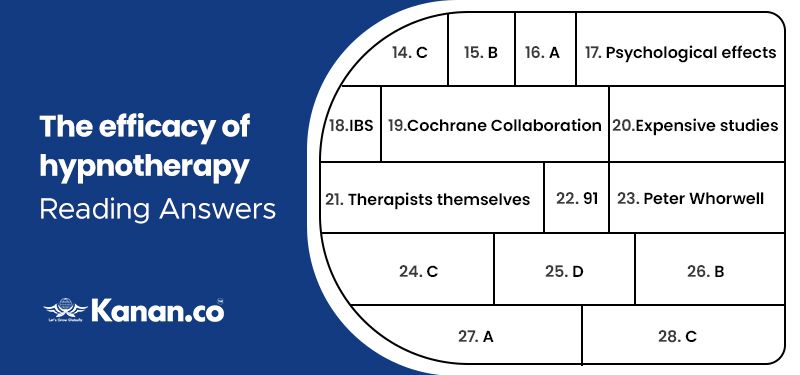
Here we have given The Efficacy of Hypnotherapy reading answers, in the table given below.

Answer Table
| 14. C | 17. Psychological effects | 20. Expensive studies | 23. Peter Whorwell | 26. B |
| 15. B | 18. IBS | 21. Therapists themselves | 24. C | 27. A |
| 16. A | 19. Cochrane Collaboration | 22. 91 | 25. D | 28. C |
The Efficacy of Hypnotherapy IELTS reading practice test-Exam Review
In this article we have given The Efficacy of Hypnotherapy IELTS reading answers as a sample article for IELTS reading practice test. Use this article while practicing for your exam, this will help you attain a band score in your exams. Check out the given passage to answer the questions.
Passage
Here we have given The Efficacy of Hypnotherapy reading answers with location, be attentive while reading the passage and answer the given questions.
The Efficacy of Hypnotherapy reading answers
- In the 1840s Scottish neurosurgeon, James Braid coined ‘Hypnotherapy’. At that time, in India, British surgeon, James Esdaile, practiced hundreds of scrotal and abdominal operations, adopting hypnosis as the only anesthetic. It was unfortunate timing that he reported his research dissertation on hypnosis to London Royal Society just as chemical anesthetics were discovered. The technique was not agreed on by the medical establishment.
- These days, whilst an increasing number of people are asking about private practitioners, the level of studies within the hypnotherapy field is meaningful enough that it remains on the fringes of medicine. In a report on alternative and complementary medicine in 2000, the Science and Technology Committee of the UK’s House of Lords has given hypnosis a bad reputation by putting it in the “poor research/regulation” category. In other words, the therapies were unlikely to enter mainstream medicine without substantial changes.
- If you research the PubMed database using the term “hypnotherapy,” you find 11,518 hit-words, so there are plenty of studies out there. However, most of the researchers are not satisfied with the gold standard of a Randomised Controlled Trial (RCT) instead of taking the frame of reviews or case studies. Only 91 relevant RCTs conducted in the world have worked in the past four years. The researchers propose that hypnotherapy can be an effective treatment for pain control, irritable bowel syndrome, anxiety disorders and smoking cessation.
- There is clear evidence that hypnosis has psychological and physiological effects. That’s why Peter Whorwell at the University of Manchester has researched the efficacy of IBS (irritable bowel syndrome) surgery for gastrointestinal modulation with hypnotherapy and possible immune function support. But even though IBS is one of the best-covered areas, the action with mechanism is not clear and the Cochrane Collaboration from assessing clinical trials has criticized the size and quality of the studies.
- In spite of the evidence that hypnotherapy reduces pain, anxiety and stress, there are a couple of reasons why few trials have been done. From these stages, hypnosis’s usage doesn’t aid its image. Also, it has the same problems as other “talking” therapies. Alternative funding should be built up, as the drug companies do not benefit from funding expensive studies.
- But, one of the biggest obstacles to hypnosis being considered on a more scientific basis is the therapists themselves. Its effects are a result of a unique interaction between the practitioner and the patient. The expectation is similar to that of a drug and therefore should follow the same trial testing criteria. However, this argument is not helpful.
- I strongly believe that whilst meeting with a living, breathing person, it is hard to decrease the process of clinical hypnosis and to receive YES or NO responses that are able to be reliably repeated in other conditions. However, for hypnosis to be considered medical, it should be measurable, replicable and vigorous. Actually, we need to model a body of clinical evidence in order to adapt to the medical profession.
- With standardizing protocol used, we demand quantitative measures of the effects on the patient, so studies can be compared. Ideally, researchers would have access to state-of-the-art brain scanning equipment. In reality, we are able to get simple biochemical markets of hypnosis and after-effects under suitable usage.
- Coming out of such studies in England, Ursula James founded the Medical School Hypnosis Association with her colleagues. According to Complementary Therapies in Clinical Practice, she explains schemes to bring medical professors and students together with hypnotherapists to operate coordinated national trials and build up a large body of evidence from research replicated at multiple locations. Most of all, one of the first questions is whether clinical hypnosis is able to decrease stress. That is an important component potentially in an illness. We work towards using standardized questionnaires to calculate lifestyle, stress and depression and to measure various stress hormone levels in saliva samples taken from case applicants.
- If we are able to show that there is a decrease in stress, we hope that hypnosis will be supplied to patients to treat their condition. With a wide range of usages, it could open up study into other areas including decreasing the thoughts of pain and improving recovery times.
Questions
Questions 14-16
- Choose the appropriate letters A-D and write them in boxes 14-16 on your answer sheet.
14. According to information in the text, hypnotherapy
A Was created by British surgeon James Esdaile in 1840.
B Has already been used during an operation by James Braid.
C Originated from the work of Scottish neurosurgeon James Braid in the 1840s.
D Was created by James Esdaile and James Braid in the 1840s.
15. According to information in the text, the recent perception on hypnotherapy among private practitioners
A Maintains plenty of research within alternative medicine.
B Is on the fringes of mainstream medicine because there hasn’t been enough research.
C Means there is a neutral attitude within alternative medicine.
D Demands non-practical, but has potential.
16. According to a randomized controlled trial (RCT), hypnotherapy
A Works in a variety of cases.
B Supplied research and development in advance.
C Works in cold.
D Was found to be an antidote against irritable bowel syndrome (IBS).
Questions 17-21
- Complete the summary.
- Choose one or two words from the passage for each answer.
- Write your answers in boxes 17-21 on your answer sheet.
To show evidence of hypnosis, researchers have proved physiological and 17……………………….. as well. They discovered that hypnotherapy presumes to assist modulate gastrointestinal and immune function whilst operated 18………………………. The mechanism of action is not justified, also, what assesses clinical trials, the 19 ……………………….. has underestimated the value and scale of studies. Despite having several effects, drug companies deny the therapy due to 20……………………… it should be demanded as a substitute investment. However, an outstanding barrier is 21…………………………
Questions 22-23
- Answer the questions below.
- Choose no more than two words and/or a number from the passage for each answer.
- Write your answers in boxes 22 and 23 on your answer sheet.
22 How many relevant RCTs were there in the past four years?
23 Who reported that hypnotherapy aids gastrointestinal modulation and supports immune function?
Questions 24-27
- Look at the following people and the list of statements below.
- Match each name with the correct statement.
- Write the correct letter, A-E, in boxes 24-27 on your answer sheet.
24 James Braid
25 James Esdaile
26 Peter Whorwell
27 Ursula James
List of Statements
A Founded the Medical School Hypnosis Association.
B Discovered hypnotherapy suppose to aid gastrointestinal modulation and support immune function.
C Created a new term, hypnotherapy, in the 1840s.
D Implemented over several hundred abdominal and scrotal operations.
E Criticized the quality and size of hypnotherapy.
Question 28
- Choose the appropriate letter A-D and write it in box 28 on your answer sheet.
- Which of the following statements best describes the writer’s main purpose in Reading Passage 2?
A To inform the reader relative not to mimic during operating of hypnotherapy
B To encourage the reader to act against misinformation regarding hypnotherapy
C To make the reader spread the right perception of hypnotherapy
Answers for The Efficacy of Hypnotherapy with Explanation
We have given The Efficacy of Hypnotherapy reading answers with explanation, this will help you to correct your mistakes in the answering process.
14. Answer: C
Explanation: “In the 1840s Scottish neurosurgeon, James Braid coined ‘Hypnotherapy’. At that time, in India, British surgeon, James Esdaile, practiced hundreds of scrotal and abdominal operations, adopting hypnosis as the only anesthetic”. With this line it is clear that according to information in the text, hypnotherapy originated from the work of Scottish neurosurgeon James Braid in the 1840s. Hence the given answer is located in the 1-3 lines of paragraph 1.
15. Answer: B
Explanation: “These days, whilst an increasing number of people are asking about private practitioners, the level of studies within the hypnotherapy field is meaningful enough that it remains on the fringes of medicine. In a report on alternative and complementary medicine in 2000, the Science and Technology Committee of the UK’s House of Lords has given hypnosis a bad reputation by putting it in the “poor research/regulation” category”. With this line it is clear that the recent perception on hypnotherapy among private practitioners, is on fringes of mainstream medicine because there hasn’t been enough research. Hence the given answer is located in the first 6 lines of paragraph 2.
16. Answer: A
Explanation: “If you research the PubMed database using the term “hypnotherapy,” you find 11,518 hit-words, so there are plenty of studies out there. However, most of the researchers are not satisfied with the gold standard of a Randomised Controlled Trial (RCT) instead of taking the frame of reviews or case studies”. With this line it is clear that According to a randomized controlled trial (RCT), hypnotherapy works in a variety of cases. Hence the given answer is located in the 1-4 lines of paragraph 3.
17. Answer: Psychological effects
Explanation: “There is clear evidence that hypnosis has psychological and physiological effects”. With this line it is clear that it is clearly evident that hypnosis has psychological and physiological effects. Hence the given answer is located in the first line of paragraph 4.
18. Answer: IBS
Explanation: “That’s why Peter Whorwell at the University of Manchester has researched the efficacy of IBS (irritable bowel syndrome) surgery for gastrointestinal modulation with hypnotherapy and possible immune function support”. With this line it is clear that they discovered that hypnotherapy presumes to assist modulate gastrointestinal and immune function whilst operating IBS. Hence the given answer is located in the 2-5 lines of paragraph 4.
19. Answer: Cochrane Collaboration
Explanation: “But even though IBS is one of the best-covered areas, the action with mechanism is not clear and the Cochrane Collaboration from assessing clinical trials has criticized the size and quality of the studies”. With this line it is clear that the mechanism of action is not justified, also, what assesses clinical trials, the Cochrane Collaboration has underestimated the value and scale of studies. Hence the given answer is located in the first 3 lines of paragraph 4.
20. Answer: Expensive studies
Explanation: “Alternative funding should be built up, as the drug companies do not benefit from funding expensive studies”. With this line it is clear that despite having several effects, drug companies deny the therapy due to expensive studies. Hence the given answer is located in the last 2 lines of paragraph 5.
21. Answer: Therapists themselves
Explanation: “But, one of the biggest obstacles to hypnosis being considered on a more scientific basis is the therapists themselves”. With this line it is clear that one of the biggest obstacles to hypnosis being considered on a more scientific basis is the therapists themselves. Hence the given answer is located in the first 2 lines of paragraph 6.
22. Answer: 91
Explanation: “Only 91 relevant RCTs conducted in the world have worked in the past four years”. With this line it is clear that there only 91 relevant RCTs conducted in the world have worked in the past four years. Hence the given answer is located in the 4-5 lines of paragraph 3.
23. Answer: Peter Whorwell
Explanation: “Peter Whorwell at the University of Manchester has researched the efficacy of IBS (irritable bowel syndrome) surgery for gastrointestinal modulation with hypnotherapy and possible immune function support”. With this line it is clear that Peter Whorwell has reported that hypnotherapy aids gastrointestinal modulation and supports immune functionHence the given answer is located in the 2-4 lines of paragraph 4.
24. Answer: C
Explanation: “In the 1840s Scottish neurosurgeon James Braid coined ‘Hypnotherapy’.” with this line it is clear that James Braid created a new term, hypnotherapy, in the 1840s. Hence the given answer is located in the first line of paragraph 1.
25. Answer: D
Explanation: “At that time, in India, British surgeon, James Esdaile, practiced hundreds of scrotal and abdominal operations, adopting hypnosis as the only anesthetic”. With this line it is clear that James Esdaile implemented over several hundred abdominal and scrotal operations. Hence the given answer is located in the first 3 lines of paragraph 1.
26. Answer: B
Explanation: “Peter Whorwell at the University of Manchester has researched the efficacy of IBS (irritable bowel syndrome) surgery for gastrointestinal modulation with hypnotherapy and possible immune function support”. With this line it is clear that Peter Whorwell discovered hypnotherapy suppose to aid gastrointestinal modulation and support immune function. Hence the given answer is located in the 2-5 lines of paragraph 4.
27. Answer: A
Explanation: “Coming out of such studies in England, Ursula James founded the Medical School Hypnosis Association with her colleagues”. With this line it is clear that Ursula James founded the Medical School Hypnosis Association with her colleagues. Hence the given answer is located in the first 2 lines of paragraph 9.
28. Answer: C
Explanation: In this passage the writer's main purpose, reader wants to spread the right perception of hypnotherapy. Hence the given answer is C.
Other reading answers

About Author Tejaswini Kota
Tejaswini is an enthusiastic writer, reader and a passionate learner. Additionally, she was a research fellow and holds a grip in English writings and research/paper publications. She holds bachelors and masters degrees in engineering. She spent three years in the education industry and is currently working as a full-time content writer at Kanan International, writing articles for study abroad projects. She is proficient in creating good quality content that helps the students for language proficiency tests like IELTS, GRE, TOEFL etc. and can help in advising you the right choice of college for admission.
Kanan.co is a trusted study abroad consultancy offering comprehensive services, resources, and solutions for students and education institutions. We support students at every stage of their global education journey, ensuring a smooth and guided experience. Along with test preparation for IELTS, GRE, TOEFL, and SAT, we provide expert services such as SOP writing, visa guidance, accommodation support, scholarship assistance, and education loan support. Our expertise and commitment to excellence make us a reliable partner for students pursuing international education.
Free Online Mock Test 2026
Practice our mock test worth Rs. 25000 for Free and know your IELTS score!








Global Headquarters
Kanan Int EdTech Inc
320 Bay Street, Suite 321 (Spaces), Toronto ON, Canada M5B 1N9
Indian Headquarters
Kanan International Pvt. Ltd.
D-wing, 2nd Floor, Trident Complex, Ellora Park Vadiwadi Road, Vadodara, Gujarat 390007
IT/ Digital Campus
Kanan International Pvt. Ltd
Old, New No 3, 2nd Floor, 1A, Dr Sadasivam Rd, T. Nagar, Chennai, Tamil Nadu 600017
Our branches
- Bardoli
- Bharuch
- Chennai
- Dehradun
- Gurugram
- Himatnagar
- Karnal
- Nadiad
- Navsari
- Palanpur
- Rajkot
- Vadodara
- Valsad
- Vallabh Vidyanagar
- Vapi
Study Abroad
Test Prep
Top Universities
Consultants
IELTS Centers
GRE Centers
TOEFL Centers
SAT Centers
Language Courses in Vadodara
Study Abroad Calculators
Featured Blogs
Study Abroad Consultants in Chennai
Study Abroad Consultants in Surat
Study Abroad Consultants in Navsari
Study Abroad Consultants in Bardoli
Study Abroad Consultants in Ahmedabad
Study Abroad Consultants in Anand
Study Abroad Consultants in Khanna
Study Abroad Consultants in Nadiad
Study Abroad Consultants in Vadodara
Study abroad consultants in Valsad
Copyright © 2026 KANAN.CO All rights reserved.