- Study Abroad
- / ielts
- / the end of the email reading answers
The End of The Email Reading Answers


Author
17-09-2025

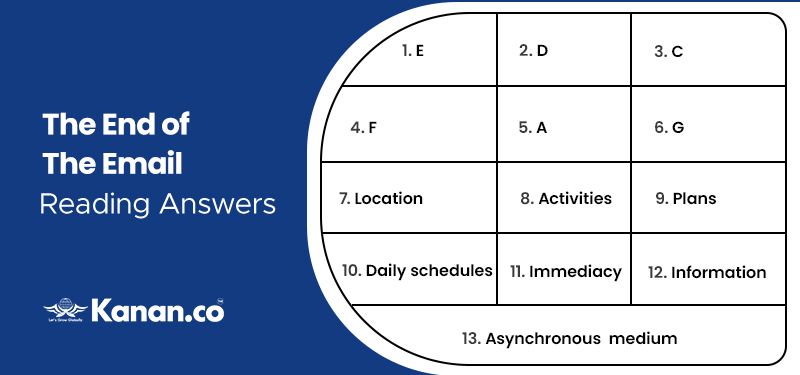
In this article we have given “the end of the email” reading answers along with questions, answers and explanations. This article has 13 questions based on the given passage in 3 different types namely- 6 questions as locating information, 4 questions as short answer questions and 3 questions as sentence completion.
Check out our YouTube Channel to Practice Full-Length IELTS Reading Tests Daily

Table of content:
- Solution for the end of the email
- The end of the email IELTS reading practice test
- Passage
- Questions
- Answers with explanation
Solution of The End of The Email
Below, we have given the answers for the end of the email reading answers in the table answers.

Answer Table
| 1. E | 4. F | 7. Location | 10. Daily schedules | 13. Asynchronous medium |
| 2. D | 5. A | 8. Activities | 11. Immediacy | |
| 3. C | 6. G | 9. Plans | 12. Information |
The End of The Email IELTS Reading Practice Test - Exam Review
Here we have given the end of the email IELTS reading answers, as a sample article for the IELTS reading practice test. This article will help you to be excellent in your exams with band scores. Scrutinize the given passage to answer the questions.
Passage
We have given the end of the email reading answers with location. Be careful while reading the passage and answer the questions.
The End of The Email Reading Answers
More than 107 trillion emails are sent every year but its grip on your lives is loosening.
A. For several years students of the internet have noticed that young people are abandoning email in favor of alternative electronic ways of staying in touch. A leading US internet research firm, ComScore, recently reported a 59% decline in the use of internet-based email services by 12 to 17 year-olds, an 18% decline among 25 to 35 year-olds, and an 8% fall among 35 to 44 year-olds. There are even signs that email is beginning to lose favor in the workplace too.
B. Europe's largest IT company, Atos Origin, intends to scrap internal emails altogether. Its staff will still use email to correspond with clients and other businesses but to talk among themselves they will adopt a variety of newer services such as instant messaging services and older methods - namely talking face to face. The company's chairman prompted headlines around the world when he mentioned he had not sent an email in more than three years. But in fact, a number of companies have been quietly moving away from using email as the primary way of communicating within the company. Intel, for example, has been experimenting with 'no-email Fridays' encouraging its engineers to solve problems by phone or face to face instead.
C. The move, in part, reflects the preferences of its workers, many of whom are under the age of 30. However, it is also happening because the volume of emails is becoming unsustainable. Employees who usually get 200 emails a day, spend between five and 20 hours a week just clearing their inboxes. The distraction and time-wasting of email have been a regular part of office life for more than a decade. More than 107 trillion are now sent each year, of which half are spam. The rest are a mix of round robins, personal messages and badly written memos that pile up in archives and do little to
boost productivity. Research shows that it takes 64 seconds to regain concentration after reading an email and when you consider that US office workers have been measured checking their emails and swapping windows on their computer screens an average of 37 times an hour, that adds up to major distraction.
D. Employees will be expected to use collaboration and social media tools instead of email to communicate with co-workers. In English, that means newer types of electronic messaging services. One such service is instant messaging. Devised in the 1990s by people playing games on the net, instant messaging or IM is much simpler and more responsive than email. IM users can see when colleagues are online and then communicate in small, continuous trails of dialogues on their screens, much more like a phone call. These messages tend to be deleted as they go, thus avoiding clogged up email inboxes and archives. Less formal than email, they are also a far more efficient way of, for example, trying to arrange a meeting. IM or 'chat' facilities often form part of larger social networks, such as Facebook and Twitter.
E. The immediacy of these synchronous messaging systems enable people to stay in touch and broadcast information to each other their location, activities, plans and daily schedules without the need for constant emailing.'Status updates' in which users post
a simple message that can be read by all their contacts, enable people to see and share information that might not be worth an email but can be useful nonetheless. All such 'easy chat' services were born of engagement with the internet that just didn't exist when email overtook the world of communication in the early 1990s.
F. Until about a decade ago, most neuroscientists thought the brain stopped developing after childhood. But the constant distraction and torrent of information that we subject ourselves to via email, surfing the web, TY, multi-tasking - is now thought to alter the way we think. The new technology is, in effect, rewiring our brains. Scientists have drawn parallels between the use of electronic communication and addiction to food stimulants that release small amounts of dopamine in the brain. We feel a buzz of excitement when a message arrives, which then fades, leaving us feeling flat and bored until the next one comes. But whether this makes us less productive is open to
question. Research has found that people work better in bursts of concentration interrupted by breaks even for pointless emails- then long sustained spells.
G. There are still an estimated three billion email accounts in the world, a figure that dwarfs any other form of communication. Email also retains several distinguishing qualities. Unlike the galaxy of social networks and IM services on the internet all requiring different accounts and often their own software email systems are all fundamentally compatible. It doesn't matter which program you send it from. And even its annoyances contain advantages: mail archives have proved to be hugely valuable, and because it is an asynchronous medium (the recipients choose when to open their messages) this means we can try and preserve some control Over our time. This is not the end of the email, it will remain a bedrock of businesses for some time to come. It's simply the end of its monopoly.
Questions
Questions 1-6
- The reading passage has seven paragraphs labeled A-G.
- Which paragraph contains the following information?
- Write the correct letter A-G in boxes 1-6 on your answer sheet.
- NB You may use any letter more than once.
1. Reasons for the appeal of social networking tools over email
2. A description of alternatives to email as a form of communication in the workplace
3. A reference to why one business plans to reduce its flow of internal email
4. A brief conclusion of findings on the effects technology has on our attention span
5. Evidence of a decline in the popularity of email
6. A reference to some positive features of email as a form of communication
Questions 7-10
- Write your answers in boxes 7-10 of your answer sheet.
- List FOUR examples of information that can be communicated using the medium of Instant Messaging.
7 …………………
8 …………………
9 …………………
10 …………………
Questions 11-13
- Complete the sentences below with words taken from the reading passage.
- Use NO MORE THAN TWO WORDS for each answer.
- Write your answers in boxes 11-13 of your answer sheet.
11. Young people use social networking tools that provide the level of ...... they want.
12. The advantage of social networking is that it puts people in control of the …….. they see.
13. Email is an ………, so you don't know if someone has read your message.
Answers for The End of The Email with explanation
Here we have given the answers for the end of the email reading answers with explanations, this section will guide you while answering.
1. Answer: E
Explanation: “the immediacy of these synchronous messaging systems enable people to stay in touch and broadcast information to each other their location, activities, plans and daily schedules without the need for constant emailing”. With this line it is clear that why people prefer using social networking tools over email. Hence the given answer is located in the 1-3 lines of paragraph E.
2. Answer: D
Explanation: “Employees will be expected to use collaboration and social media tools instead of email to communicate with co-workers”. With this line it is clear that the details of the tools that can used in-place of emails for communication in the workplace. Hence the given answer is located in the 1-2 lines of paragraph D.
3. Answer: C
Explanation: “because the volume of emails is becoming unsustainable. Employees who usually get 200 emails a day, spend between five and 20 hours a week just clearing their inboxes” and “Research shows that it takes 64 seconds to regain concentration after reading an email”. With this line it is clear that the reason why business plans to reduce its internal flow of emails. Hence the given answer is located in the 3-5 lines and 10-11 lines of paragraph C.
4. Answer: F
Explanation: “Research has found that people work better in bursts of concentration interrupted by breaks even for pointless emails- then long sustained spells”. With this line it is clear that the effects technology has on our attention span. Hence the given answer is located in the last 2 lines of paragraph F.
5. Answer: A
Explanation: “A leading US internet research firm, ComScore, recently reported a 59% decline in the use of internet-based email services by 12 to 17 year-olds, an 18% decline among 25 to 35 year-olds, and an 8% fall among 35 to 44 year-olds”. With this line it is clear that the evidence of a decline in the popularity of email. Hence the given answer is located in the 2-5 lines of paragraph A.
6. Answer: G
Explanation: “Even its annoyances contain advantages: mail archives have proved to be hugely valuable, and because it is an asynchronous medium (the recipients choose when to open their messages) this means we can try and preserve some control Over our time”. With this line it is clear that positive features of email as a form of communication. Hence the given answer is located in the 5-8 lines of paragraph G.
7. Answer: location
Explanation: “The immediacy of these synchronous messaging systems enable people to stay in touch and broadcast information to each other their location, activities, plans and daily schedules without the need for constant emailing”. With this line it is clear that locations are one of the examples of information that can be communicated using the medium of Instant Messaging. Hence the given answer is located in the first 3 lines of paragraph of E.
8. Answer: Activities
Explanation: “The immediacy of these synchronous messaging systems enable people to stay in touch and broadcast information to each other their location, activities, plans and daily schedules without the need for constant emailing”. With this line it is clear that activities are one of the examples of information that can be communicated using the medium of Instant Messaging. Hence the given answer is located in the first 3 lines of paragraph of E.
9. Answer: plans
Explanation: “The immediacy of these synchronous messaging systems enable people to stay in touch and broadcast information to each other their location, activities, plans and daily schedules without the need for constant emailing”. With this line it is clear that activities are one of the examples of information that can be communicated using the medium of Instant Messaging. Hence the given answer is located in the first 3 lines of paragraph of E.
10. Answer: daily schedules
Explanation: “The immediacy of these synchronous messaging systems enable people to stay in touch and broadcast information to each other their location, activities, plans and daily schedules without the need for constant emailing”. With this line it is clear that activities are one of the examples of information that can be communicated using the medium of Instant Messaging. Hence the given answer is located in the first 3 lines of paragraph of E.
11. Answer: immediacy
Explanation: “The immediacy of these synchronous messaging systems enable people to stay in touch and broadcast information to each other their location, activities, plans and daily schedules without the need for constant emailing”. With this line it is clear that activities are one of the examples of information that can be communicated using the medium of Instant Messaging. Hence the given answer is located in the first 3 lines of paragraph of E.
12. Answer: information
Explanation: “Status updates' in which users post a simple message that can be read by all their contacts, enable people to see and share information that might not be worth an email but can be useful nonetheless”. With this line it is clear that the advantage of social networking is that it puts people in control of the information they see. Hence the given answer is located in the 3-5 lines of paragraph of E.
13. Answer: asynchronous medium
Explanation: “Because it is an asynchronous medium (the recipients choose when to open their messages)” With this line it is clear that Email is an asynchronous medium, so you don't know if someone has read your message. Hence the given answer is located in the 7-8 lines of paragraph of G.
Other reading answers

About Author Gayathri Nagarajan
Gayathri, a trusted study-abroad expert, with expertise in standardized tests like IELTS, TOEFL, PTE, GRE, and GMAT. With a strong tech background from SASTRA University, she excels in software testing and has a passion for content writing and digital marketing. She aids students in finding the perfect academic fit, offering guidance on course selection, LOR and SOP writing. She remains up-to-date with the latest trends in higher education, delivering credible, accurate information on international education, including courses and test prep materials. As a trusted Study abroad expert at Kanan International, explore her latest blogs and articles for comprehensive insights into studying abroad and realizing your academic aspirations.
Kanan.co is a trusted study abroad consultancy offering comprehensive services, resources, and solutions for students and education institutions. We support students at every stage of their global education journey, ensuring a smooth and guided experience. Along with test preparation for IELTS, GRE, TOEFL, and SAT, we provide expert services such as SOP writing, visa guidance, accommodation support, scholarship assistance, and education loan support. Our expertise and commitment to excellence make us a reliable partner for students pursuing international education.
Free Online Mock Test 2026
Practice our mock test worth Rs. 25000 for Free and know your IELTS score!








Global Headquarters
Kanan Int EdTech Inc
320 Bay Street, Suite 321 (Spaces), Toronto ON, Canada M5B 1N9
Indian Headquarters
Kanan International Pvt. Ltd.
D-wing, 2nd Floor, Trident Complex, Ellora Park Vadiwadi Road, Vadodara, Gujarat 390007
IT/ Digital Campus
Kanan International Pvt. Ltd
Old, New No 3, 2nd Floor, 1A, Dr Sadasivam Rd, T. Nagar, Chennai, Tamil Nadu 600017
Our branches
- Bardoli
- Bharuch
- Chennai
- Dehradun
- Gurugram
- Himatnagar
- Karnal
- Nadiad
- Navsari
- Palanpur
- Rajkot
- Vadodara
- Valsad
- Vallabh Vidyanagar
- Vapi
Study Abroad
Test Prep
Top Universities
Consultants
IELTS Centers
GRE Centers
TOEFL Centers
SAT Centers
Language Courses in Vadodara
Study Abroad Calculators
Featured Blogs
Study Abroad Consultants in Chennai
Study Abroad Consultants in Surat
Study Abroad Consultants in Navsari
Study Abroad Consultants in Bardoli
Study Abroad Consultants in Ahmedabad
Study Abroad Consultants in Anand
Study Abroad Consultants in Khanna
Study Abroad Consultants in Nadiad
Study Abroad Consultants in Vadodara
Study abroad consultants in Valsad
Copyright © 2026 KANAN.CO All rights reserved.