- Study Abroad
- / ielts
- / the great australian fence reading answers
The Great Australian Fence Reading Answers


Author
16-09-2025

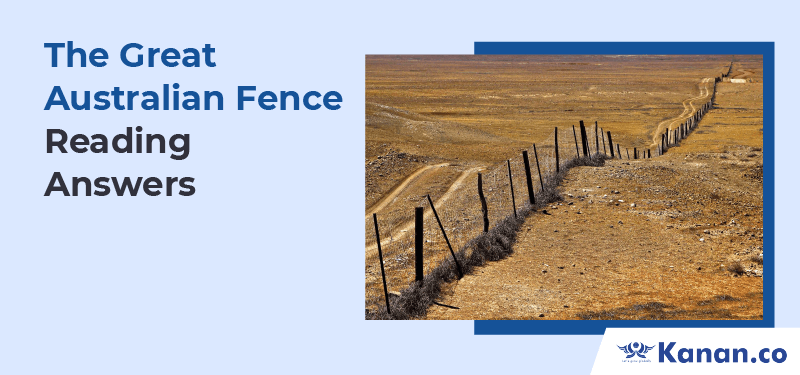
Analyze and identify the mistakes in your solutions with the Great Australian Fence Reading Answers questions.
Solution For The Great Australian Fence
| 1. D | 5. NO | 9. NOT GIVEN | 13. A |
| 2. B | 6. YES | 10. YES | |
| 3. C | 7. NO | 11. NOT GIVEN | |
| 4. A | 8. YES | 12. B |

Your reading proficiency will be measured in the IELTS reading test. You will be given a practice test along with The Great Australian Fence Reading Answers. This IELTS reading passage will assess your reading and comprehension abilities, as well as improve your time management skills.
The passage of The Great Australian Fence reading answers contain information about the fence, which is even greater than the Great wall of China, and also about how it was built. There are 14 different IELTS reading question types, of which three are given below for your practice.
- IELTS Reading Multiple-Choice Questions
- IELTS Reading yes no not given
Check Out our YouTube Channel to Practice Full-Length IELTS Reading Tests Daily

Strategies to solve “The Great Australian Fence” reading passage
Let us go through a few topics concerning the article "The Great Australian Fence IELTS Reading Answers." This will greatly improve your understanding of the text.
- You must write the letter of the option, not words or phrases, on your response sheet while answering multiple-choice questions.
- Concentrate on the writer's perspective on that specific question statement. Keep in mind that you will have at least one question for each of the three response options "Yes," "No," and "Not Given."
- If you can't locate the solution, don't freak out. Remain calm and deliberate since you can predict the right response better.
- To successfully answer the reading questions, you will need a large vocabulary due to the extensive usage of synonyms and other forms of word rephrasing throughout this section.
- To get a decent IELTS score, you must be familiar with the question types and understand the procedures for answering them.
- There will be no specific time allocated for transferring your answers in the reading portion, therefore it must be finished within the 60 minute time limit.
You must have a view of the IELTS reading tips before trying "The Great Australian Fence IELTS Reading Answers."
The Great Australian Fence Reading Passage
Reading Passage, Questions and the great Australian fence reading answers with explanation is given.
The Great Australian Fence-Reading Answers
For over a century, sheep ranchers in Australia have been at odds with the dingo, Australia's wild dog. To preserve their livelihood, the farmers erected a wire fence—3,307 miles of continuous wire mesh stretching from the coast of South Australia to the cotton fields of eastern Queensland, just short of the Pacific Ocean.
The Fence is Australia's equivalent of the Great Wall of China, except it is much longer and was built to keep away hostile invaders, in this instance, hordes of yellow dogs. The empire it protects is that of the woolgrowers, sovereigns of the world's second-largest sheep flock after China's (some 123 million head), and guardians of a four-billion-dollar wool export enterprise. Never mind that an increasing number of people-conservationists, lawmakers, taxpayers, and animal lovers argue that such a barrier would never be permitted today on ecological grounds. With portions dating back over a century, the dog fence has become, as conservator Lindsay Fairweather ruefully concedes, "an emblem of Australian frontier inventiveness."
I spent a portion of the Australian autumn touring the wires, appreciating this strange outback monument, and meeting the people whose lives rely on it. It goes by several names in different states: the "Dog Fence" in South Australia, the "Border Fence" in New Mexico, and the "Barrier Fence" in Queensland. I'd just call it the fence.
For most of its epic length, this epic barrier runs like a river across a terrain devoid of rivers until heavy rain has occurred. The circuitous course, primarily dictated by property borders, offers a taste of outback topography: the fence winds through dunes, across salt lakes, up and down rock-strewn hills, thick bush, and over bleak plains.
The barrier keeps towns at bay. Where it runs through a town, it has become a tourist attraction, frequented by bus excursions. It is the traditional boundary between cattle and sheep. Dingoes are shot, poisoned, and imprisoned inside, where they are legally categorized as pests. Sheep and dingoes do not mix, and the fence makes it clear for miles.
What is this monster that, despite the existence of the world's most fanatical fence, threatens a whole business, causing several million dollars in damage each year? Cam's lupus dingo is an invasive species of wild dog related to coyotes and jackals derived from Asian wolves. Skeletal evidence suggests that Asian mariners who arrived on Australia's north coast brought the dingo more than 3,500 years ago. The adaptive dingo expanded quickly and became the main predator, eliminating all of its marsupial rivals. With a large snout, short pointed ears, and a bushy tail, the dingo resembles a miniature wolf. Dingoes shriek and howl rather than bark. The dingo is Australia's biggest terrestrial carnivore, at around 22 inches at the shoulder, slightly higher than a coyote.
The woolgrowers' fight against dingoes, which is akin to sheep ranchers' wrath against coyotes in the United States, began not long after the first European settlers arrived in 1788, carrying a cargo of sheep with them. Dingoes became criminals when the government set a reward on their heads in 1830. Today's bounty for troubled dogs Killing sheep inside the fence may cost up to $500. Fences replaced shepherds when pioneers invaded the interior with their flocks of sheep. By the end of the nineteenth century, hundreds of miles of barrier fencing crisscrossed the enormous grazing areas.
"The dingo began as a calm observer, but quickly came to symbolize everything dark and terrible on the continent,' says Roland Breckwoldt in A Very Elegant Animal: The Dingo. Dingo populations are said to have multiplied a hundredfold since sheep arrived in Australia. Although dingoes have been exterminated in certain areas of Australia, an educated assessment puts the number at more than a million.
Eventually, government authorities and graziers decided that a single well-maintained fence, built on the outside of sheep country and funded by woolgrower taxes, should replace the tangle of private nets. By 1960, three states' barriers had been connected to create a single dog fence.
Private confrontations between wool farmers and dingoes have often served solely to define the fence in economic terms. It denotes the distinction between profit and loss. However, the fence throws a considerably larger ecological shadow since it has become a form of a terrestrial dam, obstructing the movement of creatures within and outside. The environmental consequences are most visible at Sturt National Park. In 1845, The explorer Charles Sturt undertook a failed trip across these areas in quest of an inland sea. A kangaroo sighting was an unusual occurrence for Sturt and other early explorers. They are now everywhere because, in the absence of a natural predator, the kangaroo population has surged within the fence. Kangaroos have become more cursed than dingoes. They have replaced sheep as competitors for water and pasture. As a result, state governments shoot around three million kangaroos each year to prevent Australia's national emblem from overrunning the pastoral regions. Park authorities acknowledge that the barrier is at fault and reply to the influx of kangaroos by stating, "The fence is there, and we have to live with it."
The Great Australian Fence IELTS Reading questions
Question 1-4:
Choose the appropriate letters A-D and write them in boxes 1-4 on your answer sheet.
1. Why was the fence built?
- to separate the sheep from the cattle.
- to stop the dingoes from being slaughtered by farmers.
- to act as a boundary between properties.
- to protect the Australian wool industry.
2. On what point do conservationists and politicians agree?
- Wool exports are vital to the economy.
- The fence poses a threat to the environment.
- The fence acts as a useful frontier between states.
- The number of dogs needs to be reduced.
3. Why did the author visit Australia?
- to study Australian farming methods.
- to investigate how the fence was constructed.
- because he was interested in life around the fence.
- because he wanted to learn more about the wool industry.
4. How does the author feel about the fence?
- impressed
- delighted
- shocked
- annoyed
Questions 5–11:
Do the following statements agree with the information given in the reading passage?
In boxes 5-11 on your answer sheet, write
Yes, if the statement agrees with the views of the writer.
No, if the statement contradicts the views of the writer.
It is not given if it is impossible to say what the writer thinks about this.
5. The fence serves a different purpose in each state.
6. The fence is only partially successful.
7. The dingo is indigenous to Australia.
8. Dingoes have flourished as a result of the sheep industry.
9. Dingoes are known to attack humans.
10. Kangaroos have increased in number because of the fence.
11. The author does not agree with the culling of kangaroos.
Also, check the IELTS reading yes no not given.
Questions 12–13:
Choose the appropriate letters from A-D.
Write them in boxes 12-13 on your answer sheet.
12. When did the authorities first acknowledge the dog problem?
- 1788
- 1830
- 1845
- 1960
13. How do the park officials feel about the fence?
- philosophical
- angry
- pleased
- proud13
Also, check the IELTS reading Multiple choice questions.
The Great Australian Fence IELTS Reading Answers with explanations.
Find the great australian fence reading answers with explanation below which help you to analyze your answers.
1. Answer: D
Keywords Location: Paragraph 1, Line 2
Explanation: The fence was built to protect the livelihood of farmers, which is the wool industry. Hence, protecting the Australian wool industry is the correct answer. Thus, the correct answer is “D”.
2. Answer: B
Keywords Location: Paragraph 2, 3rd statement
Explanation: “A threat” and “a barrier never allowed” have the same meaning in this context.
“Environment” and “ecological grounds” are interchangeable in this case. Hence, the answer is correct. As these barriers pose a threat to the environment,
3. Answer: C
Keyword Location: Paragraph 3, Line 1
Explanation: “Life around the fence” and “meet people whose livelihoods depend on it (fence)” have the same meaning in this context. “Interested in” and “appreciate” have the same meaning in this context. Hence, C is the correct answer.
4. Answer: A
Keyword Location: Paragraph 4, Line 1
Explanation: We could easily choose Option A as the correct answer after reading paragraph 4 because: “Impressed” and “prodigious” are interchangeable, having the same meaning in this case. Thus, the correct answer is "A."
5. Answer: NO
Keywords Location: Paragraph 3, Line 3-5
Explanation: We can conclude from paragraph 3 that the fence has different names in different states, not that each state has a different purpose. Thus, the correct answer is "NO."
6. Answer: YES
Keywords Location: Paragraph 2, Line 3
Explanation: Even though the fence serves the purpose, it would not be allowed based on ecological grounds. Hence, it can be considered as a partial success.
7. Answer: No
Keywords Location: Paragraph 6, Line 4-5
Explanation: After reading paragraph 6, Dingo is not indigeneous to australia. Hence, the correct answer is “NO”
8. Answer: YES
Keywords Location: Paragraph 8, Line 3-4
Explanation: After reading paragraph 8, “Sheep industry” & “sheep arrived in Australia” have the same meaning in this case.“Flourished” refers to “ numbers have increased a hundredfold”.
Thus, the correct answer is “YES”
9. Answer: NOT GIVEN.
10. Answer: YES
Keywords Location: Paragraph 10, Line 7-8
Explanation: After reading paragraph 10, “Increased in number” and “ubiquitous” have the same meaning in this case. With the predator gone due to the fence, the number of kangaroos has also increased. Thus, the correct answer is “YES”.
11. Answer: NOT GIVEN
12 Answer: B
Keyword Location: Paragraph 7, Line 3-4
Explanation: After reading paragraph 7, “First acknowledge” and “officially became outlaws” have the same meaning in this case. Hence the authorities first acknowledged the problem in 1830 as the correct answer.
13. Answer: A
Keywords Location: Paragraph 10, Last Line
Explanation: park officials say that the fence is to blame, but as it is there, they will have to live with it. This contradicting opinion is philosophical, and hence, it is the correct answer.
Other reading passages
- Candle Making in Colonial America Reading Answers
- The Nature and Aims of Archaeology Reading Answers
- When Evolution Runs Backwards Reading Answers
Conclusion
"The Great Australian Fence Reading Answers" can assist you in assessing your answers correctly. Make this part of your IELTS preparation which will help you to do well on the IELTS exam. Use the other resources in our website to enhance your understanding of the IELTS reading sections.

About Author Dinesh Pandiyan
Dinesh is a highly experienced content writer who specializes in language proficiency tests like IELTS, GRE, PTE, TOEFL, and study abroad. He provides valuable insights and tips to students on various modules of these tests, including reading, writing, speaking, and listening. His articles are well-researched, informative, and engaging, offering practical guidance to students looking to succeed in their academic pursuits. Additionally, Dinesh has coordinated with IELTS trainers to prepare test preparation materials, guides, practice tests, and mock tests, and worked closely with counsellors for study abroad consultancy, providing guidance on choosing the right institution, preparing for interviews, and writing effective statements of purpose (SOP) and letters of recommendation (LOR). Students can benefit from Dinesh's comprehensive knowledge and experience by checking out his articles.
Kanan International is a study abroad consultancy that offers reliable services, products, and solutions for students and education institutions. We support students throughout their study abroad journey, ensuring a hassle-free experience. Our expertise and commitment to excellence make us the go-to partner for expanding global horizons. The company provides coaching for IELTS, GRE, TOEFL, and SAT exams and services like visa consultation, accommodation, scholarship assistance, and education loans.
Free Online Mock Test 2026
Practice our mock test worth Rs. 25000 for Free and know your IELTS score!








Global Headquarters
Kanan Int EdTech Inc
320 Bay Street, Suite 321 (Spaces), Toronto ON, Canada M5B 1N9
Indian Headquarters
Kanan International Pvt. Ltd.
D-wing, 2nd Floor, Trident Complex, Ellora Park Vadiwadi Road, Vadodara, Gujarat 390007
IT/ Digital Campus
Kanan International Pvt. Ltd
Old, New No 3, 2nd Floor, 1A, Dr Sadasivam Rd, T. Nagar, Chennai, Tamil Nadu 600017
Our branches
- Bardoli
- Bharuch
- Chennai
- Dehradun
- Gurugram
- Himatnagar
- Karnal
- Nadiad
- Navsari
- Palanpur
- Rajkot
- Vadodara
- Valsad
- Vallabh Vidyanagar
- Vapi
Study Abroad
Test Prep
Top Universities
Consultants
IELTS Centers
GRE Centers
TOEFL Centers
SAT Centers
Language Courses in Vadodara
Study Abroad Calculators
Featured Blogs
Study Abroad Consultants in Chennai
Study Abroad Consultants in Surat
Study Abroad Consultants in Navsari
Study Abroad Consultants in Bardoli
Study Abroad Consultants in Ahmedabad
Study Abroad Consultants in Anand
Study Abroad Consultants in Khanna
Study Abroad Consultants in Nadiad
Study Abroad Consultants in Vadodara
Study abroad consultants in Valsad
Copyright © 2026 KANAN.CO All rights reserved.