- Study Abroad
- / ielts
- / the growth of bike sharing reading answers
The Growth of Bike Sharing Reading Answers


Author
18-09-2025

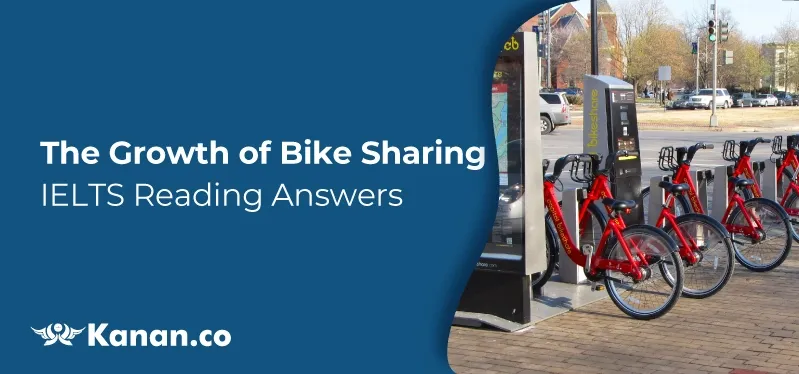
The Growth of Bike Sharing Reading Answers practice test and answers with explanations are given here for your reference and practice. The reading passage consists of seven paragraphs along with 13 questions. The questions are divided into three types: locating information questions, multiple choice questions, and summary completion questions.
Table of contents:
- Solution for The Growth of Bike Sharing Reading Answers
- The Growth of Bike Sharing Reading Answers IELTS Reading Practice Test
- Passage
- Questions
- Answers with Explanations
Solution for The Growth of Bike Sharing Reading Answers
For your understanding, we have provided The Growth of Bike Sharing reading answers in the table below.
Answer Table
| 1. E | 5. A | 9. E | 13. POLICE |
| 2. C | 6. B | 10. ACTIVISTS | |
| 3. F | 7. D | 11. CONSUMERISM | |
| 4. C | 8. D | 12. LEAFLETS |

The Growth of Bike Sharing IELTS Reading Practice Test - Exam Review
Check out our YouTube Channel to Practice Full-Length IELTS Reading Tests Daily

The Growth of Bike Sharing Reading Answers is given here for your practice, and it will help you develop your time-management and critical thinking skills. To solve the questions quickly, read the passage attentively, and mark the keywords and important details given in the passage. You can easily crack your IELTS reading module with key strategies.
Passage
We have provided The Growth of Bike Sharing Reading reading passage. Read the passage and answer all the questions(1-13) in 20-22 mins. Check your answers with The Growth of Bike Sharing Reading Answers with location.
The Growth of Bike Sharing
How Dutch engineer Luud Schimmelpennink helped to devise urban bike-sharing schemes.
- The original idea for an urban bike-sharing scheme dates back to a summer’s day in Amsterdam in 1965. Provo, the organization that came up with the idea, was a group of Dutch activists who wanted to change society. They believed the scheme, which was known as the Witte Fietsenplan, was an answer to the perceived threats of air pollution and consumerism. In the center of Amsterdam, they painted a small number of used bikes white. They also distributed leaflets describing the dangers of cars and inviting people to use the white bikes. The bikes were then left unlocked at various locations around the city, to be used by anyone in need of transport.
- Luud Schimmelpennink, a Dutch industrial engineer who still lives and cycles in Amsterdam, was heavily involved in the original scheme. He recalls how the scheme succeeded in attracting a great deal of attention - particularly when it came to publicizing Provo’s aims - but struggled to get off the ground. The police were opposed to Provo’s initiatives and almost as soon as the white bikes were distributed around the city, they removed them. However, for Schimmelpennink and for bike-sharing schemes in general, this was just the beginning. ‘The first Witte Fietsenplan was just a symbolic thing,’ he says. ‘We painted a few bikes white, that was all. Things got more serious when I became a member of the Amsterdam city council two years later.’
- Schimmelpennink seized this opportunity to present a more elaborate Witte Fietsenplan to the city council. ‘My idea was that the municipality of Amsterdam would distribute 10,000 white bikes over the city, for everyone to use,’ he explains. ‘I made serious calculations. It turned out that a white bicycle - per person, per kilometer - would cost the municipality only 10% of what it contributed to public transport per person per kilometer.’ Nevertheless, the council unanimously rejected the plan. ‘They said that the bicycle belongs to the past. They saw a glorious future for the car,’ says Schimmelpennink. But he was not in the least discouraged.
- Schimmelpennink never stopped believing in bike-sharing, and in the mid-90s, two Danes asked for his help to set up a system in Copenhagen. The result was the world’s first large-scale bike-share program. It worked on a deposit: ‘You dropped a coin in the bike and when you returned it, you got your money back.’ After setting up the Danish system, Schimmelpennink decided to try his luck again in the Netherlands - and this time he succeeded in arousing the interest of the Dutch Ministry of Transport. ‘Times had changed,’ he recalls. ‘People had become more environmentally conscious, and the Danish experiment had proved that bike-sharing was a real possibility.’ A new Witte Fietsenplan was launched in 1999 in Amsterdam. However, riding a white bike was no longer free; it cost one guilder per trip and payment was made with a chip card developed by the Dutch bank Postbank. Schimmelpennink designed conspicuous, sturdy white bikes locked in special racks which could be opened with the chip card - the plan started with 250 bikes, distributed over five stations.
- Theo Molenaar, who was a system designer for the project, worked alongside Schimmelpennink. ‘I remember when we were testing the bike racks, he announced that he had already designed better ones. But of course, we had to go through with the ones we had.’ The system, however, was prone to vandalism and theft. ‘After every weekend there would always be a couple of bikes missing,’ Molenaar says.‘I really have no idea what people did with them because they could instantly be recognized as white bikes.’ But the biggest blow came when Postbank decided to abolish the chip card because it wasn’t profitable. ‘That chip card was pivotal to the system,’ Molenaar says. ‘To continue the project we would have needed to set up another system, but the business partner had lost interest.’
- Schimmelpennink was disappointed, but - characteristically - not for long. In 2002 he got a call from the French advertising corporation JC Decaux, who wanted to set up his bike-sharing scheme in Vienna. ‘That went really well. After Vienna, they set up a system in Lyon. Then in 2007, Paris followed. That was a decisive moment in the history of bike-sharing.’ The huge and unexpected success of the Parisian bike-sharing program, which now boasts more than 20,000 bicycles, inspired cities all over the world to set up their own schemes, all modeled on Schimmelpennink’s. ‘It’s wonderful that this happened,’ he says. ‘But financially I didn’t really benefit from it, because I never filed for a patent.’
- In Amsterdam today, 38% of all trips are made by bike and, along with Copenhagen, it is regarded as one of the two most cycle-friendly capitals in the world - but the city never got another Witte Fietsenplan. Molenaar believes this may be because everybody in Amsterdam already has a bike. Schimmelpennink, however, cannot see that this changes Amsterdam’s need for a bike-sharing scheme. ‘People who travel on the underground don’t carry their bikes around. But often they need additional transport to reach their final destination.’ Although he thinks it is strange that a city like Amsterdam does not have a successful bike-sharing scheme, he is optimistic about the future. ‘In the 60s we didn’t stand a chance because people were prepared to give their lives to keep cars in the city. But that mentality has totally changed. Today everybody longs for cities that are not dominated by cars.'
Questions
Questions 1-5
The Reading Passage has seven paragraphs, A-G.
Which paragraph contains the following information?
Write the correct letter, A-G, in boxes 1-5 on your answer sheet.
NB You may use any letter more than once.
- a description of how people misused a bike-sharing scheme - ____
- an explanation of why a proposed bike-sharing scheme was turned down - ____
- a reference to a person being unable to profit from their work - ____
- an explanation of the potential savings a bike-sharing scheme would bring - ____
- a reference to the problems a bike-sharing scheme was intended to solve - ____
Questions 6-7
Choose TWO letters, A-E.
Write the correct letters in boxes 6 and 7 on your answer sheet.
Which TWO of the following statements are made in the text about the Amsterdam bike-sharing scheme of 1999?
- It was initially opposed by a government department.
- It failed when a partner in the scheme withdrew support.
- It aimed to be more successful than the Copenhagen scheme.
- It was made possible by a change in people’s attitudes.
- It attracted interest from a range of bike designers.
Questions 8-9
Choose TWO letters, A-E.
Write the correct letters in boxes 8 and 9 on your answer sheet.
Which TWO of the following statements are made in the text about Amsterdam today?
A. The majority of residents would like to prevent all cars from entering the city.
B. There is little likelihood of the city having another bike-sharing scheme.
C. More trips in the city are made by bike than by any other form of transport.
D. A bike-sharing scheme would benefit residents who use public transport.
E. The city has a reputation as a place that welcomes cyclists.
Questions 10-13
Complete the summary below.
Choose ONE WORD ONLY from the passage for each answer.
Write your answers in boxes 10-13 on your answer sheet.
The first urban bike-sharing scheme
The first bike-sharing scheme was the idea of the Dutch group Provo. The people who belonged to this group were 10. ______________. They were concerned about damage to the environment and about 11. _________________, and believed that the bike-sharing scheme would draw attention to these issues. As well as painting some bikes white, they handed out 12. ______________ that condemned the use of cars.
However, the scheme was not a great success: almost as quickly as Provo left the bikes around the city, the 13. _______________ took them away. According to Schimmelpennink, the scheme was intended to be symbolic. The idea was to get people thinking about the issues.
Answers for The Growth of Bike Sharing with Explanations
The Growth of Bike Sharing Reading Answers with explanations is given below for your knowledge.
(Note: The text in Bold mentions the location and referring lines from the passage. The lines in italics show the explanatory lines.)
1. Answer: E
Explanation: 4th line in paragraph E represents that The system, however, was prone to vandalism and theft. ‘After every weekend there would always be a couple of bikes missing,’ Molenaar says. People generally misuse the bike-sharing scheme, as many of the bikes are stolen, and go missing.
2. Answer: C
Explanation: 5th line in paragraph C depicts that Nevertheless, the council unanimously rejected the plan. ‘They said that the bicycle belongs to the past. The council had unanimously rejected the plan of bike sharing because according to them, the bicycle belonged to the past.
3. Answer: F
Explanation: The last line of paragraph F indicates that ‘But financially I didn’t really benefit from it, because I never filed for a patent.’ The person could not earn much profit as he did not file a patent for this work.
4. Answer: C
Explanation: 4th line of paragraph C narrates that It turned out that a white bicycle - per person, per kilometer - would cost the municipality only 10% of what it contributed to public transport per person per kilometer.’ The bike-sharing scheme would allow the municipality to save much more than they save by contributing to public transport.
5. Answer: A
Explanation: 3rd line of paragraph A describes that They believed the scheme, which was known as the Witte Fietsenplan, was an answer to the perceived threats of air pollution and consumerism. The bike-sharing scheme would solve the problem of air pollution and consumerism.
6. Answer: D
Explanation: 5th line of paragraph D explains that ‘Times had changed,’ he recalls. ‘People had become more environmentally conscious, and the Danish experiment had proved that bike-sharing was a real possibility.’ The bike-sharing scheme proved to be really possible because people’s attitude has changed nowadays, and people have become more environmentally conscious.
7. Answer: B
Explanation: 7th line of paragraph E notifies that But the biggest blow came when Postbank decided to abolish the chip card because it wasn’t profitable. The bike-sharing scheme failed when Postbank had withdrawn the chip card as the scheme wasn’t profitable.
8. Answer: D
Explanation: 4th, 5th, and 6th line of paragraph G proves that ‘People who travel on the underground don’t carry their bikes around. But often they need additional transport to reach their final destination.’ Although he thinks it is strange that a city like Amsterdam does not have a successful bike-sharing scheme, he is optimistic about the future. The bike-sharing scheme is beneficial for those, who use public transport as a means of communication.
9. Answer: E
Explanation: 1st line of paragraph G justifies that In Amsterdam today, 38% of all trips are made by bike and, along with Copenhagen, it is regarded as one of the two most cycle-friendly capitals in the world - but the city never got another Witte Fietsenplan. Amsterdam is known as one of the two most cycle-friendly capitals in the world.
10. Answer: Activist
Explanation: 2nd line of paragraph A mentions that Provo, the organization that came up with the idea, was a group of Dutch activists who wanted to change society.
11. Answer: Consumerism
Explanation: 3rd line of paragraph A cites that They believed the scheme, which was known as the Witte Fietsenplan, was an answer to the perceived threats of air pollution and consumerism.
12. Answer: Leaflets
Explanation: 4th and 5th line of paragraph A expresses that In the center of Amsterdam, they painted a small number of used bikes white. They also distributed leaflets describing the dangers of cars and inviting people to use the white bikes.
13. Answer: Police
Explanation: 3rd line of paragraph B tells that The police were opposed to Provo’s initiatives and almost as soon as the white bikes were distributed around the city, they removed them.
Other Reading Tests

About Author Dinesh Pandiyan
Dinesh is a highly experienced content writer who specializes in language proficiency tests like IELTS, GRE, PTE, TOEFL, and study abroad. He provides valuable insights and tips to students on various modules of these tests, including reading, writing, speaking, and listening. His articles are well-researched, informative, and engaging, offering practical guidance to students looking to succeed in their academic pursuits. Additionally, Dinesh has coordinated with IELTS trainers to prepare test preparation materials, guides, practice tests, and mock tests, and worked closely with counsellors for study abroad consultancy, providing guidance on choosing the right institution, preparing for interviews, and writing effective statements of purpose (SOP) and letters of recommendation (LOR). Students can benefit from Dinesh's comprehensive knowledge and experience by checking out his articles.
Kanan International is a study abroad consultancy that offers reliable services, products, and solutions for students and education institutions. We support students throughout their study abroad journey, ensuring a hassle-free experience. Our expertise and commitment to excellence make us the go-to partner for expanding global horizons. The company provides coaching for IELTS, GRE, TOEFL, and SAT exams and services like visa consultation, accommodation, scholarship assistance, and education loans.
Free Online Mock Test 2026
Practice our mock test worth Rs. 25000 for Free and know your IELTS score!








Global Headquarters
Kanan Int EdTech Inc
320 Bay Street, Suite 321 (Spaces), Toronto ON, Canada M5B 1N9
Indian Headquarters
Kanan International Pvt. Ltd.
D-wing, 2nd Floor, Trident Complex, Ellora Park Vadiwadi Road, Vadodara, Gujarat 390007
IT/ Digital Campus
Kanan International Pvt. Ltd
Old, New No 3, 2nd Floor, 1A, Dr Sadasivam Rd, T. Nagar, Chennai, Tamil Nadu 600017
Our branches
- Bardoli
- Bharuch
- Chennai
- Dehradun
- Gurugram
- Himatnagar
- Karnal
- Nadiad
- Navsari
- Palanpur
- Rajkot
- Vadodara
- Valsad
- Vallabh Vidyanagar
- Vapi
Study Abroad
Test Prep
Top Universities
Consultants
IELTS Centers
GRE Centers
TOEFL Centers
SAT Centers
Language Courses in Vadodara
Study Abroad Calculators
Featured Blogs
Study Abroad Consultants in Chennai
Study Abroad Consultants in Surat
Study Abroad Consultants in Navsari
Study Abroad Consultants in Bardoli
Study Abroad Consultants in Ahmedabad
Study Abroad Consultants in Anand
Study Abroad Consultants in Khanna
Study Abroad Consultants in Nadiad
Study Abroad Consultants in Vadodara
Study abroad consultants in Valsad
Copyright © 2026 KANAN.CO All rights reserved.