- Study Abroad
- / ielts
- / the pyramid of cestius reading answers
The Pyramid of Cestius Reading Answers


Author
17-09-2025

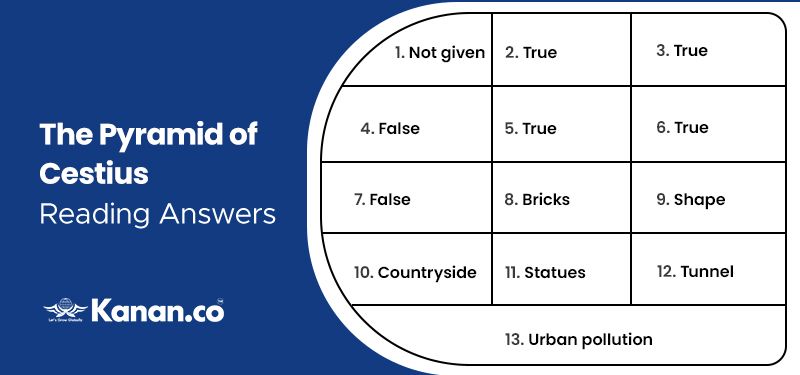
Here we have given The Pyramid of Cestius reading answers as a practice test in this article along with answers and explanations. This topic has 13 questions in 2 different types namely- 7 questions as true, false or not given and 6 questions as notes completion. Read the entire passage and answer the questions.
Check out our YouTube Channel to Practice Full-Length IELTS Reading Tests Daily

Table of contents:
- Solution for The Pyramid of Cestius
- The Pyramid of Cestius IELTS reading practice test
- Passage
- Questions
- Answers with explanations
Solution for The Pyramid of Cestius
Here we have given The Pyramid of Cestius reading answers, in the table given below.

Answer Table
| 1. Not given | 4. False | 7. False | 10. Countryside | 13. Urban pollution |
| 2. True | 5. True | 8. Bricks | 11. Statues | |
| 3. True | 6. True | 9. Shape | 12. Tunnel |
The Pyramid of Cestius IELTS reading practice test - Exam Review
Here we have given The Pyramid of Cestius IELTS reading answers, as a sample article for the IELTS reading practice test. This article will help you to crack your exam with band scores. Scrutinize the given passage to answer the questions.
Passage
We have given The Pyramid of Cestius reading answers with location. Be careful while reading the passage and answer the questions.
The Pyramid of Cestius reading answers
A 2000-year-old pyramid in the city of Rome has been restored by archaeologists.
- Though Rome draws tourists from around the world to its many impressive sites, one notable monument there has never attracted nearly as much interest: The Pyramid of Cestius, But why would there be a pyramid in Italy? After the Roman conquest of Egypt in 30 B.C, Egyptian architectural style became the fashion in Rome.
- Though obelisks and other monuments inspired by Egypt’s great pyramids sprung up around the city, only two actual pyramids are known to have been built. The only one left standing, the pyramid of Cestius, was designed as the burial pyramid for a Roman politician named Caius Cestius, who ordered that the building work be completed within a period of 330 days.
- Construction took place at some point between 18 B.C. and 12 B.C. Cestius pyramid had a layer of white Carrara marble on the outside, and was constructed from brick held together by a basic kind of cement on the inside. One of the things that strikes you when you look at the pyramid is how steep it is, so that the shape of Cestius’ pyramid is quite unlike that of typical Egyptian ones. This is a difference that could have been the result of inaccurate information sent back to Rome by soldiers who saw the pyramids in person in Egypt. Alternatively, Roman builders could have drawn inspiration from the pyramids in NUbia, a region located in what is today northern Sudan and southern Egypt.
- At the time of its construction, since there was a strict Roman law prohibiting the placement of tombs within the city itself, the pyramid of Cestius would have stood in the countryside. Rome grew enormously during the next two centuries, and by the 3rd century A.D., the pyramid would have been surrounded by buildings. We also know that in the 3rd century A.D., the pyramid of Cestius was hidden behind a high wall on the orders of Emperor Aurelian; this probably helped it survive throughout the centuries to come, even as other ancient monuments disappeared.
- By the Middle Ages, the pyramid was covered in vegetation and thick dirt, and popular myth had developed that it might be a tomb for one of the twin brothers Romulus and Remus, who were regarded as the men who had established the city of Rome. Cestius' actual tomb within the pyramid and the inscription identifying the pyramid as his, weren’t rediscovered until the 1660’s when the pyramid underwent restoration. During excavations, when trees and plants were cleared away, two marble bases were found in front of the pyramid, as well as fragments of bronze statues that had once stood on them on either side of the pyramid. The people employed to excavate the pyramid did not find the urn that would have contained Cestius' remains, but they did come across a tunnel. It was quite possible, therefore, that robbers had at some earlier time removed the contents of the tomb. But while some of the features of Cestius’ tomb no longer exist, at least the pyramid itself has survived.
- Today, the foundations of Cestius pyramid rest below street level near an intersection with heavy traffic, so that passing tourists and residents could easily fail to notice its full height of 119 feet. Across the intersection is the piramide station, located on line B of the Rome Metro. In 2011, the Japanese clothing company entrepreneur Yuzo Yagi, president of Yagi Tsusho Ltd, announced his intention to help the Italian government pay for an ambitious renovation of the pyramid of Cestius. ‘It’s an act of gratitude’, he later told journalists. “Our company has grown thanks to Italy’ Work began at the site shortly after Yagi signed an official agreement with the Special Superintendency for the Archaeological Heritage of Rome, and was completed ahead of schedule thanks to his 2- million-euro contribution.
- As archaeologist Leonardo Guarnieri explained to journalists, officials are now conducting tours of the newly renovated pyramid twice a month by reservation. Visitors who take advantage of the tour can make their way through a narrow corridor in order to enter the burial chamber itself. It is within these walls that they can admire the frescoes: watercolour paintings typical of the time. In the chamber, it is possible to make out four frescoes of the winged Roman goddess of war, Victoria, a figure from Roman legend, as well as of a series of vases, the type that would have been used for special rituals and purification purposes. We know from the writings of earlier visitors that there used to be more here, but the majority have disappeared over time.
- Only one problem remains now that the restoration is complete. The white exterior of the pyramid of Cestius will have to be cleaned every few months to remove the layer of urban pollution. A team of free-climbers will be employed to do the job, in order to avoid placing builder’s scaffolding around the newly welcoming monument.
Questions
Questions 1-7
- Do the following statements agree with the information given in reading passage 1?
- In boxes 1-7 on your answer sheet, write
- True if the statement agrees with the information
- False if the statement contradicts the information
- Not given if there is no information on this
- The pyramid of Cestius has always been one of Rome's most popular tourist attractions.
- The construction of the pyramid was completed before Cestius’ death.
- In the Middle Ages, people thought an original founder of Rome was buried in the pyramid of Cestius.
- Today the height of the pyramid is something that tourists and residents immediately notice.
- Japanese businessman Yuzo Yagi was an admirer of both Italian and Egyptian architecture.
- The restoration of the pyramid of Cestius, which was funded by Yuzo Yagi, finished earlier than expected.
- Most of the original frescoes inside Cestius’ tomb have survived to this day.
Questions 8-13
- Complete the notes below.
- Choose one word only from the passage for each answer.
- Write your answers in boxes 8-13 on your answer sheet.
History of the pyramid of Cestius
Construction of Cestius’ pyramid
- It was made from 8______ marble and cement
- Its 9________ is different to the pyramids found in Egypt
- It was originally built in the 10________ as building tombs in the city was forbidden
- Emperor Aurelian ordered that a wall had to be built around it.
Restoration of Cestius’ pyramid in the 1660s
- In the 1660s. Some broken 11_________ were found next to it
- The 12___________ inside the tomb suggests that robbers had been there
- The frescoes show mythological scenes, and images of Vases Restoration of Cestius pyramid today.
- A Japanese businessman paid for its restoration
- Climbers are helping to get rid of signs of 13______
Answers for The Pyramid of Cestius with explanation
Here we have given The Pyramid of Cestius reading answers with explanations, this section will assist you to identify your mistakes in the answering process.
1. Answer: Not given
2. Answer: True
Explanation: “The pyramid of Cestius, was designed as the burial pyramid for a Roman politician named Caius Cestius, who ordered that the building work be completed within a period of 330 days”. With this line it is clear that the construction of the pyramid was completed before Cestius’ death. Hence the given answer is located in the last 2 lines of paragraph B.
3. Answer: True
Explanation: “By the Middle Ages, the pyramid was covered in vegetation and thick dirt, and popular myth had developed that it might be a tomb for one of the twin brothers Romulus and Remus, who were regarded as the men who had established the city of Rome”. With this line it is clear that in the Middle Ages, people thought an original founder of Rome was buried in the pyramid of Cestius. Hence the given answer is located in the first 3 lines of paragraph E.
4. Answer: False
Explanation: “Today, the foundations of Cestius pyramid rest below street level near an intersection with heavy traffic, so that passing tourists and residents could easily fail to notice its full height of 119 feet. Across the intersection is the piramide station, located on line B of the Rome Metro”. With this line it is clear that today the height of the pyramid is something that tourists and residents fail to notice. Hence the given answer is located in the first 4 lines of paragraph F.
5. Answer: True
Explanation: “In 2011, the Japanese clothing company entrepreneur Yuzo Yagi, president of Yagi Tsusho Ltd, announced his intention to help the Italian government pay for an ambitious renovation of the pyramid of Cestius. ‘It’s an act of gratitude’, he later told journalists”. With this line it is clear that Japanese businessman Yuzo Yagi was an admirer of both Italian and Egyptian architecture. Hence the given answer is located in the 4-7 lines of paragraph F.
6. Answer: True
Explanation: “the Special Superintendency for the Archaeological Heritage of Rome, and was completed ahead of schedule thanks to his 2- million-euro contribution”. With this line it is clear that the restoration of the pyramid of Cestius, which was funded by Yuzo Yagi, finished earlier than expected. Hence the given answer is located in the last 2 lines of paragraph F.
7. Answer: False
Explanation: “In the chamber, it is possible to make out four frescoes of the winged Roman goddess of war, Victoria, a figure from Roman legend, as well as of a series of vases, the type that would have been used for special rituals and purification purposes. We know from the writings of earlier visitors that there used to be more here, but the majority have disappeared over time”. With this line it is clear that the given statement contradicts with the given answer. Hence the given answer is located in the last 5 lines of paragraph G.
8. Answer: Bricks
Explanation: “Construction took place at some point between 18 B.C. and 12 B.C. Cestius pyramid had a layer of white Carrara marble on the outside, and was constructed from brick held together by a basic kind of cement on the inside”. With this line it is clear that Construction of Cestius’ pyramid was made from bricks, marble and cement. Hence the given answer is located in the first 3 lines of paragraph C.
9. Answer: Shape
Explanation: “One of the things that strikes you when you look at the pyramid is how steep it is, so that the shape of Cestius’ pyramid is quite unlike that of typical Egyptian ones”. With this line it is clear that its shape is different to the pyramids found in Egypt. Hence the given answer is located in the 3-5 lines of paragraph C.
10. Answer: Country side
Explanation: “At the time of its construction, since there was a strict Roman law prohibiting the placement of tombs within the city itself, the pyramid of Cestius would have stood in the countryside”. With this line it is clear that it was originally built in the countryside as building tombs in the city was forbidden. Hence the given answer is located in the first 3 lines of paragraph D.
11. Answer: Statues
Explanation: “During excavations, when trees and plants were cleared away, two marble bases were found in front of the pyramid, as well as fragments of bronze statues that had once stood on them on either side of the pyramid”. With this line it is clear that In the 1660s. Some broken statues were found next to it. Hence the given answer is located in the 6-8 lines of paragraph E
12. Answer: Tunnel
Explanation: “The people employed to excavate the pyramid did not find the urn that would have contained Cestius' remains, but they did come across a tunnel”. With this line it is clear that the tunnel inside the tomb suggests that robbers had been there. Hence the given answer is located in the 9-10 lines of paragraph E.
13. Answer: urban pollution
Explanation: “Only one problem remains now that the restoration is complete. The white exterior of the pyramid of Cestius will have to be cleaned every few months to remove the layer of urban pollution”. With this line it is clear that a Japanese businessman paid for its restoration and climbers are helping to get rid of signs of urban pollution. Hence the given answer is located in the first 3 lines of paragraph H.
Other reading answers

About Author Gayathri Nagarajan
Gayathri, a trusted study-abroad expert, with expertise in standardized tests like IELTS, TOEFL, PTE, GRE, and GMAT. With a strong tech background from SASTRA University, she excels in software testing and has a passion for content writing and digital marketing. She aids students in finding the perfect academic fit, offering guidance on course selection, LOR and SOP writing. She remains up-to-date with the latest trends in higher education, delivering credible, accurate information on international education, including courses and test prep materials. As a trusted Study abroad expert at Kanan International, explore her latest blogs and articles for comprehensive insights into studying abroad and realizing your academic aspirations.
Kanan.co is a trusted study abroad consultancy offering comprehensive services, resources, and solutions for students and education institutions. We support students at every stage of their global education journey, ensuring a smooth and guided experience. Along with test preparation for IELTS, GRE, TOEFL, and SAT, we provide expert services such as SOP writing, visa guidance, accommodation support, scholarship assistance, and education loan support. Our expertise and commitment to excellence make us a reliable partner for students pursuing international education.
Free Online Mock Test 2026
Practice our mock test worth Rs. 25000 for Free and know your IELTS score!








Global Headquarters
Kanan Int EdTech Inc
320 Bay Street, Suite 321 (Spaces), Toronto ON, Canada M5B 1N9
Indian Headquarters
Kanan International Pvt. Ltd.
D-wing, 2nd Floor, Trident Complex, Ellora Park Vadiwadi Road, Vadodara, Gujarat 390007
IT/ Digital Campus
Kanan International Pvt. Ltd
Old, New No 3, 2nd Floor, 1A, Dr Sadasivam Rd, T. Nagar, Chennai, Tamil Nadu 600017
Our branches
- Bardoli
- Bharuch
- Chennai
- Dehradun
- Gurugram
- Himatnagar
- Karnal
- Nadiad
- Navsari
- Palanpur
- Rajkot
- Vadodara
- Valsad
- Vallabh Vidyanagar
- Vapi
Study Abroad
Test Prep
Top Universities
Consultants
IELTS Centers
GRE Centers
TOEFL Centers
SAT Centers
Language Courses in Vadodara
SOP Blogs
Featured Blogs
Study Abroad Consultants in Chennai
Study Abroad Consultants in Surat
Study Abroad Consultants in Navsari
Study Abroad Consultants in Bardoli
Study Abroad Consultants in Ahmedabad
Study Abroad Consultants in Anand
Study Abroad Consultants in Khanna
Study Abroad Consultants in Nadiad
Study Abroad Consultants in Vadodara
Study abroad consultants in Valsad
Copyright © 2026 KANAN.CO All rights reserved.