- Study Abroad
- / ielts
- / unsung and lowly creatures reading answers
Unsung And Lowly Creatures reading Answers


Author
19-09-2025

Unsung And Lowly Creatures reading answers practice test is provided with answers and explanations. This passage comprises 13 questions divided into three question types that answer the questions and classify the following.
Table of contents:
- Solution for Unsung And Lowly Creatures
- Unsung And Lowly Creatures IELTS Reading Practice Test
- Passage
- Questions
- Answers with Explanations
Solution for Unsung And Lowly Creatures
Unsung And Lowly Creatures Reading answers are listed in the table below. Check your answers using the following table,
Answer Table
| 14. D | 18. Muscular action | 22. Water | 26. Ecological awareness |
| 15. B | 19. Gizzard | 23. Bodily contractions | |
| 6. C | 20. Essential minerals | 24. (soil) micro-organisms | |
| 17. A | 21. Lubricating mucus | 25. Acidity |

Unsung And Lowly Creatures IELTS Reading Practice Test - Exam Review
Check out our YouTube Channel to Practice Full-Length IELTS Reading Tests Daily

Unsung And Lowly Creatures Reading answers are given here, which will help you practise IELTS reading practice test to challenge your reading skills. Use the skimming and scanning techniques to grasp the ideas efficiently. Make sure to check your answers with unsung and lowly creatures reading answers with explanations.
Passage
We’ve provided the reading passage of Unsung And Lowly Creatures. Read the passage and carefully complete the questions. Check the answers with our Unsung And Lowly Creatures reading answers with locations
Unsung And Lowly Creatures
A. Earthworms are not creatures likely to attract much attention. Socrative, silent, slow-moving, and featureless, almost no one would ever think. Let’s quote Charles Darwin, who wrote: ‘It may be doubted whether there are many other animals witches have played so important a part in the history of the world as have these lowly-organised creatures’.
B. That is high praise indeed for what is basically a slimy, muscular, moist, segmented tube. This tube is also hermaphroditic, meaning that there are both male and female segments in the one creature. Some segments contain testes, others eggs, release ooze, exchange, and store fluids, and then a long complicated process eventually leads to the secretion of an egg case. From this, small but fully-formed worms will emerge, reaching full size in about one year, and living for one or two years after that.
C. Yet earthworms are rarely seen, spending as they do their whole lives underground. Only after heavy rains can they sometimes be found on the surface, apparently stranded. Three hypotheses are put forward to explain this. The stormwater may flood their burrows, forcing them upwards. Alternatively, the worms may be taking advantage of the wet conditions to either travel more quickly through the open air (compared to burrowing beneath the ground), or otherwise to meet and mate. Whatever the case, if they find themselves on concreted, rocky, or hardened earth, they are effectively trapped. If this is during dawn, in high summer, or in the daytime, these earthworms quickly die due to bird predation or dehydration.
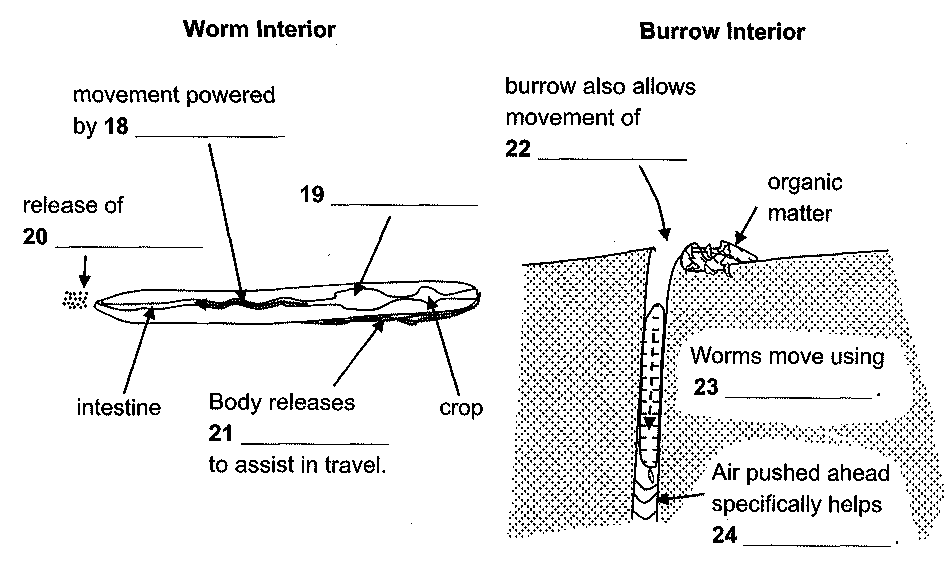
D. Normally, however, worms quietly go about their hidden business, and this often leads to an underestimation of their actual numbers. Darwin himself thought that arable land contained about 50,000 worms per acre, yet modern research has suggested that the figure could reach as high as almost two million. Putting this another way, the weight of earthworms beneath the soil is often greater than that of the cows horses, and sheep arezing upon is surface. And those worms are just as hungry. Worms do, in fact, have a small mouth and a simple but effective digestive system, similar to the animals above, Food is sucked into the body, then pushed along the length of the worm through muscular action, passing through the crop, gizzard, intestine, and finally the anus.
E. Perhaps surprisingly, it is this constant eating which so benefits the chemistry of the soil. Earthworms feed on undecayed leaf litter and organic matter. They pull pieces down into their burrows, shred them into smaller parts, and then consume each of these, along with small soil particles. In the worms’ gut, everything is ground into a a fine paste, to be eventually excreted, releasing essential minerals in an easily accessible form. One single worm may produce over four kilograms of this diested paste per year. Multiply that by a million worms, and one can understand Darwin’s comment about ‘unsung creatures which, in their untold millions, transformed the land’.
F. The other great benefit relates to earthworms’ search for food. It might surprise many to know that these creatures are very mobile, moving to the surface then down into the safer depths on a daily basis. Aided by the secretion of lubricating mucus, they push themselves through the soil using waves of bodily contractions, which alternately shorten and lengthen their form. The point is, water can also move through their tunnels. More importantly, as the worms travel, they push air in and out of the soil on a continuous basis. In the same way that animals need oxygen, so too do the myriad micro-organisms in the soil. Thus, without worms, the ground would become waterlogged, airless, and less productive for farming purposes.
G. Naturally, with so many worms in the soil, they form the base of many food chains. Not only birds, but also some mammals, such as hedgehogs, moles, and even larger ones, such as foxes and bears, will actively dig into the ground of worms. Such predation is natural, and has little effect on worm populations. However, the use of certain fertilisers is a different case. Earthworms depend on the temperature, texture, and moisture content of the soil, but it is its acidity to which they are most sensitive. Nitrogenous fertilisers can raise this to levels fatal to these creatures, often causing disastrous drops in numbers. The more ecologically-awareness farmer avoids such chemicals, and regularly adds a surface mulch of organic matter raising worm numbers for the natural benefit of both soil and man.
Questions
Questions 14-17
Choose the correct letter, A, B, C, or D.
14. Charles Darwin thought that worms
A were only moderately important.
B were organised.
C liked arable land.
D numbered in the many millions.
15. A single worm
A is either male or female.
B has many segments.
C is a complicated organism.
D lives for about a year.
16. Stormwater may possibly
A clean out worm burrows.
B slow down worms.
C help worms encounter others.
D harden the earth.
17. Grazing animals
A often weigh less than the worms below.
B are hungrier than the worms below.
C have very different digestive systems from worms.
D have simpler digestive systems than worms.
Questions 18-24
Complete the diagram.
Choose NO MORE THAN TWO WORDS from the passage for each answer.
18. ______
19. ______
20. ______
21. ______
22. ______
23. ______
24. ______
Questions 25-26
Complete the sentences.
Choose NO MORE THAN TWO WORDS from the passage for each answer.
Worm numbers will especially fall when the soil has high 25. _______
Adding mulch to the soil shows 26. _______
Answers for Unsung And Lowly Creatures With Explanations
Unsung And Lowly Creatures Reading answers with explanations is given below. Refer to the following answers with an explanation section in order to correct your errors.
(Note: The text in italics mentions the location and referring lines written in the reading passage.)
1. Answer: D
Explanation: Located in the last two lines of paragraph D, “ Multiply that by a million worms, and one can understand Darwin’s comment about ‘unsung creatures which, in their untold millions, transformed the land”.
2. Answer: B
Explanation: Located in the first line of paragraph B, “That is high praise indeed for what is basically a slimy”.
3. Answer: C
Explanation: Located in the first four lines of paragraph C, “Yet earthworms are rarely seen, spending as they do their whole lives underground. Only after heavy rains can they sometimes be found on the surface, apparently stranded. Three hypotheses are put forward to explain this. The stormwater may flood their burrows, forcing them upwards”.
4. Answer: A
Explanation: Located in the fourth and fifth lines of paragraph D, “Putting this another way, the weight of earthworms beneath the soil is often greater than that of the cows, horses, and sheep arezing upon its surface”.
5. Answer: Muscular action
Explanation: Located in the first two lines of paragraph B, “muscular, moist, segmented tube. This tube is also hermaphroditic, meaning that there are both male and female segments in the one creature”.
6. Answer: Gizzard
Explanation: Located in the last line of paragraph D, “passing through the crop, gizzard, intestine, and finally the anus”.
7. Answer: Essential minerals
Explanation: Located in the fifth line of paragraph E, “releasing essential minerals in an easily accessible form”.
8. Answer: Lubricating mucus
Explanation: Located in the third line of paragraph F, “Aided by the secretion of lubricating mucus, they push themselves”.
9. Answer: Water
Explanation: Located in the fifth line of paragraph F, “ The point is, water can also move through their tunnels”.
10. Answer: Bodily contractions
Explanation: Located in the fourth line of paragraph F, “using waves of bodily contractions, which alternately shorten and lengthen ”.
11. Answer: (soil) micro-organisms
Explanation: Located in the second last line of paragraph F, “micro-organisms in the soil”.
12. Answer: Acidity
Explanation: Located in the sixth line of paragraph G, “it is its acidity to which they are most sensitive”.
13. Answer: Ecological awareness
Explanation: Located in the second last line of paragraph G, “ecologically-awareness farmers avoids such chemicals”.
Other Reading Tests

About Author Arivarasi
Arivarasi is an experienced author with expertise in the study abroad industry and preparing test materials for exams like IELTS, TOEFL, GRE, SAT, PTE, etc. She stays up-to-date with university and college requirements for international students which allows her to provide guidance on course selection, documents like SOP, LOR, and scholarship opportunities. She has written numerous articles on study abroad exams, destinations, universities & colleges requirements, admission procedures, and the entire process of studying abroad. Collaborating with industry experts and counselors, she crafts informative articles that make students take the right decisions.
Kanan.co is a trusted study abroad consultancy offering comprehensive services, resources, and solutions for students and education institutions. We support students at every stage of their global education journey, ensuring a smooth and guided experience. Along with test preparation for IELTS, GRE, TOEFL, and SAT, we provide expert services such as SOP writing, visa guidance, accommodation support, scholarship assistance, and education loan support. Our expertise and commitment to excellence make us a reliable partner for students pursuing international education.
Free Online Mock Test 2026
Practice our mock test worth Rs. 25000 for Free and know your IELTS score!








Global Headquarters
Kanan Int EdTech Inc
320 Bay Street, Suite 321 (Spaces), Toronto ON, Canada M5B 1N9
Indian Headquarters
Kanan International Pvt. Ltd.
D-wing, 2nd Floor, Trident Complex, Ellora Park Vadiwadi Road, Vadodara, Gujarat 390007
IT/ Digital Campus
Kanan International Pvt. Ltd
Old, New No 3, 2nd Floor, 1A, Dr Sadasivam Rd, T. Nagar, Chennai, Tamil Nadu 600017
Our branches
- Bardoli
- Bharuch
- Chennai
- Dehradun
- Gurugram
- Himatnagar
- Karnal
- Nadiad
- Navsari
- Palanpur
- Rajkot
- Vadodara
- Valsad
- Vallabh Vidyanagar
- Vapi
Study Abroad
Test Prep
Top Universities
Consultants
IELTS Centers
GRE Centers
TOEFL Centers
SAT Centers
Language Courses in Vadodara
Study Abroad Calculators
Featured Blogs
Study Abroad Consultants in Chennai
Study Abroad Consultants in Surat
Study Abroad Consultants in Navsari
Study Abroad Consultants in Bardoli
Study Abroad Consultants in Ahmedabad
Study Abroad Consultants in Anand
Study Abroad Consultants in Khanna
Study Abroad Consultants in Nadiad
Study Abroad Consultants in Vadodara
Study abroad consultants in Valsad
Copyright © 2026 KANAN.CO All rights reserved.