- Study Abroad
- / ielts
- / venus flytrap reading answers
Venus Flytrap Reading Answers


Author
19-09-2025

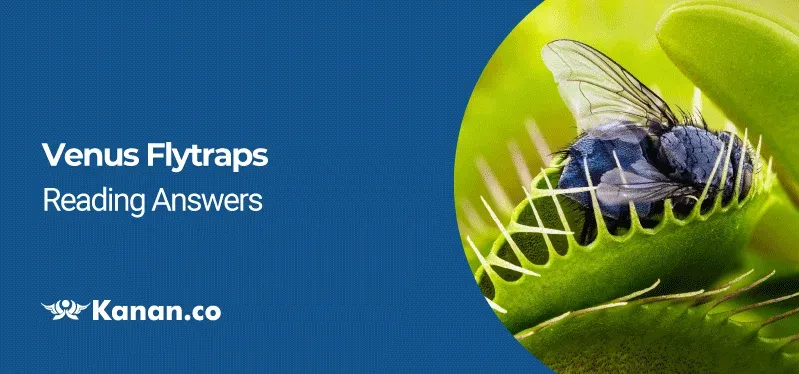
Venus Flytrap reading practice tests are provided with answers and explanations. This passage comprises 13 questions divided into three question types - choose correct letter, sentence completion and true/false/not given. Venus Flytrap Reading Answers reading answers with explanation.
Solution for Venus Flytrap
Venus Flytrap Reading Answers reading answers are listed in the table below. Verify your answers against our answer table, then correct any inaccuracies.
Answer Table
| 14. D | 18. E | 22. Nitrogen | 26. True |
| 15. B | 19. C | 23. True | |
| 16. F | 20. Useful Nourishment | 24. Not given | |
| 17. A | 21. Exoskeleton | 25. False |

Venus Flytrap IELTS Reading Practice Test - Exam Review
Check out our YouTube Channel to Practice Full-Length IELTS Reading Tests Daily

Venus Flytrap Reading reading answers are given here, which will help you excel in the IELTS reading practice test to challenge your reading skills. Paraphrasing can help you to understand the ideas clearly which makes you able to efficiently answer the questions.
Passage
We’ve provided the reading passage of Venus Flytrap Reading Answers. Read the passage and carefully complete the questions. Check the answers with our Venus Flytrap reading answers with locations.
Venus Flytrap Reading Answers
- from indigenous myths to John Wyndham’s Day of the Triffids and the off-Broadway musical Little Shop of Horrors, the idea of cerebral, carnivorous flora has spooked audiences and readers for centuries. While shrubs and shoots have yet to uproot themselves or show any interest in human beings, however, for some of earth’s smaller inhabitants – arachnids and insects – the risk of being trapped and ingested by a plant can be a threat to their daily existence. Easily, the most famous of these predators is the Venus Flytrap, one of only two types of ‘snap traps’ in the world. Though rarely found growing wild, the Flytrap has captured popular imagination and can be purchased in florists and plant retailers around the world.
- Part of the Venus Flytrap’s mysterious aura begins with the tide itself. While it is fairly clear that the second half of the epithet has been given for its insect-trapping ability, the origin of ‘Venus’ is somewhat more ambiguous. According to the International Carnivorous Plant Society, the plant was first studied in the 17th and 18th centuries, when puritanical mores ruled Western societies and obsession was rife with forbidden human impulses and urges, women were often portrayed in these times as seductresses and temptresses, and botanists are believed to have seen a parallel between the behaviour of the plant in luring and devouring insects and the imagined behaviour of women in luring and ‘trapping’ witless men. The plant was thus named after the pagan goddess of love and money – Venus.
- The Venus Flytrap is a small plant with six to seven leaves growing out of a bulb-like stem. At the end of each leaf is a trap, which is an opened pod with cilia around the edges like stiff eyelashes. The pod is lined with anthocyanin pigments and sweet-smelling sap to attract flies and other insects. When they fly in, trigger hairs inside the pod sense the intruder’s movement, and the pod snaps shut. The trigger mechanism is so sophisticated that the plant can differentiate between living creatures and non-edible debris by requiring two trigger hairs to be touched within twenty seconds of each other, or one hair to be touched in quick succession. The plant has no nervous system, and researchers can only hypothesise as to how the rapid shutting movement works. This uncertainty adds to the Venus Flytrap’s allure.
- The pod shuts quickly but does not seal entirely at first; scientists have found that tins mechanism allows miniscule insects to escape, as they will not be a source of useful nourishment for the plant. If the creature is large enough, however, the plant’s flaps will eventually meet to form an airtight compress, and at this point, the digestive process begins. A Venus Flytrap’s digestive system is remarkably similar to how a human stomach works. For somewhere between five and twelve days, the trap secretes acidic digestive juices that dissolve the soft tissue and cell membranes of the insect. These juices also kill any bacteria that have entered with the food, ensuring the plant maintains its hygiene so that it does not begin to rot. Enzymes in the acid help with the digestion of DNA, amino acids, and cell molecules so that every fleshy part of the animal can be consumed. Once the plant has reabsorbed the digestive fluid – this time with the added nourishment, the trap reopens and the exoskeleton blows away in the wind.
- Although transplanted to other locations around the world, the Venus Flytrap is only found natively in an area around Wilmington, North Carolina in the United States. It thrives in bogs, marshes, and wetlands and grows in wet sand and peaty soils. Because these environments are so depleted in nitrogen, they asphyxiate other flora, but the Flytrap overcomes this nutritional poverty by sourcing protein from its insect prey. One of the plant’s curious features is resilience to flame. It is speculated that the Flytrap evolved this to endure through periodic blazes and to act as a means of survival that its competition lacks.
- While the Venus Flytrap will not become extinct any time soon (an estimated 3-6 million plants are presently in cultivation), its natural existence is uncertain. In the last survey, only 35,800 Flytraps were found remaining in the wild, and some prominent conservationists have suggested the plant be given the status of ‘vulnerable’. Since this research is considerably dated, having taken place in 1992, the present number is considerably lower. The draining and destruction of natural wetlands where the Flytrap lives is considered to be the biggest threat to its existence, as well as people removing the plants from their natural habitat. Punitive measures have been introduced to prevent people from doing this. Ironically, while cultural depictions of perennial killers may persist, the bigger threat is not what meat-eating plants might do to us but what we may do to them.
Questions
Questions 14-19
Reading Passage 2 has six paragraphs, A-F. Which paragraph contains the following information?
Write the correct letter, A-F, in boxes 14-19 on your answer sheet.
14 An overview of how the Flytrap eats its prey
15 A comparison between human and plant behaviour
16 A measure designed to preserve Flytraps in their native environment
17 An example of a cultural and artistic portrayal of meat-eating plants
18 A characteristic of the Venus Flytrap that is exceptional in the botanical world
19 A reference to an aspect of the Venus Flytrap’s biology that is not fully understood
Questions 20-22
Complete the sentences below with words taken from Reading Passage 2. Use NO MORE THAN TWO WORDS for each answer.
If they are too small to provide (20)…………………………………., the closing pod allows insects to get out.
Only the (21)………………………………is left after the Flytrap has finished digesting an insect.
Many plants cannot survive in bogs and wetlands owing to the lack of (22)……………………………
Questions 23-26
Do the following statements agree with the information given in Reading Passage 2? In boxes 23—26 on your answer sheet write
TRUE if the statement is true
FALSE if the statement is false
NOT GIVEN if the information is not given in the passage
23 The Venus Flytrap can withstand some exposure to fire.
24 Many botanists would like the Venus Flytrap to be officially recognised as an endangered plant species.
25 Only 35,800 Venus Flytraps now survive in their natural habitats.
26 Human interference is a major factor in the decline of wild Venus Flytraps.
Answers for Venus Flytrap With Explanations
Venus Flytrap Reading reading answers with explanations is given below. Refer to the following answers with an explanation section in order to correct your errors.
(Note: The text in italics mentions the location and referring lines written in the reading passage.)
14. Answer: D
Explanation: Located in the entire paragraph D, “The pod shuts quickly but does not seal entirely at first; scientists have found that tins mechanism allows miniscule insects to escape, as they will not be a source of useful nourishment for the plant. If the creature is large enough, however, the plant’s flaps will eventually meet to form an airtight compress, and at this point, the digestive process begins. A Venus Flytrap’s digestive system is remarkably similar to how a human stomach works. For somewhere between five and twelve days, the trap secretes acidic digestive juices that dissolve the soft tissue and cell membranes of the insect. These juices also kill any bacteria that have entered with the food, ensuring the plant maintains its hygiene so that it does not begin to rot. Enzymes in the acid help with the digestion of DNA, amino acids, and cell molecules so that every fleshy part of the animal can be consumed. Once the plant has reabsorbed the digestive fluid – this time with the added nourishment, the trap reopens and the exoskeleton blows away in the wind”.
15 Answer: B
Explanation: Located in the last few lines of paragraph B, “According to the International Carnivorous Plant Society, the plant was first studied in the 17th and 18th centuries, when puritanical mores ruled Western societies and obsession was rife with forbidden human impulses and urges, women were often portrayed in these times as seductresses and temptresses, and botanists are believed to have seen a parallel between the behaviour of the plant in luring and devouring insects and the imagined behaviour of women in luring and ‘trapping’ witless men. The plant was thus named after the pagan goddess of love and money – Venus”.
16. Answer: F
Explanation: Located in the first two lines of paragraph F, “ While the Venus Flytrap will not become extinct any time soon (an estimated 3-6 million plants are presently in cultivation), its natural existence is uncertain”.
17. Answer: A
Explanation: Located in the first four lines of paragraph A, “he idea of cerebral, carnivorous flora has spooked audiences and readers for centuries. While shrubs and shoots have yet to uproot themselves or show any interest in human beings, however, for some of earth’s smaller inhabitants – arachnids and insects – the risk of being trapped and ingested by a plant can be a threat to their daily existence”.
18. Answer: E
Explanation: Located in the last three lines of paragraph E, “One of the plant’s curious features is resilience to flame. It is speculated that the Flytrap evolved this to endure through periodic blazes and to act as a means of survival that its competition lacks”.
19. Answer: C
Explanation: Located in the last three lines of paragraph C, “The plant has no nervous system, and researchers can only hypothesise as to how the rapid shutting movement works. This uncertainty adds to the Venus Flytrap’s allure”.
20. Answer: Useful Nourishment
Explanation: Located in the second line of paragraph D, “useful nourishment for the plant”.
21. Answer: Exoskeleton
Explanation: Located in the last line of paragraph D, “exoskeleton blows away in the wind”.
22. Answer: Nitrogen
Explanation: Located in the fourth line of paragraph E, “depleted in nitrogen, they asphyxiate other flora”.
23. Answer: True
Explanation: Located in the third last line of paragraph E, “One of the plant’s curious features is resilience to flame”.
24. Answer: Not given
Explanation: Not Available
25. Answer: False
Explanation: Located in the third line of paragraph F, “35,800 Flytraps were found remaining in the wild”.
26. Answer: True
Explanation: Located in the seventh line of paragraph F, “as well as people removing the plants from their natural habitat ”.

About Author Tejaswini Kota
Tejaswini is an enthusiastic writer, reader and a passionate learner. Additionally, she was a research fellow and holds a grip in English writings and research/paper publications. She holds bachelors and masters degrees in engineering. She spent three years in the education industry and is currently working as a full-time content writer at Kanan International, writing articles for study abroad projects. She is proficient in creating good quality content that helps the students for language proficiency tests like IELTS, GRE, TOEFL etc. and can help in advising you the right choice of college for admission.
Kanan.co is a trusted study abroad consultancy offering comprehensive services, resources, and solutions for students and education institutions. We support students at every stage of their global education journey, ensuring a smooth and guided experience. Along with test preparation for IELTS, GRE, TOEFL, and SAT, we provide expert services such as SOP writing, visa guidance, accommodation support, scholarship assistance, and education loan support. Our expertise and commitment to excellence make us a reliable partner for students pursuing international education.
Free Online Mock Test 2026
Practice our mock test worth Rs. 25000 for Free and know your IELTS score!








Global Headquarters
Kanan Int EdTech Inc
320 Bay Street, Suite 321 (Spaces), Toronto ON, Canada M5B 1N9
Indian Headquarters
Kanan International Pvt. Ltd.
D-wing, 2nd Floor, Trident Complex, Ellora Park Vadiwadi Road, Vadodara, Gujarat 390007
IT/ Digital Campus
Kanan International Pvt. Ltd
Old, New No 3, 2nd Floor, 1A, Dr Sadasivam Rd, T. Nagar, Chennai, Tamil Nadu 600017
Our branches
- Bardoli
- Bharuch
- Chennai
- Dehradun
- Gurugram
- Himatnagar
- Karnal
- Nadiad
- Navsari
- Palanpur
- Rajkot
- Vadodara
- Valsad
- Vallabh Vidyanagar
- Vapi
Study Abroad
Test Prep
Top Universities
Consultants
IELTS Centers
GRE Centers
TOEFL Centers
SAT Centers
Language Courses in Vadodara
Study Abroad Calculators
Featured Blogs
Study Abroad Consultants in Chennai
Study Abroad Consultants in Surat
Study Abroad Consultants in Navsari
Study Abroad Consultants in Bardoli
Study Abroad Consultants in Ahmedabad
Study Abroad Consultants in Anand
Study Abroad Consultants in Khanna
Study Abroad Consultants in Nadiad
Study Abroad Consultants in Vadodara
Study abroad consultants in Valsad
Copyright © 2026 KANAN.CO All rights reserved.