- Study Abroad
- / ielts
- / what are dreams reading answers
What Are Dreams? Reading Answers


Author
17-09-2025

Here we have given “what are dreams?” Reading answers as an illustration for the IELTS reading practice test. It has 14 questions based on the given passage in 3 different forms namely - 5 questions as locating information, 3 questions as multiple choice questions and 5 questions as matching information.
Check out our YouTube Channel to Practice Full-Length IELTS Reading Tests Daily

Table of contents:
- Solution for what are dreams?
- What are dreams? IELTS reading practice test
- Passage
- Questions
- Answers with explanation
Solution for What are Dreams?
Below, we have given the answers for what are dreams? Reading answers in the table form.

Answer table
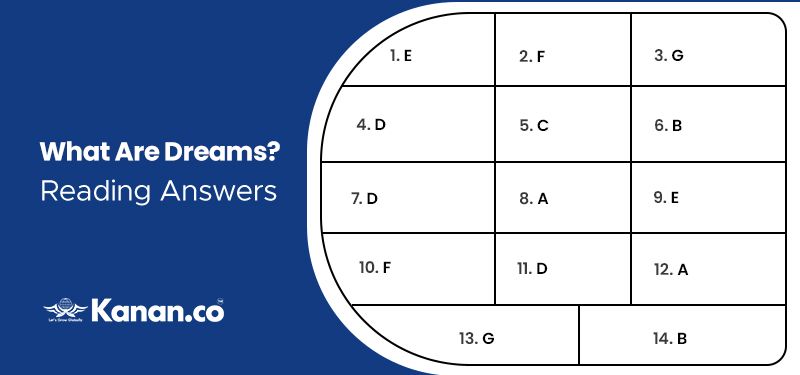
| 1. E | 4. D | 7. D | 10. F | 13. G |
| 2. F | 5. C | 8. A | 11. D | 14. B |
| 3. G | 6. B | 9. E | 12. A |
What are Dreams? IELTS Reading Practice Test - Exam Review
We have given what are dreams? IELTS reading answers. This article will aid you to be excellent in the IELTS reading practice to challenge your reading skill and go through the given passage and answer the questions.
Passage
Here we have given what are dreams? reading answers with location. Read the complete passage carefully and answer the questions.
What are dreams? Reading answers
A. Thousands of years ago, dreams were seen as messages from the gods, and in many cultures, they are still considered prophetic. In ancient Greece, sick people slept at the temples of Asclepius, the god of medicine, in order to receive dreams that would heal them. Modern dream science really begins at the end of the 19th century with Sigmund Feud, who theorized that dreams were the expression of unconscious desires often stemming from childhood. He believed that exploring these hidden emotions through analysis could help cure mental illness. The Freudian model of psychoanalysis dominated until the 1970s when new research into the chemistry of the brain showed that emotional problems could have biological or chemical roots, as well as environmental ones. In other words, we weren’t sick just because of something our mothers did (or didn’t do), but because of some imbalance that might be cured with medication.
B.
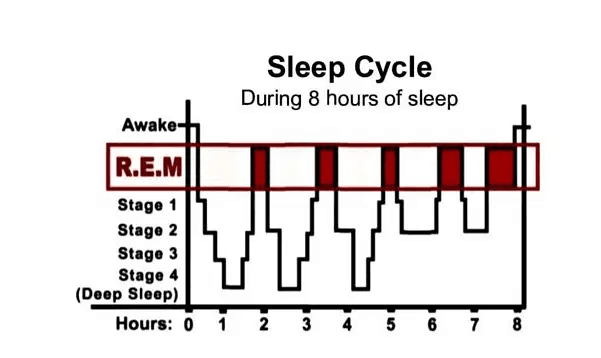
After Freud, the most important event in dream science was the discovery in the early 1950s of a phase of sleep characterized by intense brain activity and rapid eye movement (REM). People awakened in the midst of REM sleep reported vivid dreams, which led researchers to conclude that most dreaming took place during REM. Using the electroencephalograph (EEG), researchers could see that brain activity during REM resembled that of the waking brain. That old them that a lot more was going on at night than anyone had suspected. But what, exactly?
C. Scientists still don’t know for sure, although they have lots of theories. On one side are scientists like Harvard’s Allan Hobson, who believes that dreams are essentially random. In the 1970s, Hobson and his colleague Robert McCarley proposed what they called the “activation-synthesis hypothesis’” which describes how dreams are formed by nerve signals sent out during REM sleep from a small area at the base of the brain called the pons. These signals, the researchers said, activate the images
that we call dreams. That put a crimp in dream research; if dreams were meaningless nocturnal firings, what was the point of studying them?
D. Adult humans spend about a quarter of their sleep time in REM, much of it dreaming. During that time, the body is essentially paralyzed but the brain is buzzing. Scientists using PET and fMRI technology to watch the dreaming brain have found that one of the most active areas during REM is the limbic system, which controls our emotions. Much less active is the prefrontal cortex, which is associated with logical thinking. That could explain why dreams in REM sleep often lack a coherent storyline (some researchers have also found that people dream in non-REM sleep as well, although those dreams generally are less vivid.) Another active part of the brain in REM sleep is the anterior cingulate cortex, which detects discrepancies. Eric Nofzinger, director of the Sleep Neuroimaging Program at the University of Pittsburgh Medical Center, thinks that could be why people often figure out thorny problems in their dreams. “As if the brain surveys the internal milieu and tries to figure out what it should be doing, and whether our actions conflict with who we are,” he says.
E. These may seem like vital mental functions, but no one has yet been able to say that REM sleep or dreaming is essential to life or even sanity. MAO inhibitors, an older class of antidepressants, essentially block REM sleep without any detectable effects, although people do get a “REM rebound” – extra REM – if they stop the medication. That’s also true of selective serotonin reuptake inhibitors (SSRIs) like Prozac, which reduce dreaming by a third to a half. Even permanently losing the ability to dream doesn’t have to be disabling. Israeli researcher Peretz Lavie has been observing a patient named Yuval Chamtzani, who was injured by a fragment of shrapnel that penetrated his brain when he was 19. As a result, he gets no REM sleep and doesn’t remember any dreams. But Lavie says that Chamtzani, now 55, “is probably the most normal person I know and one of the most successful ones.” He’s a lawyer, a painter and the editor of a puzzle column in a popular Israeli newspaper.
F. The mystery of REM sleep is that even though it may not be essential, it is ubiquitous – at least in mammals and birds. But that doesn’t mean all mammals and birds dream (or if they do, they’re certainly not – talking about it). Some researchers think REM may have evolved for physiological reasons. “One thing that’s unique about mammals and birds is that they regulate body temperature”, says neuroscientist Jerry Siegel, director of UCLA’s Center for Sleep Research. “There’s no good evidence that any coldblooded animal has REM sleep.” REM sleep heats up the brain and non-REM cools it off, Siegel says, and that could mean that the changing sleep cycles allow the brain to repair itself. “It seems likely that REM sleep is filling a basic physiological function and that dreams are a kind of epiphenomenon,” Siegel says – an extraneous byproduct; like foam on beer.
G. Whatever the function of dreams at night, they clearly can play a role in therapy during the day. The University of Maryland’s Clara Hill, who has studied the use of dreams in therapy, says that dreams are a ‘backdoor’, into a patient’s thinking. “Dreams reveal stuff about you that you didn’t know was there,” she says. The therapists she trains to work with patients’ dreams are, in essence, heirs to Freud, using dream imagery to uncover hidden emotions and feelings. Dreams provide clues to the nature of the more serious mental illness. Schizophrenics, for example, have poor-quality dreams, usually about objects rather than people. “If you’re going to understand human behavior,” says Rosalind Cartwright, a chairman of psychology at Rush University Medical Center in Chicago, “here’s a big piece of it. Dreaming is our own storytelling time – to help us know who we are, where we’re going and how we’re going to get there.” Cartwright has been studying depression in divorced men and women, and she is finding that “good dreamers,” people who have vivid dreams with strong storylines, are less likely to remain depressed. She thinks that dreaming helps diffuse strong emotions. “Dreaming is a mental-health activity,” she says.
Questions
Questions 1-5
- Reading Passage has seven paragraphs, A-G.
- Which paragraph contains the following information?
- Write the correct number, A-G, in boxes 1-5 on your answer sheet.
1. reference of an artist’s dreams who has versatile talents
2. the dream actually happens to many animals
3. Dreams are related to benefit and happiness
4. advanced scientific technology applied in the investigation of the REM stage.
5. Questioning concern raised about the usefulness of investigation on dreams
Questions 6-8
- Choose the correct letter, A, B, C or D.
- Write your answers in boxes 6-8 on your answer sheet.
6. What were dreams regarded as by ancient people?
- Superstitious and unreliable
- Communication with gods and chance to predict the future
- Medical relief for children with an ill desire
- Rules to follow as they fell asleep in a temple
7. According to Paragraph D, which part of the brain controls reasoning?
- Anterior cingulate cortex
- Internal cortex
- Limbic system
- prefrontal cortex
8. What can we conclude when the author cited a reference for dreams in animals?
- Brain temperature rises when REM pattern happens.
- The reason why mammals are warm-blooded
- Mammals are bound to appear with more frequent REM.
- REM makes people want to drink beer with more foam.
Questions 9-14
- Look at the following people and the list of statements below.
- Match each statement with the correct person, A-G.
- Write the correct letter, A-G, in boxes 9-14 on your answer sheet.
List of people
- Sigmund Freud
- Allan Hobson (Harvard)
- Robert McCarley
- Eric Nofzinger
- Jerry Siegel
- Clara Hill
- Rosalind Cartwright
9. Dreams sometimes come along with REM as no more than a trivial attachment
10. Exploring patients’ dreams would be beneficial for treatment as it reveals the unconscious thinking
11. Dreams help people cope with the difficulties they meet in the daytime
12. Decoding dreams would provide a reminder to human desire in the early days
13. Dreams are a body function to control strong emotion
14. Dreams seem to be as randomly occurring and have limited research significance.
Answers for what are dreams? with explanation
In this section we have given the answers for what are dreams? Reading answers with explanations. This will help you while answering.
1. Answer: E
Explanation: “But Lavie says that Chamtzani, now 55, “is probably the most normal person I know and one of the most successful ones.” He’s a lawyer, a painter and the editor of a puzzle column in a popular Israeli newspaper”. With this line it is clear that paragraph E states the reference of an artist’s dreams who has versatile talents. Hence the given answer is located in the last 3 lines of paragraph E.
2. Answer: F
Explanation: “At least in mammals and birds. But that doesn’t mean all mammals and birds dream (or if they do, they’re certainly not – talking about it)”. With this line it is clear that paragraph F states about the dream actually happening to many animals. Hence the given answer is located in the 2-3 lines of paragraph F.
3. Answer: G
Explanation: “She thinks that dreaming helps diffuse strong emotions. “Dreaming is a mental-health activity,” she says. With this line it is clear that paragraph G describes mental health and happiness. Hence the given answer is located in paragraph G.
4. Answer: D
Explanation: “Scientists using PET and fMRI technology to watch the dreaming brain have found that one of the most active areas during REM is the limbic system, which controls our emotions”. With this line it is clear that paragraph D states advanced scientific technology applied in the investigation of the REM stage. Hence the given answer is located in the 3-5 lines of paragraph D.
5. Answer: C
Explanation: “That put a crimp in dream research; if dreams were meaningless nocturnal firings, what was the point of studying them?. With this line it is clear that paragraph c states about questioning concerns raised about the usefulness of investigation on dreams. Hence the given answer is located in the last 2 lines of paragraph C.
6. Answer: B
Explanation: “Thousands of years ago, dreams were seen as messages from the gods, and in many cultures, they are still considered prophetic. In ancient Greece, sick people slept at the temples of Asclepius, the god of medicine, in order to receive dreams that would heal them. Modern dream science really begins at the end of the 19th century with Sigmund Feud, who theorized that dreams were the expression of unconscious desires often stemming from childhood”. With this line it is clear that communication with gods and chance to predict the future were dreams regarded by ancient people. Hence the given answer is located in the 1-6 lines of paragraph A.
7. Answer: D
Explanation:“Much less active is the prefrontal cortex, which is associated with logical thinking. That could explain why dreams in REM sleep often lack a coherent storyline (some researchers have also found that people dream in non-REM sleep as well, although those dreams generally are less vivid.). With this line it is clear that the brain controls reasoning prefrontal cortex. Hence the given answer is located in the 5-8 lines of paragraph D.
8. Answer: A
Explanation: “One thing that’s unique about mammals and birds is that they regulate body temperature”, says neuroscientist Jerry Siegel, director of UCLA’s Center for Sleep Research”. With this line it is clear that when the author cited a reference for dreams in animals, brain temperature rises when REM pattern happens. Hence the given answer is located in the 4-6 lines of paragraph F.
9. Answer: E
Explanation: “Siegel says, and that could mean that the changing sleep cycles allow the brain to repair itself. “It seems likely that REM sleep is filling a basic physiological function and that dreams are a kind of epiphenomenon,” Siegel says – an extraneous byproduct; like foam on beer”. With this line it is clear that Jerry Siegel states that dreams sometimes come along with REM as no more than a trivial attachment. Hence the given answer is located in the last 4 lines of paragraph F.
10. Answer: F
Explanation: “The University of Maryland’s Clara Hill, who has studied the use of dreams in therapy, says that dreams are a ‘backdoor’, into a patient’s thinking. “Dreams reveal stuff about you that you didn’t know was there,” she says. The therapists she trains to work with patients’ dreams are, in essence, heirs to Freud, using dream imagery to uncover hidden emotions and feelings”. With this line it is clear that clara Hills states that exploring patients’ dreams would be beneficial for treatment as it reveals the unconscious thinking. Hence the given answer is located in the last 2 lines of paragraph D.
11. Answer: D
Explanation: “As if the brain surveys the internal milieu and tries to figure out what it should be doing, and whether our actions conflict with who we are,” he says. With this line it is clear that Eric Nofzinger states that dreams help people cope with the difficulties they meet in the daytime. Hence the given answer is located in the last 2 lines of paragraph D.
12. Answer: A
Explanation: “Dreams were the expression of unconscious desires often stemming from childhood”. With this line it is clear that Sigmund Freud states that decoding dreams would provide a reminder to human desire in the early days. Hence the given answer is located in the 5-6 lines of paragraph A.
13. Answer: G
Explanation: “She thinks that dreaming helps diffuse strong emotions. “Dreaming is a mental-health activity,” she says. With this line it is clear that Rosalind Cartwright states that dreams are a body function to control strong emotion. Hence the given answer is located in the last 2 lines of paragraph G.
14. Answer: B
Explanation: “activation-synthesis hypothesis’” which describes how dreams are formed by nerve signals sent out during REM sleep from a small area at the base of the brain called the pons. These signals, the researchers said, activate the images that we call dreams. That puts a crimp in dream research”. With this line it is clear that Allan Hobson (Harvard) states that dreams seem to be as randomly occurring and have limited research significance. Hence the given answer is located in the 4-7 lines of paragraph C.
Other reading answers

About Author Tejaswini Kota
Tejaswini is an enthusiastic writer, reader and a passionate learner. Additionally, she was a research fellow and holds a grip in English writings and research/paper publications. She holds bachelors and masters degrees in engineering. She spent three years in the education industry and is currently working as a full-time content writer at Kanan International, writing articles for study abroad projects. She is proficient in creating good quality content that helps the students for language proficiency tests like IELTS, GRE, TOEFL etc. and can help in advising you the right choice of college for admission.
Kanan.co is a trusted study abroad consultancy offering comprehensive services, resources, and solutions for students and education institutions. We support students at every stage of their global education journey, ensuring a smooth and guided experience. Along with test preparation for IELTS, GRE, TOEFL, and SAT, we provide expert services such as SOP writing, visa guidance, accommodation support, scholarship assistance, and education loan support. Our expertise and commitment to excellence make us a reliable partner for students pursuing international education.
Free Online Mock Test 2026
Practice our mock test worth Rs. 25000 for Free and know your IELTS score!








Global Headquarters
Kanan Int EdTech Inc
320 Bay Street, Suite 321 (Spaces), Toronto ON, Canada M5B 1N9
Indian Headquarters
Kanan International Pvt. Ltd.
D-wing, 2nd Floor, Trident Complex, Ellora Park Vadiwadi Road, Vadodara, Gujarat 390007
IT/ Digital Campus
Kanan International Pvt. Ltd
Old, New No 3, 2nd Floor, 1A, Dr Sadasivam Rd, T. Nagar, Chennai, Tamil Nadu 600017
Our branches
- Bardoli
- Bharuch
- Chennai
- Dehradun
- Gurugram
- Himatnagar
- Karnal
- Nadiad
- Navsari
- Palanpur
- Rajkot
- Vadodara
- Valsad
- Vallabh Vidyanagar
- Vapi
Study Abroad
Test Prep
Top Universities
Consultants
IELTS Centers
GRE Centers
TOEFL Centers
SAT Centers
Language Courses in Vadodara
SOP Blogs
Featured Blogs
Study Abroad Consultants in Chennai
Study Abroad Consultants in Surat
Study Abroad Consultants in Navsari
Study Abroad Consultants in Bardoli
Study Abroad Consultants in Ahmedabad
Study Abroad Consultants in Anand
Study Abroad Consultants in Khanna
Study Abroad Consultants in Nadiad
Study Abroad Consultants in Vadodara
Study abroad consultants in Valsad
Copyright © 2026 KANAN.CO All rights reserved.