- Study Abroad
- / ielts
- / wind power in the us reading answers
Wind Power in the US reading answers


Author
17-09-2025

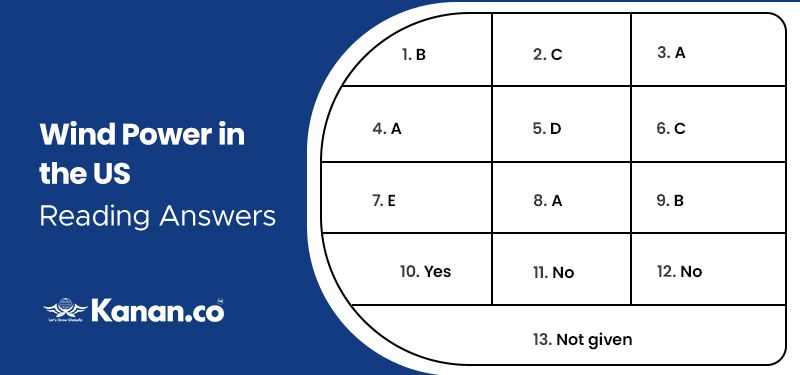
We have given Wind Power in the US reading answers, as a sample IELTS reading practice test in this article. We have also given the answers along with explanations. This topic has 13 questions in 3 different types namely - 5 questions are from multiple choice, 4 questions are from sentence completion and 4 questions as yes, no or not given.
Check out our YouTube Channel to Practice Full-Length IELTS Reading Tests Daily

Table of content:
- Solution for Wind Power in the US
- Wind Power in the US IELTS reading practice test
- Passage
- Questions
- Answers with explanation
Solution for Wind Power in the US
Below, we have given Wind Power in the US reading answers, in the table form.

Answer Table
| 1. B | 4. A | 7. E | 10. Yes | 13. Not given |
| 2. C | 5. D | 8. A | 11. No | |
| 3. A | 6. C | 9. B | 12. No |
Wind Power in the US IELTS reading practice test - Exam Review
Here we have given Wind Power in the US IELTS reading answers, as a sample article for the IELTS reading practice test. This article will help you to be excellent in your exams with band scores. Scrutinize the given passage to answer the questions.
Passage
We have given Wind Power in the US reading answers with location. Be careful while reading the passage and answer the questions.
Wind Power in the US reading answers
- Prompted by the oil crises of the 1970s, a wind-power industry flourished briefly in the United States. But then world oil prices dropped, and funding for research into renewable energy was cut. By the mid-1980s, US interest in wind energy as a large-scale source of energy had almost disappeared. The development of wind power at this time suffered not only from badly designed equipment, but also from poor long-term planning, economic projections that were too optimistic and the difficulty of finding suitable locations for the wind turbines.
- Only now are technological advances beginning to offer hope that wind power will come to be accepted as a reliable and important source of electricity. There have been significant successes in California, in particular, where wind farms now have a capacity of 1500 megawatts, comparable to a large nuclear or fossil-fuelled power station, and produce 1.5 percent of the state’s electricity.
- Nevertheless, in the US, the image of wind power is still distorted by early failures. One of the most persistent criticisms is that wind power is not a significant energy resource. Researchers at the Battelle Northwest Laboratory, however, estimate that today wind turbine technology could supply 20 percent of the electrical power the country needs. As a local resource, wind power has even greater potential. Minnesota’s energy commission calculates that a wind farm on one of the state’s south-western ridges could supply almost all that state’s electricity. North Dakota alone has enough sites suitable for wind farms to supply more than a third of all electricity consumed in the continental US.
- The prevailing notion that wind power is too costly results largely from early research which focused on turbines with huge blades that stood hundreds of metres tall. These machines were not designed for ease of production or maintenance, and they were enormously expensive. Because the major factors influencing the overall cost of wind power are the cost of the turbine and its supporting systems, including land, as well as operating and maintenance costs, it is hardly surprising that it was thought at the time that wind energy could not be supplied at a commercially competitive price. More recent developments such as those seen on California wind farms have dramatically changed the economic picture for wind energy. These systems, like installations in Hawaii and several European countries, have benefited from the economies of scale that come through standardised manufacturing and purchasing. The result has been a dramatic drop in capital costs: the installed cost of new wind turbines stood at $1000 per kilowatt in 1993, down from about $4000 per kilowatt in 1980, and continues to fall. Design improvements and more efficient maintenance programs for large numbers of turbines have reduced operating costs as well. The cost of electricity delivered by wind farm turbines has decreased from about 30 cents per kilowatt-hour to between 7 and 9 cents, which is generally less than the cost of electricity from conventional power stations.
- Reliability has also improved dramatically. The latest turbines run more than 95 percent of the time, compared with around 60 percent in the early 1980s. Another misconception is that improved designs are needed to make wind power feasible. Out of the numerous wind turbine designs proposed or built by inventors or developers, the propeller-blade type, which is based on detailed analytical models as well as extensive experimental data, has emerged as predominant among the more than 20,000 machines now in commercial operation worldwide. Like the gas-driven turbines that power jet aircraft, these are sophisticated pieces of rotating machinery. They are already highly efficient, and there is no reason to believe that other configurations will produce major benefits. Like other ways of generating electricity, wind power does not leave the environment entirely unharmed. There are many potential problems, ranging from interference with telecommunications to impact on wildlife and natural habitats. But these effects must be balanced against those associated with other forms of electricity generation.
- Conventional power stations impose hidden costs on society, such as the control of air pollution, the management of nuclear waste and global warming. As wind power has been ignored in the US over the past few years, expertise and commercial exploitation in the field have shifted to Europe. The European Union spends 10 times as much as the US government on research and development of wind energy. It estimates that at least 10 percent of Europe’s electrical power could be supplied by land-based wind turbines using current technology. Indeed, according to the American Wind Energy Association, an independent organisation based in Washington, Denmark, Britain, Spain and the Netherlands will each surpass the US in the generating capacity of wind turbines installed during the rest of the decade.
Questions
Questions 1-5
- Choose the correct letter A, B, C or D.
- Write the correct letter in boxes 1 - 5 on your answer sheet.
1. Which one of the statements is true?
- Cost was a big factor in preventing the development of wind power
- Wind power can provide enough electricity for a large portion of the United States
- Some US states are powered solely by the wind
- Wind power has developed steadily since the 1970s
2. What is the general view of wind energy in the United States?
- Very positive
- It can only provide small amounts of energy
- Wind power is not a good enough energy resource
- Very negative
3. Which of these factors has not contributed to the reduced cost of wind energy?
- State subsidies
- Economies of scale
- More efficient maintenance
- Standardisation of design
4. Wind turbine designs ...
- Are already very good
- Will be much more efficient in the future
- Are expected to improve in the future
- Are good for the environment
5. How does wind power negatively affect the environment?
- Causes air pollution.
- Produce nuclear waste
- Accelerate global warming
- Impacts on wildlife and natural habitats
Questions 6 – 9
- Complete each sentence with the correct ending, A-G below.
- Write the correct letter, A-G in boxes 6-9 on your answer sheet.
6. By the mid-1980s...
7. The image of wind power in the US...
8. Wind turbine technology in the US could supply...
9. Wind power does not have...
A: one-fifth of the electrical power the country needs.
B: costs on society, such as the control of air pollution.
C: US interest in wind energy had almost disappeared.
D: any potential problems.
E: still misrepresented by early failures.
F: 1.5 percent of the US electricity demand.
G: improved design.
Questions 10 – 13
- Do the following statements agree with the views of the writer in the Reading Passage?
- In boxes 10 -13 on your answer sheet, write
- YES if the statement agrees with the views of the writer
- NO if the statement contradicts the views of the writer
- NOT GIVEN if it is impossible to say what the writer thinks about this
10. The wind-power industry flourished briefly in the US due to oil crises.
11. Wind Power in North Dakota supplies 20 percent of the electrical power the United States.
12. Wind power is too costly for the US.
13. Denmark produces more electricity than the United States.
Answers for Wind Power in the US with Explanation
In this section Wind Power in the US reading answers with explanations is given here, this section will help you to identify your errors in the answering process.
Explanation: “There have been significant successes in California, in particular, where wind farms now have a capacity of 1500 megawatts, comparable to a large nuclear or fossil-fuelled power station, and produce 1.5 percent of the state’s electricity”. With this line it is clear that Wind power can provide enough electricity for a large portion of the United States. Hence the given answer is located in the last 3 lines of paragraph 2.
Explanation: “One of the most persistent criticisms is that wind power is not a significant energy resource”. With this line it is clear that the general view of wind energy in the United States is that wind power is not a good enough energy resource. Hence the given answer is located in the 2-3 lines of paragraph 3.
Explanation: “More recent developments such as those seen on California wind farms have dramatically changed the economic picture for wind energy. These systems, like installations in Hawaii and several European countries, have benefited from the economies of scale that come through standardised manufacturing and purchasing. The result has been a dramatic drop in capital costs: the installed cost of new wind turbines stood at $1000 per kilowatt in 1993, down from about $4000 per kilowatt in 1980, and continues to fall. Design improvements and more efficient maintenance programs for large numbers of turbines have reduced operating costs as well”. With this line it is clear that State subsidies have not contributed to the reduced cost of wind energy. Hence the given answer is located in the 8-16 lines of paragraph 4.
Explanation: “ Like other ways of generating electricity, wind power does not leave the environment entirely unharmed. There are many potential problems, ranging from interference with telecommunications to impact on wildlife and natural habitats”. With this line it is clear that Impacts on wildlife and natural habitats on wind power negatively affect the environment. Hence the given answer is located in the 10-13 lines of paragraph 5.
Explanation: “By the mid-1980s, US interest in wind energy as a large-scale source of energy had almost disappeared”. With this line it is clear that by the mid-1980, US interest in wind energy had almost disappeared. Hence the given answer is located in the 3-4 lines of paragraph 1.
Explanation: “Nevertheless, in the US, the image of wind power is still distorted by early failures”. With this line it is clear that the image of wind power in the US is still misrepresented by early failures. Hence the given answer is located in the first 2 lines of paragraph 3.
Explanation: “Researchers at the Battelle Northwest Laboratory, however, estimate that today wind turbine technology could supply 20 percent of the electrical power the country needs”. With this line it is clear that wind turbine technology in the US could supply one-fifth of the electrical power the country needs. Hence the given answer is located in the 3-5 lines of paragraph 3.
Explanation: “Conventional power stations impose hidden costs on society, such as the control of air pollution, the management of nuclear waste and global warming”. With this line it is clear that wind power does not have costs on society, such as the control of air pollution. Hence the given answer is located in the first 2 lines of paragraph 6.
Explanation: “Prompted by the oil crises of the 1970s, a wind-power industry flourished briefly in the United States”. With this line it is clear that the Wind-power industry flourished briefly in the US due to oil crises. Hence the given answer is located in the first line of paragraph 1.
Explanation: “North Dakota alone has enough sites suitable for wind farms to supply more than a third of all electricity consumed in the continental US”. From this line it is clear that the given statement contradicts with the given information on the passage. Hence the given answer is located in the last 2 lines of paragraph 3.
Explanation: “The cost of electricity delivered by wind farm turbines has decreased from about 30 cents per kilowatt-hour to between 7 and 9 cents, which is generally less than the cost of electricity from conventional power stations”. From this line it is clear that the given statement contradicts with the given information on the passage. Hence the given answer is located in the last 4 lines of paragraph 4.
Other reading answers

About Author Manimegalai Samidurai
Manimegalai is a multifaceted professional, excelling as an author, writer, and study-abroad expert. Her vast knowledge of English proficiency exams, including IELTS, GRE, SAT, and PTE, and exceptional content writing skills make her a go-to resource for students seeking guidance and support in their foreign education journey. She is a trusted authority in writing content related to these test-prep exams, making her an invaluable resource for those seeking guidance. With her well-researched and informative blogs, articles, and study materials, Manimegalai has helped countless students achieve their desired band scores and get admissions to top-notch colleges & universities in countries like Canada, USA, UK, Australia, Ireland, etc.
Kanan.co is a trusted study abroad consultancy offering comprehensive services, resources, and solutions for students and education institutions. We support students at every stage of their global education journey, ensuring a smooth and guided experience. Along with test preparation for IELTS, GRE, TOEFL, and SAT, we provide expert services such as SOP writing, visa guidance, accommodation support, scholarship assistance, and education loan support. Our expertise and commitment to excellence make us a reliable partner for students pursuing international education.
Free Online Mock Test 2026
Practice our mock test worth Rs. 25000 for Free and know your IELTS score!








Global Headquarters
Kanan Int EdTech Inc
320 Bay Street, Suite 321 (Spaces), Toronto ON, Canada M5B 1N9
Indian Headquarters
Kanan International Pvt. Ltd.
D-wing, 2nd Floor, Trident Complex, Ellora Park Vadiwadi Road, Vadodara, Gujarat 390007
IT/ Digital Campus
Kanan International Pvt. Ltd
Old, New No 3, 2nd Floor, 1A, Dr Sadasivam Rd, T. Nagar, Chennai, Tamil Nadu 600017
Our branches
- Bardoli
- Bharuch
- Chennai
- Dehradun
- Gurugram
- Himatnagar
- Karnal
- Nadiad
- Navsari
- Palanpur
- Rajkot
- Vadodara
- Valsad
- Vallabh Vidyanagar
- Vapi
Study Abroad
Test Prep
Top Universities
Consultants
IELTS Centers
GRE Centers
TOEFL Centers
SAT Centers
Language Courses in Vadodara
Study Abroad Calculators
Featured Blogs
Study Abroad Consultants in Chennai
Study Abroad Consultants in Surat
Study Abroad Consultants in Navsari
Study Abroad Consultants in Bardoli
Study Abroad Consultants in Ahmedabad
Study Abroad Consultants in Anand
Study Abroad Consultants in Khanna
Study Abroad Consultants in Nadiad
Study Abroad Consultants in Vadodara
Study abroad consultants in Valsad
Copyright © 2026 KANAN.CO All rights reserved.