- Study Abroad /
- blog /
- Fall Intake in USA 2026 - 2027: Deadlines, Universities & Complete Application Guide
Fall Intake in USA 2026 - 2027: Deadlines, Universities & Complete Application Guide


Author
04-05-2026
Planning to study in the USA? Good choice! The United States continues to be the #1 destination for international students, especially from India. As per the Open Doors 2025 report by the colleges and universities of International Education, the U.S. has over 1.2 million international students, including 363,019 Indian students, a 10% increase year-on-year.
With such a large number of students applying every year, choosing the right intake becomes crucial. There are three intakes in the USA such as Fall intake (September), Spring intake (January), and Summer intake (May). Among these three intakes, the Fall intake in the USA is the primary and most popular intake with the highest number of applications every year.
The Fall intake begins in August/September and marks the start of the academic year, offering maximum UG & PG programs, scholarships, and internship opportunities (CPT/OPT). It also aligns well with the Indian academic calendar, making it the preferred choice for most Indian students. In this complete guide to Fall intake in USA 2026 - 2027, you’ll find everything including application timeline, deadlines, top universities, F1 visa process, costs in INR, and expert tips. Choose the right intake and plan your study abroad journey effectively!
Key Highlights of Fall Intake in USA
- Primary Intake: Fall intake is the main admission cycle in the USA with the highest number of applications and program availability.
- Start Date: Begins in August–September, marking the start of the academic year.
- Application Deadlines: Typically fall between November and January (Early, Regular & Rolling).
- Maximum Programs & Scholarships: Offers access to 90%+ courses along with the highest number of scholarships.
- Best for Internships (CPT): Fall students become eligible for summer internships after completing one academic year.
What is Fall Intake in the USA?
The Fall intake in the USA is also known as September intake. It is considered as the primary or main intake among prospective students as it offers a large number of programs.
According to the thumb rule, applicants need to begin their application at least 12-18 months ahead of the fall intake. The Autumn intake of the USA starts its academic session in August/September. The admission process usually starts in late November/early December of the previous year. However, it is not advisable to wait until the deadline as top universities accept applications in the early January of the previous year.
The Fall intake admission offers a smooth transition for many international students, including those from India. It provides the best financial aid and accommodation options. The Fall semester season in the USA allows students to experience a stunning display of colorful foliage. Therefore, 99% Indian students target Fall intake in USA.
What are the benefits of choosing Fall Intake in the USA?
If you are still stuck in choosing the right intake, then you will decide to apply for Fall intake in the USA by knowing the benefits of studying in fall semester. Explore the top reasons listed below for why you can apply for Fall intake:
1. Largest Programme & University Selection: Fall intake is the main admission cycle, offering access to 90%+ UG & PG programs across top US universities. It makes fall the widest choice of courses and institutions to apply to.
2. Maximum Scholarship & Financial Aid Access: The majority of institutional scholarships, grants, and external financial aid are tied to the fall academic cycle.
3. CPT & Summer Internship Advantage: F-1 students must complete one full academic year before accessing CPT (Curricular Practical Training). Fall enrollees fulfil this requirement by May, making them internship-ready in their very first summer.
4. OPT & Job Market Alignment: Fall graduates enter the job market when most US companies run their primary hiring cycles. It significantly improves post-study employment prospects through Optional Practical Training (OPT).
5. Seamless Academic Transition: Fall intake aligns with most international school and undergraduate graduation schedules. It enables a direct, gap-free transition into higher education in the USA.
6. Stronger Campus Integration: Orientation programmes, club fairs, and networking events are concentrated in the fall semester. The best time to build connections, join communities, and ease cultural adjustment.
USA Fall Intake Application Timeline 2027
Many foreign students prefer the September intake as 90% of courses remain available. Early birds would ideally start their application process one year in advance to avoid any unforeseen delays in their journey. The detailed Fall intake application timeline in USA for cohorts for the year 2027 is given below. Check it out before you start with your application process.
| Month | Phase | What You Should Do | Key Priority |
| May – July 2026 | Research & Shortlisting | Research universities and courses based on your career goals. Shortlist 8–12 universities, compare ROI, acceptance rates, and deadlines and explore scholarships |
Finalise strong university shortlist |
| Aug – Oct 2026 | Exams & Preparation | Register and take GRE/GMAT and IELTS/TOEFL/PTE. Plan a retake buffer; start drafting SOP. Request 2–3 LORs from professors or managers |
Achieve target test scores + SOP draft ready |
| Sep – Oct 2026 | Early Applications | Start applying for Early Action / Early Decision universities. Prepare tailored SOPs and track priority deadlines carefully |
Increase early admit chances |
| Nov 2026 – Jan 2027 | Main Applications | Submit all applications with SOP, LORs, resume, and transcripts. Apply for scholarships and double-check deadlines for each university |
Complete all applications on time |
| Feb – Mar 2027 | Interviews & Tracking | Attend university interviews. Regularly check email and application portals. Respond quickly to requests and submit any pending documents |
Convert applications into admits |
| Feb – Apr 2027 | Rolling Admissions | Apply to rolling universities (e.g., ASU, Northeastern, UTD, USC). Focus on programs still open and act quickly as seats fill fast |
Last chance to secure admission |
| Apr – May 2027 | Admit Decisions | Compare admission offers based on tuition, scholarships, and location. Evaluate ROI, accept your preferred university and pay enrollment deposit |
Finalise university before May 1 deadline |
| May – June 2027 | Visa Process | Request and receive I-20. Pay SEVIS fee ($350), complete DS-160 form. Book visa slot immediately after slots open |
Secure early visa slot |
| June – July 2027 | Visa Interview | Prepare visa documents and financial proof. Attend F1 visa interview confidently and answer questions clearly |
Get visa approval |
| July – Aug 2027 | Pre-Departure | Book flight tickets Arrange accommodation Connect with peers Attend university orientation and prepare all documents |
Complete travel preparation |
| Aug – Sep 2027 | Classes Begin | Travel to the USA Attend orientation sessions Complete enrollment formalities and start your academic journey |
Smooth transition to university life |
This timeline aligns with Indian academic schedules and global opportunities.
It's time to check the top universities in the USA, including popular courses, acceptance rates, application deadlines, and more. You’ll find all this essential information in the next section.
Top Universities & Popular Programs for Fall intake in USA 2027
In Fall intake in USA, almost all top universities fill their seats. Thereby, many Indian students develop a strong preference for this intake. Check out the universities, acceptance rates, popular programs offered and deadlines below to get admitted to this Fall intake.
| Popular USA Universities Offering Fall Intake 2027 | |||||
| Top Universities |
QS World University Ranking 2026 | Popular Programs | Admission Type |
Early Action Deadlines | Regular Action Deadlines |
| Massachusetts Institute of Technology (MIT) | 1 |
|
Early Action (EA) | November 1, 2026 | January 6, 2027 |
| Harvard University | 4 |
|
Restrictive Early Action (REA) | November 1, 2026 | January 1, 2027 |
| Stanford University | 6 |
|
Restrictive Early Action (REA) | November 1, 2026 | January 5, 2027 |
| University of Pennsylvania | 11 |
|
Early Decision (ED) | November 1, 2026 | January 5 , 2027 |
| University of California Berkeley | 12 |
|
UC Application System (No EA/ED) | Berkeley does not offer applications for early admission or early decision. | October 1 – December 2 |
| Cornell University | 16 |
|
Early Decision (ED) | November 1, 2026 | January 2, 2027 |
| University of Chicago | 21 |
|
Early Action (EA) / ED | November 1, 2026 | January 6, 2027 |
| Princeton University | 22 |
|
Restrictive Early Action (REA) | November 1, 2026 | January 1, 2027 |
| Yale University | 23 |
|
Restrictive Early Action (REA) | November 1, 2026 | January 2, 2027 |
| Columbia University | 34 |
|
Early Decision (ED) | November 1, 2026 | January 1, 2027 |
Note: Deadlines, acceptance rates, and program availability may vary by course and year. Always check the official university website before applying.
Important Note on Fall Intake Deadlines
Most US universities follow a structured admission cycle for the Fall intake. Early Action and Early Decision deadlines usually fall in November, while Regular Decision deadlines extend from January to February. If you miss these, some universities offer rolling admissions until April or May, where applications are reviewed on a first-come, first-served basis and decisions are typically given within 4–6 weeks.
As of now, applications for Fall 2026 are mostly closed. Students are advised to target Fall 2027 intake to improve their chances of admission and scholarships.
To apply for the above mentioned universities, check the necessary documents required in the following section.
What are the documents required for Fall Intake in USA 2027?
Check out the documents required for fall (main intake) intake admission 2027 mentioned below:
1. University Application Documents
| Document | Requirement | Important Tips (India-Specific) |
| Academic Transcripts | Official mark sheets from Class 10, 12, and all semesters | Some universities require WES evaluation (takes 4–6 weeks). Get transcripts sealed by your university |
| Degree Certificate / Provisional Certificate | Final degree certificate | If in final year, submit provisional certificate or bonafide letter |
| English Language Test Scores | IELTS / TOEFL / PTE / Duolingo | Minimum: IELTS 6.5–7.5 or TOEFL 90–105 (varies by university) |
| Standardized Test Scores | SAT/ACT (UG), GRE/GMAT (PG) | Many universities are test-optional, but scores strengthen your profile |
| Statement of Purpose (SOP) | 750–1000 words | Must be customized for each university (avoid generic SOPs) |
| Letters of Recommendation (LORs) | 2–3 LORs | At least 1 academic LOR required for MS and give recommenders 4–6 weeks |
| Admission Essays | University-specific essays | Some universities require multiple essays |
| Resume / CV | 1–2 pages | Follow US format (no photo, no DOB). Quantify achievements |
| Portfolio (if required) | For design, architecture, etc. | Include projects and practical work |
| Passport Copy | Valid passport | Should be valid for at least 6 months beyond course start date |
| Application Fee Receipt | Proof of payment | Required for application processing |
| Work Experience Certificates | For MBA / MS programs | Include offer letters, payslips if needed |
| Medium of Instruction (MOI) | Optional | Accepted by some universities instead of IELTS/TOEFL |
2. F-1 Visa Documents (Post Admission)
| Document | Requirement | Important Tips |
| Form I-20 | Issued by university after admission | Must be signed by student and university official |
| SEVIS Fee Receipt (I-901) | ~$350 (₹32,000–₹33,000 approx.) | Pay at least 3 days before visa interview |
| DS-160 Confirmation Page | Online visa application form | Ensure details match your SOP and application |
| Valid Passport | Mandatory | Same passport used in DS-160 |
| Visa Appointment Confirmation | Interview booking proof | Book early as slots fill quickly |
| Bank Statements | Last 6 months | Must show 1 year tuition + living expenses |
| Sponsor Affidavit | If funded by parents/relatives | Include IT returns (last 2–3 years) |
| Education Loan Sanction Letter | If applicable | Must clearly mention loan amount approved |
| Photographs | As per US visa rules | 5x5 cm, white background, recent |
| Academic Documents | Transcripts, test scores | Carry originals + copies for verification |
Once your documents are ready, the next step is to plan your finances smartly for fall intake in the USA. Learn about budgeting, funding options, and managing expenses in the upcoming section.
How to Apply for Fall Intake in USA 2027 (Complete Step-by-Step Process)
Applying for the Fall intake in USA 2027 requires more than just filling out forms. It involves strategic planning, strong documentation, and timely execution to maximize your chances of admission and scholarships. Start your preparation 10–12 months in advance for the best results.
1. Build a Smart University List
Shortlist 8–12 universities based on:
- Course fit and specializations
- Tuition fees and ROI
- Location and job opportunities
- Acceptance rate
2. Check Eligibility & Admission Deadlines
Review each university’s requirements:
- Academic scores (GPA/percentage)
- IELTS/TOEFL/PTE requirements
- GRE/GMAT (if required or optional)
- Work experience (for MBA/PG programs)
Also note application types:
- Early Action / Early Decision: Nov–Dec
- Regular Decision: Jan–Feb
- Rolling Admissions: Till seats fill (Apr–May)
3. Plan & Take Standardized Tests
- Register early for GRE/GMAT and IELTS/TOEFL.
- Take exams 3–5 months before deadlines to allow time for retakes and score improvement.
4. Prepare Application Documents
- Start early and keep all documents ready:
- Academic transcripts (may require WES evaluation – takes 4–6 weeks)
- Statement of Purpose (SOP) (customized for each university)
- Letters of Recommendation (2–3 LORs)
- Resume (US format)
- Test score reports
- Essays / Portfolio (if required)
5. Write a Compelling SOP
Your SOP should clearly explain:
- Academic background
- Career goals
- Why this university and program
Tip: Avoid generic content. Tailor each SOP to the university.
6. Apply Strategically (Timing Matters)
- Apply early (Nov–Dec) for better admission + scholarship chances
- Use rolling universities as backup options if you apply late
Note: Most scholarships follow application deadlines, so early applications increase funding opportunities.
7. Submit Applications & Pay Fees
- Complete online applications carefully
- Upload all required documents
- Pay application fees and save confirmation receipts
Tip: Double-check everything before submission to avoid rejection due to errors.
8. Track Applications & Attend Interviews
- Monitor application status through university portals
- Respond quickly to additional document requests
- Prepare for interviews (if required), usually conducted between January and March
9. Receive Offers & Confirm Admission
- Compare admits based on fees, scholarships, internships, and career outcomes
- Accept your preferred university by the common May 1 deadline
- Pay the enrollment deposit to secure your seat
10. Apply for Scholarships & Financial Aid
- Apply for university, government, and external scholarships
- Some require separate applications
- Deadlines usually align with Nov–Jan application cycle
11. Start F-1 Visa Process
- After accepting your offer:
- Receive Form I-20 from the university
- Pay SEVIS fee (~$350 / ₹32,000+)
- Fill DS-160 form
- Book your visa slot early
Note: Visa slots for Fall intake fill quickly, so apply as soon as they open.
12. Prepare for Departure
- Attend visa interview (June–July)
- Book flights and arrange accommodation
- Arrange finances, forex, and documents
- Attend university orientation
How to Plan Financially for Fall Intake in USA 2027?
Worried about expenses for studying in the US this Fall 2027? Plan your finances early with the below simple checklist. So, you can focus on your studies without the financial stress.
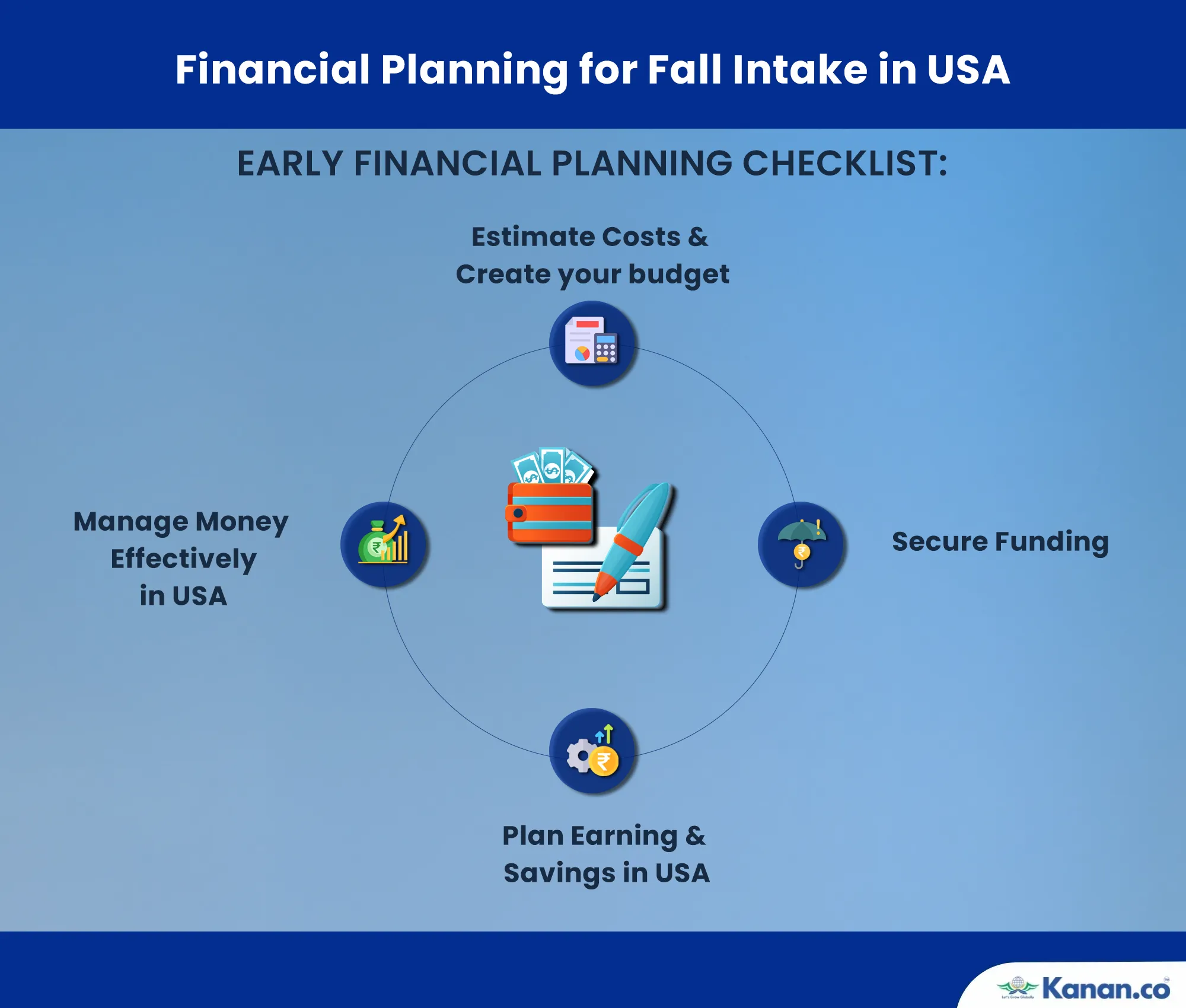
1. Estimate Costs & Create Your Budget (Do This Immediately!)
- Calculate all expenses: List tuition, housing (compare on/off-campus), living, food, books, travel, fees and personal spending to estimate your total cost of studying in USA.
- Research Location Costs: Compare cost of living across cities—choosing a budget-friendly location helps cut expenses. Use student budget calculators for estimates.
- Create Budget: Prioritize essentials (tuition, housing); track your spending; know needs vs. wants.
- Budget for Currency: Keep a buffer for potential INR to US Dollar fluctuations.
2. Secure Funding
- Apply for Scholarships: Research & apply for university-specific (merit-based included), organizational, and government scholarships/grants in the USA. Check deadlines.
- Explore Loans: Compare government and private bank education loan options (interest rates, terms). Apply early as processing takes time.
- Check Employer Sponsorship: If working, see if your employer offers tuition sponsorship or reimbursement.
- Research Assistantships (Grads): For graduate students, research Teaching or Research Assistantships (TA/RA) which offer stipends/tuition waivers.
3. Plan Earning & Saving in USA
- On-Campus Jobs: Look for part-time job opportunities available at your university upon arrival.
- Off-Campus Work Opportunities: International students in USA can work off-campus for up to 24 hours per week during academic sessions. Make sure to understand IRCC rules and get the right permit before starting any job.
- Arrange Health Insurance: Ensure you have mandatory provincial or university health insurance arranged for your entire stay.
- Save Money Daily: Buy used books, cook at home, use public transport & avail student discounts.
4. Manage Money Effectively in USA
- Open Canadian Bank Account: Do this after arrival to manage your finances, pay bills and to avoid foreign transaction fees.
- Use Uni Financial Workshops: Attend university workshops on budgeting and financial management.
- Build Credit Carefully: Pay bills on time. Consider a student credit card later if needed and manageable.
Plan early, be prepared, and manage your money smartly to make your USA Fall 2027 journey stress-free and successful.
Tips for Fall Intake in USA (Do’s & Don’ts)
Do’s (What You Should Do)
- Start Early (12–15 Months Before Intake): Begin your preparation at least a year in advance to avoid last-minute stress and increase admission and scholarship chances.
- Track Everything in One Place: Maintain a spreadsheet to track universities, deadlines, application links, fees, and document status to stay organised.
- Prioritise Early Deadlines (Nov–Dec): Many top universities have Early Action and priority deadlines. Applying early improves your chances of admission and funding.
- Prepare for Tests with a Retake Buffer: Book GRE/GMAT and IELTS/TOEFL early and keep time for a second attempt if needed to improve scores.
- Customise Your SOP for Each University: Avoid generic content. Mention specific courses, faculty, or research areas to stand out.
- Plan Finances & Proof of Funds Early: Arrange education loans, scholarships, and valid bank statements well before visa processing.
- Apply for Scholarships Proactively: Check both university-specific and external scholarships. Many deadlines align with early application rounds.
- Follow a Structured Timeline: Align your preparation with monthly milestones (research -> tests -> applications -> visa) to stay on track.
Don’ts (What to Avoid)
- Don’t Delay Your Application: Late applications reduce your chances of admission, scholarships, and preferred programs.
- Don’t Submit Incomplete or Incorrect Documents: Even small errors can lead to rejection. Always review your application thoroughly before submission.
- Don’t Ignore Financial Proof Requirements: Lack of proper documentation for funds can lead to visa rejection.
- Don’t Miss Scholarship Deadlines: Many students lose funding opportunities simply by applying late.
- Don’t Schedule Tests at the Last Minute: Late test attempts leave no time for improvement or retakes.
Want to study abroad at a US University? Connect with our Kanan Study Abroad Counsellors and get personalized guidance. We’ll help you with university admissions, test preparation, and everything in between. Start your application today and take the next big step in your academic journey!
Frequently Asked Questions for Fall Intake in USA 2027
1. What is the September intake in the USA?
The September intake, also called the Fall intake, is the primary admission cycle in the USA. It begins in August/September and offers the maximum number of courses, scholarships, and opportunities.
2. Which month does the Fall intake start in the USA?
The Fall intake in the USA typically starts in late August or early September. Classes continue until December, marking the beginning of the academic year.
3. How many intakes are there in the USA?
There are three intakes in the USA: Fall (September), Spring (January), and Summer (May). Among these, Fall is the primary and most preferred intake.
4. When should I start applying for Fall intake in the USA?
You should start preparing 12–15 months in advance. Applications usually begin around September–October of the previous year.
5. What is the deadline for Fall intake applications in the USA?
Deadlines vary by university, but most fall between November (early deadlines) and January/February (regular deadlines). Always check individual university websites while some universities extend deadlines till February or offer rolling admissions.
6. Can Indian students study in the USA in 2027?
Yes, Indian students can apply for Fall 2027, Spring 2027, or Fall 2027 intakes. A valid academic profile, test scores, and visa approval are required.
7. Can I apply for scholarships for Fall intake in the USA?
Yes, many universities offer scholarships for Fall intake applicants. Applying early increases your chances of securing financial aid.
8. What if I miss the Fall intake deadline in the USA?
If you miss the Fall intake, you can apply for Spring or Summer intake. Alternatively, you can prepare better and target the next Fall cycle.
9. What is the difference between Fall and Spring intake in the USA?
Fall intake offers more courses, scholarships, and internship opportunities, while Spring intake has fewer options but is useful if you need extra preparation time.
10. Can I apply to multiple universities for Fall intake?
Yes, students typically apply to 8–12 universities, including dream, moderate, and safe options to increase admission chances.
11. When should I book my F-1 visa slot for Fall intake?
You should book your F-1 visa slot as soon as you receive your I-20 and complete DS-160 and SEVIS payment, usually by June–July.
12. How should I prepare for the GRE/GMAT for Fall intake?
Start preparation at least 4–6 months in advance. Use mock tests and keep a buffer for retakes to achieve competitive scores.
13. Can I transfer universities after joining Fall intake?
Yes, transfers are possible but depend on university policies. You may need a new I-20 and must follow visa regulations carefully.
14. Is it possible to apply for Fall intake with low GPA?
Yes, some universities accept lower GPAs if supported by strong SOP, work experience, or test scores. Pathway programs are also an option.
About Author Manimegalai Samidurai
Manimegalai is a multifaceted professional, excelling as an author, writer, and study-abroad expert. Her vast knowledge of English proficiency exams, including IELTS, GRE, SAT, and PTE, and exceptional content writing skills make her a go-to resource for students seeking guidance and support in their foreign education journey. She is a trusted authority in writing content related to these test-prep exams, making her an invaluable resource for those seeking guidance. With her well-researched and informative blogs, articles, and study materials, Manimegalai has helped countless students achieve their desired band scores and get admissions to top-notch colleges & universities in countries like Canada, USA, UK, Australia, Ireland, etc.

Kanan.co is a trusted study abroad consultancy offering comprehensive services, resources, and solutions for students and education institutions. We support students at every stage of their global education journey, ensuring a smooth and guided experience. Along with test preparation for IELTS, GRE, TOEFL, and SAT, we provide expert services such as SOP writing, visa guidance, accommodation support, scholarship assistance, and education loan support. Our expertise and commitment to excellence make us a reliable partner for students pursuing international education.
Get USA Admission Counselling by Experts
More Posts from Manimegalai Samidurai


Manimegalai Samidurai
Universities in USA Accepting 3-Year Bachelor’s Degree in 2026


18-08-2023
Manimegalai Samidurai
12 Best places to Study in USA for International Students
18-08-2023
Manimegalai Samidurai
Exams to Study in USA in 2026 | IELTS, TOEFL, GMAT, GRE, SAT
03-08-2023
Manimegalai Samidurai
Study in USA without IELTS in 2026
04-05-2023








Global Headquarters
Kanan Int EdTech Inc
320 Bay Street, Suite 321 (Spaces), Toronto ON, Canada M5B 1N9
Indian Headquarters
Kanan International Pvt. Ltd.
D-wing, 2nd Floor, Trident Complex, Ellora Park Vadiwadi Road, Vadodara, Gujarat 390007
IT/ Digital Campus
Kanan International Pvt. Ltd
Old, New No 3, 2nd Floor, 1A, Dr Sadasivam Rd, T. Nagar, Chennai, Tamil Nadu 600017
Our branches
- Bardoli
- Bharuch
- Chennai
- Dehradun
- Gurugram
- Himatnagar
- Karnal
- Nadiad
- Navsari
- Palanpur
- Rajkot
- Vadodara
- Valsad
- Vallabh Vidyanagar
- Vapi
Study Abroad
Test Prep
Top Universities
Consultants
IELTS Centers
GRE Centers
TOEFL Centers
SAT Centers
Language Courses in Vadodara
SOP Blogs
Featured Blogs
Study Abroad Consultants in Chennai
Study Abroad Consultants in Surat
Study Abroad Consultants in Navsari
Study Abroad Consultants in Bardoli
Study Abroad Consultants in Ahmedabad
Study Abroad Consultants in Anand
Study Abroad Consultants in Khanna
Study Abroad Consultants in Nadiad
Study Abroad Consultants in Vadodara
Study abroad consultants in Valsad
Copyright © 2026 KANAN.CO All rights reserved.