- Study Abroad /
- blog /
- Statement of Purpose (SOP) for BBA: How to Write, Samples, Format & Tips
Statement of Purpose (SOP) for BBA: How to Write, Samples, Format & Tips


Author
28-05-2026
A Statement of Purpose (SOP) for BBA is one of the most important documents required for admission to top universities and B-schools abroad. Also known as a personal statement or statement of interest, an SOP for BBA highlights your academic background, career goals, leadership skills, extracurricular activities, achievements, and interest in business administration. Since most students apply for a BBA program directly after high school with limited work experience, universities use the SOP to evaluate a student’s personality, communication skills, potential, and overall fit for the program. In this guide, we will discuss how to write an SOP for BBA, format, writing tips, mistakes to avoid, and sample SOPs for different student profiles along with pdfs.
What is an SOP for BBA and Why is it important?
A Statement of Purpose (SOP) for BBA is a personal essay submitted during the undergraduate admission process. Most universities usually expect it to be around 600 - 1000 words, while UK universities may ask for a 4000-character personal statement through UCAS. Simply put, the SOP helps the admission committee understand who you are beyond marks, scores, and certificates.
For example, two students may have similar academic performance, but their SOP can create a completely different impression. One student may write generic lines copied from the internet, while another may explain their goals, experiences, and interest in business management in a more personal and genuine way. Naturally, the second SOP becomes more memorable.
A strong SOP for BBA helps universities understand:
- your motivation for studying business management,
- your career goals and interests,
- leadership skills and extracurricular involvement,
- communication abilities,
- and how well you fit the program.
For students applying directly after high school with little or no work experience, the SOP often becomes one of the most important parts of the application.
Format of SOP for BBA
A well-structured Statement of Purpose for BBA should follow a logical flow where each paragraph focuses on a specific part of your academic journey, experiences, goals, and personality. Instead of randomly listing achievements and strengths, students should present their story in a clear and meaningful manner.
An ideal SOP for BBA generally includes:
- Motivation for pursuing BBA
- Academic background and relevant coursework
- Projects, internships, certifications, or achievements
- Leadership skills and extracurricular activities
- Challenges, experiences, or personal growth
- Short-term and long-term career goals
- Reasons for choosing the university and BBA program
Below is the ideal 6-part SOP format followed by many top universities abroad:
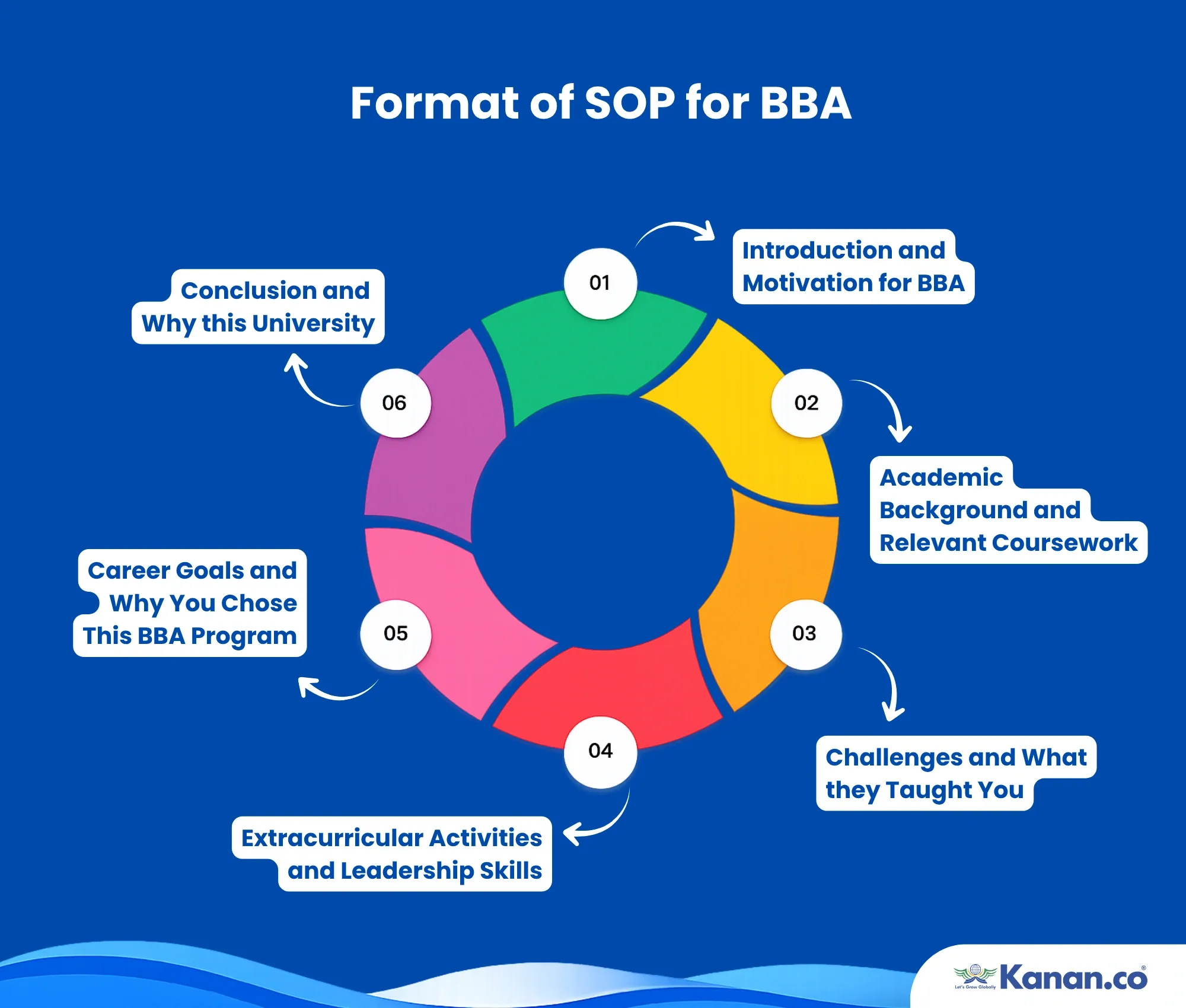
Part 1: Introduction and Motivation for BBA
The introduction paragraph should immediately capture the reader’s attention and explain what sparked your interest in business management. Avoid generic openings like “Since childhood, I have been passionate about business.” Instead, try to begin with a real observation, experience, or moment that influenced your interest in management, entrepreneurship, marketing, or economics.
The first paragraph should briefly introduce:
- your interest in BBA,
- personal motivation/personal story,
- and the experiences that shaped your career direction.
For example:
| During my school years, I became curious about how small businesses around me used social media and digital platforms to attract customers. I noticed that even local brands were growing rapidly by understanding customer behavior and adapting to changing trends. Observing these changes gradually developed my interest in business management and motivated me to pursue a BBA program. |
Part 2: Academic Background and Relevant Coursework
In this section, explain your academic background and subjects relevant to business administration. Instead of only mentioning marks and grades, focus on how subjects like Economics, Accountancy, Mathematics, or Business Studies helped you develop analytical thinking, communication, or problem-solving skills.
Students can also mention:
- academic projects & project work,
- certifications,
- competitions,
- seminars,
- internships,
- presentations,
- or leadership experiences relevant to the BBA program.
For example:
| Subjects like Economics and Business Studies helped me understand concepts such as consumer behavior, marketing strategies, and business operations in a practical way. I also participated in a business presentation competition where my team developed a startup idea and presented its marketing strategy, which improved my communication and teamwork skills. |
Part 3: Challenges and What They Taught You
Apparently, many students do not include challenges or personal experiences in their SOP. However, universities also want to understand how students handle difficult situations and what they learn from them. The challenge does not always need to be dramatic. It can be:
- a failed competition,
- confidence issues,
- financial difficulties,
- balancing academics and extracurricular activities,
- or any experience that helped you grow personally.
The important thing is to focus on the lesson learned and how the experience shaped your mindset.
For example:
| Earlier, I was not very confident while speaking in front of large groups. However, participating in presentations and school activities gradually helped me improve my communication skills and become more comfortable expressing my ideas in public situations. |
Part 4: Extracurricular Activities and Leadership Skills
Business schools look for students who are active beyond academics. This section should highlight your extracurricular activities, hobbies, leadership roles, teamwork experiences, volunteering work, sports participation, or event management experiences.
Instead of listing every activity, focus on experiences that genuinely helped you develop important qualities like:
- leadership,
- teamwork,
- communication,
- discipline,
- and problem-solving.
For example:
| One of the most valuable experiences during school was being part of the organizing team for a cultural event. Managing responsibilities, coordinating with different teams, and handling last-minute changes taught me the importance of teamwork, adaptability, and quick decision-making. |
Part 5: Career Goals and Why You Chose This BBA Program
In this section, clearly explain your short-term and long-term career goals. If you have work experience, mention your job role, responsibilities, tasks handled, and any rewards or recognition received. You should also mention your specific interests within business administration, such as:
- marketing,
- finance,
- entrepreneurship,
- international business,
- business analytics,
- or management.
You should also explain why you selected this university and how the BBA program aligns with your goals. Mention specific factors such as:
- internships,
- practical learning,
- case studies,
- business clubs or student’s association activities,
- industry exposure,
- or specialization opportunities.
For example:
| I am particularly interested in marketing and business strategy because I enjoy understanding customer behavior and market trends. I believe the practical learning opportunities, internships, conferences and industry exposure offered by the BBA program will help me build the skills required for a career in this field. |
Part 6: Conclusion and Why this University
The conclusion should briefly connect your motivation, experiences, skills, and future goals. Keep it concise, realistic, and natural instead of sounding overly formal or repetitive. You can also mention how the university’s learning environment and opportunities will help you grow academically and professionally.
For example:
| I believe pursuing a BBA degree at your university will help me strengthen my understanding of business management while also giving me practical exposure to real-world business environments. I am eager to learn, improve my skills, and gain experiences that will help me grow both personally and professionally. |
Sample SOP for BBA
Below is a sample SOP written by a student applying to a BBA program:
I did not seriously think about studying business until my higher secondary years. Earlier, I assumed business was mostly about calculations, profits, and large companies. But slowly, I started noticing how businesses around me operated differently. A small café near my school used to stay crowded almost every evening while another shop nearby struggled even though both sold similar products. I became curious about what actually makes people choose one business over another. That curiosity stayed with me.
In school, I naturally enjoyed subjects where I could connect ideas with real situations instead of memorizing answers. Economics and Business Studies were two subjects that genuinely interested me because they helped me understand things happening around us every day. Even simple classroom discussions about customer behavior, pricing, or advertising used to hold my attention for longer than I expected.
One experience that made me look more seriously at management was during a school cultural event. I was part of the student team handling coordination work. Initially, we thought everything would go smoothly because we had planned most things in advance. But on the event day, a few arrangements changed at the last minute, some students did not arrive on time, and we had to adjust quickly. It was stressful for a while, honestly. Still, I liked the process of solving problems, communicating with people, and making quick decisions when things became unorganized. That experience taught me that management is not only theory. It also involves patience, teamwork, and practical thinking.
Outside academics, I participated in presentations, group activities, and sports events whenever I had the opportunity. Earlier, public speaking used to make me nervous. Over time, I became more comfortable expressing my thoughts in front of others. Sports also played an important role in shaping my personality because they taught me discipline and consistency. Losing matches at times helped me handle pressure better and improve gradually instead of giving up quickly.
Another reason I want to pursue BBA is because businesses today are changing rapidly due to technology and digital platforms. I often come across stories of startups and small businesses growing through social media marketing and online branding. Seeing how ideas can turn into successful businesses made me interested in learning how management actually works beyond textbooks and social media discussions.
I am particularly interested in areas like marketing, entrepreneurship, and business communication because these fields involve both creativity and practical decision-making. I want to learn through internships, projects, and case studies so that I can understand how businesses deal with real challenges in competitive environments.
Studying at your university will give me exposure to a learning environment where I can interact with students from different backgrounds and improve my understanding of business from multiple perspectives. I also look forward to participating in practical learning activities that can help me grow both academically and personally.
There is still a lot I need to learn about the business world, and that is exactly why I want to study management professionally. I see this BBA program as an important step that will help me build stronger skills, gain practical exposure, and prepare myself for future opportunities in the field of business and management.
SOP for BBA Sample 2
Given below is another sample SOP for BBA written for by a student with a different academic background and career interests:
Growing up, I spent a lot of time around my uncle’s clothing store during weekends and holidays. At first, I only helped with small tasks like arranging products or handling packaging. But over time, I started noticing how customers behaved differently depending on pricing, discounts, product display, and even the way staff communicated with them. Sometimes a small change in presentation would increase sales noticeably within a few days. Watching these situations closely made me interested in how businesses attract customers and make decisions in competitive markets.
During my school years, I was always more interested in practical learning than theoretical memorization. Subjects like Economics and Accountancy helped me understand how businesses function beyond what we see from the outside. I enjoyed classroom discussions where we spoke about market trends, consumer behavior, and business strategies because they felt connected to real life rather than just exam preparation.
Apart from academics, I actively participated in school activities whenever possible. I was part of a small team that handled promotions for our school fest, and that experience changed the way I looked at communication and planning. We used social media platforms to share event updates and encourage student participation. Some ideas worked well, while others did not attract much response. It was interesting to see how differently people react depending on the way something is presented.
Over the last few years, I have also developed an interest in how digital platforms are changing modern businesses. Today, even small brands are building strong customer bases through online marketing and content creation. I often follow startup stories and young entrepreneurs online because I find it inspiring how simple ideas can grow into successful businesses through creativity and consistency.
One thing I have learned from these experiences is that business management is not limited to selling products or earning profits. It also involves understanding people, adapting to change, and making decisions during uncertain situations. I enjoy environments where I can interact with people, exchange ideas, and work on practical challenges, which is one of the main reasons I want to pursue a BBA program.
Outside academics, sports and extracurricular activities also played an important role in shaping my personality. They taught me discipline, teamwork, and patience. There were situations where results did not go as expected, but those experiences helped me become more consistent and better at handling pressure.
I now want to study business management in a structured environment where I can improve my understanding of areas like marketing, entrepreneurship, business communication, and management principles. I am especially interested in gaining practical exposure through internships, projects, and collaborative learning experiences because I believe these opportunities help students understand how businesses actually operate in real-world situations.
I believe studying at your university will help me grow both academically and personally by exposing me to new perspectives, practical learning experiences, and a diverse student environment. I am eager to learn, improve my skills, and prepare myself for future opportunities in the field of business and management.
Pursuing a BBA degree is an important step for me because it will help me build a strong foundation for my future career while also allowing me to develop as an individual who can adapt, communicate effectively, and contribute positively in professional environments.
SOP for BBA: University Requirements and Word Count
Different universities have different SOP requirements for BBA programs. Some universities may ask for a detailed personal statement, while others require shorter essays through platforms like UCAS or Common App. Therefore, students should carefully check the official SOP guidelines, format, and word limit specified by the university before submitting the application.
Given below are the SOP requirements and recommended word count for popular universities offering BBA and business-related undergraduate programs abroad.
| University | Country | SOP Requirement / Word Count | Key Focus Area |
| MIT Sloan School of Management | USA | 1-2 pages | Personal experiences, leadership, goals, community contribution |
| California Institute of Technology | USA | Common App or supplemental essay | Academic interests, motivation, future goals |
| University of Michigan | USA | 250–650 words | Personal statement and supplemental essays |
| University of Wisconsin–Madison | USA | Two essays, max 650 words each | Academic background, extracurricular activities |
| Simon Fraser University | Canada | Short essay / supplemental application | Academic goals and interest in business |
| University of Toronto | Canada | Student profile and supplementary application form | Leadership, achievements, non-academic involvement |
| University of Cambridge | UK | 4000 characters via UCAS | Academic curiosity and subject interest |
| University of Oxford | UK | 4000 characters via UCAS | Academic strengths and motivation |
| Kingston University | UK | Around 700–800 words | Academic background, internships, skills |
| Hult International Business School | USA/UK | 400–700 words or video SOP | Leadership, international mindset, ambition |
| University of Amsterdam | Netherlands | Around 500 words | Motivation and academic fit |
| Texas State University | USA | One-page essay from given topics | Writing ability and personal perspective |
Common Mistakes That Can Get Your SOP for BBA Rejected
These are some common mistakes that admission committees notice in many BBA SOPs. Avoiding them can make your SOP more clear, personal, and effective.
1. Using Generic Opening Lines
Starting with quotes from famous business leaders or lines like “Since childhood, I have been passionate about business” makes the SOP sound repetitive. Instead, begin with a real experience, observation, or moment that influenced your interest in business management.
2. Trying Too Hard to Impress
Some students make themselves sound perfect in every field, while others sound too underconfident. A good SOP should feel honest and balanced.
3. Copying SOP Samples From the Internet
Using samples for reference is fine, but copying content makes the SOP look generic and unoriginal. Universities can often identify copied or template-based writing easily.
4. Ignoring University Guidelines
Different universities follow different SOP formats and word limits. Submitting a 1200-word SOP where only 500 words are required creates a poor impression. Always check the official guidelines before submitting the application.
5. Writing Vague Career Goals
Simply saying “I want to become an entrepreneur” is not enough. Explain your specific interests and how the BBA program will help you achieve your goals.
6. Grammar and Spelling Mistakes
Grammar and spelling errors can affect the overall quality of the SOP. Proofread the document carefully before submission.
7. Adding Too Much Information
Trying to include every achievement and activity can make the SOP look crowded. Focus only on the most relevant experiences and explain them clearly.
Skills you should Highlight in your BBA SOP
Apart from academics and career goals, universities also look for students who have practical skills and the right mindset for business management. Given below are some important skills students can include in their SOP for BBA.
- Analytical and Problem-Solving Skills: These skills show that you can think logically and handle problems in a practical way. Students can mention subjects like Mathematics, Economics, or situations where they solved problems during projects or competitions.
- Communication Skills: Good communication is very important in business management. Students can mention presentations, debates, group discussions, public speaking, or event participation.
- Leadership and Teamwork: Business schools prefer students who can work with others and handle responsibilities. Leadership roles, sports activities, volunteering, or organizing school events can help show these qualities.
- Entrepreneurial Thinking: Students can mention situations where they came up with new ideas, managed activities, or tried to solve a problem creatively. Even small experiences can reflect entrepreneurial thinking.
- Awareness of Business Trends: Having interest in business news, startups, digital marketing, or current market trends shows genuine interest in business management and learning.
- Adaptability and Resilience: Universities also value students who can learn from difficult situations and improve themselves. Students can mention experiences that helped them become more confident, disciplined, or adaptable.
- Research and Learning Skills: Students who enjoy learning new things and exploring topics related to business can mention projects, certifications, online courses, or independent learning experiences.
Tips for Writing an SOP for BBA
Writing an SOP may look difficult at first, especially if you are applying abroad for the first time. But honestly, a good SOP is not about using fancy words or writing a perfect story. It is about explaining your experiences, goals, and interest in business management in a simple and genuine way.
Given below are some useful tips that can help students write a strong SOP for BBA admissions:
- Keep the SOP clear, simple, and to the point.
- Use simple language instead of difficult vocabulary.
- Avoid adding unnecessary details or repeating the same points.
- Start with a real experience or observation instead of generic opening lines.
- Be honest about your academic background, experiences, and career goals.
- Do not exaggerate achievements or skills.
- Mention both strengths and areas where you improved over time.
- Use examples and personal experiences to make the SOP more genuine.
- Follow the university’s SOP format and word count carefully.
- Customize the SOP according to the university and BBA program.
- Read the SOP aloud to check if the sentences sound natural.
- Proofread the document carefully before submission.
- Ask teachers, mentors, friends, or family members to review the SOP.
- Start writing the SOP early instead of waiting until the last minute.
- Revise the SOP multiple times to improve clarity and flow.
At the end of the day, universities are not expecting a perfect story. They simply want to understand who you are, why you want to study BBA, and how serious you are about your future goals. A clear, honest, and well-structured SOP can leave a much stronger impression than an overly polished or copied one.
Final Checklist Before Submitting Your SOP for BBA
Before submitting your SOP, make sure you check these important points carefully:
- Does the introduction sound interesting and personal?
- Have you clearly explained why you want to pursue BBA?
- Did you connect your academic background and experiences to business management?
- Have you mentioned any challenges, lessons, or personal growth experiences?
- Did you include extracurricular activities, leadership roles, or teamwork experiences?
- Are your short-term and long-term career goals clear?
- Have you explained why you selected that particular university or BBA program?
- Is the SOP within the required word count or character limit?
- Did you proofread the SOP for grammar, spelling, and sentence clarity?
- Does the SOP sound natural and personal instead of copied or overly formal?
- Have you removed unnecessary details and repetitive sentences?
Writing a strong SOP for BBA takes time, multiple edits, and honest thinking. A good SOP does not need difficult vocabulary or dramatic stories. It simply needs to explain your experiences, goals, and interest in business management in a clear and genuine way. If you need help with your SOP, our experts at Kanan can guide you with writing, reviewing, and improving your SOP for BBA admissions.
Related Resources
FAQs: SOP for BBA
1. What is an SOP for BBA?
A Statement of Purpose (SOP) for BBA is a document submitted during the admission process to universities abroad. It explains your academic background, career goals, skills, achievements, and interest in business management.
2. How do I write a good SOP for BBA?
Write your SOP in a simple and genuine way. Explain your experiences, interests, achievements, and future goals clearly. Use real examples instead of copied lines or generic statements.
3. Can I write an SOP for BBA without work experience?
Yes. Most students applying for BBA are freshers and may not have professional work experience. Students can focus on academics, school activities, leadership roles, projects, certifications, or extracurricular activities.
4. What should I include in an SOP for BBA?
Students should include their academic background, interest in business management, skills, extracurricular activities, achievements, career goals, and reasons for choosing the university and BBA program.
5. How long should an SOP for BBA be?
The word count depends on the university. Some universities may ask for 500–650 words, while others may require a longer personal statement or a 4000-character UCAS essay.
6. Is SOP important for BBA admissions?
Yes. The SOP is one of the most important documents in the admission process because it helps universities understand your personality, goals, communication skills, and overall suitability for the program.
7. Should I use the same SOP for every university?
No. Students should customize their SOP according to the university and BBA program. Mentioning specific courses, internships, clubs, or opportunities offered by the university can make the SOP stronger and more personalized.
8. Who needs an SOP for BBA?
Students applying for BBA programs abroad usually need an SOP during the admission process. This includes Class 12 students, transfer students, students applying after a gap year, and applicants applying to universities that ask for a personal statement or supplemental essay. Some universities may ask for a supplementary application form instead of a regular SOP.
About Author Sravani Kota
Sravani is an enthusiastic author who is deeply passionate about continuous learning, writing, and reading. Her academic background includes a Bachelor's and Master's degree in engineering from JNTU, gaining expertise in technical English writing, paper publications, test preps like IELTS, GRE, SAT, TOEFL, etc., and study abroad services like SOP, LOR, etc. Her expertise in the education sector makes her an excellent resource for students seeking guidance and advice. In her leisure time, she enjoys spending quality time with family, watching popular TV shows like Stranger Things and Money Heist, and she also loves to travel, explore new places, and create videos of her experiences.

Kanan.co is a trusted study abroad consultancy offering comprehensive services, resources, and solutions for students and education institutions. We support students at every stage of their global education journey, ensuring a smooth and guided experience. Along with test preparation for IELTS, GRE, TOEFL, and SAT, we provide expert services such as SOP writing, visa guidance, accommodation support, scholarship assistance, and education loan support. Our expertise and commitment to excellence make us a reliable partner for students pursuing international education.
Let Our Experts Write SOP To Win Your Admission
More Posts from Sravani Kota


Sravani Kota
SOP for USA: Samples, Format & Expert Tips


28-05-2026
Sravani Kota
SOP for PhD: Free Samples & Writing tips
24-07-2026
Sravani Kota
Statement of Purpose (SOP) for Internship 2026: A Complete Guide with Samples
24-07-2026








Global Headquarters
Kanan Int EdTech Inc
320 Bay Street, Suite 321 (Spaces), Toronto ON, Canada M5B 1N9
Indian Headquarters
Kanan International Pvt. Ltd.
D-wing, 2nd Floor, Trident Complex, Ellora Park Vadiwadi Road, Vadodara, Gujarat 390007
IT/ Digital Campus
Kanan International Pvt. Ltd
Old, New No 3, 2nd Floor, 1A, Dr Sadasivam Rd, T. Nagar, Chennai, Tamil Nadu 600017
Our branches
- Bardoli
- Bharuch
- Chennai
- Dehradun
- Gurugram
- Himatnagar
- Karnal
- Nadiad
- Navsari
- Palanpur
- Rajkot
- Vadodara
- Valsad
- Vallabh Vidyanagar
- Vapi
Study Abroad
Test Prep
Top Universities
Consultants
IELTS Centers
GRE Centers
TOEFL Centers
SAT Centers
Language Courses in Vadodara
Study Abroad Calculators
Featured Blogs
Study Abroad Consultants in Chennai
Study Abroad Consultants in Surat
Study Abroad Consultants in Navsari
Study Abroad Consultants in Bardoli
Study Abroad Consultants in Ahmedabad
Study Abroad Consultants in Anand
Study Abroad Consultants in Khanna
Study Abroad Consultants in Nadiad
Study Abroad Consultants in Vadodara
Study abroad consultants in Valsad
Copyright © 2026 KANAN.CO All rights reserved.