- Study Abroad
- / gre
- / exponents
GRE Exponents: Basics & Practice Problems


Author
22-07-2024

Exponents in the GRE refer to the mathematical operation where a base number is raised to a certain power, indicating how many times the base is multiplied by itself. Exponents are considered a core component of the GRE quantitative reasoning section that includes topics such as adding/subtracting, multiplying/dividing, and raising exponents to exponents. GRE exponents typically account for 10-15% of the total questions on the GRE mathematics exam. Mastering the rules and operations of exponents is crucial, as they are used in GRE arithmetic, algebra, and problem-solving throughout the test. In this article, we'll cover GRE exponent basics, rules, and practice questions with answers. Let's get started!
Basics and Rules of GRE Exponents
Understanding the base is crucial in every GRE problem that includes powers. The base refers to the number beneath the exponent. For example, in 53, five is the base and three is the exponent. This notation signifies that you are multiplying 5 (the base) three times: 5×5×5=125.
Before exploring other exponent rules, it's essential to understand the basics of different types of exponents.
| Exponent Type | Definition |
| Squaring (n2) | Multiplying n by itself (n × n). |
| Cubing (n3) | Multiplying n by itself three times (n × n × n). |
| negative Exponents (n-k) | Represents 1/nk, where n is not zero. |
| Zero Exponent (n0) | Equals 1, provided n is not zero. |
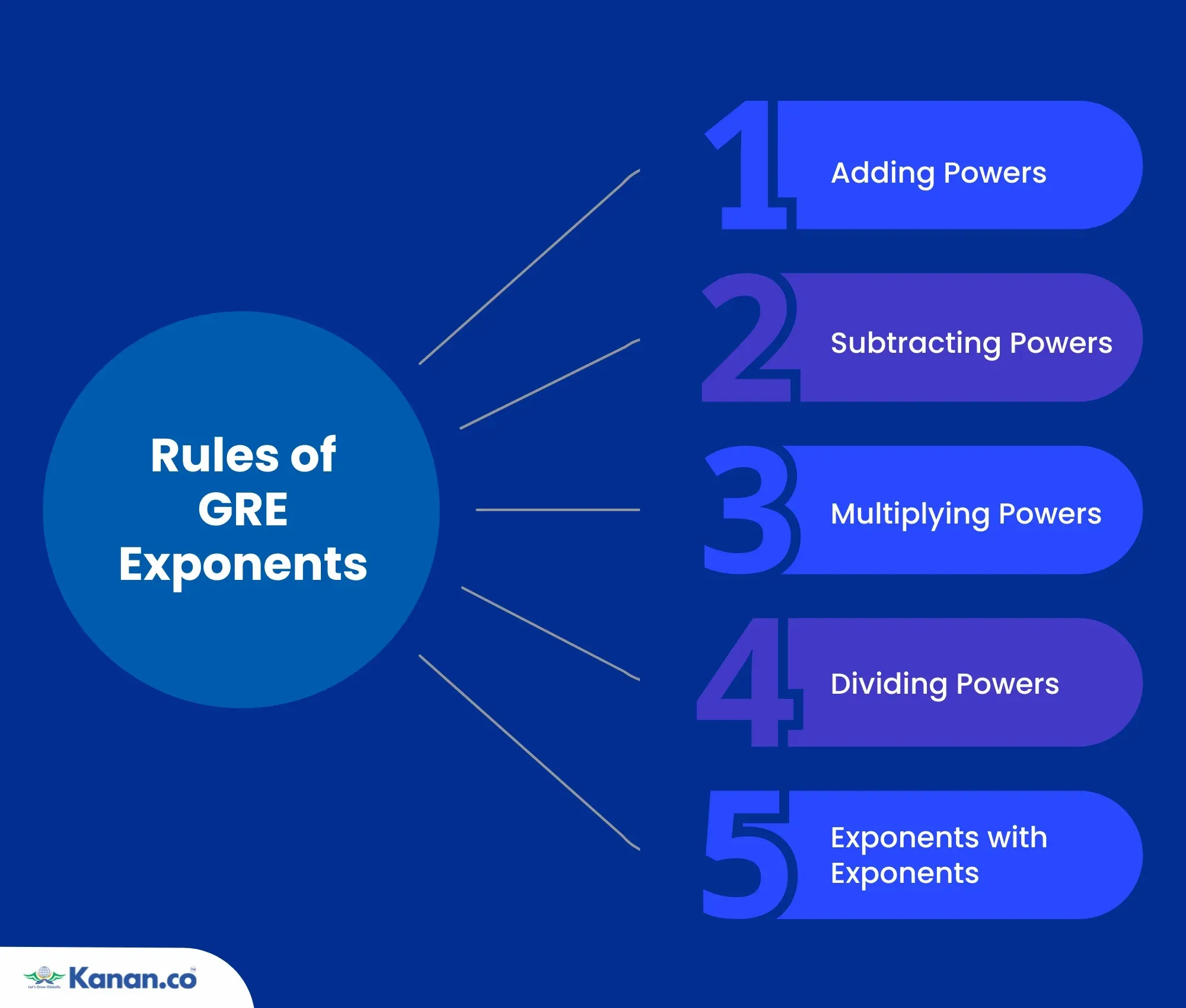
1. Adding Powers/Exponents
When you add similar bases in exponent form, you cannot simply add the powers.
For instance:
33+35
You cannot add the exponents (3 and 5). Instead, you need to factorize:
33+35= 33 (1+32) = 33 (1+9) = 33 (10)
Remember, whether bases are the same or different, you cannot add their exponents directly.
Key Takeaways:
- Exponents cannot be added when the bases are added.
- The rule applies regardless of whether the bases are identical or different.
- To solve problems involving adding exponents, understanding how to factorize is essential.
- Always check for common bases or terms that can be factored out when dealing with exponents.
2. Subtracting Powers/Exponents
Everything about adding powers also applies to subtracting them. Remember, subtracting is essentially adding a negative number.
For example:
35 - 33
The answer is NOT 32! Instead, you need to factorize:
35 - 33 = 33 (32-1) = 33 (9-1) = 33 (8) = 216
Key Takeaways:
- Exponents cannot be subtracted when you are subtracting the bases.
- This rule holds true whether the bases are the same or different.
- To solve problems involving the subtraction of exponents, factorization is necessary.
3. Multiplying Powers/Exponents
Consider 33 × 32, The rule is: if the bases are the same and you are multiplying them, then you should add the powers.
So, 33 × 32 = 3 3+2 = 35.
Keep the base (3) the same and add the exponents.
Now, let's see for 33 × 22. Since the bases are different, you cannot combine them like before. You would need to multiply the numbers directly:
33 × 22 = 27×4 =108.
There is an exception: if the exponents are the same but the bases are different, you can multiply the bases. For example, in 33 × 23, the bases are different but the exponents are the same. Here, you multiply the bases and keep the exponent: 33 × 23 = (3 × 2)3 = 63 = 216.
Key Takeaways:
- Add powers when multiplying terms with the same bases.
- You can multiply exponential terms if the bases are the same or if the exponents/powers are the same.
- Remember always to check if the bases or exponents are the same before applying these exponent rules.
4. Dividing Powers/Exponents
Just like multiplying, dividing exponential terms follows a specific rule: when you’re dividing, you subtract the powers.
For example, 33 / 32 = 33-2 = 31 = 3.
Keep the base (3) the same and subtract the exponents.
For 33 / 22, since the bases are different, you cannot combine them. You would need to divide directly: that is, 33 / 32= 27/4 = 6.75
However, when the bases are different but the powers are the same, you can divide the bases. For example, in 43 / 23, the bases are different but the exponents are the same. Here, you divide the bases and keep the power: 43 / 23 = (4/2)3 = 23.
Key Takeaways:
- Subtract the powers when dividing terms that have the same bases.
- You can divide exponential terms if the bases are the same or if the exponents/powers are the same.
- When bases are different, divide the numbers directly.
5. Exponents with Exponents
When dealing with exponents raised to other exponents, the base remains unchanged while the exponents are multiplied together. These are also called nested exponents, or power of a power, which occurs when an exponent is raised to another exponent. This means you have an exponentiation operation inside another exponentiation operation.
For example, (34)2
In this scenario, you multiply the exponents/powers while keeping the base, 3, unchanged:
4 × 2 = 8
So, (34)2 = 38
Key Takeaways:
- Maintain the same base when raising an exponent to another exponent.
- Multiply the exponents together.
- This rule simplifies expressions involving nested exponents.
GRE Exponent Practice Questions with Answers and Explanations
Below are GRE exponent practice questions with answers and explanations designed to help you strengthen your understanding of exponent rules.
Practice Questions on Adding & Subtracting Exponents
1. Reduce 24 + 26 to its simplest form.
Sol: Given: 24 + 26
Here, both terms have the same base 2 but different exponents (4 and 6). To combine these terms, follow these steps:
Factor out the common base raised to the smaller exponent:
24 + 26 = 24 × (1 + 22 )
Simplify inside the parentheses:
(1 + 22) = 1 + 4 = 5
Multiply the result by 24: 24 × 5
Calculate 24: 24 = 16
Multiply 16 by 5 = 16 × 5 = 80
Therefore, 24 + 26 = 80
2. Solve 52 + 52 + 52
Sol: Given, 52 = 25
Since all terms have the same base 5 and the same exponent 2, you can add them directly by multiplying the base by the number of terms:
52 + 52 + 52 = 3 × 25 = 75
Therefore, 52+ 52+ 52= 75.
3. If, 2-y + 2-y = ⅛, what is the value of y?
Sol: Given, 2-y + 2-y = ⅛
Since both terms have the same base 2 and the same exponent -y, we can simplify this equation by adding the terms:
2 × 2-y = ⅛
Now, divide both sides by 2:
2-y = 1/16
To find y, we need to solve for -y:
−y = log2 (1/16)
−y = -4
Therefore, the value of y = 4
4. Quantity A: 54 - 53 Quantity B: 625 − 125
(A) Quantity B is greater.
(B) Quantity A is greater.
(C) The two quantities are equal.
(D) The relationship cannot be determined from the information given.
Sol: Let's calculate each quantity:
Quantity A: 54 - 53 = 625 - 125 = 500
Quantity B: 625 − 125 = 500
Since both Quantity A and Quantity B are equal, the two quantities are equal.
Therefore, the correct answer is (C): The two quantities are equal.
Practice Questions on Multiplying & Dividing Exponents
1. Reduce 64 × 44 to its simplest form.
Sol: Let's reduce 64 × 44 to its simplest form.
When multiplying terms with the same powers/exponents but different bases, you can multiply the bases and keep the exponent:
64 × 44 = (6 × 4)4 = 244
2. If, (92)3 × 35= 3y , what is the value of y?
Sol: First, simplify (92)3 :
(92)3 = 3 2(3×2) = 312
Now combine the exponents of 3:
312 × 35 = 312+5 = 317
So, 317 = 3y, which means y = 17.
3. If 5-m × 5 -m = 1/125, what is the value of m?
Sol: First, simplify the left side using the rules of exponents:
5-m × 5 -m = 5(-m+(-m)) = 5-m-m = 5-2m
Now we have:
5-2m = 1/125
Next, express 1/125 as a power of 5:
125 = 53
1/125 = 5-3
So, we have:
5-2m = 5-3
Since the bases are the same, we can set the exponents equal to each other:
−2m = −3
Solving for m:
m = 3/2
m = 1.5
Therefore, the value of m is 1.5.
4. Find the sum of the digits of the integer z, where z = 612 × 415
Sol: Simplify the Expression: 612 × 415
Rewrite Using Powers of 2 and 3:
6 = 2 x 3
4 = 22
So we can express the terms as:
612 = (2 x 3)12 = 2)12 x 312
415 = (22)15 = 230
Combine the Expressions:
z = 212 x 312 x 230 = 212+30 x 312 = 242 x 312
Simplify Further, Notice that 242 x 312 can be broken down:
242 = (2 3)14 = 814
312
Forming the Number Using Powers of 10, We can express it as:
z = 814 x 312
Approximate the powers for simplicity:
814 = (23)14 = 242 ≈ 4.398 × 10¹²
312 ≈ 531441
Multiply these approximations:
z ≈ 4.398 × 1012 × 531441 ≈ 2.34×10¹⁸
This gives us a large number, so let's convert it to a simpler form for adding digits.
Calculate the Number and Sum the Digits:
Given, z ≈ 2.34×10¹⁸, this is a number followed by 18 zeros.
Therefore, summing the digits: 2+3+4=9
Thus, the sum of the digits of the integer z is 9.
5. Find the value of (78+ 77+76) / 75
Given:
78 = 75 × 73
77 = 75 × 72
76 = 75 × 71
75 = 75
Now, rewrite the expression:
(78+ 77+76) / 75 = (75 × 73) + (75 × 72) + (75 × 71) / 75
Cancel out 75 from the numerator and denominator:
= 73 + 72 + 7
Now, calculate each term:
73 = 343
72 = 49
7 = 7
Add them together:
343 + 49 + 7 = 399
Therefore, (78+ 77+76) / 75 = 399
6. Quantity A: (23) × (24) Quantity B: 27
(A) Quantity B is greater.
(B) Quantity A is greater.
(C) The two quantities are equal.
(D) The relationship cannot be determined from the information given.
Sol: Let's solve each quantity:
Quantity A: (23) × (24) = 23+4 = 27
So, Quantity A simplifies to 27
Quantity B: 27
So, Quantity B is already 27
Now, compare the results:
Quantity A: 27
Quantity B: 27
Since both Quantity A and Quantity B are equal, the two quantities are equal.
Therefore, the correct answer is (C): The two quantities are equal.
Practice Questions on Exponents Raised to Exponents
7. Reduce (43 × 45)2 to its simplest form.
Sol: Given, (43 × 45)2
Combine the exponents inside the parentheses:
43 × 45 = 43+5 = 48
Now raise 48 to the power of 2:
(48)2 = 48x2 = 416
Therefore, (43 × 45) = 416
8. Solve (34)3 + (23)2
Sol: Given, (34)3 + (23)2
First Calculate (34)3
(34)3 = 34x3 = 312
Then calculate (23)2
( 23)2 = 23x2 = 26
Now, add these results together:
312 + 26.
9. Simplify (23 × 32 × 41)2 .
Sol: To simplify this expression, we'll apply the rule for exponents raised to exponents and simplify within the parentheses first.
Start with the given expression (23 × 32 × 41)2.
Simplify inside the parentheses:
23 = 8
32 = 9
41 = 4
So, (23 × 32 × 41) = 8 × 9 × 4
Calculate the product: 8 × 9 × 4 = 288
Therefore, (23 × 32 × 41) = 288
Now substitute back into the original expression:
(23 × 32 × 41)2 = 2882
Apply the rule for exponents raised to exponents:
2882 = 288 × 288 = 82944
Therefore, (23 × 32 × 41)2 = 82944
Additional Exponent Problems
10. If 0 < 5n < 10,000, where n is a non-negative integer, what is the greatest value of 1/2n?
Sol: First, interpret the inequality 0 < 5n < 10,000:
5n < 10,000
Taking the logarithm base 5 on both sides gives:
n log5 (5) < log5 (10,000)
Since log5 (5) = 1 and log5 (10,000) = 4;
n<4
Therefore, n can take integer values from 0 to 3.
Now, let's evaluate 1/2n for each possible value of n:
For n=0, 1/20 = 1
For n=1, 1/21 = ½ = 0.5
For n=2, 1/22 = 1/4 = 0.25
For n=3, 1/23 = 1/8 = 0.125
Among these values, the greatest value of 1/2n occurs when n=0, which is 1.
Therefore, the greatest value of 1/2n where 0 < 5n < 10,000 is 1.
11. If n < 1/(-3)(-n) < 500, where n is a prime number, how many unique integer values of n satisfy this inequality?
A) 1
B) 2
C) 3
D) 4
E) 5
Sol: Interpret the Inequality: n < 1/(-3)(-n) < 500
Simplify 1/(-3)(-n):
1/(-3)(-n) = -3n
So the inequality becomes: n < −3n < 500
Test Values of n:
Start with the smallest prime number, which is 2:
- For n=2, 2 <−32 = −9 (not true)
Try the next prime number, 3:
- For n=3, 3 <−33 = −27 (not true)
Continue testing with the prime numbers:
- For n=5, 5 <−35 = −243 (true, as -243 < 500)
From testing, it appears that n=5 is the only prime number that satisfies the inequality
n < 1/(-3)(-n) < 500
Final Answer: A) 1
12. Solve for x: 3x = 81
A) 2
B) 3
C) 4
D) 5
E) 6
Sol: Recognize that 81 can be written as a power of 3:
81 = 34
So, we have, 3x = 34
Since the bases are the same, we can set the exponents equal to each other:
x = 4
So, the correct answer is (C): 4
13. Solve for x: 3x+1 = 243
A) 4
B) 5
C) 6
D) 7
E) 3
Sol: Recognize that 243 can be written as a power of 3:
So, we have, 3x+1 = 35
Since the bases are the same, we can set the exponents equal to each other:
x + 1 = 5
Subtract 1 from both sides: x = 4
So, the correct answer is (A): 4
14. Compare Quantity A and Quantity B. Use any additional information provided above the two quantities to help make the comparison.
Quantity A: 25
Quantity B: 52
A) The answer cannot be determined from the information given.
B) The two quantities are equal.
C) Quantity A is greater.
D) Quantity B is greater.
E) Both quantities cannot be compared with the given information.
Sol: First calculate Quantity A: 25 = 32
Next, calculate Quantity B: 52 = 25
Comparing the two quantities:
32 (Quantity A) is greater than 25 (Quantity B).
So, the correct answer is: (C)
Quantity A is greater.
15. Which one of the following is different from the others?
A) 315
B) 97.5
C) 275
D) 814
E) (1/3)-15
Sol: Rewrite each option in terms of powers of 3:
A) 315 is already in terms of base 3.
B) 97.5 = (32)7.5 = 315
C) 275 = (33)5 = 315
D) 814 = (34)4 = 316
E) (1/3)-15 = (3-1)-15 = 315
So, all options except 814 are equal to 315.
Thus, the correct answer is: (D) 814.
16. Simplify 37 + 36 .
A) 36 . 4
B) 37 . 3
C) 37
D) 313 . 3
E) 313
Sol: Factor out the common term 36
37 + 36 = 3. 36 + 36
= 36 (3 + 1)
= 36 . 4
Thus, the correct answer is: (A) 36 . 4.
Frequently Asked Questions (FAQ’s)
1. Can you calculate exponents on a GRE calculator?
No, the GRE calculator does not have the capability to calculate exponents. It is a basic four-function calculator without features like exponents, squaring, or cubing. To find the result of an expression with exponents, you must simplify it manually before entering the calculation into the GRE calculator.
2. What are the 7 Laws/Rules of Exponents?
Here are the basic laws of exponents, which are fundamental to mastering algebra, as these rules enable the simplification and manipulation of algebraic expressions and equations:
- Any number raised to the power of zero is equal to 1. x0 = 1
- A negative exponent indicates the reciprocal of the number with a positive exponent. x-m = 1/xm
- When multiplying two powers with the same base, add their exponents. xm x xn = xm+n
- When dividing two powers with the same base, subtract the exponents. xm/ xn = xm-n
- For powers with different bases but the same exponent, multiply the bases and keep the exponent unchanged. xm x ym = (xy)m
- When a fraction is raised to an exponent, apply the exponent to both the numerator and the denominator. (x/y)m = xm / ym
- If a power is raised to another exponent, multiply the exponents. (xm)n = xmn

About Author Sravani Kota
Sravani is an enthusiastic author who is deeply passionate about continuous learning, writing, and reading. Her academic background includes a Bachelor's and Master's degree in engineering from JNTU, gaining expertise in technical English writing, paper publications, test preps like IELTS, GRE, SAT, TOEFL, etc., and study abroad services like SOP, LOR, etc. Her expertise in the education sector makes her an excellent resource for students seeking guidance and advice. In her leisure time, she enjoys spending quality time with family, watching popular TV shows like Stranger Things and Money Heist, and she also loves to travel, explore new places, and create videos of her experiences.
Kanan.co is a trusted study abroad consultancy offering comprehensive services, resources, and solutions for students and education institutions. We support students at every stage of their global education journey, ensuring a smooth and guided experience. Along with test preparation for IELTS, GRE, TOEFL, and SAT, we provide expert services such as SOP writing, visa guidance, accommodation support, scholarship assistance, and education loan support. Our expertise and commitment to excellence make us a reliable partner for students pursuing international education.
Sign Up for a Free GRE Demo Class!
Ace GRE Quant & Verbal with 320+ Score — Join Us!








Global Headquarters
Kanan Int EdTech Inc
320 Bay Street, Suite 321 (Spaces), Toronto ON, Canada M5B 1N9
Indian Headquarters
Kanan International Pvt. Ltd.
D-wing, 2nd Floor, Trident Complex, Ellora Park Vadiwadi Road, Vadodara, Gujarat 390007
IT/ Digital Campus
Kanan International Pvt. Ltd
Old, New No 3, 2nd Floor, 1A, Dr Sadasivam Rd, T. Nagar, Chennai, Tamil Nadu 600017
Our branches
- Bardoli
- Bharuch
- Chennai
- Dehradun
- Gurugram
- Himatnagar
- Karnal
- Nadiad
- Navsari
- Palanpur
- Rajkot
- Vadodara
- Valsad
- Vallabh Vidyanagar
- Vapi
Study Abroad
Test Prep
Top Universities
Consultants
IELTS Centers
GRE Centers
TOEFL Centers
SAT Centers
Language Courses in Vadodara
Study Abroad Calculators
Featured Blogs
Study Abroad Consultants in Chennai
Study Abroad Consultants in Surat
Study Abroad Consultants in Navsari
Study Abroad Consultants in Bardoli
Study Abroad Consultants in Ahmedabad
Study Abroad Consultants in Anand
Study Abroad Consultants in Khanna
Study Abroad Consultants in Nadiad
Study Abroad Consultants in Vadodara
Study abroad consultants in Valsad
Copyright © 2026 KANAN.CO All rights reserved.