- Study Abroad
- / gre
- / arithmetic
GRE Math Arithmetic: Overview and Practice Questions


Author
30-08-2024

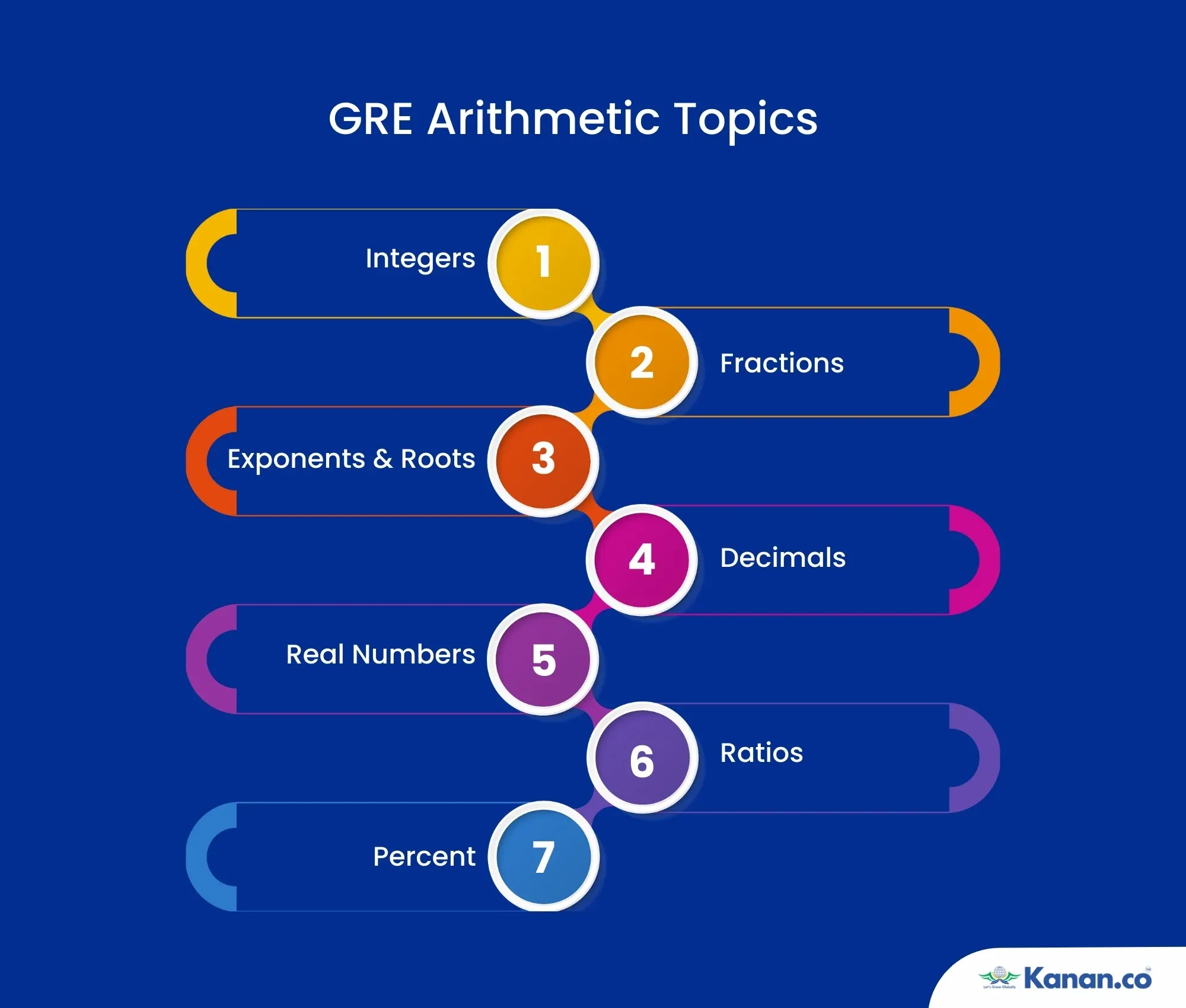
GRE arithmetic includes fundamental mathematical concepts such as integers, fractions, exponents and roots, decimals, real numbers, ratios, percent, proportions, and basic word problems. The basic arithmetic operations involved in each concept are addition, subtraction, multiplication, and division. Arithmetic comes under the quantitative section of the GRE test. The GRE Quantitative Reasoning section covers four main topics: Arithmetic, Algebra, Geometry, and Data Analysis. This section includes a total of 40 questions, divided into two sections of 20 questions each. Each section is allotted 35 minutes to complete. The score of the GRE quant section ranges on a scale of 130 to 170.
Securing a high score in the GRE (Graduate Record Examination) is crucial for getting admission in graduate school. There is a common belief that the GRE Quantitative Reasoning section is notably more challenging than other sections. That's why it is essential to master the GRE math arithmetic question types: quantitative comparison, multiple-choice (select one), multiple-choice (select one or more), and numeric entry to crack the test. In this article, we have given an overview of GRE arithmetic topics such as divisibility, factorization, prime numbers, remainders, odd and even integers, radicals, and sequences. Utilize this article to understand the GRE arithmetic syllabus and make use of the practice questions to score well in the GRE test.
1. Integers
Integers are numbers that include 0, positive numbers, and negative numbers. The positive integers are greater than 0, negative integers are less than 0, and 0 is neither positive nor negative. Integers don’t include fraction, decimal, or percentage. Integers in the GRE Arithmetic represent the numbers {.....-3,-2,-1,0,1,2,3….}.
Different forms of integers with mathematical operations are as follows:
- Addition of two integers will be an integer (negative or positive)
- Subtraction of two integers will be an integer (negative or positive)
- The product of two positive integers is a positive integer
- The product of two negative integers is a positive integer
- The product of a positive integer and a negative integer is a negative integer
- The division of two integers can be an integer or decimal (negative or positive)
- The square of an integer (negative or positive) will be a positive integer
- The root of a positive integer can be an integer or decimal
Some of the concepts you need to master to solve the integer in GRE arithmetic are:
- Factor or Divisor: When integers are multiplied, each multiplied integer is called a factor or divisor.
- Least Common Multiple: LCM of two nonzero integers a and b is the least positive integer that is a multiple of both a and b.
- Greatest Common Factor/Divisor: GCD/GCF of two nonzero integers a and b is the greatest positive integer that is a divisor of both a and b.
- Even and Odd Integer: If an integer is divisible by 2, it is called an even integer otherwise it is an odd integer.
- Prime Number: A prime number is an integer greater than 1 and can be divisible by two positive integers 1 and the integer itself. The first ten prime numbers are 2, 3, 5, 7, 11, 13, 17, 19, 23, and 29.
- Prime Factorization: Prime factorization is the process of expressing a composite number as a product of its prime factors. This means finding the prime numbers that multiply together to give the original number.
Sample Question of GRE Arithmetic Integers
If x and y are positive integers such that x×y=72x, what is the greatest possible value of x+y?
Answer: The greatest possible value of x+y is 73.
Explanation: To find x+y, we need to choose x and y to maximize their sum while their product remains 72. The pairs (x,y) that multiply to 72 are:
- (1, 72): x+y=1+72=73
- (2, 36): x+y=2+36=38
- (3, 24): x+y=3+24=27
- (4, 18): x+y=4+18=22
- (6, 12): x+y=6+12=18
- (8, 9): x+y=8+9=17
The maximum sum x+y occurs with the pair (1, 72), giving x+y=73.
2. Fractions
A fraction is a number in the form of a numerator/denominator, where the numerator and denominator are integers and the denominator is ≠ 0. For example: ⅞ is a fraction in which 7 is the numerator and 8 is the denominator. These numbers are also called rational numbers.
A numerical expression such as 2⅘ is called a mixed number that contains an integer part and a fraction part.
The fraction in the GRE can be done with arithmetic operations such as addition, subtraction, multiplication, and division.
- If the denominators of two or more fractions are the same, simply add their numerators.
- If the denominators of two or more fractions are different, then find the common denominator, and make them equal by multiplying so that the denominators become the same. And, multiply the numerator by the same number too.
- To multiply two fractions, multiply the two numerators by the two denominators.
- To divide fractions, multiply the dividend by the reciprocal of the divisor.
Sample Question of GRE Arithmetic Fraction
Evaluate ½ + ¾ × ⅔ ÷ ⁵/₆
Answer:
½ + ¾ × ⅔ ÷ ⁵/₆
= ½ + (3×2/4×3) × ⁶/₅
= ½ + (6/12) × ⁶/₅
= ½ + (1/2) × ⁶/₅
= ½ + ⁶/10
= ½ + ⅗
= ⁵/10 + ⁶/10
= 11/10
= 1 ⅒
Explanation:
- First do the multiplication: ¾ × ⅔ = 6/12 = ½
- Then divide by the second fraction: ½ ÷ ⁵/₆ = ½ × ⁶/₅ = ⁶/10 = ⅗
- Add the fractions: = ½ + ⅗ = ⁵/10 + ⁶/10 = 11/10 = 1 ⅒
3. Exponent and Roots
Exponents are used to represent the repeated multiplication of a number by itself. They indicate the number of times a number (the base) is multiplied by itself. For example, in 𝑎n - a is the base and n is the exponent. To practice the GRE exponents, you need to understand the following rules.
- If the exponent is 2, it is known as squaring i.e. 62 and if the exponent is 3, it is known as cubed i.e. 63.
- If a negative number is raised to powers, the result will be either positive or negative.
- Exponents can also be zero or negative.
Mathematical Operations on Exponents are as follows:
- Multiplication: am × an = am + n
- Division: am ÷ an = am ÷ n
- Power of a power: (am)n = am x n
- Zero exponent: Any non-zero base raised to the power of zero is 1 (a0 = 1)
- Negative exponent: (a)-x = (1/a)x
A square root of a number is a value when multiplied by itself, giving the original number. A square root is a root of order 2. Similarly, the cube root and fourth root are denoted by the orders 3 and 4.
- Every positive number has two square roots, one positive and one negative (e.g., square roots of 25 are 5 and -5).
- The non-negative square root is represented by √ . For instance, √25=5.
- The square root of 0 is 0.
- Square roots of negative numbers do not have a real number system.
Rules regarding operations with roots are as follows:
Rule 1: (√a)2 = a
Rule 2: √a2 = a
Rule 3: √a √b = √ab
Rule 4: √a / √b = √a/b
Sample Question of GRE Arithmetic Exponents and Roots
What is ∛27?
Answer: ∛27 = 3
Explanation: The cube root of 27 is a number that, when multiplied by itself thrice, gives 27. In this case, 3×3×3=27.
4. Decimals
A decimal is a number that consists of a whole number and a fraction. The decimal number system represents numbers using powers of 10.
Key points about decimals in GRE arithmetic:
- The first digit to the right of the decimal point is the tenth place.
- The second digit is the hundredth place.
- The third digit is the thousandth place, and so on.
- Every fraction with integers in the numerator and denominator is equivalent to a decimal that terminates or repeats.
- Every rational number can be expressed as a terminating or repeating decimal.
- Two decimals that are not terminating or repeating are known as irrational numbers.
Sample Question of GRE Arithmetic Decimals:
Sarah earns $12.50 per hour. How much does she earn in 35 hours?
Answer:
To find Sarah's earnings:
12.50×35=437.50
So, Sarah earns $437.50 in 35 hours.
Explanation: Multiply Sarah's hourly wage of 12.50 by the number of hours 35 to find her total earnings: 12.50×35=437.50.
5. Real Numbers
Real Numbers consist of all rational numbers and irrational numbers. The real numbers include all integers, fractions, and decimals. The set of real numbers can be represented by a number line which is known as a real number line. In the number line, all numbers to the left of 0 are negative and all numbers to the right of 0 are positive. Only the number 0 is neither negative nor positive.
Key points to be considered in GRE arithmetic real numbers are:
- A real number ‘a’ is less than a real number ‘b’ if a is to the left of b on the number line i.e. a < b.
- A real number ‘a’ is greater than ‘b’ if ‘a’ is to the right of the ‘b’ on the number line i.e. a > b
- The set of all real numbers that are between 2 and 3 is called an interval, and the double inequality 2 < a < 3 is often used to represent that interval.
- The entire real number line is also considered an interval.
- The distance between a number x and 0 on the number line is called the absolute value of x i.e. |x|.
Sample Question of GRE Arithmetic Real Numbers:
Arrange the following numbers in ascending order: −2.5,3,0,−1.8,2
Answer: Ascending order: −2.5,−1.8,0,2,3
Explanation: To arrange numbers in ascending order, start with the smallest (most negative) number and proceed to the largest (most positive) number. Thus the answer is −2.5,−1.8,0,2,3
6. Ratios
A ratio is a comparison of two or more numbers that indicate relative sizes, in which the first number is the numerator and the second number is the denominator. Ratios can be in the form of fractions. The proportion is an equation relating two ratios. To solve the GRE ratio problems, it is preferable to write a proportion and then do cross multiplication.
Sample Question of GRE Arithmetic Ratio:
If a recipe calls for 2 cups of flour for every 3 cups of sugar, how much flour is needed if you use 9 cups of sugar?
Answer: To find the amount of flour needed:
The ratio of flour to sugar = 2:3
Flour needed = 2:3 = x:9 = 6 cups
Explanation: The ratio of flour to sugar is 2:3 . To find how much flour is needed when using 9 cups of sugar, multiply the ratio by the amount of sugar used: ⅔ × 9 = 6 cups of flour.
7. Percent
A percent is a number or ratio that is used to represent parts of a whole, where a whole is considered as having 100 parts. The part is the numerator of the ratio and the whole is the denominator. Percent is denoted as %.
Key things to be known in the arithmetic percent are:
- When a quantity changes from an initial positive amount to another positive amount, it is known as percent change.
- If a quantity increases, then it is known as percent increase.
- If a quantity decreases, then it is known as percent decrease.
- When computing a percent increase, the base is the smaller number.
- When computing a percent decrease, the base is the larger number.
Sample Question of GRE Arithmetic Percent:
If 30% of a number is 45, what is the number?
Answer: To find the number:
Let x be the number 0.3x = 45
x=45/0.3=150
Explanation: To find the original number, set up the equation where 30% of the number is equal to 45. Solve x by dividing 45 by 0.3, which gives 150.
What is the order of operations in GRE arithmetic?
The order of operations in GRE Arithmetic is represented as PEMDAS (Parentheses Exponents Multiplication Division Addition Subtraction).
When solving an expression with operations of the same type (e.g., only addition, subtraction, multiplication, or division), you should work from left to right. However, for expressions involving multiple arithmetic operations, you need to follow the order of operations.
The order of operations is a rule that suggests the sequence for solving expressions with different operations. You can remember this order with the acronym PEMDAS:
- Parentheses: First, solve the operations within parentheses or brackets.
- Exponents: Next, evaluate any exponential expressions.
- Multiplication and Division: Then, moving from left to right, perform all multiplication and division operations, in the order they appear.
- Addition and Subtraction: Finally, moving from left to right, complete all addition and subtraction operations, in the order they appear.
Following the order is important especially when putting information into the calculator.
GRE Arithmetic Practice Problems with Answers and Explanation
1. What is 12−(−5)+3?
Answer: 12−(−5)+3 = 12+5+3 = 20
Explanation: Subtracting a negative number is equivalent to adding its positive counterpart: 12−(−5)=12+5. Then add 3 to get 20.
2. Calculate ¾ + ⅖
Answer: ¾ + ⅖ = 3×5+2×4/4+5 = 15+8/20 = 23/20 = 1 ³/20
Explanation: To add fractions, find a common denominator (20), then add the numerators and place them over the common denominator.
3. If the ratio of apples to oranges in a basket is 3:2 and there are 12 apples, how many oranges are there?
Answer: Number of oranges = ⅔ × 12 = 8
Explanation: Use the ratio to set up a proportion and solve for the number of oranges.
4. Simplify (23)2
Answer: (23)2 = 23*2 = 26 = 64
Explanation: When raising a power to another power, multiply the exponents: 23*2 = 26 = 64
5. What is √81?
Answer: √81=9
Explanation: The square root of 81 is 9 because 9×9=81.
6. Calculate 0.7×1.5
Answer: 0.7×1.5=1.05
Explanation: Multiply the numbers directly: 0.7×1.5=1.05
7. Simplify −8+4√2/2
Answer: −8+4√2/2 = -4 + 2 √2
Explanation: Distribute the division across the numbers in the numerator.
8. If a product's price increases from $80 to $100, what is the percentage increase?
Answer: Percentage increase = (100−80/80)×100% =25%
Explanation: Calculate the difference, divide by the original amount, and multiply by 100 to get the percentage increase.
9. Which of the following numbers is a prime number: 27, 31, 45, 51?
Answer: 31
Explanation: A prime number is a natural number greater than 1 that has no positive divisors other than 1 and itself. Let's check each number:
- 27: Divisible by 3 (27 = 3 × 9), not a prime.
- 31: Not divisible by any number other than 1 and 31, so it is a prime.
- 45: Divisible by 3 and 5 (45 = 3 × 15), not a prime.
- 51: Divisible by 3 (51 = 3 × 17), not a prime.
Thus, 31 is the only prime number among the given options.
10. If 4 notebooks cost $6, how much would 10 notebooks cost?
Answer: To find the cost of 10 notebooks:
Cost of 1 notebook = 6/4=1.5 dollars
Cost of 10 notebooks = 1.5×10=15 dollars
Explanation: First, find the cost per notebook by dividing the total cost by the number of notebooks: 6/4=1.5 dollars per notebook. Then, multiply the cost per notebook by the number of notebooks to find the total cost: 1.5×10=15 dollars.
Also, check: GRE Math Arithmetic Exercises from ETS
How to prepare for GRE Arithmetic?
To prepare for the GRE arithmetic test, you can follow some of the tips given below:
- Take your time with word problems: Carefully read and understand each word problem to ensure you grasp all the details before attempting to solve it.
- Use the calculator wisely: Use the calculator to check your work, but don’t rely on it for every calculation to avoid simple mistakes.
- Allocate stipulated time: Manage your time efficiently by spending not more than two minutes on each question, ensuring you can complete the entire section.
- Analyze all information in quantitative comparisons: Evaluate all the provided information in Quantitative Comparison questions to accurately determine the relationship between the quantities.
- Backsolve with answer choices: Use the backsolving method to see which one of the answer choices fits, especially when the answers are numerical.
- Solve with numbers: Simplify abstract problems by substituting numbers for variables, making it easier to solve.
- Practice a lot: Use GRE math preparation books and also refer to previous mathematics papers and arithmetic exercises from ETS to prepare for the test.
FAQ
1. What is arithmetic on the GRE?
The arithmetic section in the GRE General test covers basic mathematical concepts such as integers, fractions, exponents and roots, decimals, real numbers, ratios, percent, proportions, and basic word problems. The arithmetic operations involved are addition, subtraction, multiplication, and division.
2. How many topics are covered in GRE arithmetic?
The topics covered in the GRE arithmetic are divisibility, exponents, roots, remainders, percentages, ratios, and number sequences. This section includes 10-12 problems and needs to be completed within 35 minutes.
3. What level of math is tested in the GRE test?
The GRE General Test evaluates your quantitative reasoning skills using high school math fundamentals. It measures your ability to understand basic concepts in arithmetic, algebra, geometry, and data analysis; reason quantitatively, and solve problems.
4. Do I need to memorize complex formulas for GRE Arithmetic?
Yes, you should memorize GRE math formulas so that you can apply these formulas to get more accurate answers. Without them, you might struggle to find the solution, which could result in incorrect answers.
5. Can I use a calculator in the GRE Arithmetic section?
Yes, you can use the calculator in the GRE Arithmetic section. In the Quantitative Reasoning section of the GRE Revised General Test, students are provided with an on-screen calculator for solving computations. The computer-based test mandates the use of this on-screen calculator, as external calculators are not permitted.
6. What is the difficulty level of the arithmetic questions on the GRE?
The GRE Math section tests 10th-grade standard/high school math, however, the questions are designed to be difficult. To succeed, students need a clear understanding of these concepts and solve each problem within 2 minutes. If you can't solve the questions within this time frame, it indicates that you are not clear in your concepts. your concepts may not be clear enough.
7. Can I use scratch paper or take notes during the GRE Arithmetic section?
Yes, you are allowed to have scratch paper when you take the GRE. It is to be noted that you can only bring the pencils and scratch paper provided by the test center to the exam hall.

About Author Arivarasi
Arivarasi is an experienced author with expertise in the study abroad industry and preparing test materials for exams like IELTS, TOEFL, GRE, SAT, PTE, etc. She stays up-to-date with university and college requirements for international students which allows her to provide guidance on course selection, documents like SOP, LOR, and scholarship opportunities. She has written numerous articles on study abroad exams, destinations, universities & colleges requirements, admission procedures, and the entire process of studying abroad. Collaborating with industry experts and counselors, she crafts informative articles that make students take the right decisions.
Kanan.co is a trusted study abroad consultancy offering comprehensive services, resources, and solutions for students and education institutions. We support students at every stage of their global education journey, ensuring a smooth and guided experience. Along with test preparation for IELTS, GRE, TOEFL, and SAT, we provide expert services such as SOP writing, visa guidance, accommodation support, scholarship assistance, and education loan support. Our expertise and commitment to excellence make us a reliable partner for students pursuing international education.
Sign Up for a Free GRE Demo Class!
Ace GRE Quant & Verbal with 320+ Score — Join Us!








Global Headquarters
Kanan Int EdTech Inc
320 Bay Street, Suite 321 (Spaces), Toronto ON, Canada M5B 1N9
Indian Headquarters
Kanan International Pvt. Ltd.
D-wing, 2nd Floor, Trident Complex, Ellora Park Vadiwadi Road, Vadodara, Gujarat 390007
IT/ Digital Campus
Kanan International Pvt. Ltd
Old, New No 3, 2nd Floor, 1A, Dr Sadasivam Rd, T. Nagar, Chennai, Tamil Nadu 600017
Our branches
- Bardoli
- Bharuch
- Chennai
- Dehradun
- Gurugram
- Himatnagar
- Karnal
- Nadiad
- Navsari
- Palanpur
- Rajkot
- Vadodara
- Valsad
- Vallabh Vidyanagar
- Vapi
Study Abroad
Test Prep
Top Universities
Consultants
IELTS Centers
GRE Centers
TOEFL Centers
SAT Centers
Language Courses in Vadodara
Study Abroad Calculators
Featured Blogs
Study Abroad Consultants in Chennai
Study Abroad Consultants in Surat
Study Abroad Consultants in Navsari
Study Abroad Consultants in Bardoli
Study Abroad Consultants in Ahmedabad
Study Abroad Consultants in Anand
Study Abroad Consultants in Khanna
Study Abroad Consultants in Nadiad
Study Abroad Consultants in Vadodara
Study abroad consultants in Valsad
Copyright © 2026 KANAN.CO All rights reserved.