- Study Abroad
- / gre
- / geometry
GRE Geometry: Concepts, Formulas, Rules and Practice Questions


Author
02-08-2024


GRE Geometry is a vital portion of the GRE quantitative reasoning section that tests your ability to solve geometry problems. GRE Math geometry has 20 questions that are divided into 2 parts. The GRE Geometry questions make up around 15% of the questions in quantitative reasoning, and candidates are required to complete each of these parts in 35 minutes.
GRE geometry problems are based on high school level mathematics that includes multiple-choice questions, Numeric Entry questions, and Quantitative Comparisons. Candidates should have a clear understanding of elementary math concepts to be able to solve problems in the GRE geometry section effectively.
GRE Geometry Rules and Formulas
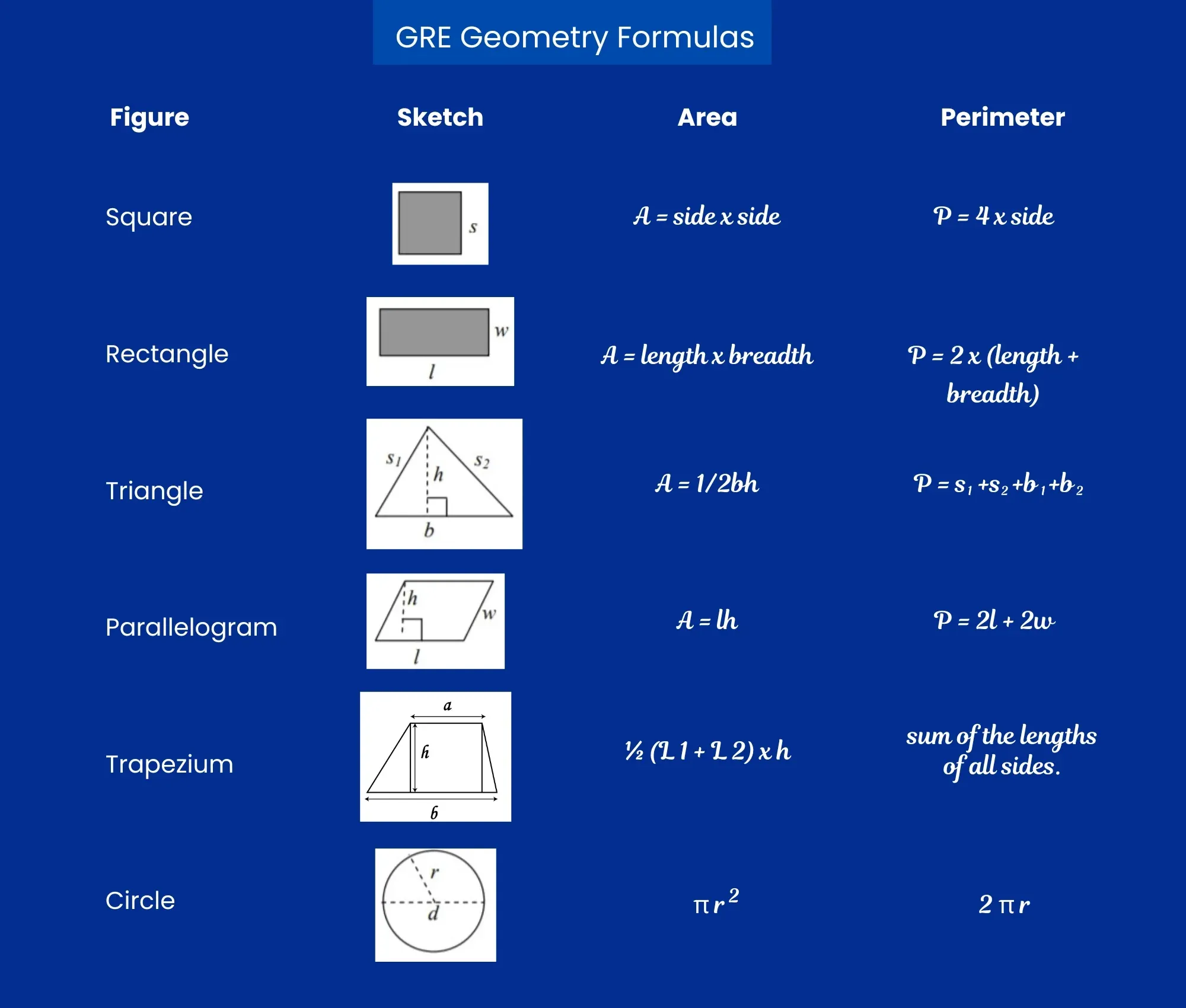
GRE geometry concepts include lines and angles, triangles, quadrilaterals, circles, 3D shapes, and coordinate geometry. Each of these topics has its own set of rules and formulas. Some of the most common GRE geometry formulas are as provided in the infographic below:
GRE Geometry Lines and Angles
Understanding the concepts of lines and angles is fundamental to learning GRE Geometry.
Concepts
- A straight line equals 180 degrees.
- Corresponding angles, Alternate interior angles, and Alternate exterior angles are equal in measure.
- Consecutive interior angles measure up to 180 degrees.
- An acute angle is less than 90 degrees.
- An obtuse angle measures between 90 and 180 degrees.

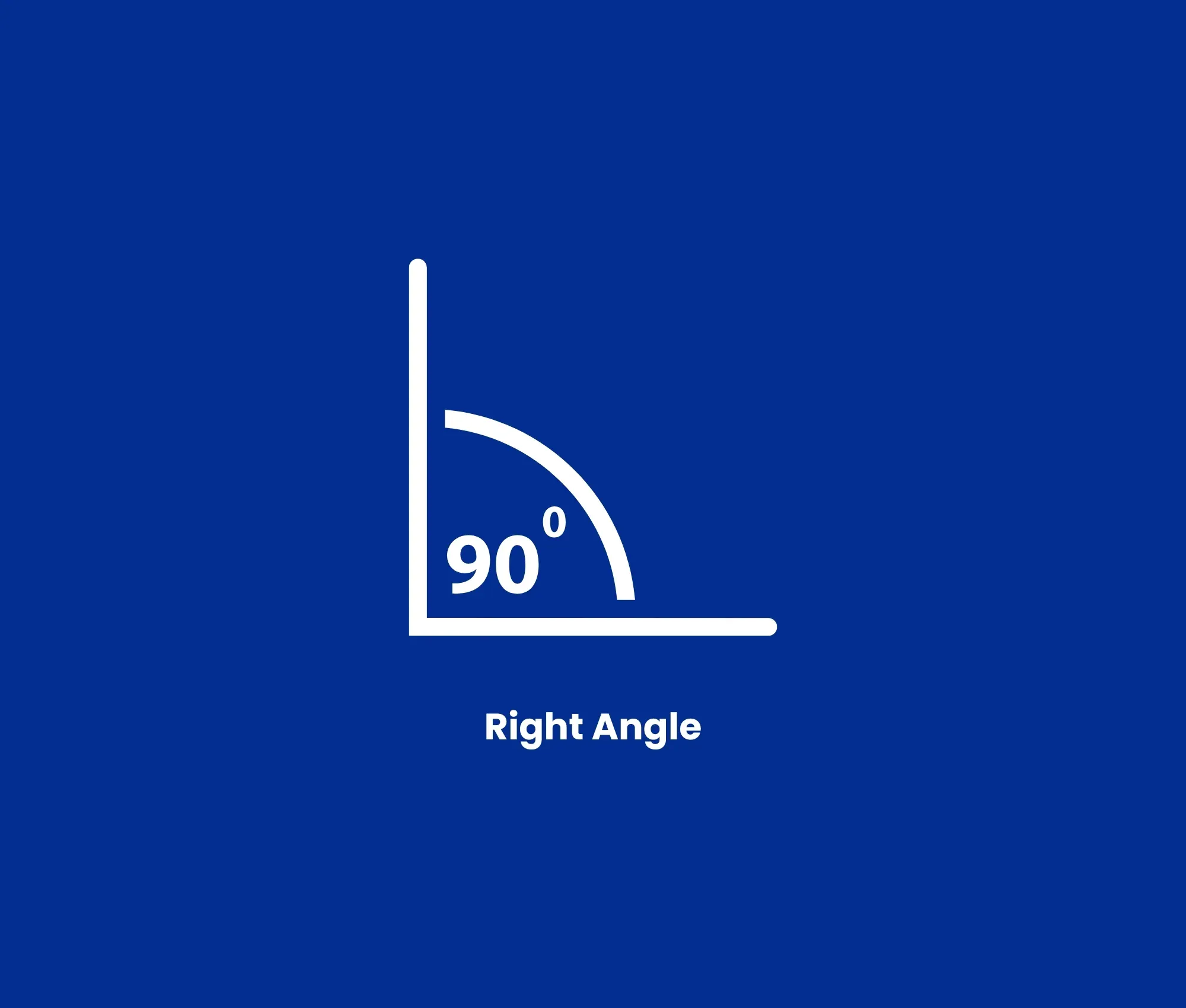
- A right angle equals 90 degrees and is usually signified by a small square:
- The symbol ∠ is used to represent an angle. For example: angle X=∠X.
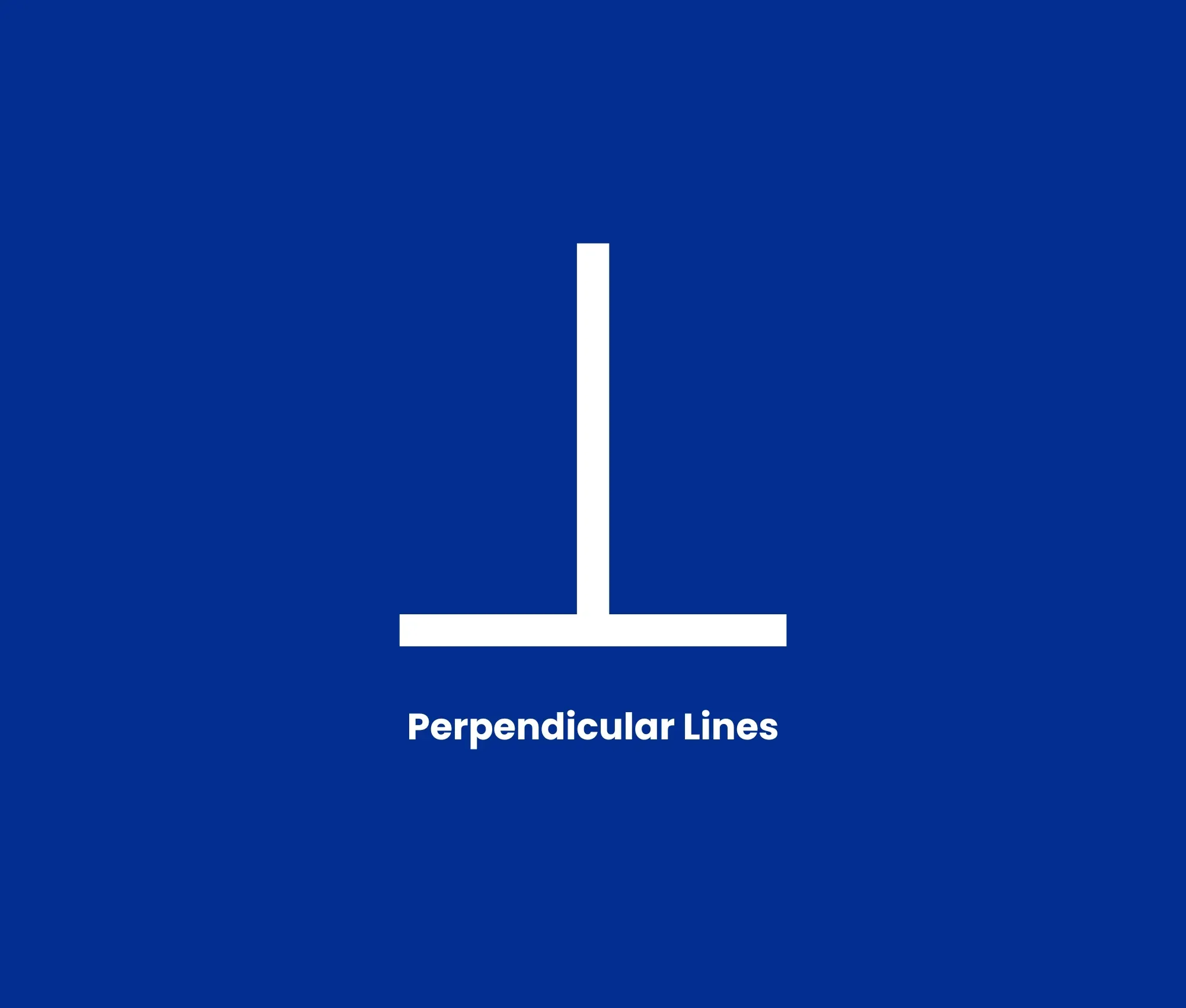
- Two lines that intersect in a way that creates 90-degree angles are perpendicular to each other.
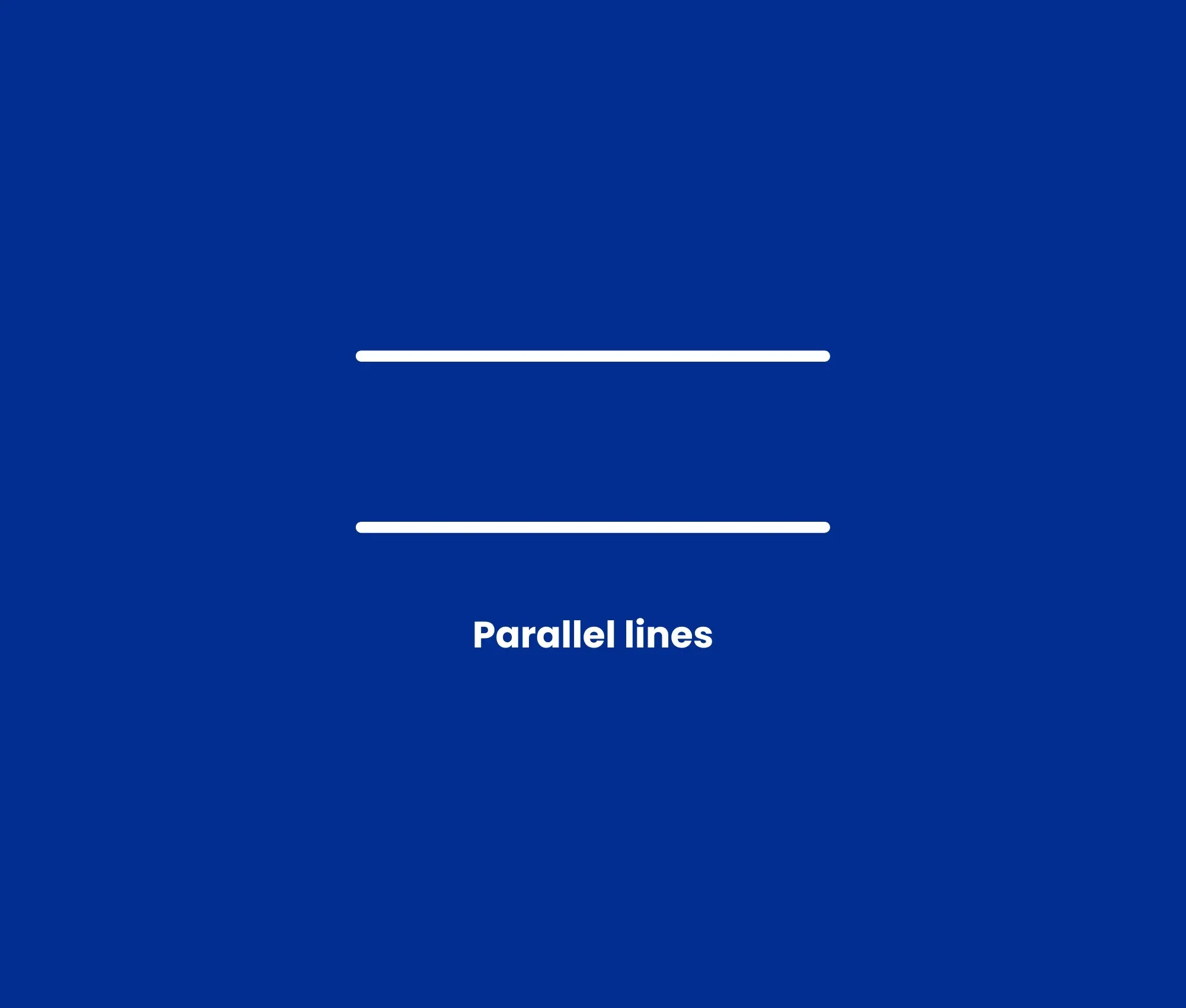
- Two lines with the same slope that never meet are parallel lines.
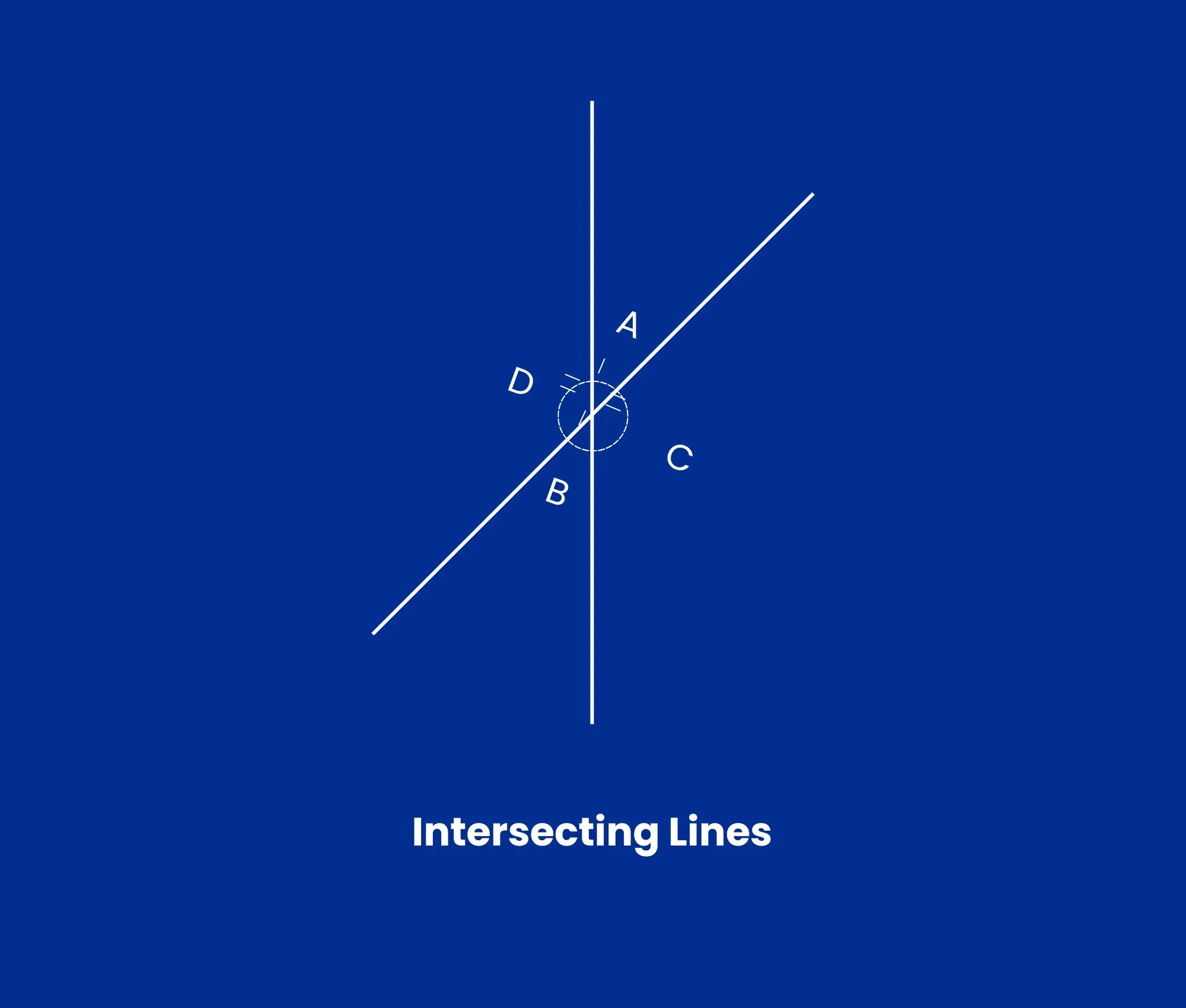
- When two lines intersect and pass through each other, four angles are created as a result:
- Opposite angles measure the same ($∠A=∠B$, $∠C=∠D$).
- Adjacent angles add up to 180 degrees ($∠A+∠D=180$, $∠A+∠C=180$, $∠B+∠D=180$, $∠B+∠C=180$).
- When a single line intersects two parallel lines, eight angles are created a result:
- corresponding angles are equal in measure.
- alternate interior angles are equal in measure.
- alternate exterior angles are equal in measure.
- consecutive interior angles add up to 180 degrees.
GRE Geometry Triangles
GRE Geometry has concepts related to triangles. GRE triangle questions are based on different types of triangles such as equilateral, isosceles, right, obtuse, acute and scalene. These GRE Geometry problems should be solved using the set of concepts and formulas given below.
Concepts
- All three angles in a triangle add up to 180 degrees.
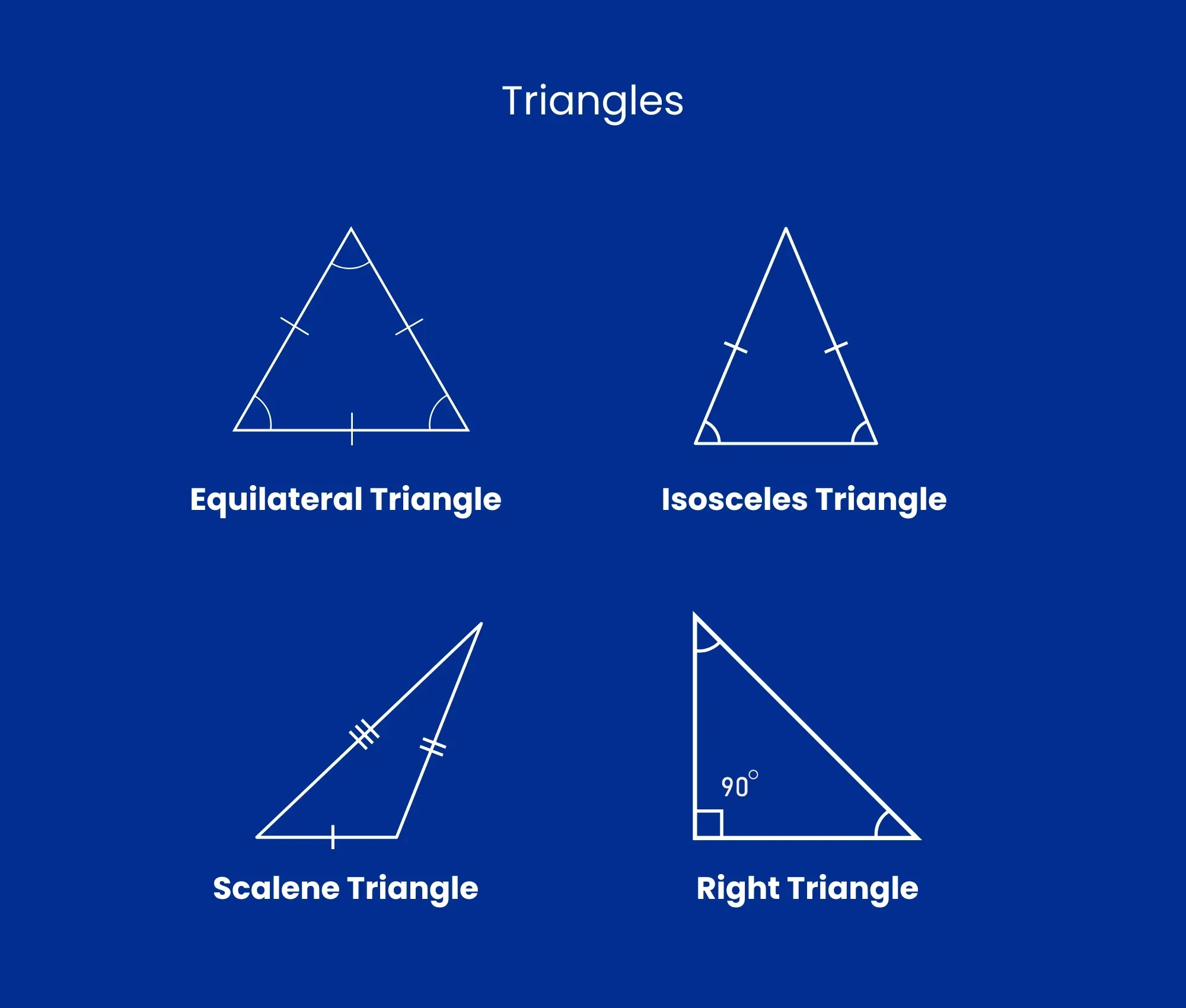
- The three types of GRE special triangles are as follows:
- Equilateral: All sides of the triangle are equal with each angle measuring 60°
- Isosceles: Only two sides of the triangle are equal in length with two opposite angles measuring the same.
- Scalene: All sides of the triangle differ in length and all angles differ in measure.
- Right: One of the angles is 90°, opposite to which is the longest side of the triangle, called the “hypotenuse”. The sum of all sides add up to 180°
Formula
The most common formulas for triangles in GRE geometry are the area of triangle and the Pythagorean Theorem.
Area of Triangle = ½ bh
- B = base, h = height
Pythagorean Theorem:
As per the pythagorean theorem, the square of the length of the hypotenuse in a right-angled triangle is equal to the sum of the squares of lengths of the other two sides.
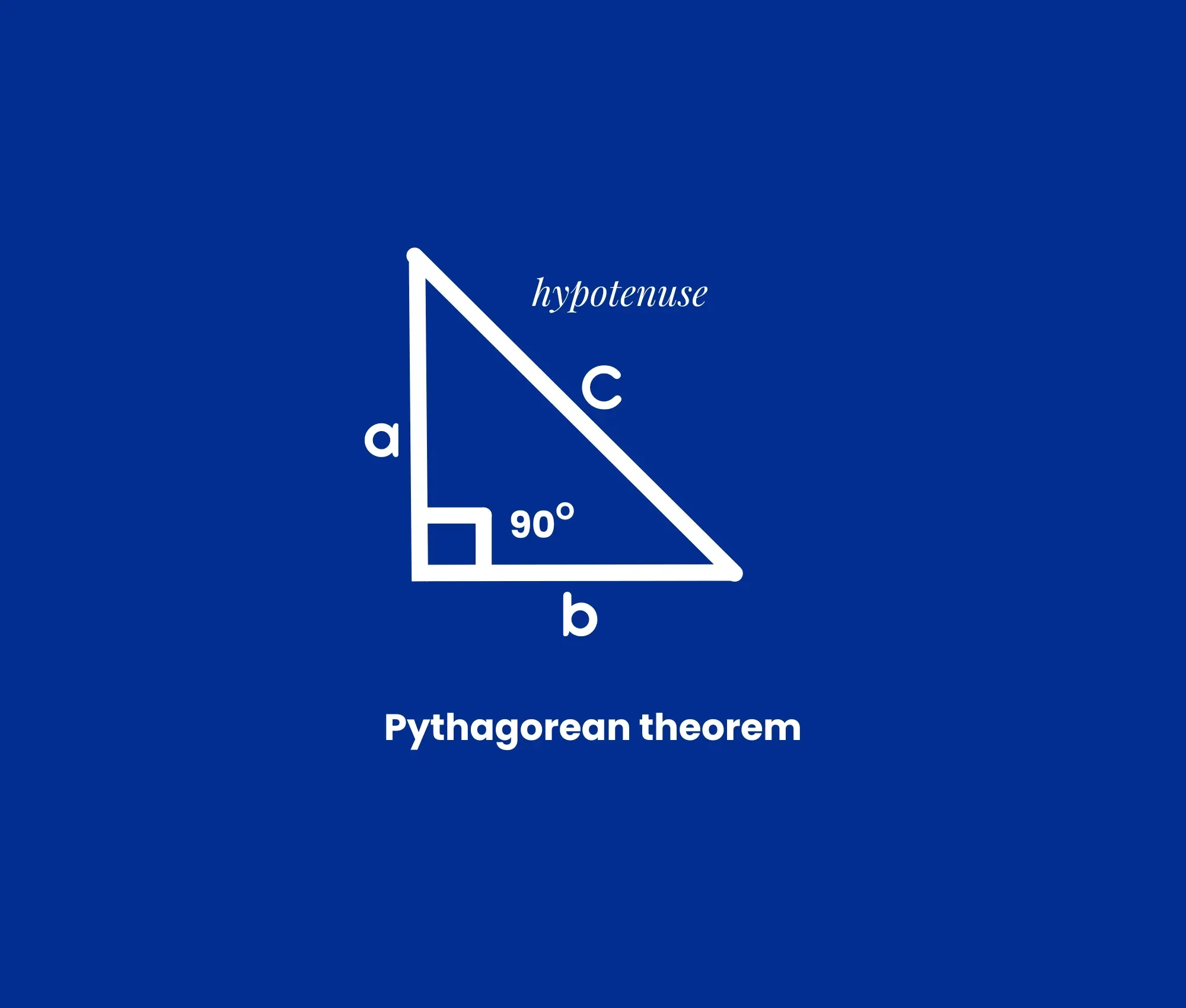
c2 = a2 + b2
- c is the length of the hypotenuse,
- a and b are the lengths of the other two sides.
GRE Geometry Quadrilateral
Quadrilaterals are a vital part of GRE geometry. Solving quadrilateral-related problems requires the knowledge of all five types of quadrilateral concepts including square, rectangle, parallelogram, rhombus, and trapezium. The formulas and concepts required to solve quadrilateral-based GRE geometry problems are as follows:
- Square:
Concepts
-
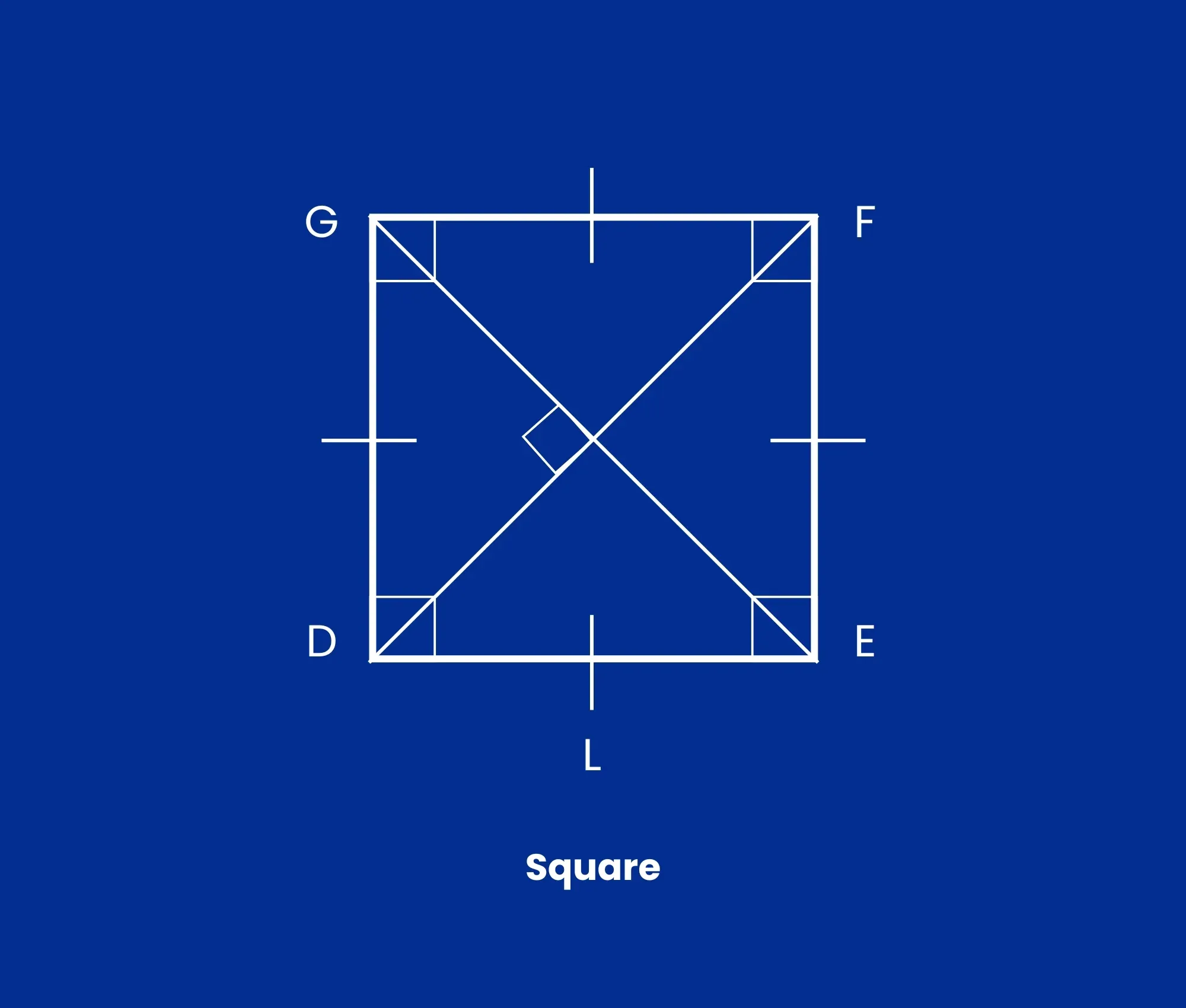
- All sides of a square are equal in length.
- Opposite sides of a square are parallel to each other.
- All interior angles in a square are right angles.
- The perimeter of a square is the total length of all sides.
Formulas
Area of a square = side x side
Perimeter of a square = 4 x side
- Rectangle:
Concepts
-
- Opposite sides in a rectangle are equal in length and parallel to each other.
- All interior angles in a rectangle are right angles.
- The perimeter of a rectangle is the total length of all sides.
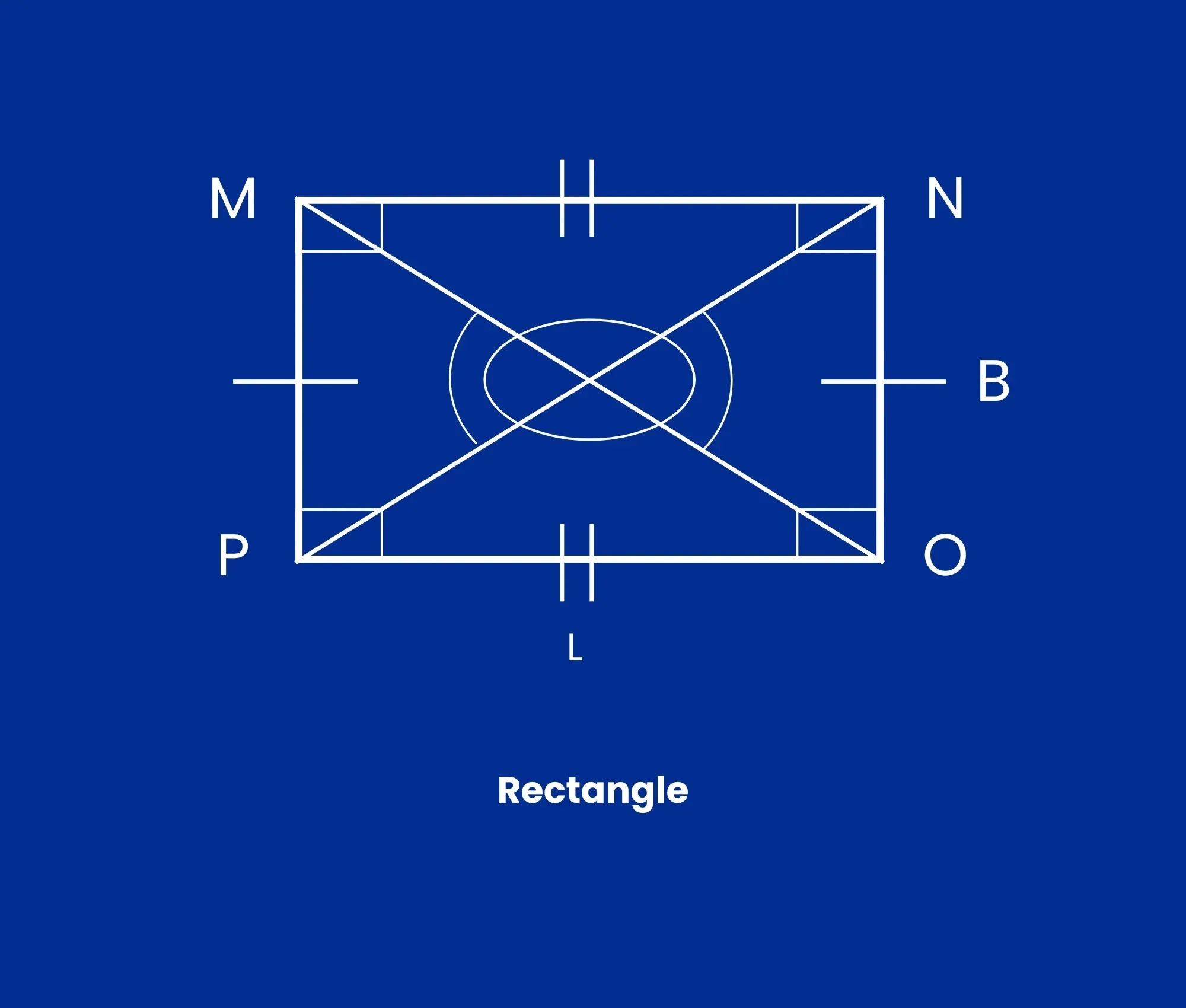
Formulas
Area of rectangle = length x breadth
Perimeter of rectangle = 2x (length + breadth)
- Parallelogram:
Concepts
-
- Opposite sides in a parallelogram are equal in length and are parallel to each other.
- Opposite angles in a parallelogram are equal.
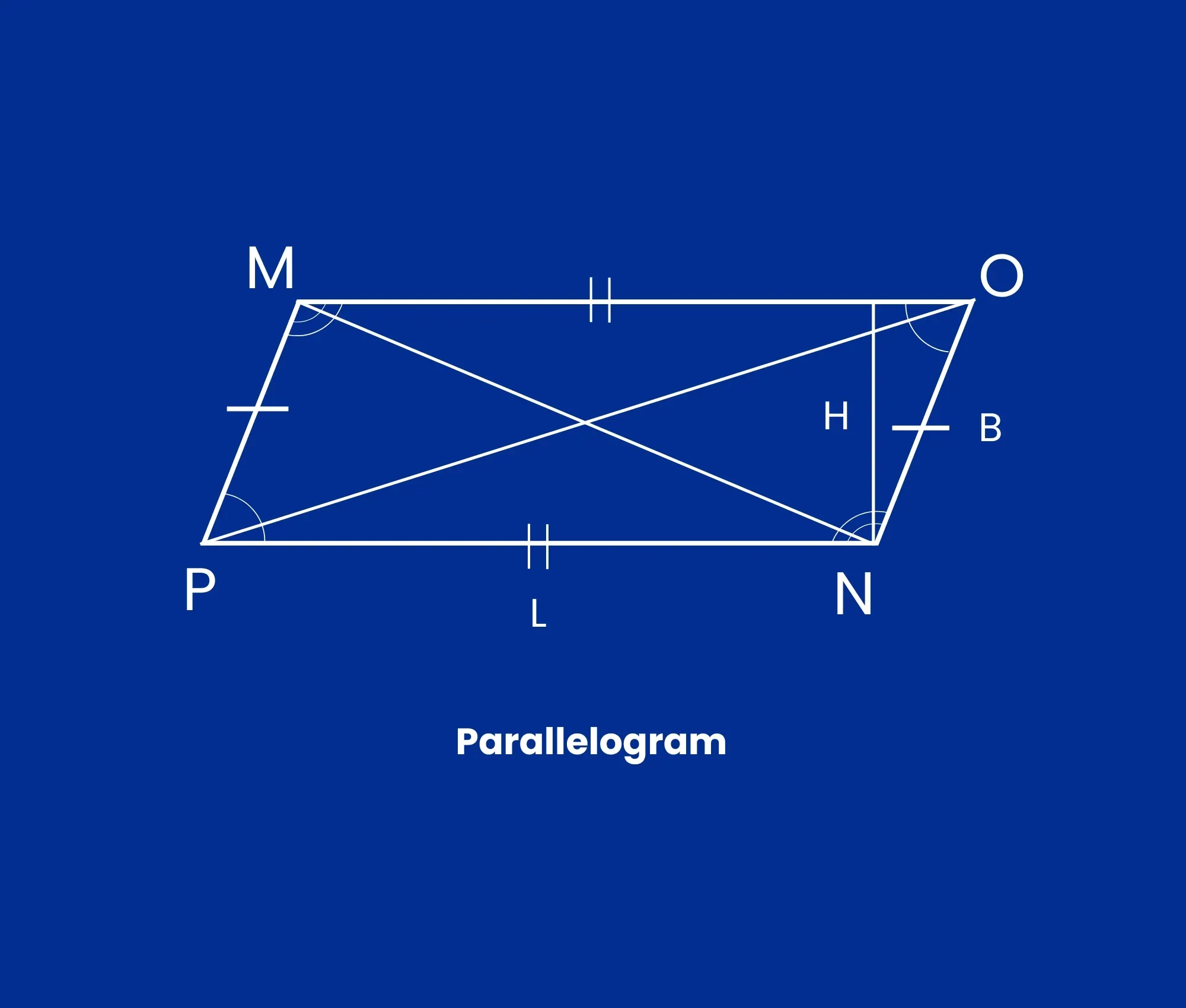
Formulas
Area of parallelogram = A = base x height (or) A = bh
- b is the length of the base.
- h is the perpendicular height (the distance between the bases).
Perimeter of parallelogram = P = 2 x (a+b)
- a is the length of one pair of opposite sides.
- b is the length of the other pair of opposite sides.
Rhombus:
- Concepts
- All sides of a rhombus are equal in length and the opposite sides are parallel to each other.
- The diagonal lines bisecting are perpendicular.
- Adjacent angles are supplementary implying that the sum of the angles is 180°
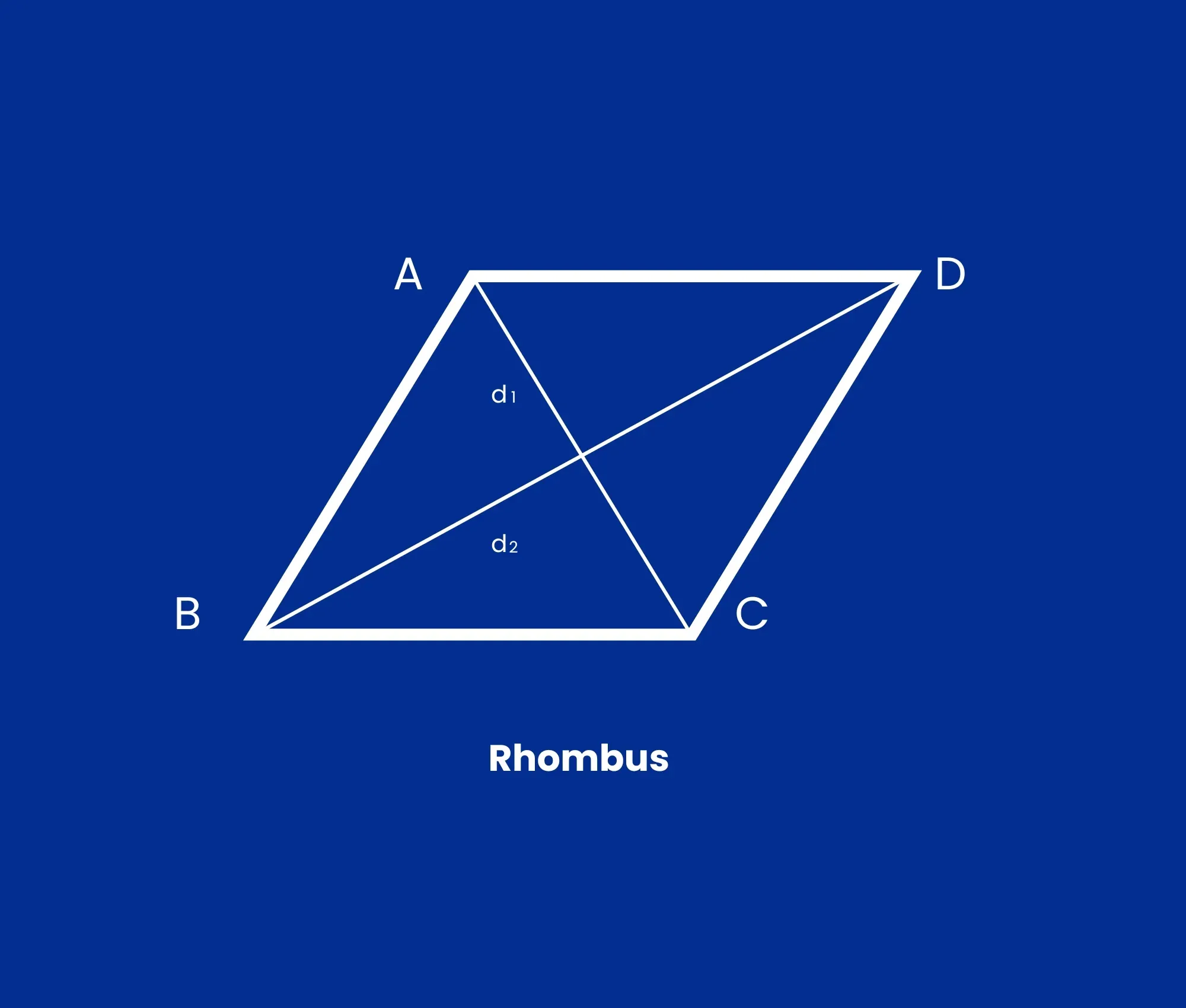
Formulas
Area of Rhombus:
Using the lengths of diagonals:
A = ½ x d1 x d2
- d1 x d2 are the lengths of the diagonals of the rhombus.
Using the base and height:
A = b x h
- b is the length of a side (base) of the rhombus.
- h is the perpendicular height (the distance between two opposite sides).
Perimeter of Rhombus = 4 x length of side
- Trapezium:
- Concepts
- The base and opposite sides of a trapezium are parallel to each other.
- The angles, sides, and diagonals of a trapezium are not congruent,
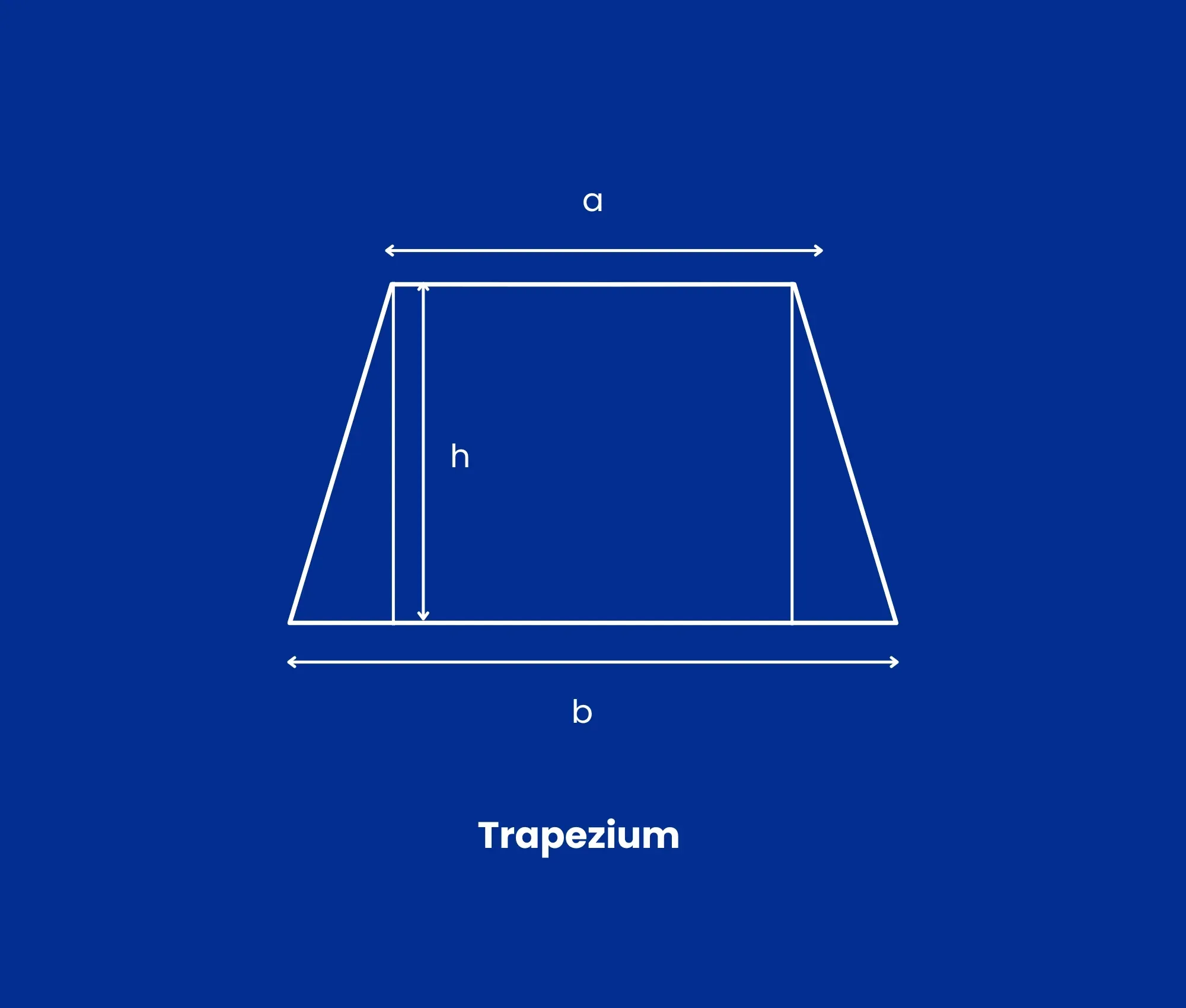
Formulas
Area of Trapezium = ½ (L1 + L2) x h
- L1 is length, L2 is length 2 and h refers to height
Perimeter of the Trapezium = sum of the length of all sides
GRE Geometry Circles
A circle is defined as a set of all points in a plane that are equidistant from a fixed point. The perimeter of a circle is called the “circumference of the circle”. GRE circle problems can be solved using the concepts and formulas given below:
Concepts
-
- Radius: The distance from the center of a circle to any point on its circumference.
- Chord: A line segment with both endpoints on the circumference of the circle.
- Diameter: A line segment that passes through the center of the circle, joining any two points of the circle.
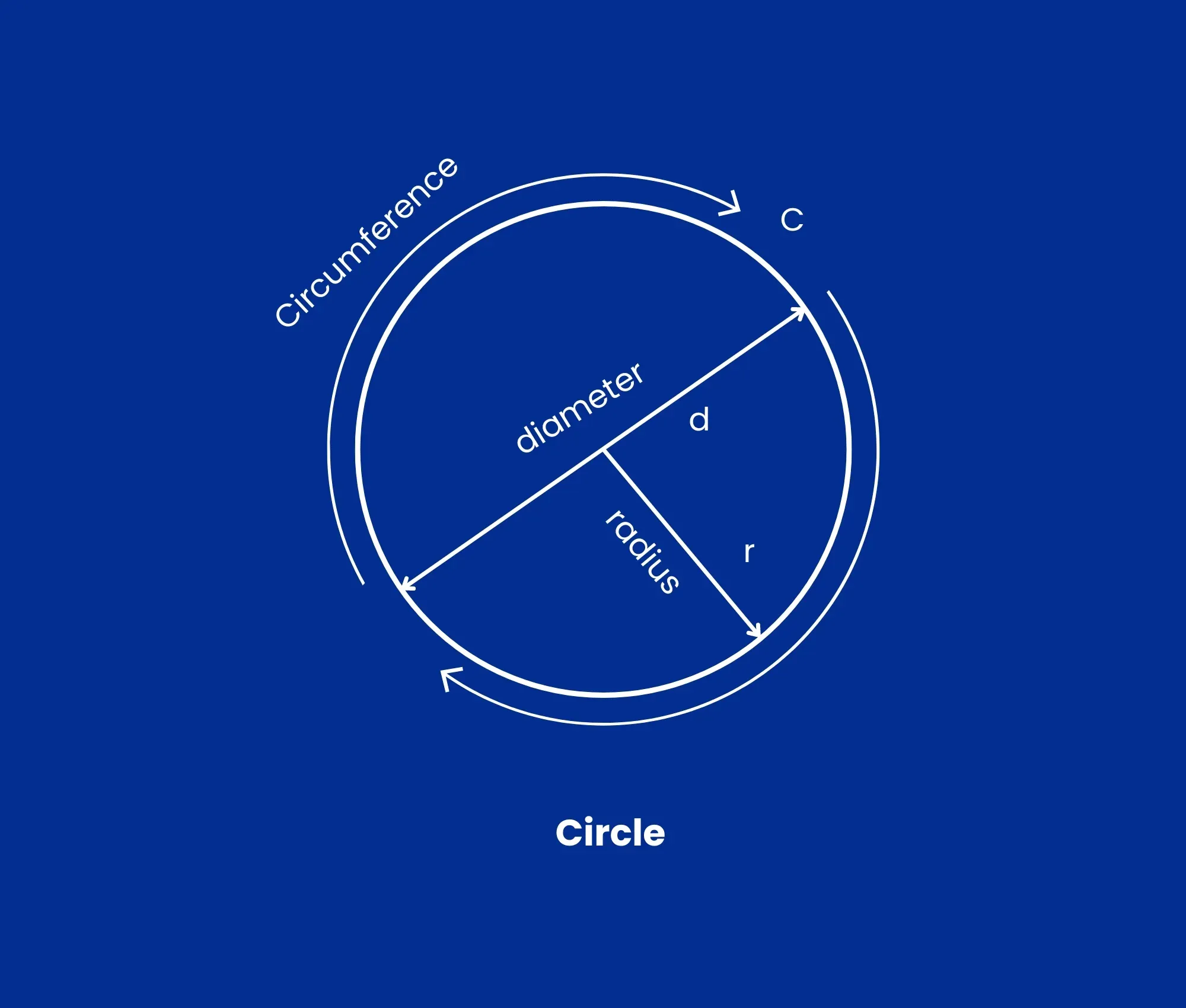
Formula
Diameter of circle = 2 x radius
Area of circle = π r2
Circumference of circle = 2 π r
GRE Geometry Three-dimensional Shapes
GRE geometry includes 3D geometry-based math problems dealing with cube, cuboid, cylinders, cones, and hemispheres. Given below are the formulas to find the area and volumes of the said 3D figures.
- Cube: The volume of a cube is enclosed by its six square sides.
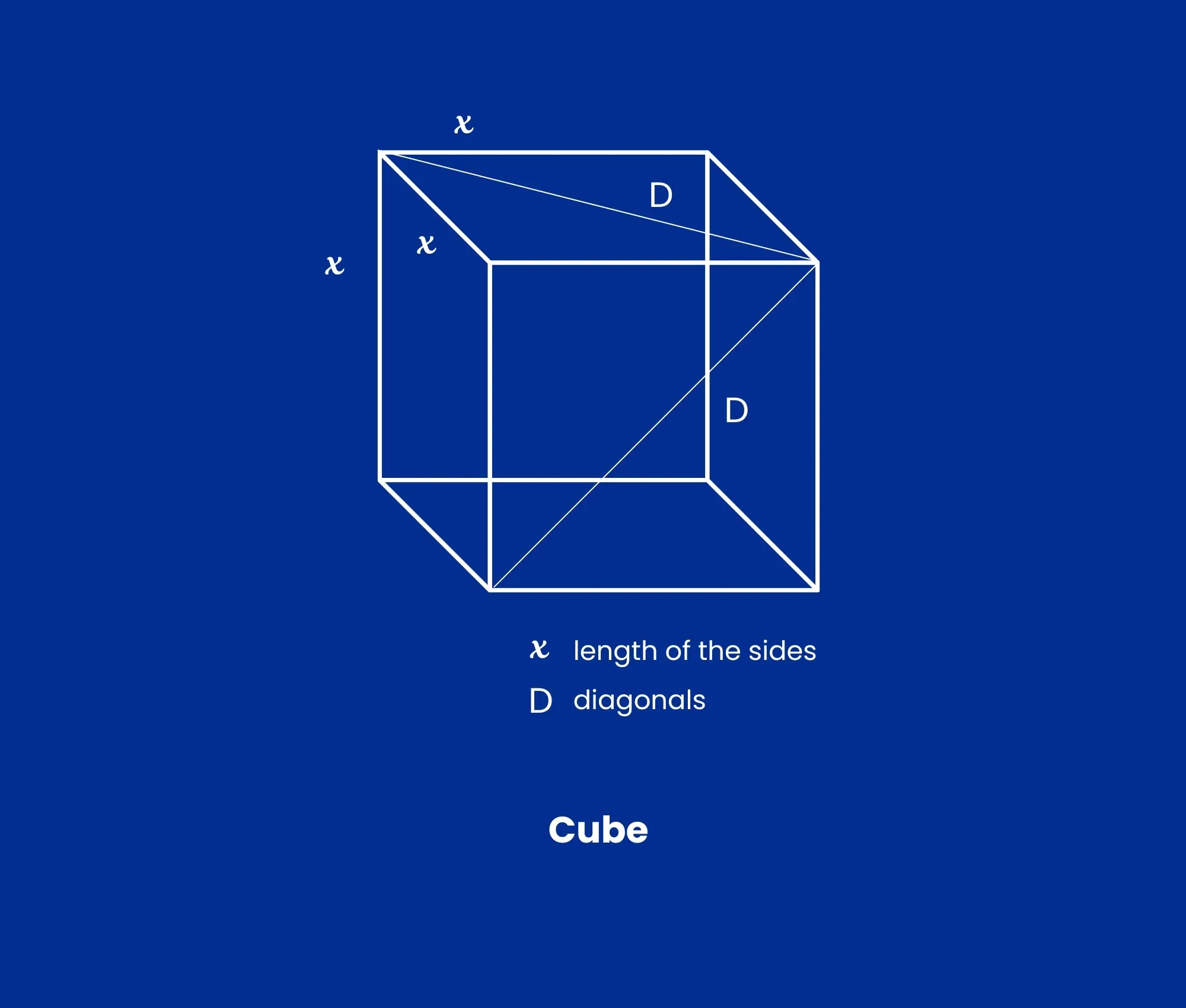
Formulas
Volume = x3
Lateral surface area = 4x2
Total surface area = 6x2
Length of diagonal of cube = √3x
- Cuboid: The volume of a cube is enclosed by its six rectangle sides.
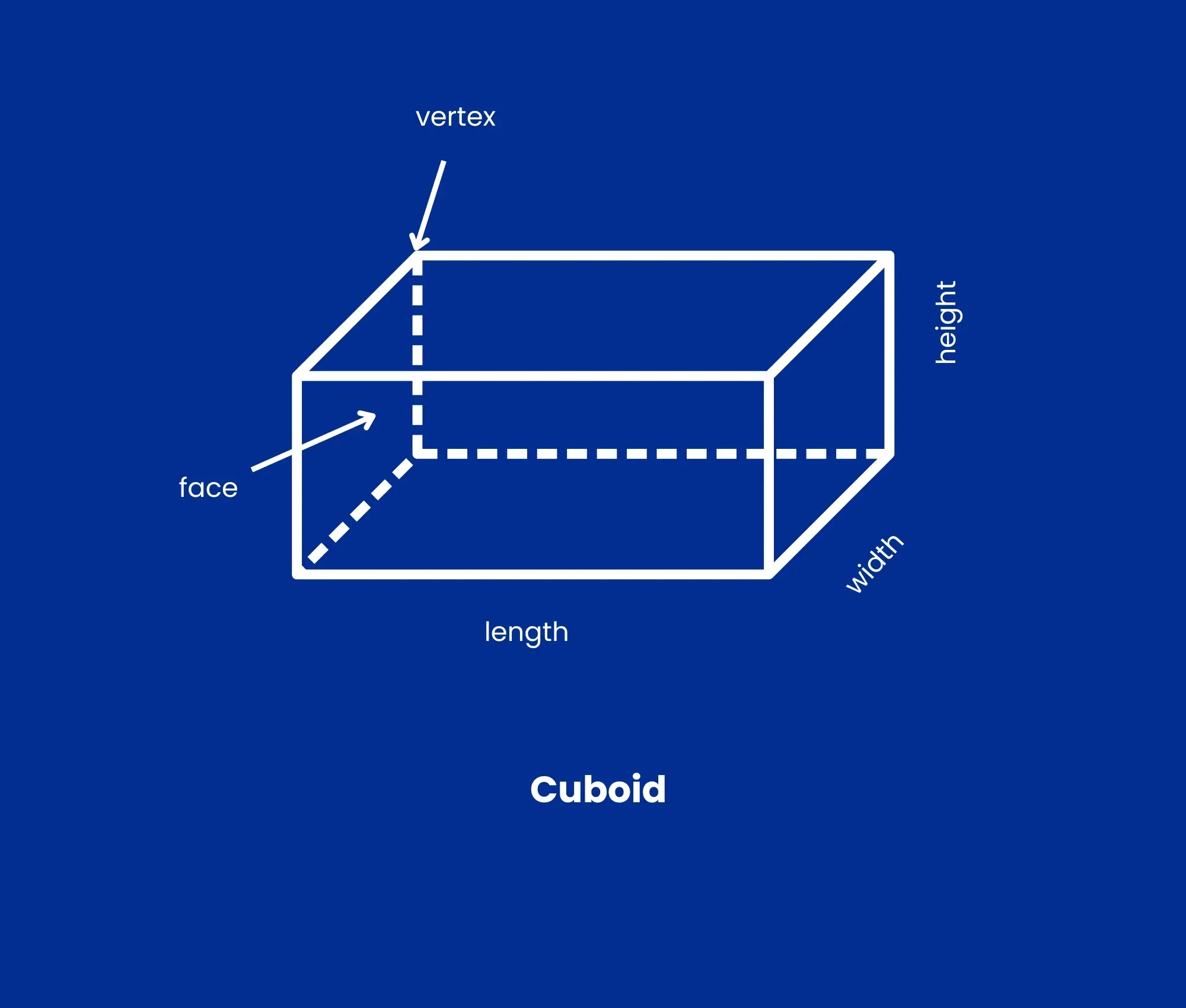
Formulas
Total surface area = 2(length x width x width x height x height x length)
Lateral surface area = 2 height (length x width)
Volume = length x width x height
Length of the longest diagonal = √(l2+w2+h2)
- Cone: A cone is a 3D shape with a circular base with sides that narrow to one singular point.
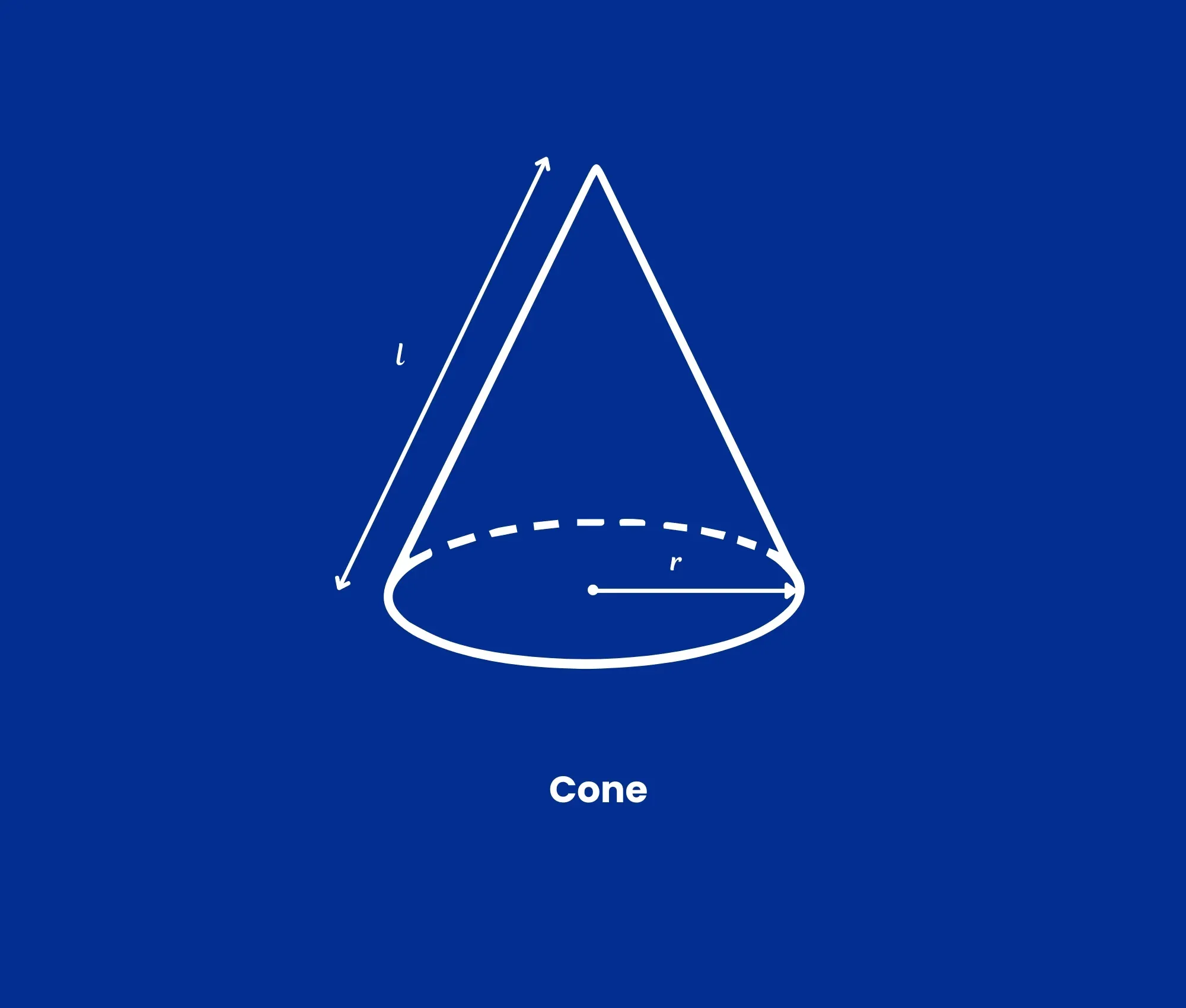
Formulas
Slant height = √r2 + h2
Volume of a cone = ⅓ π r2 h
Total surface area = πrl + π r2 h
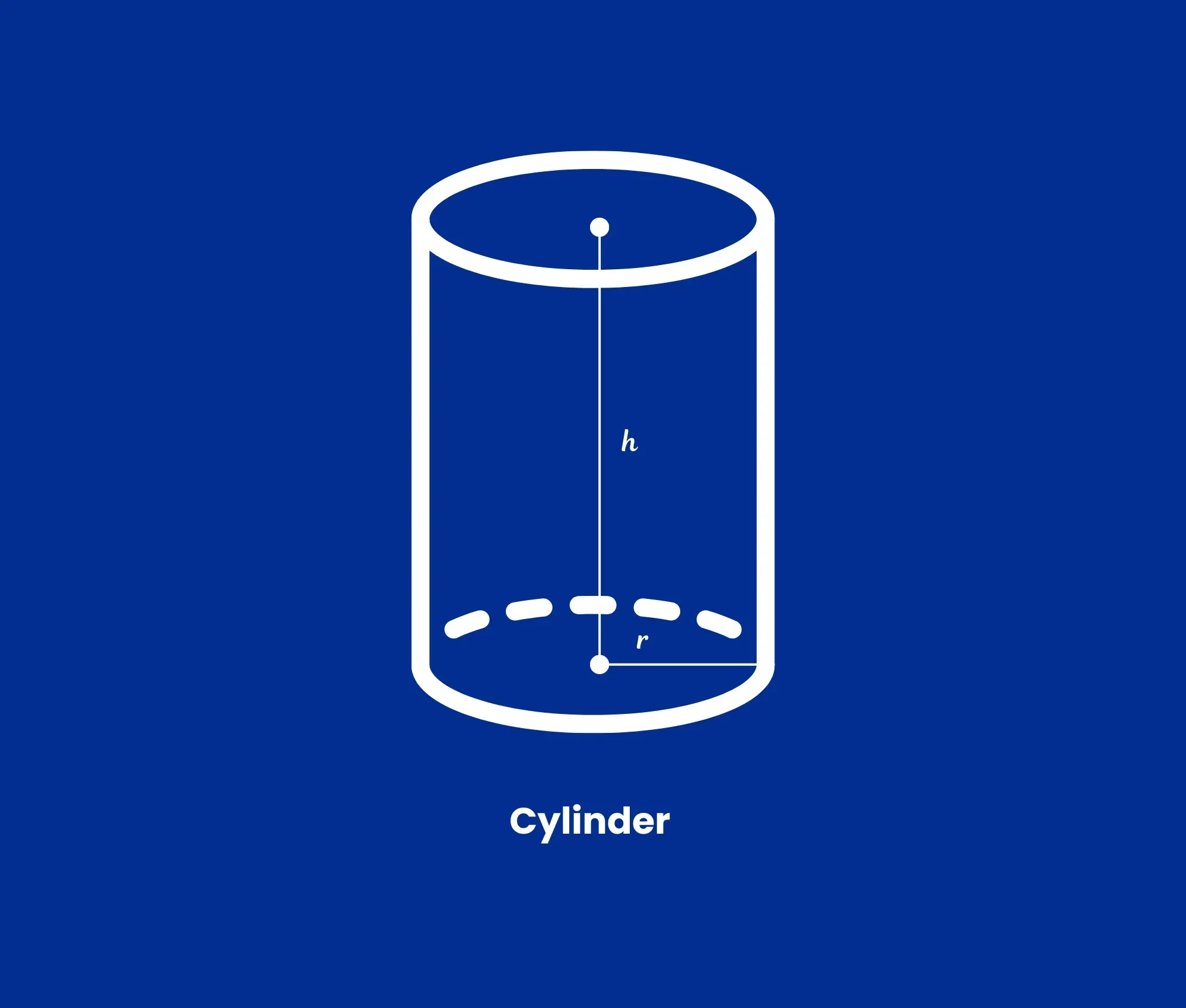
- Cylinder: A 3 D object with two parallel circular bases connected by a curved surface.
Formulas
Volume of a cylinder = π r2 h
Surface area of a cylinder = 2πr(h+r)
GRE Coordinate Geometry
In GRE Geometry, calculations in coordinate geometry are performed on the coordinate plane axes. The coordinate axis in the number line is the key component in coordinate geometry.
Concepts
A point on the coordinate plane is represented by an ordered pair (x,y), where x is the abscissa and y is the ordinate. The coordinate plane is basically divided into four quadrants. GRE candidates should practice problems based on these concepts to prepare for their GRE test.
Formulas
Distance: d2 = (x-a)2 + (y-b)2
Theorem: d = √(x-a)2 + (y-b)2
GRE Geometry Practice Questions
GRE geometry is a section that requires application of the right formulas and meticulous attention to details. Candidates should regularly solve GRE geometry practice problems to improve their problem solving skills and perform to the best of their abilities in the test. Here you can download some GRE geometry practice questions for your preparation.
How to prepare for GRE Geometry?
- Understand Key Concepts: Familiarise yourself with basic geometric shapes, rules, formulas, and theorems.
- Review Geometry Formulas: Memorise and understand the geometric formulas for common shapes such as triangles, circles, squares, and rectangles.
- Solve Practice Problems: Keep testing yourself by solving practice problems to get the hang of solving geometry problems and improving your problem solving skills.
- Analyze Practice Tests: Reflect on your performance by taking full-length practice tests to identify your weaknesses and develop strategies to mitigate them.
- Use Study Resources: Utilize GRE prep books, online resources and courses, and tutoring services to learn and prepare for your test effectively.
- Learn to Draw Diagrams: Practice sketching diagrams to visualize and solve geometric problems more effectively.
FAQs
1. What geometry is on the GRE?
The geometry portion on the GRE includes basic geometry concepts such as properties of shapes, area, volume, and coordinate geometry. It also includes triangles, circles, quadrilaterals, and 3-dimensional figures.
2. How important is geometry in GRE?
Geometry is a crucial part of the GRE quantitative section that makes up 15%-20% of the questions. It’s a vital part that has a significant impact on the score.
3. How to solve GRE geometry problems?
Solving GRE geometry problems requires the understanding of fundamental concepts, formulas, diagrams, and the ability to apply problem solving strategies.
4. What level of math is on the GRE?
The level of math on the GRE is high school level math that includes algebra, geometry, and basic statistics. The GRE geometry questions often involve straightforward concepts and calculations.
5. How much time should I allocate to studying GRE Geometry?
Start your preparation a few months before your exam date. Start with 1-2 hours a week and slowly increase the study time as you approach the exam date for more focused preparation.
6. Can I use a calculator for GRE Geometry problems?
No, you cannot use calculators to solve GRE geometry problems. Practice solving the questions without using a calculator to ensure you can comfortably do the same during your test.
7. How many geometry questions are on the GRE?
Around 20 questions on the GRE quantitative section are expected to be geometry related questions.
8. What is the syllabus for geometry in GRE?
The syllabus for GRE geometry includes basic shapes, properties of angles, triangles, circles, quadrilaterals, and coordinate geometry.
9. What topics in geometry should I focus on for the GRE?
The topics in GRE geometry that you should focus on are area and perimeter of shapes, properties of triangles and circles, coordinate geometry, and volume and surface area of solids.
10. How can I improve my visualization skills for GRE Geometry problems?
To improve your visualization skills for solving GRE geometry problems, you can try practicing sketching shapes, studying geometric properties, and solving a variety of geometry problems to build spatial reasoning.

About Author Vikram
Vikram is a study abroad expert who specialises in preparing study materials for IELTS, TOEFL, GRE, PTE, SAT, etc. With over five years of experience as a content writer, he is passionate about guiding students in the process of international standardised exams. His informative articles help students gain insights into the study abroad examination process, college requirements, admission procedures, top universities and courses. He spends his leisure time reading books, watching series and anime.
Kanan.co is a trusted study abroad consultancy offering comprehensive services, resources, and solutions for students and education institutions. We support students at every stage of their global education journey, ensuring a smooth and guided experience. Along with test preparation for IELTS, GRE, TOEFL, and SAT, we provide expert services such as SOP writing, visa guidance, accommodation support, scholarship assistance, and education loan support. Our expertise and commitment to excellence make us a reliable partner for students pursuing international education.
Sign Up for a Free GRE Demo Class!
Ace GRE Quant & Verbal with 320+ Score — Join Us!








Global Headquarters
Kanan Int EdTech Inc
320 Bay Street, Suite 321 (Spaces), Toronto ON, Canada M5B 1N9
Indian Headquarters
Kanan International Pvt. Ltd.
D-wing, 2nd Floor, Trident Complex, Ellora Park Vadiwadi Road, Vadodara, Gujarat 390007
IT/ Digital Campus
Kanan International Pvt. Ltd
Old, New No 3, 2nd Floor, 1A, Dr Sadasivam Rd, T. Nagar, Chennai, Tamil Nadu 600017
Our branches
- Bardoli
- Bharuch
- Chennai
- Dehradun
- Gurugram
- Himatnagar
- Karnal
- Nadiad
- Navsari
- Palanpur
- Rajkot
- Vadodara
- Valsad
- Vallabh Vidyanagar
- Vapi
Study Abroad
Test Prep
Top Universities
Consultants
IELTS Centers
GRE Centers
TOEFL Centers
SAT Centers
Language Courses in Vadodara
Study Abroad Calculators
Featured Blogs
Study Abroad Consultants in Chennai
Study Abroad Consultants in Surat
Study Abroad Consultants in Navsari
Study Abroad Consultants in Bardoli
Study Abroad Consultants in Ahmedabad
Study Abroad Consultants in Anand
Study Abroad Consultants in Khanna
Study Abroad Consultants in Nadiad
Study Abroad Consultants in Vadodara
Study abroad consultants in Valsad
Copyright © 2026 KANAN.CO All rights reserved.