- Study Abroad
- / gre
- / rational expressions
GRE Rational Expressions: Key Concepts, Simplification, Practice Problems


Author
10-12-2024

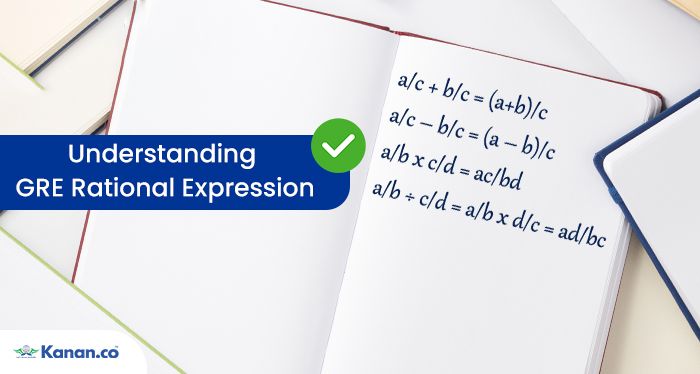
Rational expressions (also called algebraic fractions) are ratios of two algebraic expressions containing unknown variables, wherein the numerator and denominator are polynomial expressions. To simplify a rational expression, the numerator and denominator are converted to their lowest forms. In GRE Math, rational expressions are a critical part of the algebra topic. Read on to explore the key concepts, simplification, and operations on rational expressions along with practice problems.
What is a Rational Expression?
Rational expressions are the ratio of two polynomials. In other words, a rational expression is a fraction with variables where both the numerator and denominator are polynomials. The denominator can never be zero since it would make the expression undefined. Rational expressions are expressed in the form of p(x) / q(x), where p(x) and q(x) are polynomials and q(x) ≠ 0. Since rational expressions are similar to fractions, they follow the same rules for operations.
What is a polynomial?
Polynomials are mathematical expressions that combine numbers and variables (x, y) using addition, subtraction, and multiplication. A term is each part of a polynomial that is separated by a + or − symbol.
Example of a polynomial: x + 2 (This has 2 terms: x and 2)
To find the root or zero of a polynomial, set the entire expression equal to zero. But in case of rational expressions, only the numerator needs to be set equal to zero. This works only when the expression is fully simplified, meaning that the numerator and denominator have no common factors. For example, the fraction 3/9 is not in the lowest form. It can be reduced to ⅓ by taking 3 as a common factor.
Similarly, the rational expression x2 +2x/5x is not in its lowest form. By taking the common factor x from both the numerator and denominator, it can be simplified to (x+2)/5, which is the lowest form of this rational expression.
How to Simplify a Rational Expression?
Simplifying a rational expression involves reducing it to its simplest form by ensuring the numerator and denominator have no common factors other than 1. Similar to simplifying fractions, the primary step is identifying and cancelling out these common factors to achieve the reduced expression. The step-by-step procedure to simplify rational expressions is as given below:
- Identify and factorize both the numerator and denominator into their simplest polynomial forms.
- Identify the common factor between the numerator and denominator.
- Divide both the numerator and denominator by their common factors.
- Check for restrictions and note values that make the denominator zero.
- Ensure that the expression is correct and fully simplified.
Example: Simplify x2 -9/x2 -3x
- Factor the numerator and denominator: (x+3)(x+3)/x(x-3).
- Cancel the common factor (x-3): x+3/3.
- Restriction: x ≠ 0 and x ≠ 3.
Operations on Rational Expressions
When performing operations on rational expressions, the process is similar to that used for fractions. Operations such as addition, subtraction, multiplication, and division can be applied to algebraic fractions the same way they can be applied to numeric fractions.
Adding and Subtraction of Rational Expressions
When adding or subtracting rational expressions, the denominators must be the same. If the denominators are already the same, you can simply add or subtract the numerators. If the denominators are different, you need to find the Least Common Denominator (LCD) to rewrite the expressions with matching denominators before performing the operation. The general formula for addition and subtraction of rational expressions is as given below:
- Addition: a/c + b/c = (a+b)/c
- Subtraction: a/c – b/c = (a – b)/c
To understand better, let’s take an example of a fraction first.
Add and subtract ¾ and ⅚.
Addition: ¾ + ⅚ = (9+10)/12 = 19/12
Subtraction: ¾ - ⅚ = (9-10)/12 = -1/12
Here, we have normalised the denominators by finding the LCM of 4 and 6 (which is 12) and then performed the operations.
Let’s now apply the same method to perform the operations on rational expressions.
Adding Rational Expressions:
Question: Add 4/(x+3) and (x+5)/(x+3).
Solution: Since the denominators are the same:
4/(x+3) + (x+5)/(x+3) = 4+(x+5)/(x+3) = (x+9)/(x-3)
Final Answer: (x+9)/(x-3)
Subtracting Rational Expressions:
Question: Subtract 2/(x2 -9) from 8/(x-3).
Solution: Since x2-9 = (x-3)(x+3): 8/(x-3) - 2/(x-3)(x+3)
The denominators are different, so find the LCM and rewrite the fractions:
8(x+3)/(x-3)(x+3) - 2/(x-3)(x+3)
Now, perform the operation:
8(x+3)-2/(x-3)(x+3) = 8x+24-2/x2 -9 = 8x+22/x2 -9
Final Answer: 8x+22/x2 -9
Multiplication and Division of Rational Expressions
When multiplying two rational expressions, we multiply their numerators and denominators separately. However, we follow the standard principle of simplifying, factorizing, and cancelling common terms prior to performing the operation. The general formula for multiplying rational expressions is as given below:
Multiplication: a/b x c/d = ac/bd
Multiplying Rational Expressions:
Question: Multiply x+2/x-4 by x2 -16/x+5.
Solution: Factor x2 -16 = (x+4)(x-4):
x+2/x-4 X (x+4)(x-4)/x+5 = (x+2)(x+4)/(x-4)(x+5)
Cancel out the common factor x-4: (x+2)(x+4)/(x+5)
Final Answer: (x+2)(x+4)/(x+5)
To divide rational expressions, first flip the second fraction (reciprocal) and then multiply. Then follow the same procedure as the multiplication method. The general formula for dividing rational expressions is as given below:
Division: a/b ÷ c/d = a/b x d/c = ad/bc
Dividing Rational Expressions:
Question: Divide 5/x2 -9 by 10/x-3
Solution: Rewrite as multiplication by the reciprocal:
5/x2 -9 ÷ 10/x-3 = 5/x2 -9 X x-3/10
Factor x2 -9 = (x-3)(x+3): 5/(x-3)(x+3) X x-3/10
Cancel out x-3: 5/x+3 X 1/10 = 5/10(x+3)
Simplify: 1/2(x+3)
Final Answer: 1/2(x+3)
Restrictions of Rational Expressions
Restrictions are crucial to ensure the expression remains valid. Since rational expressions are fractions, the denominator cannot be equal to zero. To find the restrictions of rational expressions, set each factor of the denominator equal to zero and solve for the variable.
Example: In the rational expression x/x2 -9, let’s factorize the denominator: x2-9 = (x+3) (x-3).
Now, let’s set each factor of the denominator equal to zero to find the restrictions.
x+3 = 0 -> x = -3
x -3 = 0 -> x = 3
Thus the restrictions are: x ≠ -3 and x ≠ 3.
Rational Expressions Calculator
A rational expressions calculator is an online tool designed to calculate the rationalized form of a given rational expression. It lets the user enter the numerator and denominator values and calculates the expressions in just a few seconds. A rational expression can be expressed as the quotient or fraction p/q or simply as the quotient of two polynomials.
Rational Expressions Practice Problems
Here are some rational expressions practice questions along with solutions for you to practice and enhance your skills.
Question 1: Simplify x2+5x+6 / x2+3x
Solution: Factor both numerator and denominator:
Numerator: x2 +5x+6 = (x+2) (x+3)
Denominator: x2 +3x = x(x+3)
Cancel the common factor (x+3):
(x+2) (x+3) / x(x+3) = x+2 / x, x ≠ -3,0
Final Answer: x+2 / x. Restrictions: x ≠ -3,0
Question 2: Add 1/x+1 + 1/x-1
Solution:
Take the LCM: 1/x+1 = 1/x-1 = (x-1) + (x-1)/(x+1) (x-1)
Simplify (x-1)/(x+1) (x-1): 2x/x2 -1
Final Answer: 2x/x2 -1
Question 3: Subtract 2x/x2 -4 - x/x+2
Solution: Factorize: x2 -4 = (x+2) (x-2)
Take the LCM: 2x/(x+2) (x-2) - x/(x+2)
Multiply numerator and denominator of the second term by (x-2):
2x/(x+2) (x-2) - x(x-2)/(x+2) (x-2)
Combine and simplify:
2x-x2 +2x/(x+2) (x-2) = -x2 +4x/(x+2) (x-2) = x(-x+4)/(x+2) (x-2)
Final Answer: x(-x+4)/(x+2) (x-2)
Question 4: Multiply x2 -9/x2 -1 by x+1/x2 +3x
Solution:
Factorize all expressions: x2-9 = (x-3) (x+3), x2-1 = (x-1) (x+1),x2 2+3x = x(x+3)
Rewrite the product: (x-3) (x+3)/(x-1) (x+1). x+1/x(x+3)
Cancel the common factors (x+3) and (x+1): x-3/x(x-1)
Final Answer: x-3/x(x-1)
Question 5: Divide x2 -4x+4/x2 -9 ÷ x-2/x+3
Factorize all expressions: x2 -9 = (x-3) (x+3), x2-1 = (x-1) (x+1), x2 +3x = x(x+3)
Rewrite the product: (x-3) (x+3)/(x-1) (x+1) . x+1/x(x+3)
Cancel the common factors (x+3) and (x+1): x-3/x(x-1)
Final Answer: (x+1): x-3/x(x-1)

About Author Vikram
Vikram is a study abroad expert who specialises in preparing study materials for IELTS, TOEFL, GRE, PTE, SAT, etc. With over five years of experience as a content writer, he is passionate about guiding students in the process of international standardised exams. His informative articles help students gain insights into the study abroad examination process, college requirements, admission procedures, top universities and courses. He spends his leisure time reading books, watching series and anime.
Kanan.co is a trusted study abroad consultancy offering comprehensive services, resources, and solutions for students and education institutions. We support students at every stage of their global education journey, ensuring a smooth and guided experience. Along with test preparation for IELTS, GRE, TOEFL, and SAT, we provide expert services such as SOP writing, visa guidance, accommodation support, scholarship assistance, and education loan support. Our expertise and commitment to excellence make us a reliable partner for students pursuing international education.
Sign Up for a Free GRE Demo Class!
Ace GRE Quant & Verbal with 320+ Score — Join Us!








Global Headquarters
Kanan Int EdTech Inc
320 Bay Street, Suite 321 (Spaces), Toronto ON, Canada M5B 1N9
Indian Headquarters
Kanan International Pvt. Ltd.
D-wing, 2nd Floor, Trident Complex, Ellora Park Vadiwadi Road, Vadodara, Gujarat 390007
IT/ Digital Campus
Kanan International Pvt. Ltd
Old, New No 3, 2nd Floor, 1A, Dr Sadasivam Rd, T. Nagar, Chennai, Tamil Nadu 600017
Our branches
- Bardoli
- Bharuch
- Chennai
- Dehradun
- Gurugram
- Himatnagar
- Karnal
- Nadiad
- Navsari
- Palanpur
- Rajkot
- Vadodara
- Valsad
- Vallabh Vidyanagar
- Vapi
Study Abroad
Test Prep
Top Universities
Consultants
IELTS Centers
GRE Centers
TOEFL Centers
SAT Centers
Language Courses in Vadodara
Study Abroad Calculators
Featured Blogs
Study Abroad Consultants in Chennai
Study Abroad Consultants in Surat
Study Abroad Consultants in Navsari
Study Abroad Consultants in Bardoli
Study Abroad Consultants in Ahmedabad
Study Abroad Consultants in Anand
Study Abroad Consultants in Khanna
Study Abroad Consultants in Nadiad
Study Abroad Consultants in Vadodara
Study abroad consultants in Valsad
Copyright © 2026 KANAN.CO All rights reserved.